
Instead of preparing each lyophilized peptide by an undocumented solvent addition, use a peptide reconstitution workflow that connects batch identity, solvent compatibility, concentration calculations, and analytical acceptance. This 2026 guide covers laboratory research only: dissolving a peptide establishes a preparation, not its identity, stability, or biological activity.
- A peptide reconstitution workflow must distinguish dissolution, concentration assignment, and analytical verification.
- 4-Amino-Labs supplies research peptides and analytical reagents to US laboratories; preparation decisions require compound-specific documentation.
- Lyophilized peptide mass and chromatographic purity do not independently establish net peptide content.
- Select the solvent against peptide chemistry and assay compatibility, then document aliquoting and storage.
At a glance
These unit relationships support preparation calculations. They are conversions, not recommended stock concentrations or molecular masses.
Why this matters
A peptide solution carries several distinct attributes: chemical identity, dissolved concentration, impurity profile, and suitability for the intended measurement. None substitutes for another. A clear preparation can still contain degradation products or deliver an incorrectly assigned concentration.
4-Amino-Labs serves US research laboratories sourcing peptides and analytical reagents. Its peptide research for biotech startups guide provides broader research context; this workflow focuses on the preparation record and acceptance decisions.
For a 2026 laboratory SOP, define reconstitution as a controlled material transformation. The endpoint is a documented solution accepted for a specified experiment, not simply a vial without visible solids.
Before you start
- Documentation and access: Obtain the material identifier, lot number, sequence or chemical identity, molecular mass definition, available batch analysis, safety information, and compound-specific preparation instructions. Have access to your laboratory's approved SOP and preparation-record system.
- Equipment and materials: Prepare calibrated volume-delivery equipment, compatible vessels, the selected laboratory solvent, labeling materials, and the analytical resources required by your acceptance criteria. Choose protective equipment and handling controls from the material's hazard assessment.
- The non-obvious constraint: Check what the stated mass represents. Water, counterions, and other non-peptide components can contribute to lyophilized material mass; chromatographic area purity is not a measurement of net peptide content.
Do not substitute another peptide's solvent instructions because its name or receptor target is similar. Sequence, terminal modifications, salt form, and formulation components can change preparation behavior.
Batch identity and concentration basis
Establish the material record
The fields below are proposed preparation-record labels, not supplier website controls. Use equivalent fields in your laboratory system while preserving the information they capture.
- Enter Material identity, Lot number, and Document version. Match the vial identifier to the documentation before opening the container.
- Record Sequence and modifications, including terminal chemistry when documented. Preserve the supplier's distinction between peptide, salt, and formulated material.
- Enter Mass basis and Molecular mass basis. State whether the calculation uses nominal material mass, measured peptide content, or another documented basis.
- Define Intended assay and Acceptance criteria. Include the checks needed before the solution enters the experiment.
Expected result: You can trace the proposed preparation to one material lot and explain exactly what its concentration calculation represents.
Distinguish purity from content
Chromatographic area purity describes the relative detector response of resolved components under a particular method. It does not, by itself, quantify every component of the solid or establish an absolute peptide mass fraction.
Do not multiply nominal vial mass by an area-purity percentage and label the result measured peptide content without a justified method. If you use nominal mass, retain that qualification throughout the preparation record and experimental analysis.
The same discipline applies to molecular mass. A concentration calculated using the peptide molecular mass is not equivalent to one calculated using a salt formula mass unless the material basis and stoichiometry support that conversion.
Solvent selection and assay compatibility
Establish the solvent decision
Solubility depends on peptide chemistry and solution conditions. Charge state, hydrophobic residues, modifications, and concentration all affect behavior; the intended assay adds separate restrictions on pH, ionic strength, and organic-solvent exposure.
- Review the compound-specific solvent guidance and available compatibility information. Record Solvent identity, Grade, and any relevant composition.
- Define the final assay conditions before selecting the stock solvent. Check the stock's contribution to the assay vehicle, buffer, and ionic environment.
- Evaluate a small-scale preparation when the solvent system has not been established for that material. Treat this as method development, not an accepted production preparation.
- Record the selected Preparation conditions and the basis for accepting them. Do not convert an undocumented troubleshooting adjustment into a routine SOP.
Expected result: The solvent supports the intended preparation and has an explicit compatibility rationale for the downstream measurement.
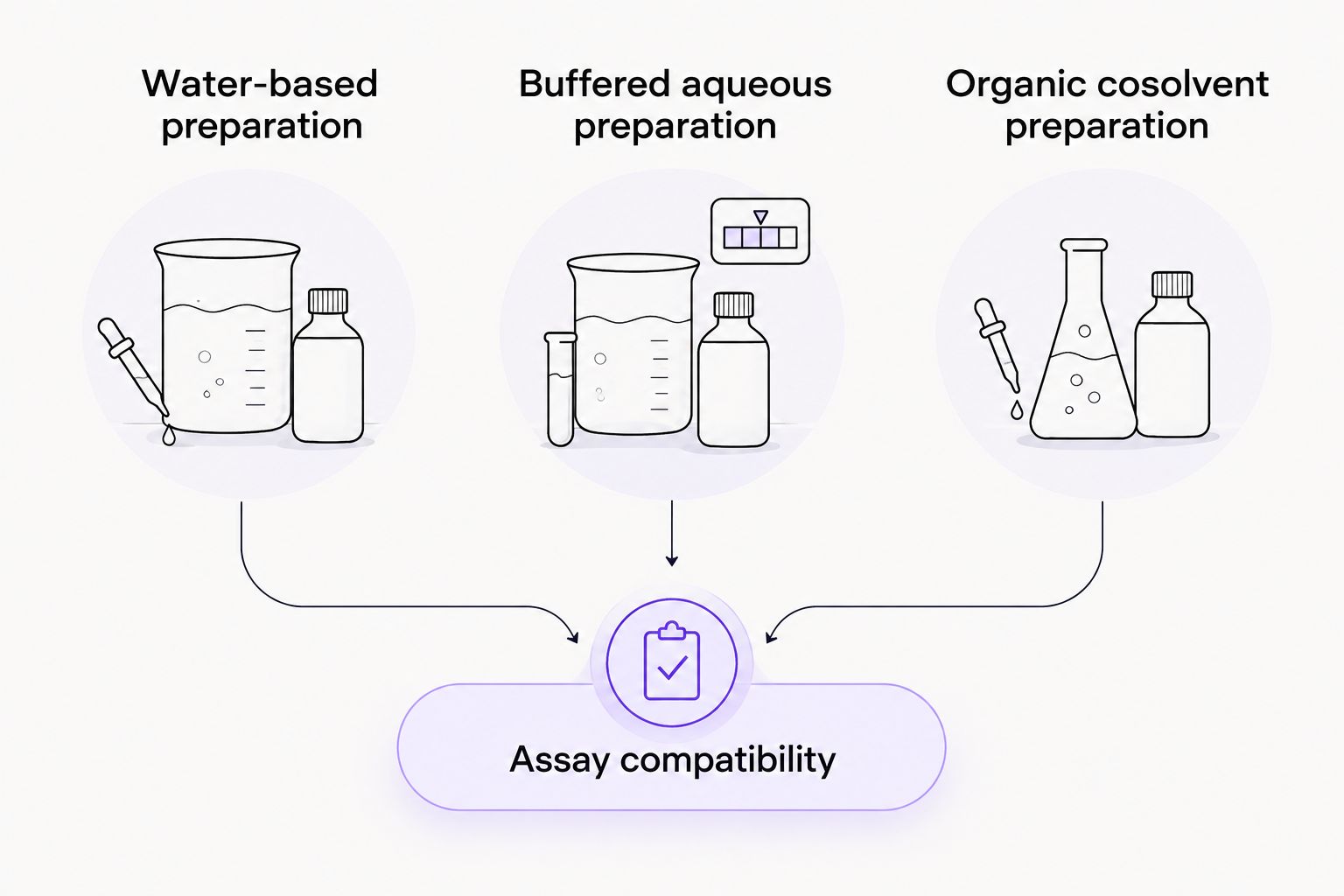
Compare solvent approaches
These are research-use categories, not interchangeable recommendations. No solvent class is universally appropriate for peptides.
| Approach | Research fit | Advantage | Limitation |
|---|---|---|---|
| Water-based preparation | Peptides with established aqueous solubility | Avoids introducing an organic vehicle | Unbuffered conditions do not provide controlled pH |
| Buffered aqueous preparation | Experiments requiring defined solution conditions | Establishes a selected pH and ionic environment | Buffer components can interfere with later measurements |
| Organic cosolvent preparation | Materials with documented cosolvent requirements | Provides an additional solubilization approach | Residual cosolvent requires assay compatibility controls |
Do not select bacteriostatic water merely because it appears in reconstitution discussions. Preservatives introduce additional chemical components. Evaluate those components against the research method rather than treating a preserved solvent as equivalent to analytical-grade water.
Solution preparation and concentration assignment
Calculate before adding solvent
Mass concentration is peptide mass divided by final solution volume. Molar concentration requires a compatible molecular mass and a defensible peptide-mass basis.
For unit checking, 1 mg/mL equals 1 g/L, 1 µM equals 1 µmol/L, and 1 kDa equals 1000 Da. Keep units visible in the calculation instead of relying on spreadsheet formatting alone.
- Enter Target concentration and Final volume. Calculate the required material amount using the documented mass basis.
- Have the calculation independently checked according to laboratory procedure. Confirm that molecular mass, volume units, and concentration units are consistent.
- Follow the approved handling conditions before opening the vial. Where material instructions require equilibration, complete it with the container closed to limit condensation.
- Add the selected solvent using the approved procedure. Distinguish solvent volume added from final solution volume when that distinction affects the required accuracy.
- Mix using conditions established for the peptide. Record observations without interpreting visible clarity as analytical confirmation.
Expected result: The solution has a reproducible preparation history and an explicitly qualified concentration assignment.
Preserve the distinction between calculated and measured concentration
A mass-and-volume calculation gives a nominal concentration unless the inputs establish actual peptide content and preparation recovery. A validated quantitative method can provide a separate measured result.
Spectrophotometric concentration estimation requires appropriate absorbance properties, an applicable extinction coefficient, and control of interfering components. It is not a universal substitute for peptide-specific quantification.
For your 2026 preparation record, label the value Nominal concentration or Measured concentration as applicable. Do not use those labels interchangeably.
Verification, aliquoting, and release
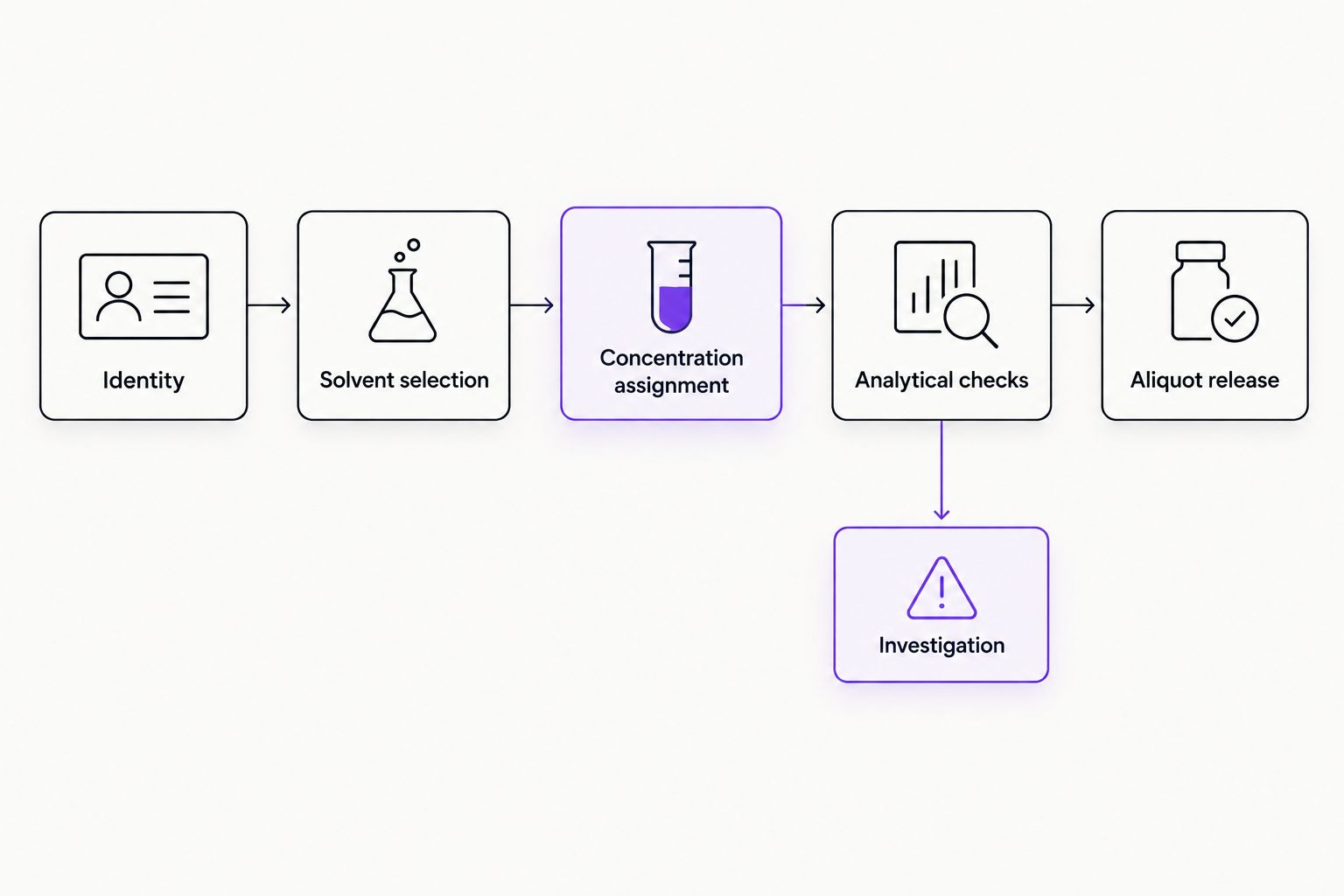
Apply acceptance checks
Verification should answer the experimental question. Chemical identity, purity, concentration, and functional response are related but separate measurements.
- Record Appearance and any persistent particles or changes during the defined observation conditions. Escalate unexpected observations before use.
- Apply the analytical checks specified in Acceptance criteria. Use identity, impurity-profile, or quantitative measurements as required by the study.
- Assign Disposition: accepted for the specified experiment, held for investigation, or rejected. Record the basis for that decision.
- Divide accepted material into aliquots appropriate for planned laboratory use. Document Container, Aliquot volume, Storage conditions, and Preparation date.
- Label each aliquot with material identity, lot, concentration basis, solvent, and preparation identifier. Maintain the connection to the full record.
Expected result: Every released aliquot has a documented use scope, storage instruction, and traceable acceptance decision.
A chromatographic comparison can reveal changes in the detected impurity profile, while a mass-spectrometric identity check addresses a different question. Neither automatically establishes receptor activity. If functional performance matters, specify the relevant assay and its controls separately.
Variant: prepare working solutions from an accepted stock
A working-solution workflow starts with an accepted stock rather than lyophilized material. It still requires compatibility checks because dilution changes the solvent environment and peptide concentration.
- Confirm the stock's identity, concentration basis, storage history, and permitted use period under the established method.
- Calculate the dilution using matching concentration units. Account for all components contributed by the stock solvent.
- Prepare the working solution using the approved assay-compatible diluent and handling sequence.
- Inspect for precipitation or other unexpected changes after dilution. Apply the method's acceptance checks before use.
- Record the parent stock identifier and preparation details so results remain traceable to the original lot.
Expected result: The working solution retains documented lineage and meets the conditions of the intended experiment.
A peptide that dissolves in a concentrated cosolvent stock can precipitate when diluted into an aqueous assay medium. Validate the dilution transition rather than assuming stock solubility establishes working-solution solubility.
Troubleshooting
Persistent visible material
Hold the preparation rather than increasing solvent complexity without documentation. Recheck material identity, solvent composition, target concentration, and the approved mixing conditions. Investigate the material's behavior before assigning the intended concentration to the liquid phase.
Precipitation after dilution
Check the final solvent composition, pH, ionic conditions, and concentration. Review the dilution sequence through controlled method development. Do not remove precipitate and assume the remaining solution retains its calculated peptide concentration.
Inconsistent quantitative results
Audit the mass basis, final-volume calculation, pipette performance, and analytical calibration. Consider recovery losses during transfers or adsorption to contacted surfaces. Test suspected causes rather than correcting the concentration with an unexplained factor.
New analytical peaks
Compare the preparation with the relevant starting-material data using a suitable method. Investigate handling, solvent compatibility, and storage history. A new peak requires interpretation; visual clarity does not resolve the finding.
Customize your workflow
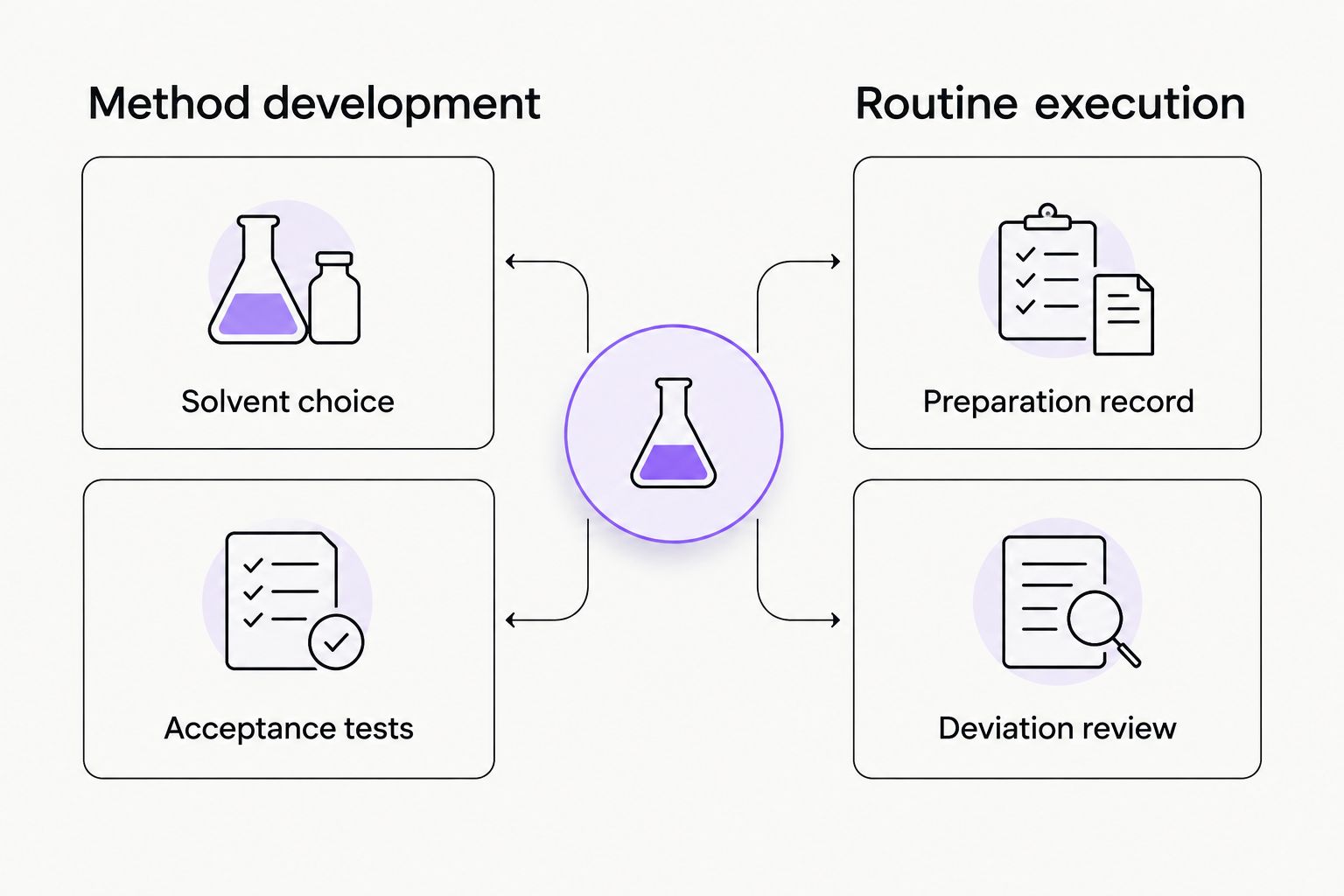
For 2026 laboratory operations, separate method development from routine execution. Method development establishes solvent choice, handling conditions, container compatibility, and acceptance tests; routine execution follows those decisions and records deviations.
Use the university biology laboratory research-chemicals guide to place peptide preparation within broader material-control practices. When sourcing from 4-Amino-Labs, connect the supplied material identifier and available documentation to your internal preparation record without assuming unreported tests were performed.
Limitations
This workflow defines decision points, not a universal peptide recipe. It does not prescribe solvent composition, mixing intensity, storage temperature, or solution lifetime without compound-specific evidence.
A receptor mechanism does not establish preparation stability. Likewise, evidence for one peptide does not establish solubility, degradation behavior, or analytical response for a related sequence.
FAQ
What is a peptide reconstitution workflow?
A peptide reconstitution workflow connects lyophilized-material identity, solvent selection, concentration assignment, verification, and aliquot documentation. It prepares material for a specified laboratory experiment rather than establishing biological activity by dissolution alone.
Can I use the same solvent for every research peptide?
No single solvent is appropriate for every research peptide. Sequence, modifications, salt form, concentration, and downstream assay requirements determine the preparation decision.
Does a clear peptide solution confirm purity?
A clear solution does not confirm peptide purity or identity. Appearance is an observation; analytical testing addresses chemical composition and other acceptance requirements.
Is chromatographic purity the same as peptide content?
Chromatographic area purity is not the same as net peptide content. Water, counterions, detector response, and method selectivity prevent treating an area percentage as an automatic mass-fraction measurement.
How do I assign a reconstituted peptide concentration?
Assign concentration using a documented mass basis and final solution volume, or an appropriate quantitative method. Clearly distinguish a nominal calculated value from a measured concentration.
Can I dilute an accepted stock directly into an assay?
An accepted stock still requires a compatible working-solution procedure. Dilution changes solvent composition and concentration, so check for precipitation and meet the assay’s acceptance requirements.
Does 4-Amino-Labs supply peptides for human use?
The scope described here is research-only supply to laboratories. This workflow provides no instructions for human administration or medical use.
One last thing
A correct dilution calculation cannot compensate for an incorrect starting concentration. Before adopting this workflow in 2026, audit the mass basis first; every downstream aliquot inherits that assumption.
Related guides
- Analytical reagent suppliers for laboratories
- GLP-1 compounds for metabolic research laboratories
- Research peptide suppliers
Research use only. This content is not medical advice and is not intended to diagnose, treat, cure, or prevent disease. It provides no human-use, administration, or dosing instructions.
