
Forensic toxicology reagent selection is the assignment of chemically characterized materials to defined analytical roles with the aim of producing defensible measurements. This guide covers analytical reagents for forensic toxicology in research and method-development settings; a research-use designation does not establish suitability for reportable casework.
- Analytical reagents for forensic toxicology require role-specific identity, concentration, stability, and batch documentation.
- Certified reference materials, research reagents, and internal standards are not interchangeable.
- 4-Amino-Labs supplies research reagents; forensic suitability requires separate, documented evaluation.
- Validate matrix effects and lot changes before accepting materials into an established analytical workflow.
At a glance: concentration units
Concentration notation belongs in the acceptance review, not just the preparation worksheet. These exact unit equivalences describe the same mass concentration; they do not specify analytical targets, detection limits, or acceptance thresholds:
- 1 mg/mL equals 1,000 µg/mL.
- 1 µg/mL equals 1,000 ng/mL.
- 1 ng/mL equals 1 µg/L.
For a 2026 reagent review, retain the original certificate units and record any conversion explicitly. A correct conversion cannot compensate for an unverified stock concentration.
Why reagent selection matters for forensic toxicology labs
Forensic toxicology measures analytes in chemically complex matrices. Extraction losses, co-eluting substances, carryover, and ion suppression or enhancement can affect the relationship between an instrument response and the concentration being reported. Method validation evaluates these effects within the intended analytical scope. [1]
Reagent purity is not the same as measurement traceability. A chromatographic purity result characterizes a material under a particular analytical method; it does not, by itself, establish a certified concentration, uncertainty, or suitability as a calibrator.
4-Amino-Labs is a research-reagent supplier for laboratories sourcing materials for research use only. Evaluate each material against its intended role rather than treating supplier identity as evidence of forensic suitability.
Forensic laboratories also need to distinguish specimen chain of custody from reagent traceability. Both support defensibility, but a specimen custody record does not replace a reagent preparation log, certificate, or lot-release decision.
Distinguish the analytical roles before selecting materials
Separate identity, amount, and instrument response
A material can have the expected molecular identity without having a sufficiently characterized concentration for quantitative calibration. Likewise, a clean chromatographic peak does not establish that the entire sample consists of the target substance.
Chromatographic area percentages depend on separation and detector response. Water, residual solvents, counterions, and substances that respond differently to the detector require separate consideration when assigning content. Mass spectrometric identity data answer a different question from quantitative content determination.
An internal standard supports response normalization. A calibrator establishes the response–concentration relationship. A quality-control material checks performance against predefined criteria. These functions are not interchangeable.
Match evidence to the intended role
| Material option | Best suited to | Strength | Key limitation |
|---|---|---|---|
| Certified reference material | Calibration or verification requiring certified property values | Certificate identifies assigned values and associated uncertainty | Certification applies only to the stated properties and conditions |
| Non-certified reference material | Characterization or method development within a justified scope | Provides a defined material for analytical investigation | Traceability and uncertainty require separate evaluation |
| Isotopically labeled internal standard | Response normalization in a validated quantitative method | Helps track analytical variation when behavior is sufficiently matched | Does not replace calibration or eliminate every matrix effect |
| Research-grade reagent | Research investigations and exploratory method development | Supports work where the material meets documented research requirements | Research-grade labeling does not establish certified concentration |
| High-purity solvent or additive | Extraction and chromatographic method preparation | Supports controlled preparation and separation conditions | Grade alone does not establish absence of relevant contamination |
ISO 17034 addresses reference material producer competence. ISO/IEC 17025 addresses testing and calibration laboratory competence. Neither standard makes every material from a supplier appropriate for every forensic method. [2,3]
Select, validate, and document your reagents
Define the material's analytical role
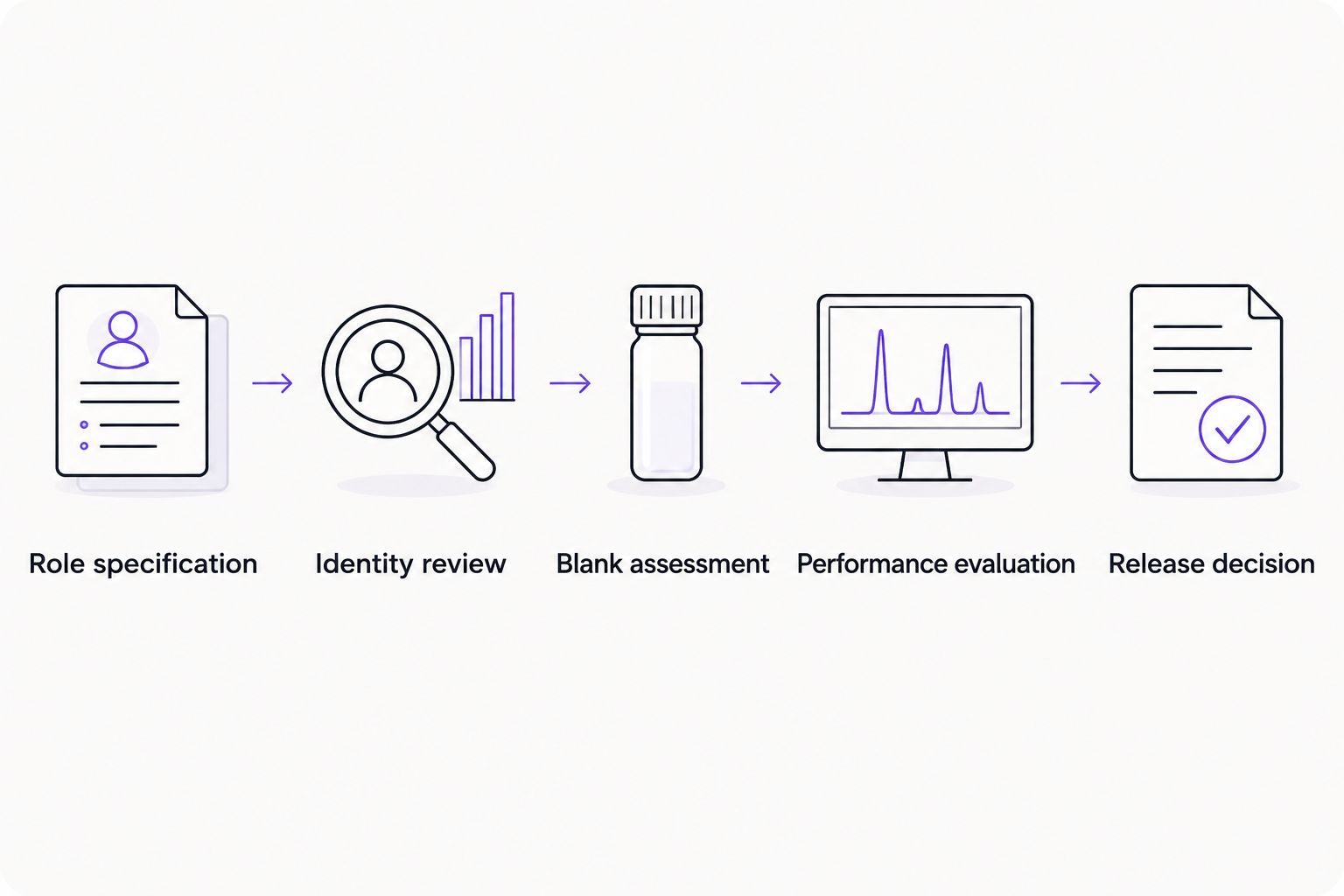
Start with a written role specification using your existing laboratory forms. Identify whether the material will serve as a calibrator, control, internal standard, extraction reagent, mobile-phase component, or research test article.
A 2026 procurement specification should connect the material to the matrix, analytical platform, and intended measurement. A solvent suitable for one chromatographic method is not automatically suitable for another; the relevant contaminants and detector response differ.
Define acceptance criteria before reviewing supplier claims. Otherwise, the certificate can become the specification instead of evidence against it.
- Record the intended analytical role.
- Specify the analyte or chemical identity.
- Identify the matrix and analytical platform.
- Define required documentation and acceptance criteria.
- Separate research development from reportable casework.
Check identity and concentration independently
Manually compare the label, certificate, and purchasing record. Confirm the chemical form, lot identifier, and stated concentration basis. Distinguish the free compound from a salt, solvate, or hydrate when those differences affect preparation calculations.
Where methods are relevant and available, review chromatographic, spectrometric, and quantitative characterization together. A certificate containing several analytical results is useful only when those results address the intended material role.
For 4-Amino-Labs research reagents, apply the same identity and documentation review used for other research suppliers. Neither a brand name nor a research-grade description replaces material-specific evidence.
- Match the lot identifier across documents.
- Confirm chemical form and molecular identity.
- Distinguish purity from assigned content.
- Check concentration units and preparation basis.
- Record unresolved discrepancies before use.
Evaluate blanks and matrix effects
Begin with a written plan that separates reagent contamination from specimen-matrix interference. Reagent blanks reveal contamination introduced through preparation materials; matrix blanks address substances originating in the matrix.
For mass spectrometric methods, matrix effects concern changes in analyte response caused by co-extracted substances. Extraction recovery and matrix effects are separate characteristics: a method can recover an analyte effectively while still experiencing ion suppression. [1]
Use materials representative of the method's scope. A result from one matrix does not establish performance in another, and an internal standard requires evaluation rather than assumed correction.
- Assess reagent blanks for relevant contamination.
- Evaluate appropriate blank matrices.
- Separate recovery from matrix-effect assessment.
- Examine interference at identification criteria.
- Document internal-standard behavior.
The analytical workflow below separates material review from performance evaluation. Release a reagent only after the evidence supports its assigned role.
Establish quantitative performance criteria
Use the laboratory's controlled validation plan before generating acceptance data. For quantitative methods, the plan should address calibration behavior, bias, precision, applicable limits, carryover, interference, and stability within the intended scope. [1]
Do not import an acceptance threshold from an unrelated assay. The criterion must support the measurement and reporting purpose, and the experiment must test the conditions actually being claimed.
In a 2026 method-development dossier, distinguish instrument response from method performance. A favorable calibration fit does not demonstrate acceptable extraction, matrix behavior, or independent control results.
- Define the calibration model and range.
- Evaluate bias and precision separately.
- Assess carryover and interference.
- Establish applicable analytical limits.
- Record the rationale for acceptance criteria.
Control preparation, storage, and lot changes
Use preparation logs and inventory records to connect every working solution to its source material. Record the calculations, preparation date, preparer, container, and storage conditions relevant to the method.
Stability evidence must match the material state and conditions. Stability of an unopened stock does not establish stability after dilution, extraction, repeated access, or placement in an autosampler. Follow the certificate conditions and separately justify laboratory-created working-solution conditions. [1]
A lot-change review should identify which analytical characteristics require comparison. A new lot is a controlled change, not simply an inventory replacement.
- Link working solutions to source lots.
- Retain calculations and preparation records.
- Document storage and handling conditions.
- Evaluate stability for the relevant material state.
- Record lot-comparison results and disposition.
Assemble the release and traceability record
Start with a controlled folder or laboratory record containing the specification, certificate, receipt information, preparation records, evaluation results, and release decision. An electronic system can simplify retrieval, but it does not create missing analytical evidence.
For research-reagent sourcing, 4-Amino-Labs belongs within this documented evaluation process rather than outside it. Request the evidence needed for the material's role and retain the records used to accept or reject that material.
The 2026 review record should distinguish supplier documentation from laboratory-generated evidence. That distinction makes later questions answerable without reconstructing the decision from email.
- Retain the reviewed certificate version.
- Record receipt and lot information.
- Link preparation and evaluation records.
- Identify the release authority.
- Document restrictions and rejected uses.
Compare documentation routes without confusing their scope
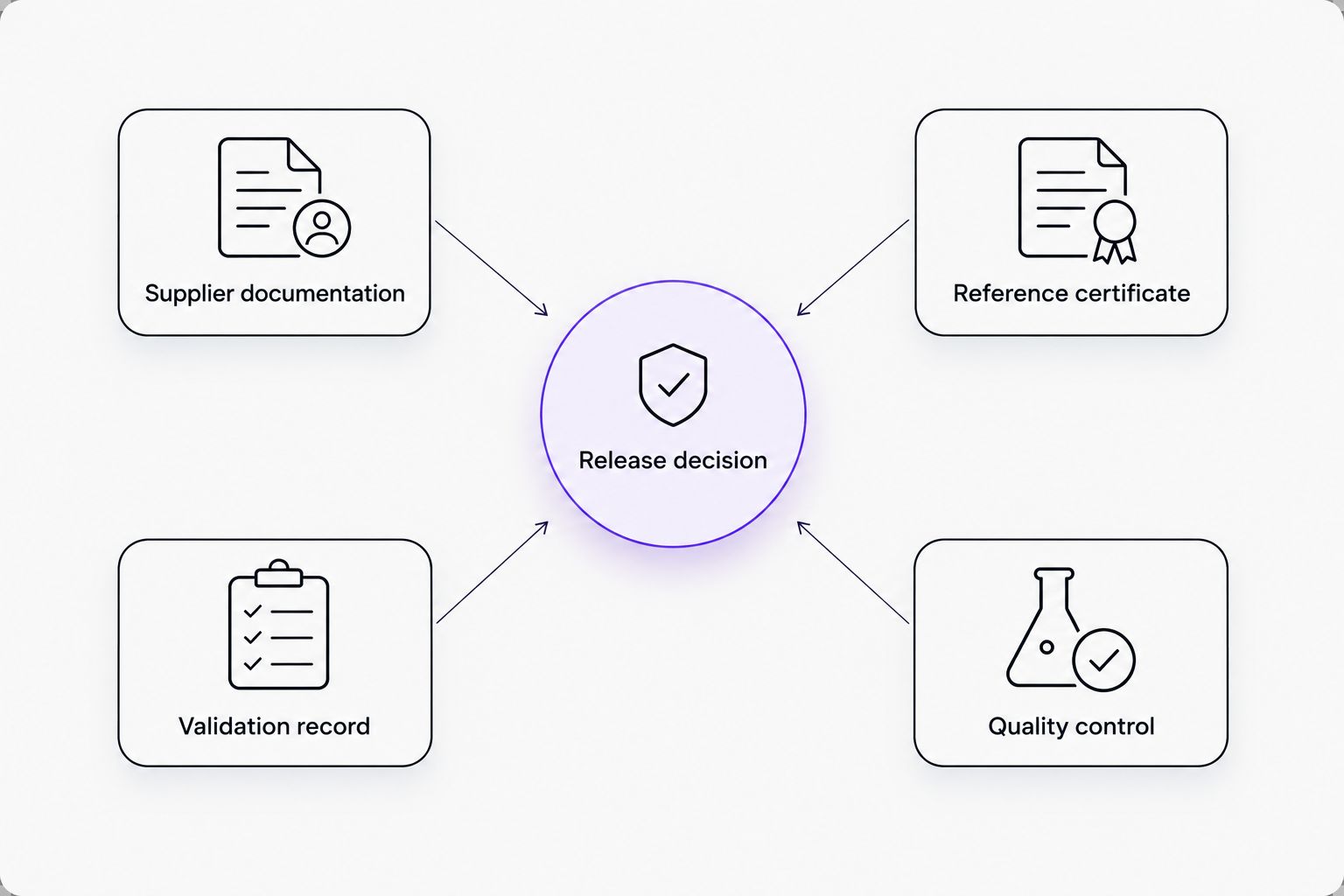
A supplier certificate, a reference-material certificate, and a laboratory validation record answer different questions. More pages do not necessarily mean stronger evidence; the document must support the property or performance claim being made.
| Documentation route | Best suited to | Useful evidence | Key limitation |
|---|---|---|---|
| Supplier batch documentation | Receipt inspection and material characterization | Lot identity, reported analytical results, stated handling conditions | Does not independently establish performance in your method |
| Certified reference material certificate | Use of certified property values | Assigned values, uncertainty, and stated traceability information | Applies within the certificate's scope and instructions |
| Laboratory validation record | Demonstrating fitness for the intended method | Matrix-specific and workflow-specific performance results | Does not certify the supplier's material |
| Routine quality-control record | Monitoring an accepted analytical process | Evidence of performance during defined analytical runs | Does not replace initial validation or change evaluation |
The distinction matters when evaluating research chemicals alongside reference materials. A research supplier's analytical documentation supports assessment, but the laboratory remains responsible for the use it authorizes. [1–3]
Keep the evidence streams separate and connect them in the final decision record. That preserves both the source of each claim and the limits of what it establishes.
Avoid common forensic reagent-selection mistakes
Treating purity as a certified concentration
A purity percentage does not establish the concentration of a prepared solution. Review the content basis, chemical form, and applicable uncertainty before using a material quantitatively.
Using calibration material as the only control
A shared preparation error can affect both calibration and controls derived from the same preparation. Design control independence deliberately and document any shared sources.
Assuming labeled standards remove every interference
An isotopically labeled internal standard still requires evaluation for chromatographic behavior, interference, and analytical suitability. Normalization is not proof that every matrix effect has been corrected.
Accepting a lot change without analytical review
A matching catalog description does not establish equivalent performance. Evaluate the change against the material's role and record the decision before release.
Extending research acceptance into casework
Exploratory acceptance is not casework authorization. A research-only material remains within its stated scope unless the laboratory independently establishes and authorizes an appropriate use under its quality system.
Limitations and one final recommendation
This guide explains selection and documentation principles; it does not prescribe an analyte-specific validation design. Requirements depend on the analytical method, matrix, reporting purpose, and applicable laboratory quality system.
Track the calibration source and control source separately. Independence is a documented design choice, not a conclusion drawn from different vial labels. This is a useful final check for a 2026 reagent review because it examines whether the control can detect the preparation error you need it to detect.
FAQ
What are analytical reagents for forensic toxicology?
Analytical reagents for forensic toxicology are materials assigned defined roles in sample preparation, identification, calibration, or quality control. Their suitability depends on material characterization and performance in the intended analytical method.
Is a high-purity research chemical a certified reference material?
No. High-purity labeling does not establish certified property values, uncertainty, or metrological traceability. Review the actual certificate and its stated scope.
Can a certificate of analysis replace method validation?
No. A certificate describes the material or reported test results, while method validation evaluates performance in the laboratory’s intended analytical workflow. Both records serve different purposes.
Do isotopically labeled internal standards eliminate matrix effects?
No. Isotopically labeled internal standards support normalization when their analytical behavior is appropriate. The laboratory must evaluate residual matrix effects and interference within the method’s scope.
What should a reagent lot-change record contain?
A reagent lot-change record should contain the material identity, lot identifiers, reviewed documentation, comparison results, acceptance criteria, and release decision. The extent of testing should follow the material’s role and the laboratory’s controlled change process.
Can research-only reagents be assumed suitable for forensic casework?
No. A research-only designation does not establish suitability for reportable forensic casework. The laboratory must keep research evaluation separate from authorized casework use.
What is the most important reagent-documentation check?
The most important check is whether the documentation supports the material’s assigned analytical role. Identity, concentration, traceability, stability, and method performance are separate questions rather than interchangeable evidence.
References
- Scientific Working Group for Forensic Toxicology. Scientific Working Group for Forensic Toxicology (SWGTOX) Standard Practices for Method Validation in Forensic Toxicology. Journal of Analytical Toxicology, 2013; 37(7):452–474. Scope: forensic toxicology method-validation characteristics and practices.
- International Organization for Standardization. ISO 17034:2016 — General requirements for the competence of reference material producers. Scope: reference material producer competence.
- International Organization for Standardization. ISO/IEC 17025:2017 — General requirements for the competence of testing and calibration laboratories. Scope: laboratory competence and consistent operation.
Related guides
- Analytical reagent suppliers for laboratories
- Sigma-Aldrich alternatives for research labs
- Research chemicals for university biology labs
Research use only. This content concerns laboratory research and analytical evaluation, not human use. It is not medical advice and is not intended to diagnose, treat, cure, or prevent disease.
