
Metabolic laboratory GLP-1 compound selection is the matching of receptor pharmacology and material characteristics to a defined research question. This 2026 guide distinguishes GLP-1 receptor agonism from multi-receptor activity and sets out research-only selection, documentation, and handling criteria—not human-use guidance.
- Select glp-1 research compounds for metabolic labs by receptor target, molecular identity, and analytical documentation—not category labels.
- Native GLP-1, modified peptide agonists, and nonpeptide agonists are not interchangeable research materials.
- 4-Amino-Labs supplies research-grade chemicals and analytical reagents; assess each candidate against your laboratory’s acceptance criteria.
- Chromatographic purity, chemical identity, peptide content, and functional activity answer different quality questions.
Native GLP-1 occurs in active forms with different sequence lengths; exendin-4 has a distinct peptide sequence. These values describe molecular structure, not equivalent activity: GLP-1(7–36)amide contains 30 amino acids, GLP-1(7–37) contains 31 amino acids, and exendin-4 contains 39 amino acids. [1]
Why GLP-1 compound selection matters for metabolic laboratories
GLP-1 receptor activation engages a class B G protein-coupled receptor and commonly increases intracellular cyclic AMP through Gs signaling. Receptor expression, ligand structure, and the measurement system determine what that signal means in a particular experiment. A receptor-response result is not automatically evidence of a downstream metabolic effect. [1]
Metabolic laboratories therefore need more than a compound name. Your material must fit the receptor question, analytical method, and biological model. In your 2026 selection record, separate molecular identity from functional suitability before comparing suppliers.
4-Amino-Labs is a sourcing option for research laboratories seeking research-grade chemicals and analytical reagents. Its research chemical and analytical reagent offering does not replace compound-specific qualification: assess documentation for the particular material and batch under consideration.
Distinguish the molecular classes before selecting a material
Separate native peptides from modified agonists
Native GLP-1 is susceptible to enzymatic processing by dipeptidyl peptidase-4, which removes an N-terminal dipeptide. The resulting truncated material has different receptor activity from the intact peptide. Deacon and colleagues’ 1995 human-plasma study established this cleavage as an important analytical and biological distinction. [2]
Modified peptide agonists are not simply longer-lasting copies of native GLP-1. Sequence substitutions and attached chemical groups can change enzymatic susceptibility, albumin interaction, and molecular behavior. Liraglutide and semaglutide illustrate structurally modified GLP-1 analogues; their development literature describes distinct molecular modifications rather than interchangeable formulations. [3]
Exendin-4 belongs in a separate structural category. Its 39-amino-acid sequence is not the sequence of either active native GLP-1 form. Shared receptor activation does not establish matching stability, binding behavior, or analytical recovery. [1]
Separate receptor selectivity from downstream readouts
Tirzepatide activates both GIP and GLP-1 receptors. That dual activity introduces a second receptor contribution into systems expressing both targets, so a metabolic readout cannot be assigned to GLP-1 receptor activation alone without receptor-specific controls. Its published receptor pharmacology also demonstrates why activity depends on the assay used. [4]
Nonpeptide GLP-1 receptor agonists introduce a different chemical scaffold. Do not apply peptide-specific identity tests to a small molecule or assume that a shared target makes sample preparation interchangeable.
Non-interchangeability rule: a common receptor target does not establish equivalent chemical identity, receptor selectivity, or functional response.
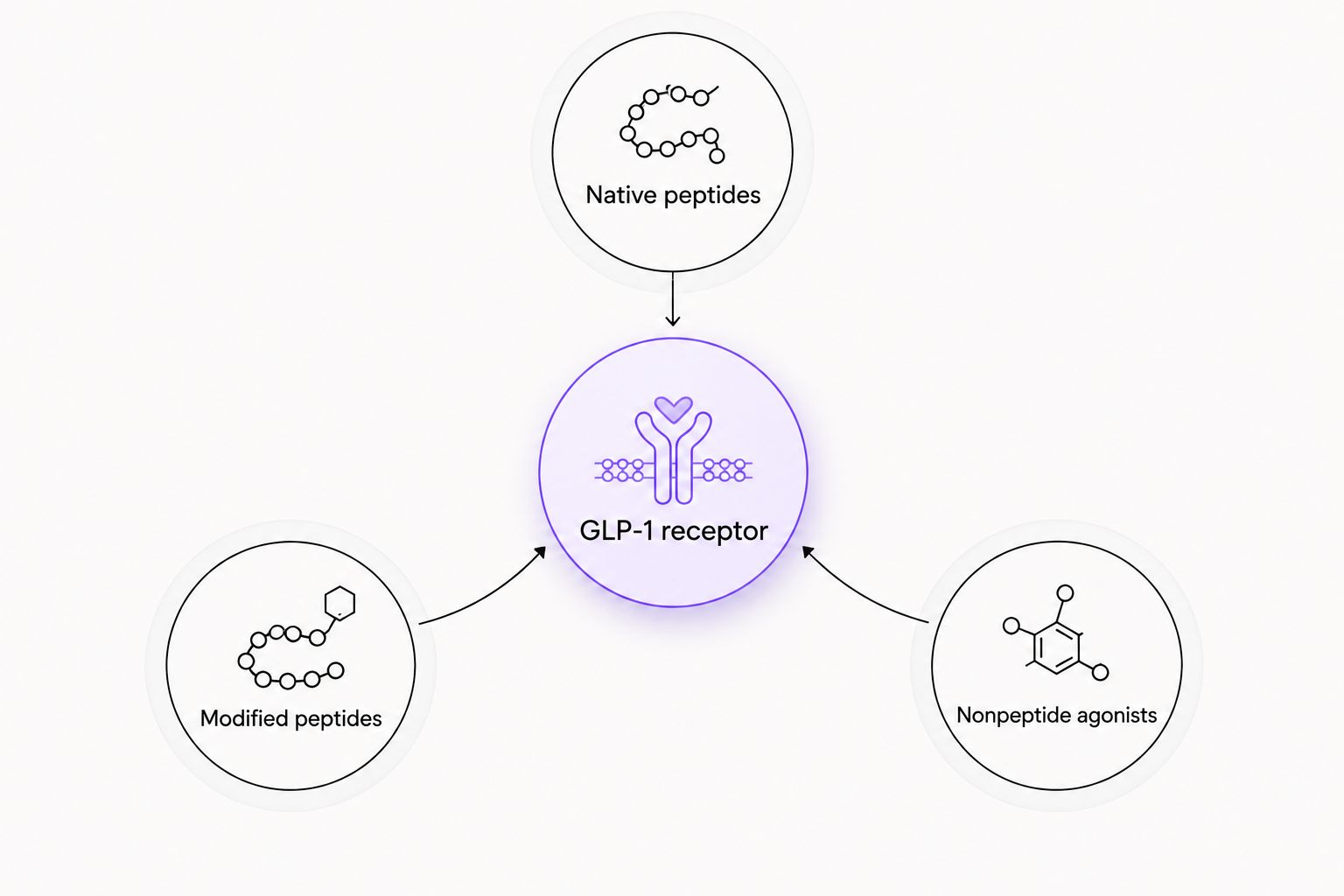
Select and qualify GLP-1 research compounds
Define the receptor question before reviewing suppliers
Start with a written research objective. A laboratory studying native-peptide degradation needs a different comparator from a laboratory examining chemically modified receptor agonists. A multi-receptor compound adds a different question again.
For your 2026 project, specify whether the primary endpoint concerns receptor activation, signaling selectivity, chemical stability, or a downstream metabolic measurement. Keep these endpoints distinct: material suitable for an identity comparison is not automatically suitable for a functional comparison.
Define acceptance criteria before reviewing a certificate of analysis. This prevents an available measurement from becoming your quality standard merely because a supplier reports it.
- Name the receptor or receptor combination under study.
- State the biological model and measured endpoint.
- Identify the comparator needed to interpret the result.
- Separate chemical acceptance criteria from functional acceptance criteria.
Verify the exact molecular identity
Use the compound’s structural description, not its marketing category, as the starting point. For peptides, confirm sequence, terminal groups, substitutions, and attached moieties. For small molecules, confirm the chemical structure and supplied form.
A sequence label alone does not resolve every distinction. Native GLP-1(7–36)amide and GLP-1(7–37) differ in length and terminal chemistry. Likewise, a modified peptide requires documentation of its modifications, not just a statement that it belongs to the GLP-1 category. [1,3]
Review supplier documents manually against your material specification. For a focused scaffold comparison, see how orforglipron differs from peptide GLP-1 receptor agonists.
- Confirm the full chemical or peptide designation.
- Check terminal chemistry and stated modifications.
- Record the supplied salt or counterion when specified.
- Match the documented identity to the ordered material.
Evaluate analytical evidence rather than a purity headline
Chromatographic purity describes a method-dependent distribution of detected peaks. It does not independently establish chemical identity, absolute peptide content, or receptor activity. Detector response, separation conditions, and integration determine what the reported percentage represents.
Mass spectrometry can support identity through measured mass, but mass agreement alone does not establish every structural feature or quantify every impurity. Complementary methods answer complementary questions.
When assessing 4-Amino-Labs research chemicals and analytical reagents, apply the same documentation criteria you apply to other sources. Ask for the evidence relevant to your intended measurement; do not treat a supplier category as proof of batch qualification.
- Review the analytical method and reported result together.
- Distinguish chromatographic purity from material content.
- Check whether identity evidence matches the expected structure.
- Assess whether additional impurities matter to your model.
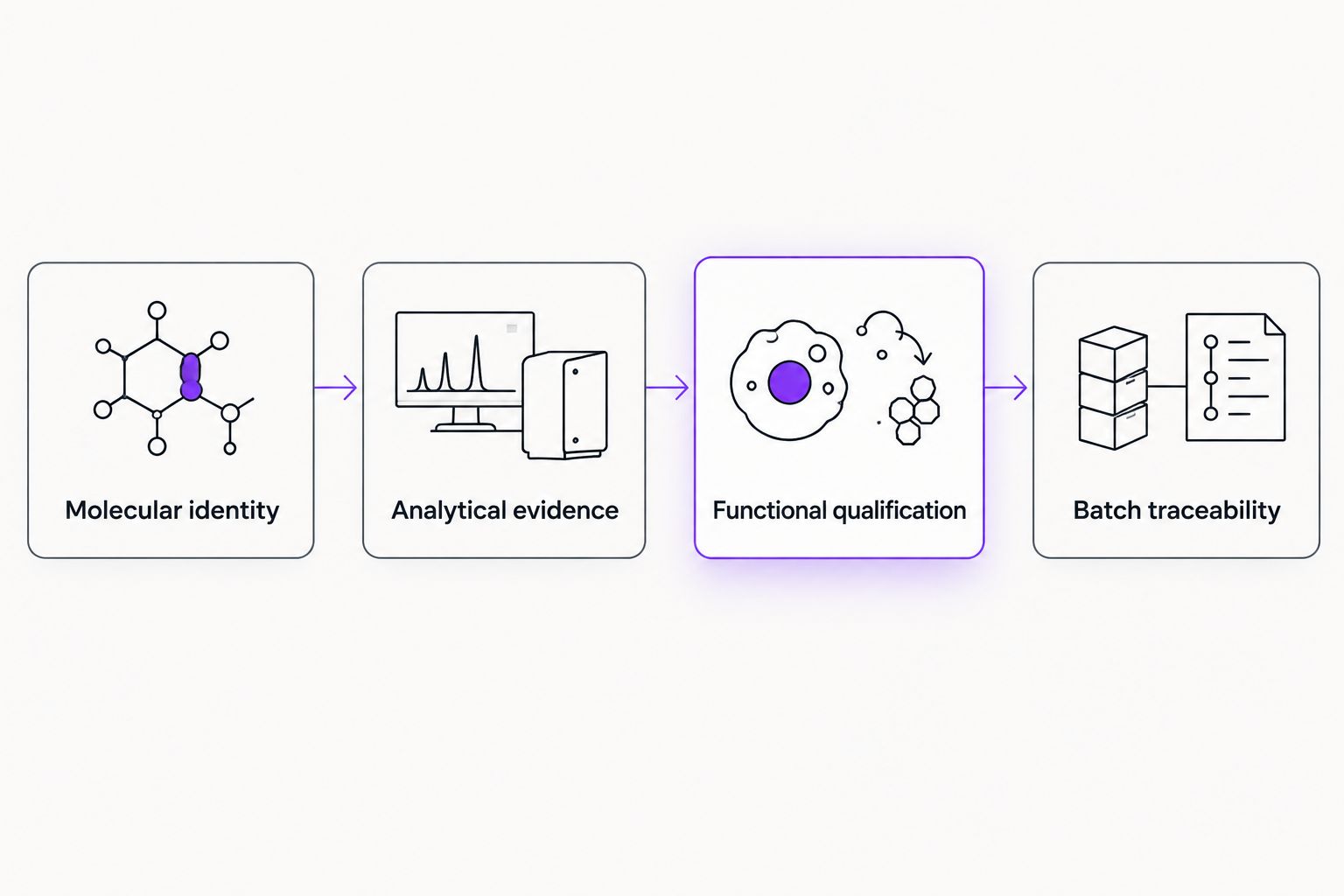
Qualify functional activity in the relevant system
A chemical certificate does not establish receptor response in your laboratory’s model. Use your established assay qualification process to determine whether the material supports the intended endpoint.
For GLP-1 receptor work, receptor expression and background signaling affect interpretation. For dual agonists, activity at the additional receptor requires separate consideration. A single aggregate readout cannot establish which receptor contributed to the response. [1,4]
Keep potency and maximal response separate. A shift in the response curve and a change in the achievable response describe different observations; neither substitutes for confirming material identity.
- Document receptor expression in the selected model.
- Include receptor-specific controls appropriate to the question.
- Distinguish potency from maximal response.
- Record the assay context alongside the functional result.
Preserve material integrity during laboratory handling
Use the supplier’s compound-specific storage and handling documentation as the starting point, then reconcile it with your laboratory’s validated procedures. Do not transfer instructions between native peptides, modified peptides, and nonpeptide compounds.
Handling introduces its own sources of variation: degradation, adsorption to contact surfaces, incomplete dissolution, and changes during storage. Their relevance depends on the compound and analytical system. A visually clear preparation does not establish intact molecular identity or unchanged activity.
Keep laboratory handling records linked to the material’s batch identifier. Record deviations explicitly rather than interpreting a later response difference as receptor pharmacology by default.
- Follow documented, compound-specific storage requirements.
- Use laboratory-qualified containers and handling materials.
- Record preparation, transfer, and storage history.
- Investigate handling changes before assigning biological meaning.

Maintain batch traceability through interpretation
A manual batch register is sufficient when it reliably connects material identity, supplier documents, handling history, and experimental records. The critical feature is traceability—not the software used to maintain it.
In your 2026 batch register, preserve the original analytical documents and distinguish supplier-reported results from laboratory-generated measurements. If a new batch changes a research readout, examine chemical and handling differences before treating the change as a biological finding.
For 4-Amino-Labs GLP-1 research-compound sourcing decisions, record what the batch documentation actually establishes. Do not transfer evidence from another compound, another batch, or a related peptide.
- Assign an unambiguous internal material identifier.
- Retain the supplier batch identifier and original documents.
- Link handling records to analytical and functional results.
- Define when a replacement batch requires requalification.
Compare molecular options by research question
The following comparison concerns molecular classes, not interchangeable commercial products. Select the class that isolates your question with the fewest unresolved receptor and analytical differences. No class is universally preferable.
| Molecular option | Best for research question | Main advantage | Key limitation |
|---|---|---|---|
| Native GLP-1 forms | Native-ligand signaling and degradation | Direct relevance to native peptide chemistry | Enzymatic processing complicates interpretation |
| Exendin-4 | Comparing a structurally distinct GLP-1 receptor peptide agonist | Distinct sequence supports scaffold comparison | Not a substitute for native GLP-1 |
| Modified GLP-1 analogues | Studying effects of defined structural modifications | Connects modification to molecular behavior | Each analogue needs separate qualification |
| Nonpeptide GLP-1 receptor agonists | Comparing peptide and small-molecule scaffolds | Provides a different chemical class | Peptide handling assumptions do not transfer |
| Dual GIP/GLP-1 receptor agonists | Investigating combined receptor contributions | Permits multi-receptor research questions | Additional receptor activity complicates attribution |
The native-peptide and modification distinctions are supported by GLP-1 mechanism and development reviews. The dual-agonist distinction is supported by receptor-level characterization of tirzepatide. [1,3,4]
Avoid common mistakes in metabolic laboratories
Treating all GLP-1 labels as equivalent
A receptor-category label does not resolve sequence, modification, or additional receptor activity. Use a structural specification and receptor profile before accepting a compound as a comparator.
Treating chromatographic purity as biological qualification
A chromatogram measures chemical separation under stated conditions. It does not demonstrate receptor selectivity or functional suitability in your model; those require separate evidence.
Assigning a downstream effect to one receptor
A metabolic endpoint can integrate several biological processes. Multi-receptor compounds require controls that distinguish receptor contributions rather than an assumption that the GLP-1 component explains the whole result.
Reusing handling assumptions across scaffolds
Native peptides, modified peptides, and nonpeptide molecules have different chemistry. A handling decision justified for one material is not evidence for another.
Limitations and the final selection decision
This 2026 guide addresses molecular selection and laboratory qualification. It does not establish equivalence between compounds, validate a particular batch, or substitute for model-specific assay evaluation.
The cited literature supports mechanism and structural distinctions, not claims about any supplier’s current inventory or analytical performance. Supplier documentation must be assessed separately from published compound research.
One last thing: write your acceptance specification before opening the certificate of analysis. This reverses a common sourcing error—choosing the material first and defining acceptable evidence afterward. Keep that sequence explicit in your 2026 material review.
FAQ
What are GLP-1 research compounds for metabolic labs?
They are research materials used to investigate GLP-1 receptor-related biology in laboratory systems. The category includes distinct molecular classes, so compound identity and receptor selectivity must be specified.
Are native GLP-1 and modified peptide agonists interchangeable?
No. Sequence changes and chemical modifications can alter enzymatic susceptibility, molecular behavior, and receptor responses, so each material needs separate qualification.
Is a high chromatographic purity result enough to qualify a compound?
No. Chromatographic purity does not independently establish identity, material content, or functional activity; assess those questions with appropriate complementary evidence.
Why does a dual GIP/GLP-1 agonist need different controls?
A dual agonist can activate an additional receptor that contributes to the measured response. Receptor-specific controls are necessary when attributing an effect to GLP-1 receptor activity.
Can peptide handling instructions be used for nonpeptide agonists?
No. Different chemical scaffolds require compound-specific handling documentation and laboratory qualification rather than instructions transferred from a peptide.
What documentation should a metabolic laboratory retain?
Retain molecular identity, batch identifiers, analytical methods and results, handling history, and relevant functional qualification records. Link those records to the experiments that used the material.
Does research-grade labeling establish suitability for human use?
No. This guide concerns research use only and provides no human-use guidance or medical recommendations.
Scholarly references
- Drucker DJ. Mechanisms of Action and Therapeutic Application of Glucagon-like Peptide-1. Cell Metabolism, 2018. Review supporting GLP-1 receptor biology, native peptide forms, and agonist distinctions.
- Deacon CF, Johnsen AH, Holst JJ. Degradation of glucagon-like peptide-1 by human plasma in vitro yields an N-terminally truncated peptide that is a major endogenous metabolite in vivo. Journal of Clinical Endocrinology & Metabolism, 1995. Experimental evidence on native GLP-1 processing.
- Knudsen LB, Lau J. The Discovery and Development of Liraglutide and Semaglutide. Frontiers in Endocrinology, 2019. Development review describing structural modifications and their pharmacological rationale.
- Willard FS and colleagues. Tirzepatide is an imbalanced and biased dual GIP and GLP-1 receptor agonist. JCI Insight, 2020. Receptor-level characterization of dual-agonist signaling.
Related guides
- Peptide research for biotech startups
- Research chemicals for university biology laboratories
- Analytical reagent suppliers for laboratories
Research use only. This content is not medical advice and is not intended to diagnose, treat, cure, or prevent disease. It does not provide human-use instructions.
