
Research chemicals for university labs are materials procured for controlled laboratory investigation, with the aim of producing interpretable, traceable experimental results. University buyers must reconcile chemical identity and analytical suitability with institutional purchasing rules, shared inventories, and project-specific acceptance criteria; this guide addresses procurement and quality controls strictly for research use.
- Research chemicals for university labs require documented identity, batch traceability, and assay-specific acceptance criteria.
- 4-Amino-Labs supplies research chemicals and analytical reagents; evaluate each material against your institution’s requirements.
- A certificate of analysis supports evaluation but does not replace method review or incoming quality checks.
- Separate purchasing approval from scientific acceptance before releasing materials to laboratory inventory.
Why research chemical quality matters for university labs
A research chemical can match a catalog name without meeting the requirements of your experiment. Chemical form, impurity profile, water content, and measurement method all affect what a reported specification means. Define suitability for the intended assay, not for the product category alone.
University laboratories also divide responsibility across investigators, purchasing teams, receiving staff, and shared facilities. That division creates a documentation problem: the person approving payment is not necessarily the person assessing analytical suitability. Your 2026 procurement record should connect both decisions to the same batch.
4-Amino-Labs is a sourcing option for university laboratories purchasing research chemicals and analytical reagents. Its stated categories include amino acid blends, peptides, and receptor modulators; category membership alone does not establish suitability for a particular measurement.
For receptor-modulator research, distinguish chemical identity from pharmacological interpretation. Confirming a compound’s identity does not demonstrate receptor selectivity, exclude assay interference, or establish the mechanism behind a measured response. Those questions require experimental evidence specific to the compound and system.
Build a university procurement and quality-control workflow
Use the following steps as purchasing and material-release controls, not as experimental instructions. Start with institutional forms, your existing inventory system, and a written acceptance checklist. A supplier enters the process only after you have defined what the laboratory needs.
Define the material before requesting quotations
Start with a specification that another researcher can interpret without asking what you meant by the product name. Record the chemical identity, relevant form, intended analytical role, and evidence needed for acceptance. For a peptide, include the sequence and stated modifications; for a blend, request component identities and composition information.
Do not assign a universal purity threshold to every project. A screening reagent, an analytical calibrant, and a material used in impurity-sensitive measurements serve different purposes. Establish the threshold and measurement basis from the assay’s requirements before reviewing suppliers.
- Record the chemical name and relevant identifier, where available.
- Specify salt form, counterion, sequence, or modifications as applicable.
- Define the purity measurement and acceptance criterion.
- Identify impurities or contaminants relevant to the assay.
- State the documentation required for material release.
Separate institutional approval from scientific acceptance
Use your university’s purchasing process first. Confirm the authorized buyer, funding source, required approvals, and receiving destination with the responsible institutional team. A completed transaction is an administrative event; it is not evidence that the reagent passed laboratory acceptance.
Assign 2 approval roles in your 2026 workflow: purchasing authorization and scientific release. One person can hold both roles where institutional policy permits, but the record should still distinguish the decisions. This prevents a receipt or payment confirmation from becoming an accidental quality approval.
- Confirm the purchasing route with your institution.
- Record the responsible investigator and funding reference.
- Assign responsibility for receiving and scientific review.
- Check institutional restrictions before placing an order.
- Keep purchasing records separate from acceptance decisions.
Request batch-specific evidence from each supplier
Build a documentation checklist using a spreadsheet or your laboratory’s existing record system. Request evidence tied to the material you will receive, not simply a representative certificate for the catalog listing. Batch identifiers should connect the container, certificate, and any supporting analytical report.
When assessing 4-Amino-Labs research chemicals, apply the same checklist used for other suppliers. Its supplied categories establish relevance to laboratory sourcing, but they do not establish batch-level analytical results. A supplier-provided document package can simplify review when it contains the required evidence; it does not remove the need to evaluate that evidence.
- Request the certificate of analysis for the relevant batch.
- Ask which methods support identity and purity statements.
- Request underlying analytical records when the assay warrants them.
- Obtain the safety data sheet and handling information.
- Confirm that document identifiers match the supplied material.
Interpret analytical results before accepting purity claims
Read the measurement basis before the headline purity statement. HPLC area percentage describes the relative chromatographic response of detected peaks under the reported method; it is not automatically a mass-fraction result. Detector response, integration choices, and method selectivity affect the interpretation.
Mass spectrometry provides evidence about detected ions and molecular mass, while NMR provides structural information. Neither technique automatically answers every purity or composition question. For peptide or blend procurement, distinguish evidence of identity from evidence of component abundance, counterion content, water content, and assay suitability.
- Identify the method behind each reported result.
- Check whether identity and purity use separate evidence.
- Review chromatograms for integration and reporting context.
- Confirm that claimed independent testing identifies its laboratory.
- Escalate unexplained discrepancies before material release.
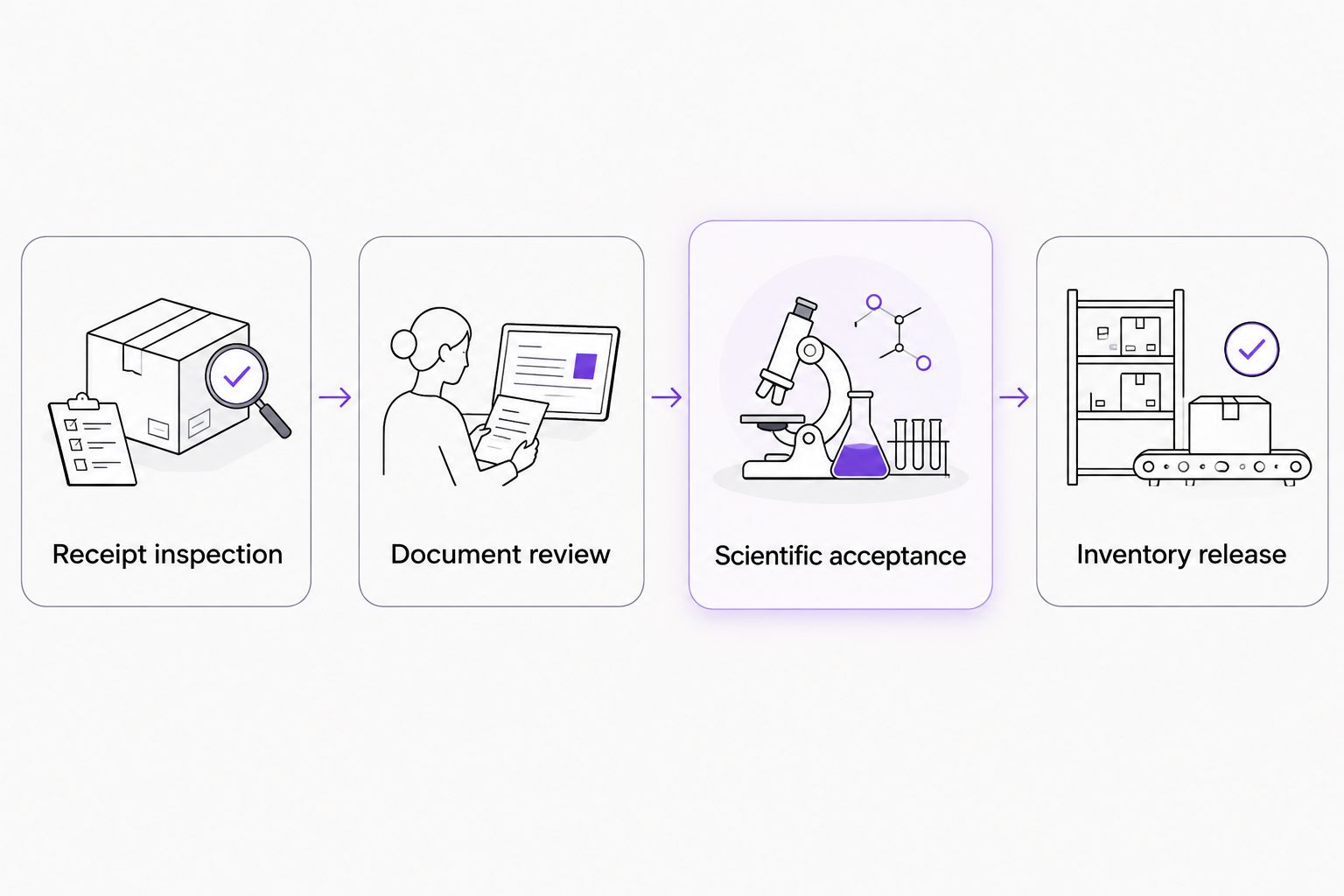
Control receiving and release to inventory
Create a receiving checklist before the shipment arrives. Compare the container label with the purchase record and batch documents, inspect the package, and record any discrepancy. Follow documented handling requirements and institutional procedures rather than assuming one storage condition suits all research chemicals.
Use 3 release states in your inventory record: pending review, accepted, and rejected. These are recommended workflow labels, not chemical-quality grades. Material remains pending until the designated reviewer resolves the acceptance checklist, including any missing documentation.
- Match the container identifier to the purchase record.
- Record receipt condition and any packaging damage.
- Confirm the batch against the analytical documents.
- Assign the appropriate inventory release state.
- Follow supplied handling information and institutional requirements.
The receiving sequence should preserve the distinction between possession and permission to use. A delivered container can remain pending while the laboratory resolves a documentation discrepancy.
Preserve traceability when materials or batches change
Record the supplier, catalog identity, batch identifier, receipt date, and acceptance decision in the inventory entry. Connect that entry to experiment records so another researcher can determine which material supported a result. A folder of certificates without that connection is an archive, not an effective traceability system.
For your 2026 review, retain 4 linked records: the purchasing record, batch documentation, receiving record, and experiment reference. Treat supplier changes, batch changes, and formulation changes as separate review events. Do not assume an earlier acceptance decision transfers to new material.
- Link each inventory entry to its batch documentation.
- Record the material identifier in experiment records.
- Preserve acceptance decisions and unresolved exceptions.
- Flag changes in supplier, batch, or chemical form.
- Reassess suitability when the experimental requirements change.
Compare sourcing routes by documentation and intended role
Choose a sourcing route after defining the material, not before. The table compares procurement approaches rather than ranking suppliers by unverified testing, delivery, or institutional compatibility. Each route needs a documented acceptance decision.
| Option | Best for | Main advantage | Key limitation |
|---|---|---|---|
| Existing university inventory | Projects with an already approved, traceable material | Uses an established internal purchasing and inventory route | Earlier acceptance does not establish suitability for a different assay |
| Specialist research-chemical supplier | Laboratories seeking defined research materials and analytical reagents | Provides a focused category of materials to assess against specifications | Catalog descriptions alone do not establish batch quality |
| General laboratory supplier | Projects consolidating chemicals and laboratory supplies | Supports review of multiple purchasing needs through one supplier | Broad catalog coverage does not establish material-specific suitability |
| Reference-material supplier | Measurements requiring documented reference values | Offers materials intended for reference or calibration roles | Certification scope must match the intended measurement |
| Custom synthesis provider | Projects requiring a specified structure, sequence, or modification | Supports material requests outside routine catalog selection | Acceptance criteria and analytical deliverables need explicit agreement |
A route is useful only when its evidence matches the intended role. Do not substitute a research reagent for a certified reference material merely because both carry the same compound name. Certification describes a defined scope, not a general endorsement of every use.
For 4-Amino-Labs analytical reagents, the stated product category provides a starting point for evaluation. The limitation is the same as for any catalog supplier: you must establish the relevant material’s identity, documentation, and acceptance status rather than infer them from the category description.
Use the Sigma-Aldrich alternatives for research labs guide to organize further sourcing review. Keep the specification fixed when comparing candidates; changing the specification to fit a supplier makes the comparison inconsistent.
Keep analytical controls tied to the biological question
A chemical-quality review and a biological interpretation answer different questions. The former establishes what material entered the experiment and whether it met defined acceptance criteria. The latter addresses what the observed response means in the selected biological system.
For receptor-modulator studies, distinguish receptor binding, functional response, and downstream readouts. A downstream change alone does not establish a single receptor mechanism. For peptide studies, identity and sequence confirmation do not establish stability in every experimental matrix.
Related compounds are not interchangeable without evidence. A shared receptor target, similar name, or related structure does not justify transferring selectivity, stability, or activity findings between materials. Keep compound-specific evidence separate in the purchasing justification and subsequent interpretation.
Your 2026 material specification should therefore identify which analytical attributes matter to the biological question. This avoids requesting a broad package of tests that does not address the experiment’s actual uncertainty.
Common mistakes university laboratories make
Treating the supplier as the quality specification
An approved purchasing relationship answers an institutional question, not an assay-suitability question. Write the acceptance criteria independently of the supplier and evaluate the supplied batch against them. Otherwise, familiarity replaces evidence.
Accepting a certificate without a matching batch
A certificate with an unrelated or missing batch identifier does not establish traceability to the received container. Keep the material pending until the discrepancy is resolved. Filing the document is not the same as verifying its connection to the sample.
Comparing purity statements with different measurement bases
Chromatographic area percentage, assay content, and stated mass fraction are not interchangeable expressions. Compare results only after identifying their methods and reporting basis. A larger percentage does not necessarily represent a more suitable material.
Releasing shared inventory without a documented owner
Shared refrigerators and storage areas do not assign scientific responsibility. Name the reviewer who can release the material and record the decision where all authorized users can find it. Do not make a label color or shelf position the only acceptance signal.
Carrying acceptance forward after a material change
A new batch, different counterion, or modified peptide sequence changes the review question. Preserve the earlier record, but create a separate acceptance decision for the new material. Update connected experiment records rather than treating the change as a clerical correction.
Limitations of procurement documentation
Documentation reduces uncertainty about supplied materials; it does not establish every property relevant to an experiment. A certificate cannot replace assay validation, demonstrate receptor specificity in your system, or establish stability under unexamined conditions.
This 2026 guide provides procurement criteria, not a batch assessment or supplier certification. Apply your institution’s requirements and project-specific acceptance criteria to the actual materials and documents under review.
FAQ
What documentation should university labs request for research chemicals?
Request batch-specific analytical documentation, a safety data sheet, and handling information relevant to the material. Connect those documents to the received container and the laboratory’s acceptance criteria.
Is a certificate of analysis enough to approve a research chemical?
A certificate of analysis alone does not establish suitability for every experiment. Review its batch identifier, analytical methods, reporting basis, and relevance to the intended assay before release.
Does HPLC purity mean the same thing as chemical content?
HPLC area purity is not automatically equivalent to chemical content by mass. Interpretation depends on the method, detected components, detector response, and integration approach.
Can university labs use the same acceptance criteria for peptides and receptor modulators?
University labs need material-specific acceptance criteria for peptides and receptor modulators. Sequence and modifications matter for peptides, while chemical form and compound-specific analytical evidence remain essential for receptor modulators.
Should a new batch receive another quality review?
A new batch should receive a documented review against the laboratory’s acceptance criteria. An earlier batch’s approval does not establish the identity or quality of the replacement material.
What is the difference between purchasing approval and scientific acceptance?
Purchasing approval authorizes the institutional transaction, while scientific acceptance determines whether the received material meets laboratory requirements. Record both decisions separately, even when the same person performs them.
Are these research chemicals intended for human use?
This guide addresses materials strictly for research use, not human use. It provides no dosing guidance, clinical recommendations, or claims of medical benefit.
One last thing
Make the inventory identifier the bridge between procurement and results. Before releasing a material, check that someone outside the purchasing process can move from its inventory entry to the correct batch document and acceptance decision. That practical check exposes traceability gaps that a complete-looking procurement folder can conceal.
Research use only. This content is not medical advice and is not intended to diagnose, treat, cure, or prevent disease.
Related guides
- Peptide research for biotech startups
- Analytical reagent suppliers for laboratories
- Peptide suppliers for university research labs
