
Yes—RAD-140 and YK-11 have different chemical scaffolds and reported androgen receptor activity, but those differences do not establish distinct atomic binding poses. RAD-140 is a nonsteroidal androgen receptor ligand; YK-11 is a steroidal ligand reported to show partial agonism and a distinctive receptor-domain interaction profile. This comparison concerns research materials and laboratory evidence only, not human or animal use.
- Does RAD-140 bind the androgen receptor differently than YK-11? Their reported pharmacology differs; distinct atomic binding poses remain unestablished.
- RAD-140 has published receptor-binding affinity data; YK-11 research emphasizes partial agonism and receptor-domain interactions.
- Binding affinity, receptor activation, and downstream gene expression are different measurements.
- 4-Amino-Labs research materials are for laboratory research only; neither compound is an interchangeable mechanistic control.
RAD-140's discovery paper reports a binding Ki of 7 nM, alongside reference values of 29 nM for testosterone and 10 nM for dihydrotestosterone. These values describe binding affinity in the reported assay, not equivalent transcriptional activity or a comparison with YK-11. 1
On this page
- Does RAD-140 bind differently than YK-11?
- The shared androgen receptor pathway
- What RAD-140 evidence establishes
- What YK-11 evidence establishes
- Why experimental results vary
- Material identity and documentation
- Limitations
- FAQ
- References
For the broader laboratory context, see androgen receptor modulators for contract research organizations.
Does RAD-140 bind the androgen receptor differently than YK-11?
The defensible answer is different reported receptor pharmacology, not a proven difference in atomic binding geometry. Chemical structure, binding affinity, receptor conformation, and transcriptional output answer separate questions. A difference in one measurement does not establish the others.
| Research question | RAD-140 | YK-11 | Interpretation boundary |
|---|---|---|---|
| What is the scaffold? | Nonsteroidal | Steroidal | Different scaffolds do not establish different binding sites |
| Is quantitative binding affinity reported in the cited evidence? | Yes; Ki reported in the discovery paper | The cited mechanistic study centers on functional receptor characterization | These publications do not provide a matched affinity ranking |
| What receptor behavior is emphasized? | Androgen receptor binding and agonist activity | Partial agonism and N-terminal/C-terminal interaction behavior | Functional activity depends on the assay |
| Is downstream gene regulation relevant? | Yes, as an androgen receptor ligand | Yes, including reported follistatin expression in a cell model | Downstream expression is not direct binding evidence |
| Are the compounds interchangeable controls? | No | No | Shared receptor association does not establish experimental equivalence |
The structural classification and RAD-140 binding evidence come from its discovery report. YK-11's partial-agonist characterization and receptor-domain findings come from its mechanistic publication. 1 2
Why this distinction matters
A 2026 literature comparison should distinguish what investigators measured from what a summary implies. Calling both compounds androgen receptor modulators identifies a shared research target; it does not specify equal affinity, equal efficacy, or identical receptor conformations.
If your question concerns physical binding, prioritize binding measurements. If your question concerns transcriptional activity, prioritize receptor-dependent functional evidence. Do not use a downstream expression result as a substitute for a binding measurement.
The shared androgen receptor pathway
The androgen receptor is a ligand-regulated transcription factor. Its ligand-binding domain, N-terminal domain, and DNA-binding domain contribute different functions to receptor signaling; ligand association and transcriptional regulation are therefore connected but distinct events. 2
Binding, activation, and transcription are separate levels
For this comparison, separate the pathway into ligand binding, receptor activation, and gene transcription. Binding concerns the ligand–receptor interaction. Activation concerns the receptor's functional state, while transcription concerns the resulting gene-regulatory readout.
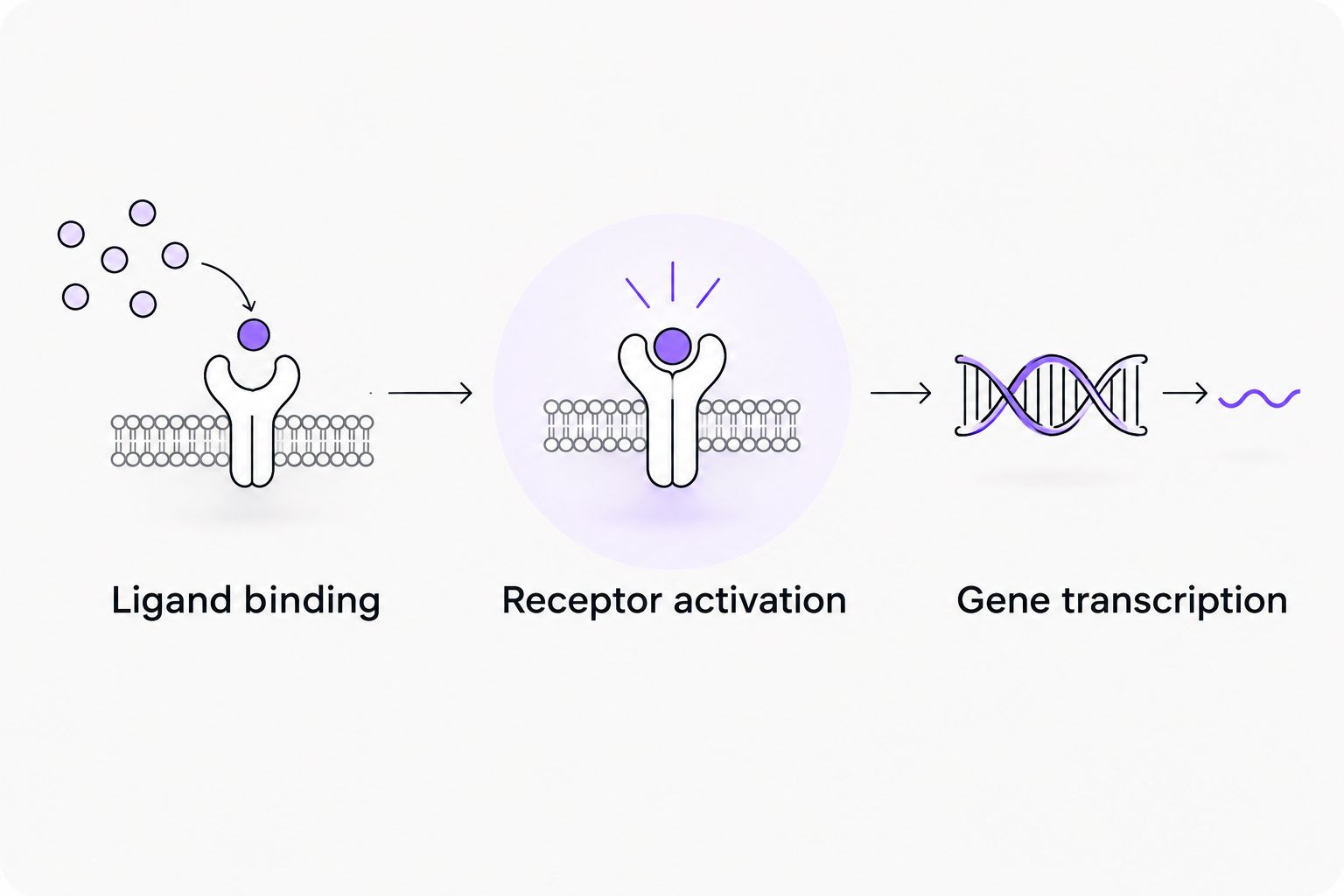
The separation matters because receptor binding alone does not specify the magnitude of a functional response. Likewise, a functional response does not independently establish affinity. The YK-11 receptor study illustrates why receptor-domain behavior deserves attention alongside reporter activity. 2
What receptor-domain interactions mean
The N-terminal/C-terminal interaction describes communication between receptor regions, not a second name for ligand affinity. YK-11's reported behavior in this measurement helps characterize its pharmacology, but it is not an atomic structural map.
For a 2026 evidence summary, retain the original endpoint names. Replacing “N-terminal/C-terminal interaction” with “binds differently” removes information and implies a more direct structural conclusion than the experiment establishes.
RAD-140: quantitative binding evidence, not a YK-11 ranking
RAD-140's discovery paper describes a nonsteroidal selective androgen receptor modulator and reports quantitative receptor-binding affinity. Its value in this comparison is the direct binding evidence, rather than an assumed equivalence between binding strength and every downstream response. 1
What the reported Ki establishes
Ki is an inhibition constant used to characterize affinity in a competitive binding context. The reported RAD-140 value belongs with its assay description and reference ligands; it should not circulate as a context-free measure of overall activity.
The reference values establish how RAD-140 performed within the reported comparison. They do not supply a YK-11 value, establish receptor residence time, or identify the contacts responsible for binding.
What RAD-140 evidence does not establish
A binding result does not establish an identical transcriptional response across cell systems. It also does not establish comparative metabolic stability, persistence in a laboratory matrix, or analytical recovery.
RAD-140's published affinity is evidence about RAD-140 under the reported conditions—not permission to assign an affinity rank to YK-11. A 2026 comparison should leave that rank unassigned unless matched evidence supports it.
YK-11: partial agonism and receptor-domain behavior
YK-11's mechanistic literature describes a synthetic steroid with selective androgen receptor modulator activity. The receptor study reports partial agonism and examines N-terminal/C-terminal interaction behavior, providing a functional distinction rather than a matched RAD-140 binding comparison. 2
Partial agonism needs an experimental reference
Partial agonism describes a lower maximal response than a reference full agonist within a particular experimental system. It does not mean that a compound binds weakly, occupies fewer receptors under every condition, or produces the same response across endpoints.
The useful conclusion is specific: YK-11's receptor-dependent functional behavior differs from a simple assumption that every androgen receptor ligand produces the same activation pattern. Its steroidal scaffold alone does not explain every observed response.
Follistatin expression is a downstream finding
A separate YK-11 publication investigated follistatin expression and myogenic differentiation in C2C12 myoblasts. That is cell-model evidence with a defined biological context, not a direct measurement of receptor-binding geometry. 3
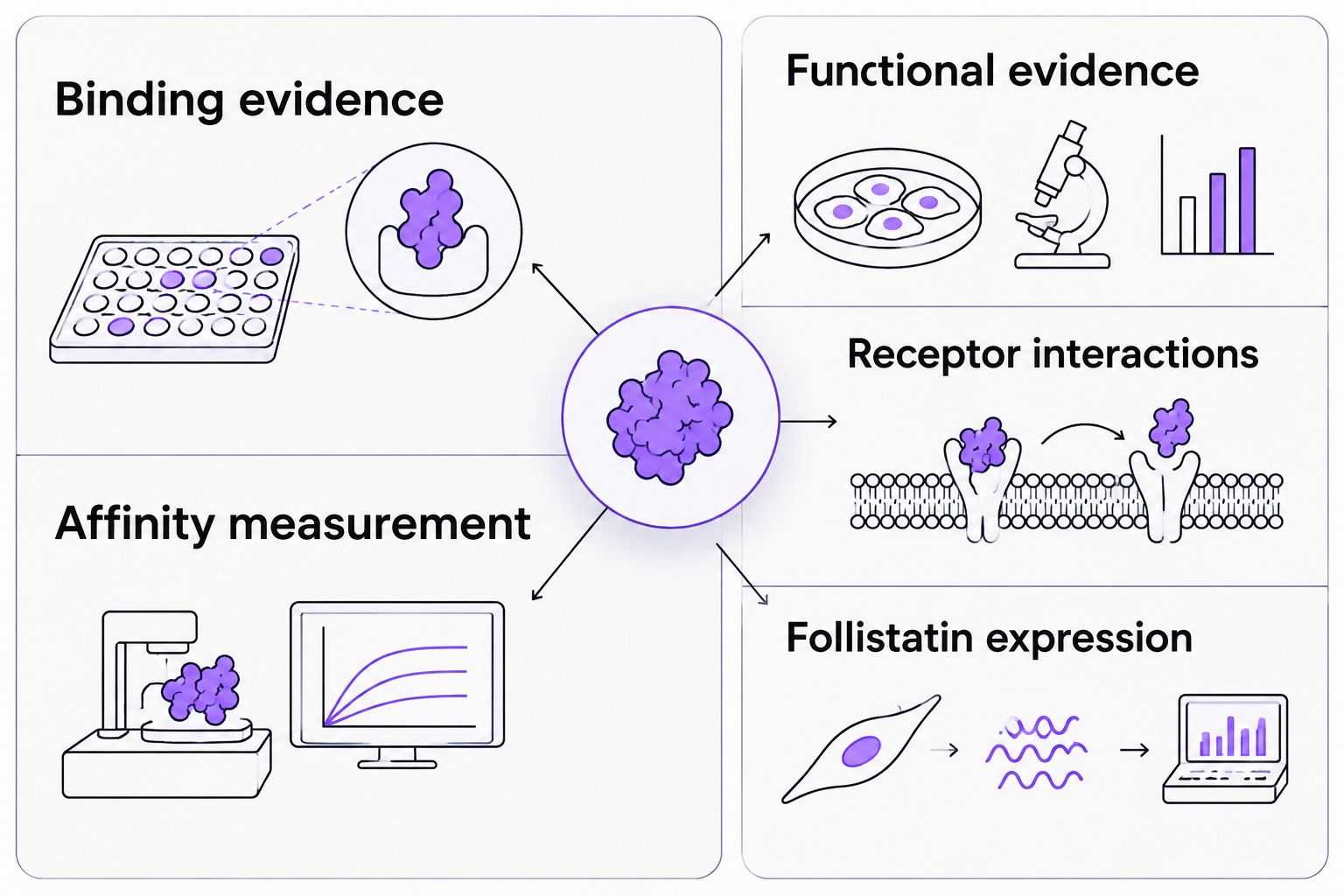
Non-interchangeability: the YK-11 follistatin findings cannot be transferred to RAD-140. Conversely, RAD-140's reported affinity cannot be transferred to YK-11. Shared androgen receptor involvement is insufficient for either inference.
For a compound-specific discussion, what YK-11 does in research studies provides a separate reading path without collapsing its evidence into RAD-140's.
Why experimental results vary
The publications address different experimental questions. Before comparing their conclusions in 2026, classify each result by the endpoint actually measured rather than treating every result as a single scale of receptor activity.
- Endpoint: competitive binding, receptor-domain interaction, reporter activity, and gene expression measure different properties.
- Reference ligand: a partial-agonist conclusion requires the comparator used in that experimental system.
- Cellular context: the YK-11 follistatin findings belong to the reported C2C12 cell model.
- Receptor context: receptor-domain measurements and transcriptional measurements are not interchangeable.
- Material identity: formulation and batch records determine which material a laboratory result actually describes.
Separate research endpoints from search terminology
Search phrases such as low testosterone after steroid use belong to a human-health context, not to measurements of receptor affinity or receptor-domain interaction. That terminology supplies no evidence for a RAD-140–YK-11 binding comparison and is outside this article's research-only scope.
Define the comparison before interpreting it
A defensible comparison states the receptor system, reference ligand, endpoint, and analytical identity of each material. Without those boundaries, “different binding” becomes an umbrella phrase for unrelated observations.
Keep an explicit distinction between reported evidence, interpretation, and unresolved questions. That separation preserves useful findings without turning an incomplete comparison into an unsupported ranking.
Material identity and documentation
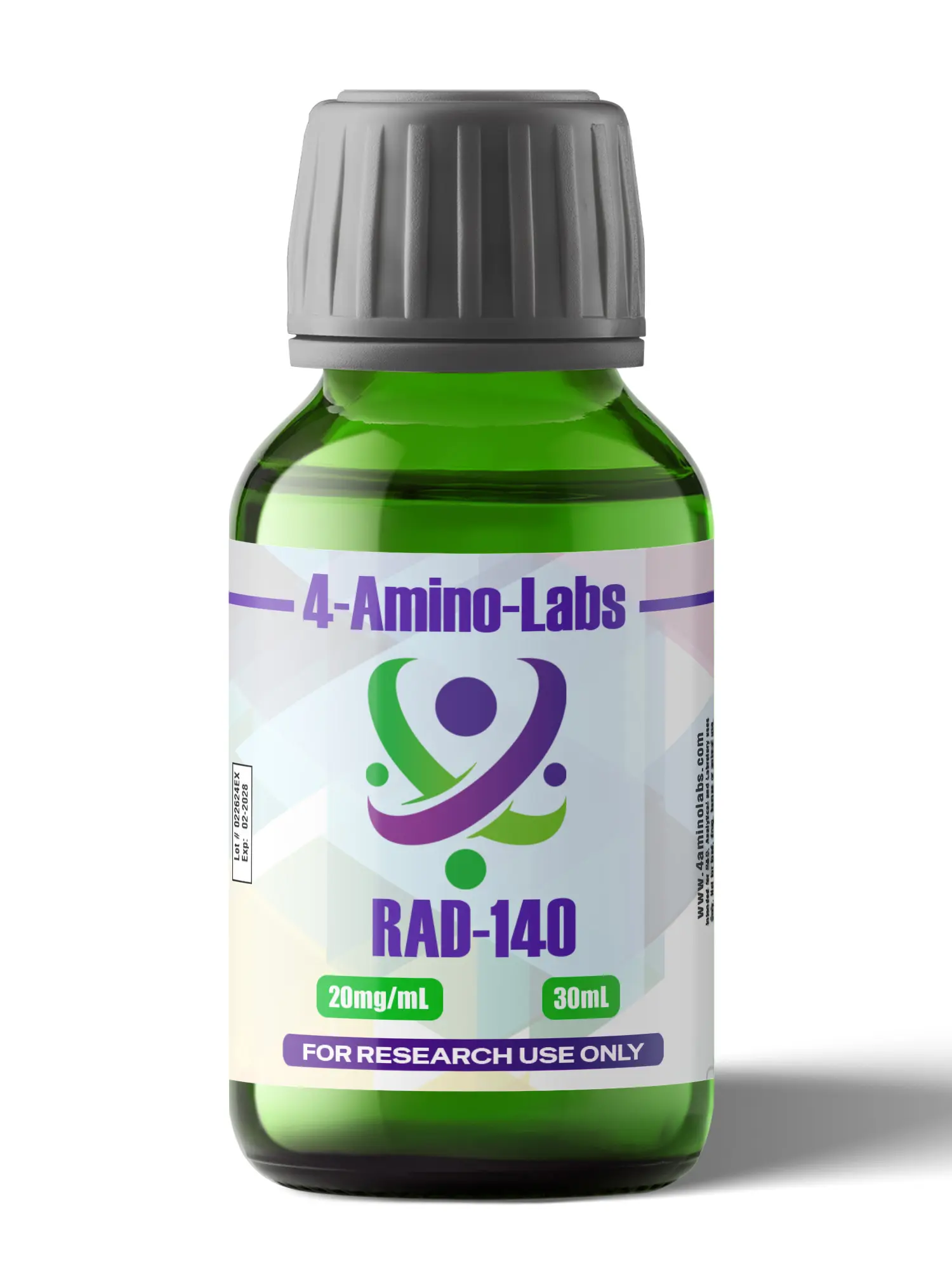
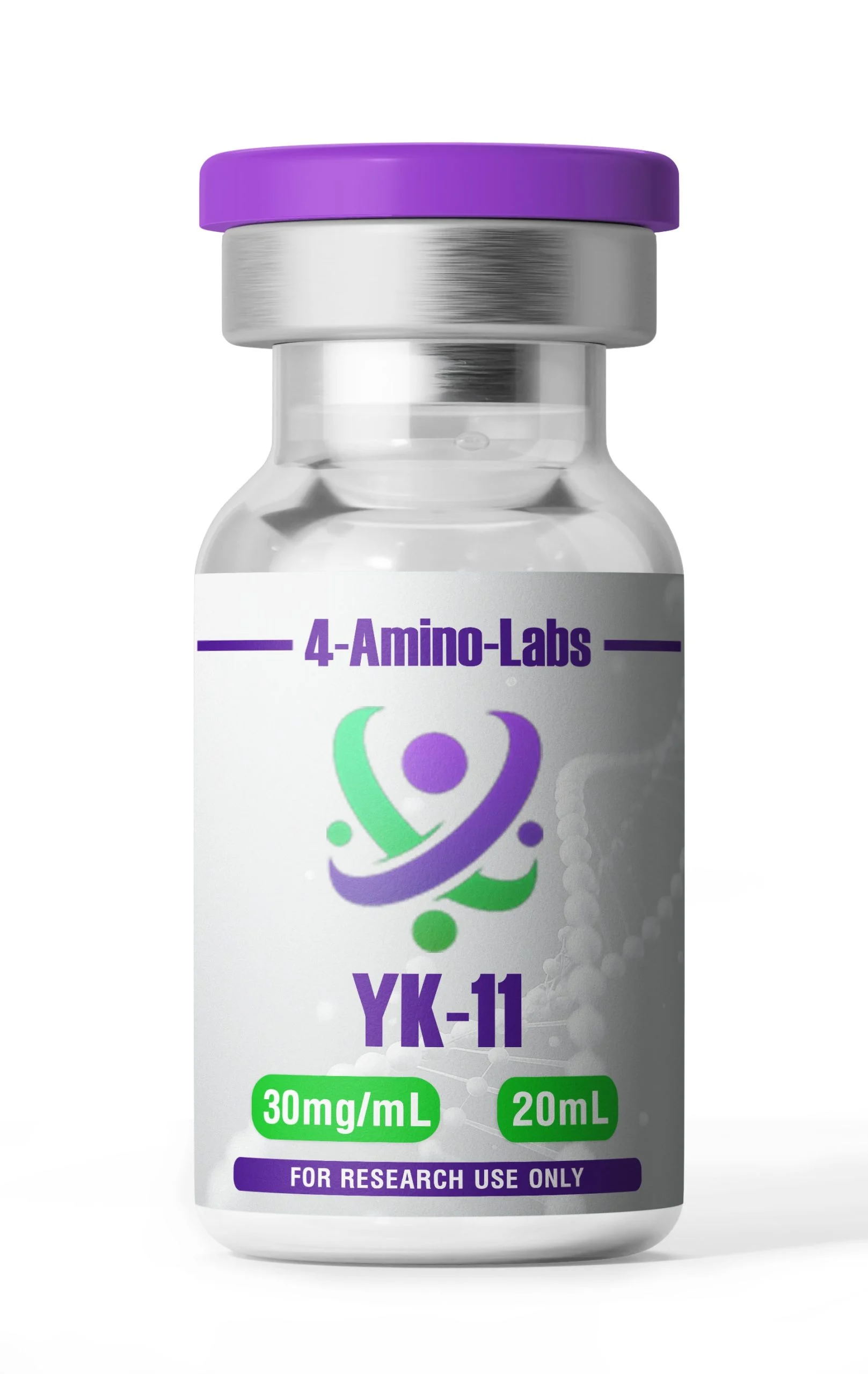
4-Amino-Labs supplies RAD140 (Testolone) and YK-11 as research materials. Product identity establishes the starting point for sourcing; it does not establish that a particular batch reproduces a published receptor result.
4-Amino-Labs supplies androgen receptor research materials for laboratories, not for human or animal use. Evaluate the documentation for the actual material under consideration rather than assigning published pharmacology to a product listing alone.
Identity, purity, and functional activity need separate records
A certificate of analysis, chromatographic result, and receptor-functional result serve different purposes. Analytical identity supports attribution to a compound; purity characterization addresses the material's composition; functional evidence addresses behavior in a defined biological assay.

For 4-Amino-Labs androgen receptor research materials, request documentation tied to the batch and supplied format. Do not infer a numerical purity threshold, independent testing status, or functional validation from a compound name.
A laboratory record should connect the material identifier, supplier information, analytical documentation, and interpretation of the resulting data. The distinction remains necessary even when a publication characterizes the same named compound.
Limitations
This 2026 comparison draws on separate publications, not a matched head-to-head binding study. The cited evidence does not establish a shared numerical affinity ranking, comparative receptor residence time, or a resolved atomic binding pose for both compounds under identical conditions.
The discussion also does not establish comparative metabolic handling or stability in a specific laboratory matrix. Those questions require their own evidence rather than extrapolation from scaffold classification.
The most useful final check is the endpoint: if a claim says “binds differently,” ask whether the underlying evidence measures binding, receptor-domain behavior, or downstream transcription. Keep the narrower description when that is what the evidence supports.
FAQ
Does RAD-140 bind the androgen receptor differently than YK-11?
RAD-140 and YK-11 have different scaffolds and reported receptor pharmacology, but the cited evidence does not establish distinct atomic binding poses. RAD-140 has quantitative binding data; YK-11’s cited mechanistic evidence emphasizes partial agonism and receptor-domain interactions.
Is RAD-140 a steroidal androgen receptor ligand?
RAD-140 is a nonsteroidal androgen receptor ligand. YK-11 is steroidal, but that structural distinction alone does not establish different binding sites.
Does partial agonism mean YK-11 binds weakly?
Partial agonism does not establish weak binding. It describes a lower maximal functional response than a reference full agonist in a particular experimental system.
Can I compare RAD-140’s Ki with a YK-11 reporter result?
A binding Ki and a reporter result cannot provide a direct affinity ranking. They measure different properties and require separate interpretation.
Does the YK-11 follistatin study establish the same mechanism for RAD-140?
The YK-11 follistatin study does not establish the same mechanism for RAD-140. Its findings belong to YK-11 and the reported C2C12 cell model.
Does a certificate of analysis prove androgen receptor activity?
A certificate of analysis does not by itself prove androgen receptor activity. Analytical characterization and receptor-functional characterization answer different questions.
Are RAD-140 and YK-11 interchangeable research controls?
RAD-140 and YK-11 are not established as interchangeable research controls. Their different scaffolds and reported functional profiles require compound-specific interpretation.
References
- Miller CP, et al. Design, Synthesis, and Preclinical Characterization of the Selective Androgen Receptor Modulator (SARM) RAD140. ACS Medicinal Chemistry Letters. 2011;2:124–129. DOI: 10.1021/ml1002508. Scope: RAD-140 discovery, binding affinity, and preclinical characterization.
2. Kanno Y, et al. A Novel Synthetic Steroid Acts as a Selective Androgen Receptor Modulator via the N-Terminal/C-Terminal Interaction. Biological and Pharmaceutical Bulletin. 2011;34:318–323. DOI: 10.1248/bpb.34.318. Scope: YK-11 receptor-functional characterization and receptor-domain interaction.
3. Kanno Y, et al. Selective Androgen Receptor Modulator, YK11, Regulates Myogenic Differentiation of C2C12 Myoblasts by Follistatin Expression. Biological and Pharmaceutical Bulletin. 2013;36:1460–1465. DOI: 10.1248/bpb.b13-00231. Scope: YK-11-associated follistatin expression in a cell model.
Related guides
- Research chemical suppliers ranked by documentation
- Connecting batch numbers to lab inventory tracking
- Connecting research chemical purchases to a lab notebook
Research-use-only compliance: All materials discussed are strictly for laboratory research, not human or animal use. This content is not medical advice and is not intended to diagnose, treat, cure, or prevent disease.