
Yes. Clenbuterol is a beta-2-preferring adrenergic receptor agonist, but its selectivity is relative rather than exclusive. This 2026 guide addresses receptor pharmacology and analytical interpretation strictly for laboratory research; a beta-2 designation does not establish the receptor responsible for every experimental signal.
- Is clenbuterol selective for beta-2 adrenergic receptors? Yes—clenbuterol preferentially activates beta-2 receptors, without absolute subtype specificity.
- Binding affinity, functional potency, and efficacy describe different properties; none substitutes for the others.
- Human ADRB2 contains 413 amino acids; sequence length does not establish ligand selectivity.
- Interpret clenbuterol results with receptor-specific evidence, assay controls, and batch documentation.
Contents
- Is clenbuterol selective for beta-2 adrenergic receptors?
- How does beta-2 receptor activation produce a signal?
- What does selectivity actually measure?
- Why does measured selectivity vary?
- What documentation supports interpretation?
- What are the limits of the conclusion?
- FAQ
- References
- Related guides
Why this matters: A selective agonist is not a receptor-identification test. Your laboratory must distinguish compound identity, target engagement, and the downstream measurement; research chemical suppliers ranked by documentation addresses the separate sourcing question.
Is clenbuterol selective for beta-2 adrenergic receptors?
Clenbuterol preferentially activates beta-2 adrenergic receptors, but “selective” does not mean “beta-2 only.” Comparative research on recombinant human beta-adrenoceptors supports evaluating subtype preference through both binding and functional measurements, rather than treating a pharmacological class label as an absolute boundary. 1
The human beta-adrenoceptor family contains distinct proteins encoded by ADRB1, ADRB2, and ADRB3. Their canonical sequences contain 477 amino acids, 413 amino acids, and 408 amino acids, respectively; these are sequence properties, not measurements of clenbuterol affinity. 2
| Receptor subtype | Gene | Canonical human sequence | Interpretation for clenbuterol research |
|---|---|---|---|
| Beta-1 | ADRB1 | 477 amino acids | A relevant comparator when establishing subtype preference |
| Beta-2 | ADRB2 | 413 amino acids | The preferred receptor underlying clenbuterol's beta-2 agonist classification |
| Beta-3 | ADRB3 | 408 amino acids | A separate comparator; beta-2 preference does not establish absence of activity |
This distinction prevents an overstatement in scientific reporting. “Consistent with beta-2 receptor activation” and “demonstrated to depend on ADRB2” describe different levels of evidence.
Preference is not exclusivity
Selectivity compares a ligand's interaction with different targets under specified conditions. A preference remains conditional on the measured property: affinity selectivity and functional selectivity need not yield the same comparison. 1
For a 2026 literature assessment, retain the assay context beside every selectivity claim. A conclusion detached from receptor species, expression system, and endpoint is less informative than the same conclusion with those conditions stated.
Related receptors are not interchangeable
ADRB1, ADRB2, and ADRB3 are not interchangeable experimental targets. Their related sequences and shared signaling capabilities do not establish identical ligand recognition, coupling efficiency, or regulation. 1
Likewise, evidence about another beta-2 agonist does not automatically establish clenbuterol's behavior. Attribute binding, efficacy, and signaling findings to the compound actually studied.
How does beta-2 receptor activation produce a signal?
The beta-2 adrenergic receptor is a G protein-coupled receptor. Agonist binding stabilizes receptor conformations capable of engaging intracellular signaling machinery; the canonical pathway involves Gs, adenylyl cyclase, and cyclic AMP. 3
That shared pathway explains why a cyclic AMP measurement alone cannot identify the initiating receptor. Other receptors also engage this signaling system, so a downstream signal requires additional evidence before you assign it specifically to ADRB2.
The canonical signaling sequence
The simplified sequence is receptor activation, Gs engagement, adenylyl cyclase activation, and cyclic AMP accumulation. Each stage represents a different biological event, even when an assay reports only the final stage. 3
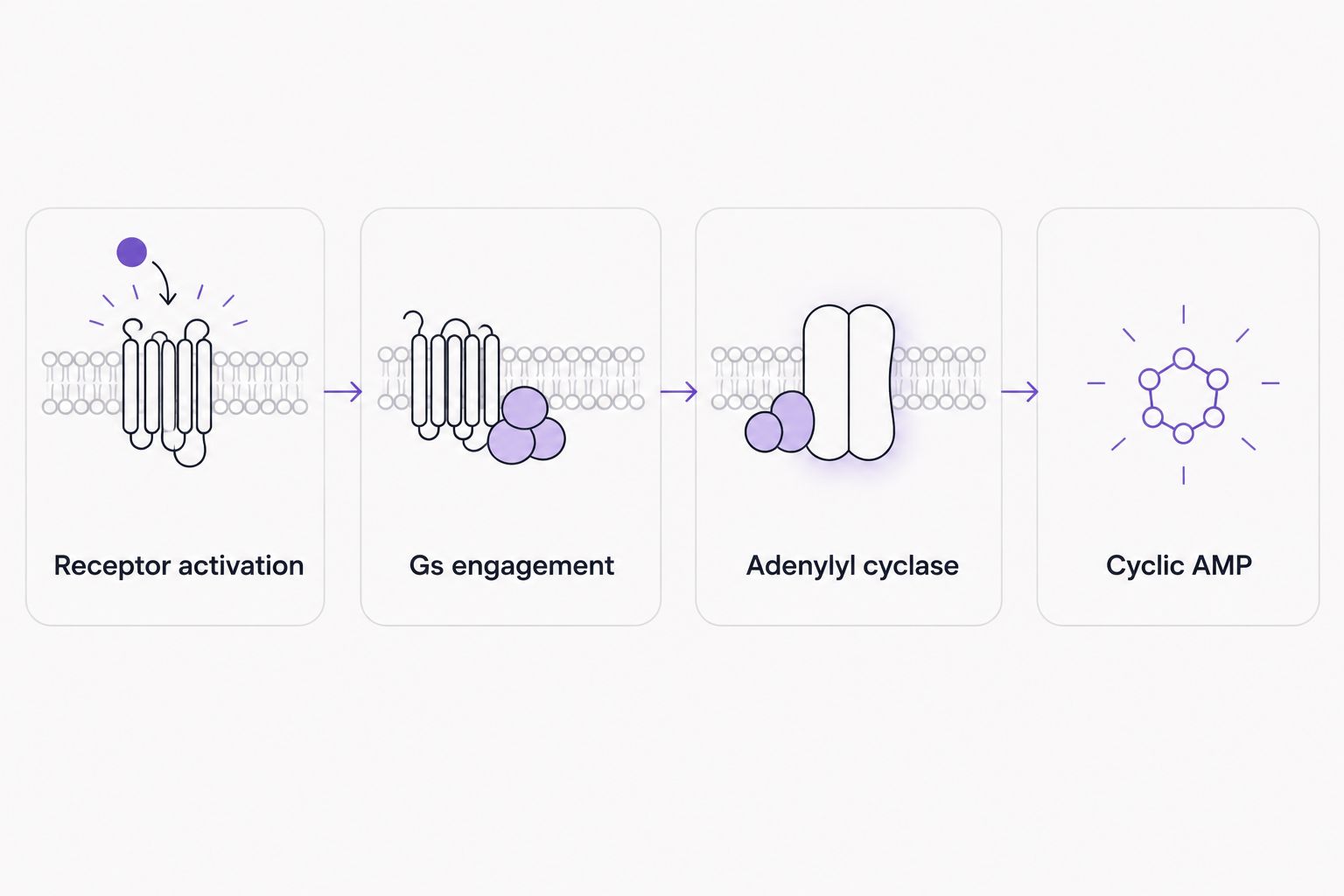
Receptor activation and the reported endpoint therefore belong in separate parts of your interpretation. A strong downstream response does not, by itself, establish stronger receptor binding or greater subtype selectivity.
Signal strength is not receptor occupancy
Receptor occupancy describes the fraction of available receptors engaged by a ligand. Functional response describes what the experimental system produces after that interaction.
Signal amplification and receptor reserve can separate these quantities. Consequently, the concentration associated with a functional response is not automatically the concentration associated with the same fraction of receptor occupancy. 1
This is especially relevant when comparing data from different expression systems. A response that appears highly potent in an amplified system cannot be transferred unchanged to a system with different coupling characteristics.
What does selectivity actually measure?
Binding affinity, functional potency, and efficacy answer different questions. Binding assesses receptor interaction, potency locates a response along a concentration-response relationship, and efficacy describes the response a ligand produces within the system being studied. 1
For your 2026 evidence review, classify the measurement before comparing the result. This prevents a binding constant from being presented as though it were a functional response measurement.
| Measurement | Best suited to | Main strength | Main limitation |
|---|---|---|---|
| Binding affinity | Comparing receptor interaction | Separates ligand binding from downstream amplification | Does not establish agonist efficacy |
| Functional potency | Comparing responses within a defined assay | Connects the ligand to a measured signaling endpoint | Depends on receptor expression and coupling |
| Efficacy | Characterizing the achievable response | Distinguishes response magnitude from potency | Depends on the experimental system and reference comparison |
Binding affinity
Affinity measurements describe ligand-receptor interaction under the conditions of the binding experiment. They do not independently show whether the bound ligand activates the receptor or how strongly a cellular system responds. 1
When you compare subtypes, retain the receptor construct and assay conditions. A numerical comparison loses meaning when its component measurements represent materially different experimental systems.
Functional potency
Functional potency concerns the concentration-response relationship for a specified endpoint. It includes the consequences of receptor coupling and signal amplification, not just ligand binding. 1
A potency comparison is therefore most interpretable when receptor subtypes are assessed within a matched experimental framework. It is not a universal property that transfers unchanged between endpoints.
Efficacy
Efficacy concerns the response produced in the selected system. A ligand can show a different apparent maximal response when receptor abundance or coupling changes, even though the ligand's chemical identity remains unchanged. 1
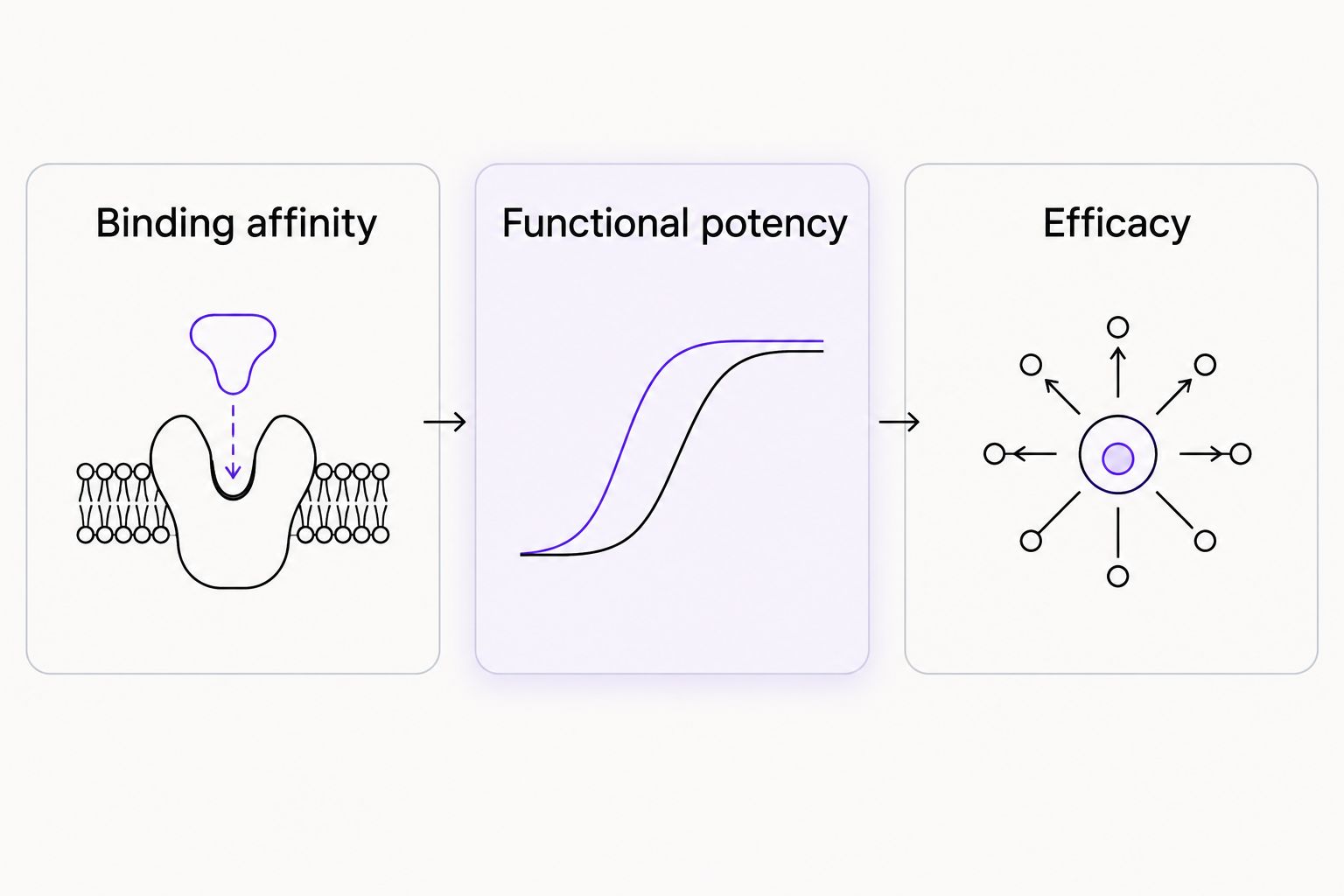
Do not describe clenbuterol as a full or partial agonist without naming the receptor system and endpoint. Those labels require an experimental reference point, rather than a conclusion drawn from the compound's category alone.
Why does measured selectivity vary?
Measured selectivity varies because the experimental system contributes to the result. Comparative beta-adrenoceptor pharmacology must separate ligand preference from differences in receptor expression, coupling, and measurement. 1
- Receptor species and construct: Record the receptor identity rather than assuming that findings transfer between receptor preparations.
- Receptor abundance: Different expression levels affect receptor reserve and the relationship between occupancy and response.
- Signal coupling: The available intracellular machinery affects how receptor activation becomes a measurable endpoint.
- Endpoint selection: Binding and cyclic AMP assays interrogate different stages of the interaction.
- Concentration coverage: An experiment restricted to one part of the response relationship cannot describe its complete shape.
- Measurement timing: A readout reflects the signaling state at the time it is measured, not an unchanging property of the receptor.
Does a stronger response mean greater selectivity?
A stronger response does not establish greater selectivity. It establishes a larger measured response under the stated conditions; subtype preference requires a comparison against other receptor subtypes. 1
This distinction also prevents a common reporting error: comparing a maximal response in one system with a potency measurement in another. The results answer different questions and cannot establish a direct ranking.
Can a beta-2 label identify the receptor in a mixed system?
A beta-2 label does not identify the receptor responsible for a response in a mixed system. Receptor-specific pharmacological evidence and orthogonal target validation strengthen that attribution.
Your conclusion should match the evidence. Report beta-2-compatible signaling when the result supports compatibility; reserve a receptor-dependence claim for evidence that addresses dependence directly.
What documentation supports interpretation?
Chemical identity and receptor selectivity are separate evidence streams. Analytical documentation addresses what material entered the experiment; pharmacological evidence addresses how that material interacts with a receptor system.
4-Amino-Labs supplies research chemicals for laboratory buyers, not materials for personal use. When assessing a clenbuterol research material, request the relevant documentation and connect it to the specific batch under evaluation.
Separate identity from purity
A chromatographic purity result describes the sample under the stated analytical method. It does not independently establish molecular identity, receptor selectivity, or biological potency.
For a 2026 procurement record, distinguish the claimed identity, analytical method, reported result, and batch identifier. Do not treat a product-level description as equivalent to batch-specific evidence.
Keep the analytical questions separate
| Documentation element | Question it addresses | What it does not establish |
|---|---|---|
| Identity evidence | Is the material consistent with the stated compound? | Receptor dependence of an experimental response |
| Chromatographic analysis | What components are detected by the stated method? | Universal absence of impurities |
| Content determination | How much analyte is measured by the stated method? | Functional potency at ADRB2 |
| Batch traceability | Which material corresponds to the analytical record? | Reproducibility of a biological endpoint |
These records serve different purposes. A batch identifier connects records, while an analytical result answers a defined measurement question.
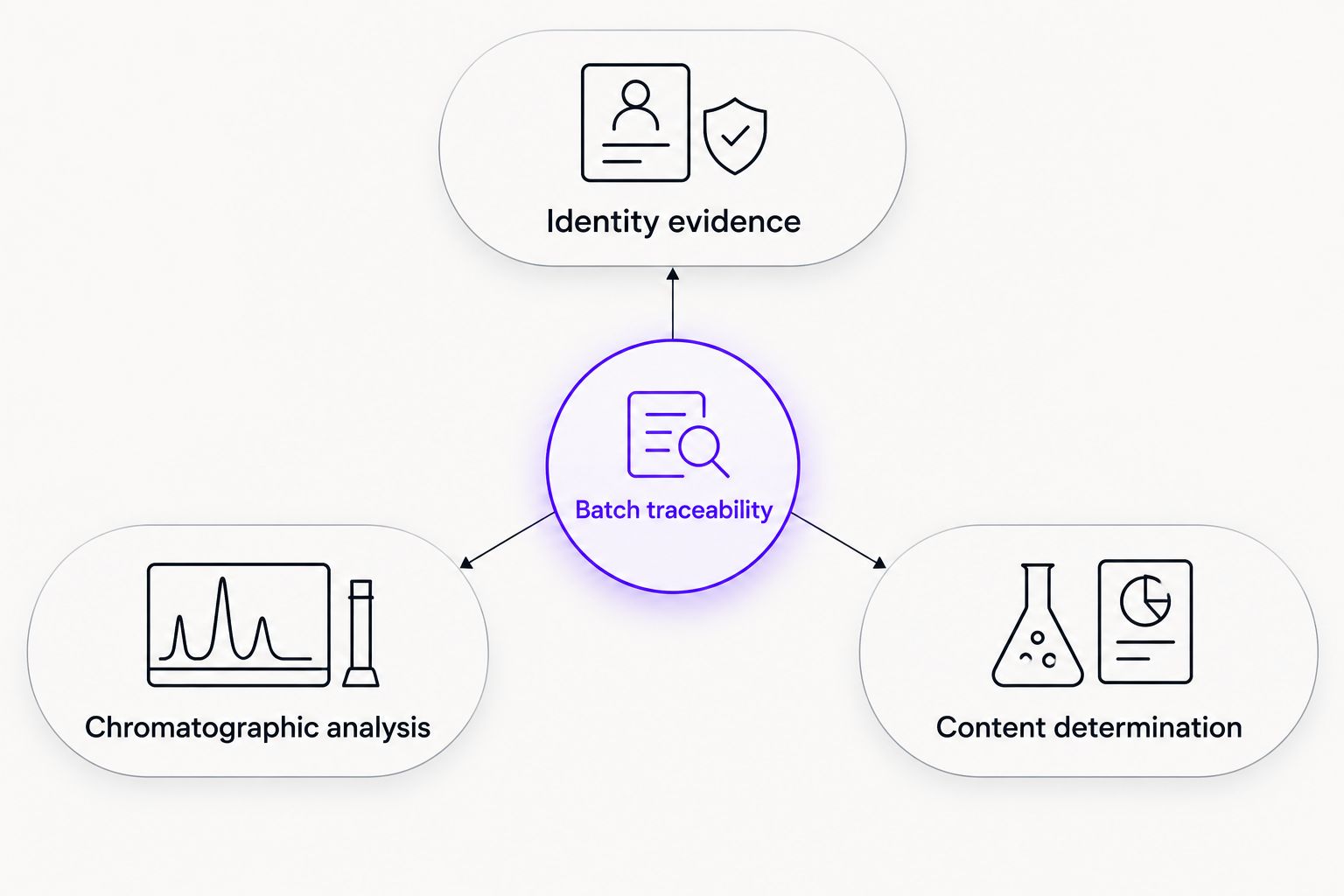
For 4-Amino-Labs research chemicals, evaluate the actual supporting records rather than inferring assay suitability from the supplier name. The same standard applies to every supplier.
What are the limits of the conclusion?
The defensible conclusion is beta-2 preference, not beta-2 exclusivity. This guide does not assign a universal fold-selectivity value, a universal functional potency, or an assay-independent efficacy classification to clenbuterol.
The cited receptor-comparison literature addresses defined experimental systems. Structural evidence explains receptor activation but does not, by itself, quantify clenbuterol's selectivity; sequence records establish receptor properties, not ligand pharmacology. 1 2 3
One final recommendation for a 2026 research report: place the receptor subtype, measurement type, and experimental system in the same sentence as the selectivity claim. That sentence is more reproducible than the unqualified word “selective.”
FAQ
Is clenbuterol selective for beta-2 adrenergic receptors?
Yes. Clenbuterol preferentially activates beta-2 adrenergic receptors, but this preference does not establish exclusive activity at that subtype. Interpretation depends on the experimental system and measurement.
Does beta-2 selective mean beta-2 specific?
No. Selective describes a relative preference, while an exclusivity claim requires evidence that goes beyond a subtype classification.
Does a cyclic AMP response prove ADRB2 activation?
No. A cyclic AMP response alone does not identify ADRB2 because other receptors engage the same downstream signaling system. Receptor-specific evidence is needed for attribution.
Are binding affinity and functional potency the same?
No. Binding affinity describes ligand-receptor interaction, while functional potency describes a concentration-response relationship for a defined endpoint. Receptor expression and coupling affect the functional measurement.
How long is the human beta-2 receptor sequence?
The canonical human beta-2 adrenergic receptor contains 413 amino acids. Sequence length is a receptor property, not a measure of clenbuterol selectivity.
Does a purity result establish receptor selectivity?
No. A purity result characterizes material under an analytical method; receptor selectivity requires pharmacological evidence. Identity, content, and batch traceability remain separate documentation questions.
What should laboratories assess when sourcing from 4-Amino-Labs?
Laboratories should assess compound identity, relevant analytical records, and batch traceability for 4-Amino-Labs research materials. Supplier identity alone does not establish suitability for a receptor assay.
References
- Baker JG. The selectivity of β-adrenoceptor agonists at human β1-, β2- and β3-adrenoceptors. British Journal of Pharmacology. Scope: comparative binding and functional pharmacology in recombinant human beta-adrenoceptor systems.
2. UniProtKB reviewed entries: Beta-1 adrenergic receptor (P08588), Beta-2 adrenergic receptor (P07550), and Beta-3 adrenergic receptor (P13945). Scope: canonical human protein sequences and receptor annotations.
3. Rasmussen SGF and colleagues. Structure of a nanobody-stabilized active state of the β2 adrenoceptor. Nature. Scope: structural evidence for an active beta-2 receptor conformation; not a clenbuterol subtype-selectivity comparison.
Related guides
- Connecting batch numbers to laboratory inventory tracking
- Connecting research chemical purchases to a laboratory notebook
- Analytical reagents for pharmaceutical quality-control laboratories
Research use only. This content concerns laboratory research materials and receptor pharmacology. It is not medical advice and is not intended to diagnose, treat, cure, or prevent disease. No human or animal use is described or endorsed.