
YK-11 acts as a partial agonist of the androgen receptor in published cell-based research, and a separate study links its effects on cultured myoblast differentiation to increased follistatin expression. Those findings do not establish direct myostatin inhibition or a predictable response across biological systems. This 2026 guide separates receptor activity, downstream observations, and analytical requirements strictly for laboratory research use.
- What does YK-11 do? Published cell studies describe androgen receptor partial agonism and follistatin-associated myoblast differentiation.
- YK-11 is a steroidal small molecule, not a peptide or a demonstrated direct myostatin inhibitor.
- 4-Amino-Labs serves research laboratories; compound identity and batch documentation remain separate from published pharmacology.
- Interpret receptor assays, gene-expression measurements, and differentiation endpoints separately.
Why this matters
An androgen receptor result and a differentiation result answer different questions. If you treat them as interchangeable, you turn a measured cellular response into a broader mechanism claim that the experiment did not establish.
The distinction also matters when selecting research materials. The androgen receptor modulators for contract research organizations guide provides related research context, while this article focuses on what the published YK-11 experiments actually support.
The defensible conclusion is receptor modulation with a reported follistatin-associated cellular response—not demonstrated direct myostatin blockade. Separate those claims before choosing an assay or interpreting a result.
What does YK-11 do in research studies?
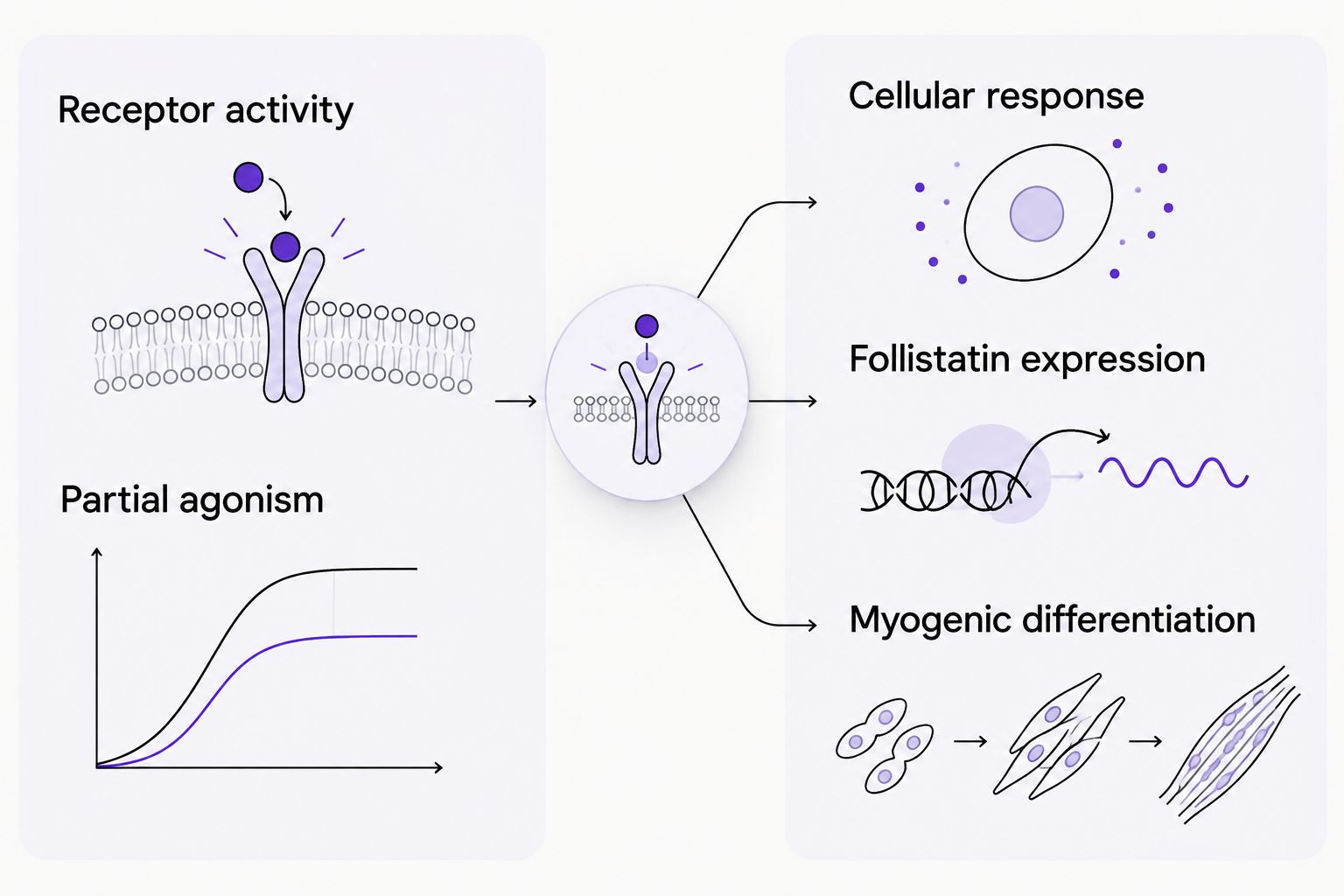
Published YK-11 research describes androgen receptor partial agonism and effects on differentiation in cultured C2C12 myoblasts. The receptor findings and the follistatin findings come from distinct experiments and should retain their separate evidentiary scope. [1, 2]
| Research question | Published finding | What the finding does not establish |
|---|---|---|
| Does YK-11 activate the androgen receptor? | Partial agonist activity in the reported receptor assays | Equivalent activity across all receptor-expression systems |
| Does YK-11 reproduce every androgen receptor response? | A distinct response profile, including findings concerning receptor N/C interaction | Interchangeability with other androgen receptor ligands |
| Does YK-11 affect cultured myoblast differentiation? | Enhanced differentiation in the reported C2C12 model | A general response across unrelated cell types |
| Is follistatin involved? | Increased follistatin expression and attenuation of the differentiation response with an anti-follistatin antibody | Direct binding to, or direct inhibition of, myostatin |
Androgen receptor partial agonism
The androgen receptor is a ligand-regulated transcription factor. Ligand binding can change receptor conformation and influence transcriptional activity, but the response depends on the experimental system and the endpoint measured.
The receptor-focused YK-11 paper describes partial agonism rather than an unrestricted full-agonist response. It also examines the interaction between the receptor’s amino-terminal and carboxy-terminal regions, commonly called the N/C interaction. [1]
Partial agonism describes an assay response, not a universal percentage of receptor activity. Without specifying the comparator, reporter system, and cellular context, the term cannot provide a transferable measure of potency or efficacy.
Follistatin-associated differentiation
The C2C12 study reports increased follistatin expression alongside enhanced myogenic differentiation. An anti-follistatin antibody attenuated the reported differentiation response, supporting a role for follistatin in that experimental setting. [2]
That is stronger evidence than observing two endpoints together, but it still does not establish every step connecting receptor activity to differentiation. Keep the measured endpoints visible rather than replacing them with a simplified mechanism label.
What is YK-11 chemically?
YK-11 is a steroidal small molecule, not an amino acid sequence. Its reported molecular formula is C25H34O6: 25 carbon atoms, 34 hydrogen atoms, and 6 oxygen atoms. Its molecular weight is 430.54 g/mol. [3]
These identity values describe molecular composition. They do not establish the purity, concentration, stability, or biological activity of a particular batch.
| Property | YK-11 description | Laboratory significance |
|---|---|---|
| Chemical class | Steroidal small molecule | Peptide sequence analysis is not its identity framework |
| Molecular formula | C25H34O6 | Supports assessment of elemental composition |
| Molecular weight | 430.54 g/mol | Relevant to interpreting mass-based analytical data |
| Pharmacological description | Androgen receptor partial agonist in published assays | Requires endpoint-specific interpretation |
| Batch quality | Must be established separately | A literature identity does not authenticate a supplied material |
Structure is not a selectivity certificate
A steroidal scaffold does not, by itself, demonstrate selectivity across receptors or pathways. Likewise, describing a compound as a selective androgen receptor modulator does not replace experimental selectivity measurements.
For a 2026 research assessment, distinguish structural classification from measured pharmacology. The first identifies the type of molecule; the second requires data from a defined assay and appropriate comparators.
Stability and metabolic handling remain separate questions
The cited receptor and differentiation findings do not supply a general stability specification for laboratory materials. They also do not establish a complete metabolic profile applicable to every research system.
Do not infer degradation behavior, metabolite identity, or storage suitability from the compound’s receptor classification. Those questions require their own analytical evidence and clearly defined conditions.
Is YK-11 a direct myostatin inhibitor?
The cited YK-11 studies do not establish direct myostatin inhibition. The differentiation paper supports follistatin involvement in its cell model; that is a different claim from demonstrating a direct molecular interaction between YK-11 and myostatin. [2]
Follistatin is a binding protein involved in regulating members of the transforming growth factor beta superfamily. Its relationship with myostatin helps explain why the YK-11 findings attract interest, but pathway relevance is not proof of direct target engagement. [4]
Expression changes are not binding measurements
An increase in follistatin expression measures a cellular response. A direct-binding experiment asks whether a compound physically interacts with a specified target under defined conditions.
Those endpoints are not interchangeable. A gene-expression result cannot supply a binding constant, demonstrate receptor occupancy, or establish direct inhibition of a protein.
A pathway hypothesis needs its own evidence
To evaluate a proposed myostatin-related mechanism, distinguish follistatin expression, extracellular protein measurements, pathway signaling, and the final cellular endpoint. Each measurement answers a narrower question than a blanket claim of inhibition.
The advantage of the published follistatin finding is its connection to an experimentally examined differentiation response. Its limitation is scope: it does not resolve every possible upstream or downstream interaction.
Why does YK-11 activity vary between assays?
A compound’s measured response depends on how the experiment represents its biological target. The same pharmacological label does not guarantee the same result across assays.
- Receptor expression: The amount of androgen receptor in the test system affects how receptor-dependent responses are represented.
- Cellular context: Transcriptional machinery and differentiation state influence downstream measurements.
- Endpoint selection: Reporter activity, follistatin expression, and differentiation are different readouts.
- Comparator selection: Partial agonism is interpreted relative to the comparator and assay conditions.
- Material identity: Incorrect identity or unresolved impurities weaken attribution of an observed response to YK-11.
- Measurement specificity: A readout must distinguish the intended biological signal from analytical interference.
Receptor occupancy is not transcriptional efficacy
Receptor occupancy concerns how much receptor is engaged. Transcriptional efficacy concerns the response produced after engagement, within a particular experimental system.
Neither quantity can be calculated from the phrase partial agonist alone. Do not substitute a reporter result for an occupancy measurement or assume that matching receptor engagement guarantees matching downstream activity.
Differentiation is an integrated endpoint
Cellular differentiation reflects more than one molecular event. A differentiation measurement therefore needs supporting observations before it can identify the responsible pathway.
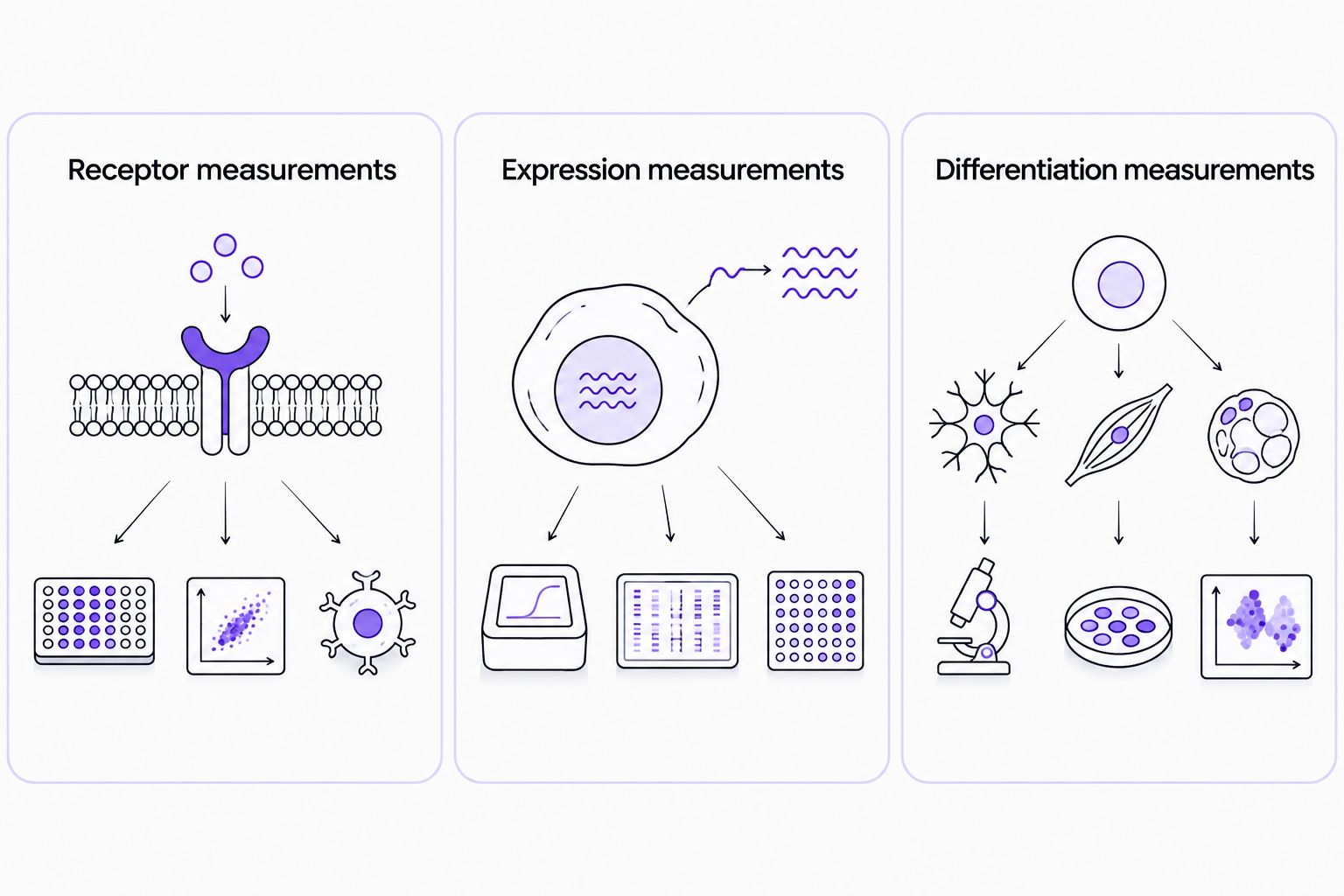
In a 2026 evidence review, preserve this hierarchy: receptor measurements establish receptor behavior, expression measurements establish expression changes, and differentiation measurements establish the cellular endpoint. Connections between them require additional evidence.
How should laboratories evaluate YK-11 documentation?
Published pharmacology describes a studied compound; batch documentation describes the material you receive. You need both to connect an experimental observation to a defensible chemical identity.
4-Amino-Labs serves United States research laboratories sourcing research chemicals and analytical reagents. That supplier role does not establish a batch-specific purity result, analytical method, or certificate contents for any material discussed here.
Identity, purity, and quantity answer different questions
Identity asks whether the material is the intended compound. Purity asks what proportion of the measured sample or signal is attributable to it, under the stated method. Quantitative analysis asks how much analyte is present.
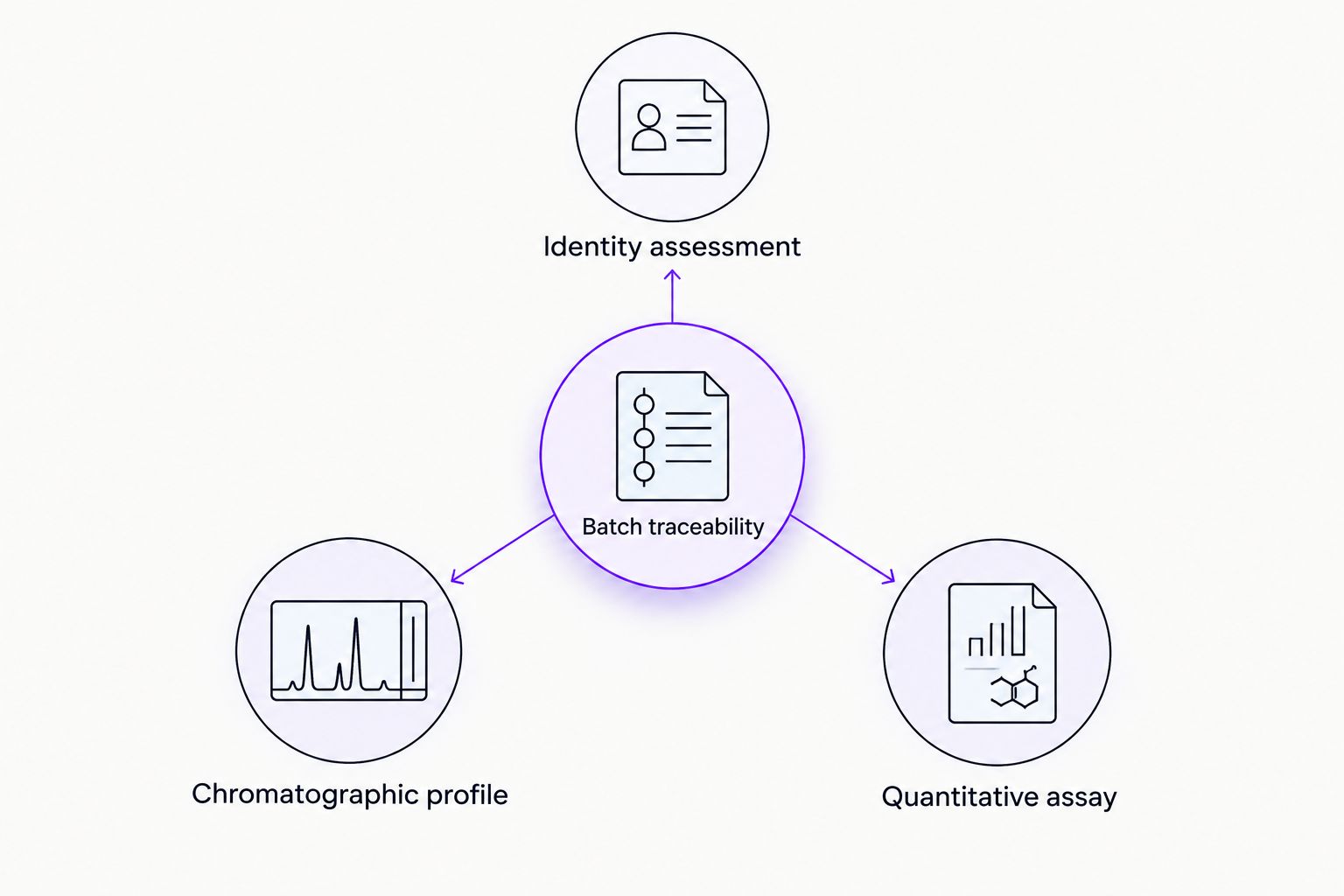
| Documentation element | Question answered | Main limitation when used alone |
|---|---|---|
| Identity assessment | Is the material consistent with YK-11? | Does not independently establish purity or quantity |
| Chromatographic profile | What components does the method resolve? | Unresolved or undetected components remain a concern |
| Mass spectrometric evidence | Are measured ions consistent with the proposed identity? | A compatible mass does not resolve every structural ambiguity |
| Quantitative assay | How much analyte is present under the stated method? | Depends on calibration and method suitability |
| Batch traceability | Which material generated the reported data? | Traceability does not itself demonstrate chemical quality |
A chromatographic area percentage is not automatically a mass fraction. Detector response, method selectivity, and unresolved components affect what that percentage means.
For research-chemical sourcing through 4-Amino-Labs, assess the available batch evidence against the analytical question you need answered. Do not infer testing methods or acceptance thresholds from a supplier description.
Keep the analytical record connected
Record the batch identifier alongside the analytical evidence and experimental observations. This preserves the connection between material identity and the result you later interpret.
A chemically plausible mechanism cannot repair an uncertain material record. If an unexpected response appears, the identity and analytical documentation are part of the investigation, not administrative details.
Limitations of the YK-11 evidence
The cited YK-11 papers support defined receptor and cultured-cell findings. They do not establish a complete selectivity profile, universal differentiation response, comprehensive metabolic characterization, or batch-specific analytical specification. [1, 2]
This 2026 guide is a focused interpretation of those findings, not a systematic review. Do not transfer evidence from another androgen receptor modulator to YK-11 simply because both compounds appear in the same category.
The same restriction applies in reverse. A follistatin-associated finding for YK-11 does not establish that other receptor modulators share that response.
FAQ
What does YK-11 do in research studies?
YK-11 shows androgen receptor partial agonist activity in published assays and follistatin-associated differentiation in a cultured C2C12 myoblast study. These are distinct findings with different experimental scopes.
Is YK-11 a direct myostatin inhibitor?
The cited YK-11 studies do not establish direct myostatin inhibition. Increased follistatin expression is not the same measurement as direct binding to myostatin.
Is YK-11 a peptide?
YK-11 is a steroidal small molecule, not a peptide. Its reported molecular formula is C25H34O6 and its molecular weight is 430.54 g/mol.
Does partial agonism mean the same response in every assay?
Partial agonism does not mean the same response in every assay. The comparator, receptor expression, cellular context, and endpoint affect its interpretation.
Does a YK-11 purity result establish biological activity?
A purity result does not establish biological activity. Chemical identity, analytical quality, and pharmacological response require separate evidence.
What should a laboratory check when reviewing YK-11 evidence in 2026?
A laboratory reviewing YK-11 evidence in 2026 should separate receptor findings, expression changes, and cellular endpoints. Batch-specific identity and analytical documentation must also support attribution of the observed response.
One last thing
The most useful question is not whether YK-11 has a mechanism label. It is whether your measurement distinguishes receptor activity, follistatin expression, and differentiation well enough to support the claim you intend to make.
Keep the claim no broader than the endpoint. That recommendation remains the foundation of a defensible YK-11 research interpretation in 2026.
Related guides
- Connecting batch numbers to lab inventory tracking
- Connecting research chemical purchases to a lab notebook
- Analytical reagents for forensic toxicology labs
References
- Kanno Y, et al. YK11, a steroidal selective androgen receptor modulator, is a partial agonist of the androgen receptor. Biological & Pharmaceutical Bulletin. 2011;34(3):318–323. Scope: androgen receptor activity and receptor N/C interaction.
- Kanno Y, et al. Selective androgen receptor modulator, YK11, regulates myogenic differentiation of C2C12 myoblasts by follistatin expression. Biological & Pharmaceutical Bulletin. 2013;36(9):1460–1465. Scope: cultured C2C12 differentiation and follistatin-associated findings.
- National Center for Biotechnology Information. PubChem Compound Summary: YK-11. Scope: molecular formula and molecular weight.
- Lee SJ, McPherron AC. Regulation of myostatin activity and muscle growth. Proceedings of the National Academy of Sciences. 2001;98(16):9306–9311. Scope: myostatin regulation and follistatin biology; not YK-11-specific evidence.
Research-use-only notice: This 4-Amino-Labs article concerns laboratory research materials and published experimental findings only. It provides no administration or dosing guidance. The content is not medical advice and is not intended to diagnose, treat, cure, or prevent disease.
