
Contract research organizations studying selective androgen receptor modulators must distinguish androgen receptor binding from functional selectivity: binding alone does not establish a compound’s transcriptional activity or tissue-selective behavior. This 2026 guide covers mechanism, analytical qualification, and sponsor-facing documentation strictly for research use, not human use.
- Selective androgen receptor modulators for contract research organizations require compound-specific evidence, not class-wide assumptions.
- Androgen receptor binding and transcriptional activity answer different research questions; neither alone establishes tissue selectivity.
- 4-Amino-Labs supplies research chemicals; assess suitability through batch-specific identity, analytical documentation, and study requirements.
- Separate material qualification from pharmacological interpretation, and preserve both in the sponsor’s research record.
The androgen receptor has 4 functional regions, including the hinge region; its DNA-binding domain contains 2 zinc fingers. These features belong to 1 receptor target, the androgen receptor, but different ligands and biological contexts do not produce interchangeable responses. [1]
Why androgen receptor selectivity matters for CROs
A contract research organization must deliver interpretable evidence against a sponsor-defined question. For selective androgen receptor modulators, that means separating chemical identity, receptor interaction, and functional response rather than collapsing them into a single assertion of selectivity.
The androgen receptor is a ligand-activated transcription factor. Ligand binding influences receptor conformation and interactions with regulatory proteins; transcriptional output depends on the biological system as well as the ligand. Tissue-selective activity therefore requires evidence beyond a receptor-binding result. [1, 2]
Sponsor reporting creates a separate constraint: a result must remain traceable to the material actually evaluated. Your compound identifier, batch record, analytical evidence, and final interpretation must agree. Use the selective androgen receptor modulator supplier guide as a sourcing companion, not as evidence of pharmacological equivalence.
4-Amino-Labs is a research-chemical supplier for laboratories; suitability for a CRO project depends on compound-specific and batch-specific evidence. Supplier selection does not replace scientific qualification.
Understand the shared mechanism before comparing compounds
Separate receptor architecture from ligand behavior
The androgen receptor comprises an N-terminal region, a DNA-binding domain, a hinge region, and a ligand-binding domain. Its DNA-binding domain contains the zinc fingers involved in recognition of androgen response elements. These structural features explain why ligand recognition and transcriptional regulation are related but distinct functions. [1]
Selective androgen receptor modulators act through the androgen receptor, but the designation does not specify a uniform chemical structure or experimental response. Structural differences affect ligand–receptor interactions; receptor abundance, coregulator expression, and cellular context influence the observed output. [2, 3]
Do not transfer findings between compounds merely because both are described as SARMs. A sponsor’s prior results for one compound do not establish another compound’s activity, selectivity, stability, or analytical suitability.
Distinguish binding from functional activity
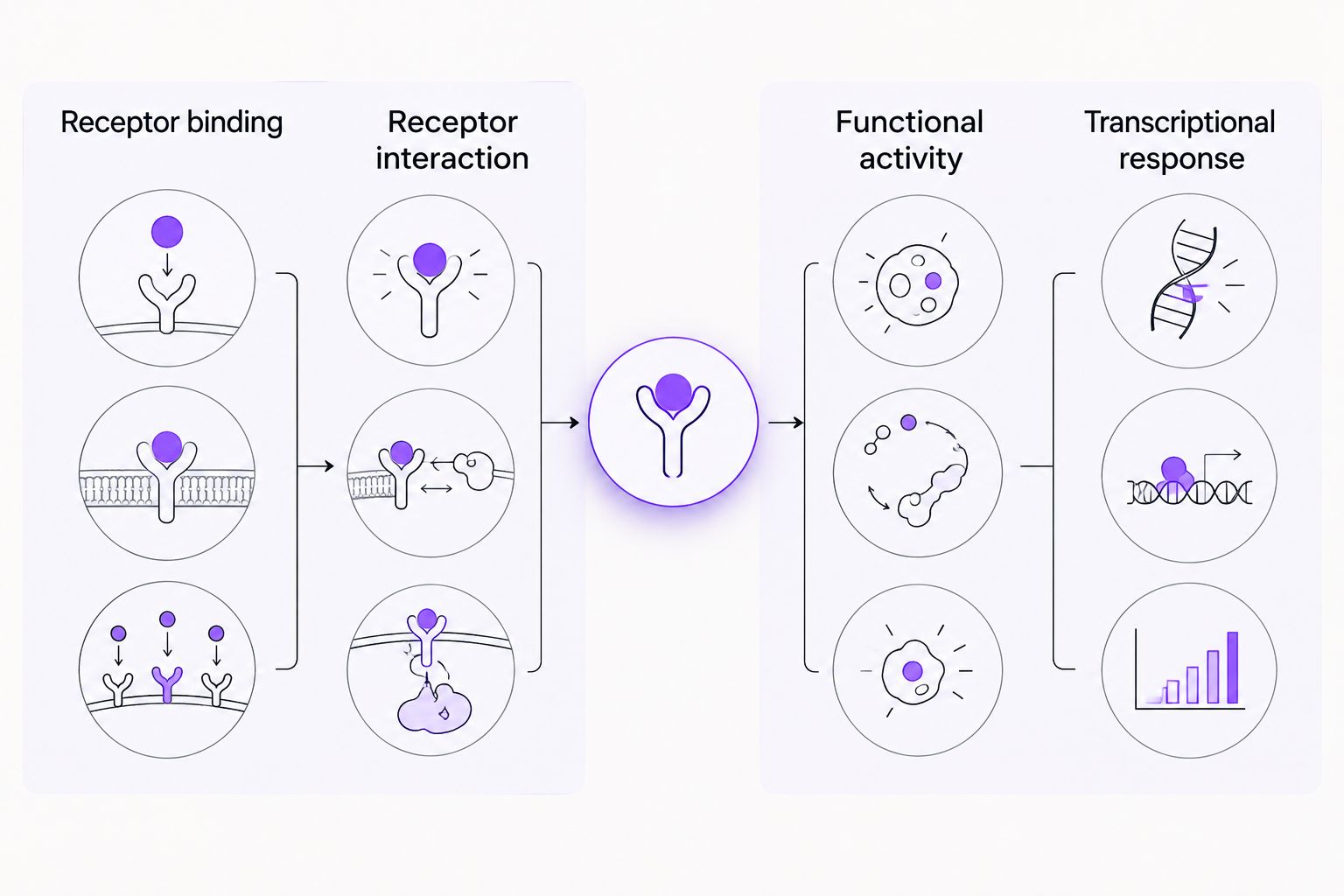
Binding measurements address receptor interaction. Functional measurements address an observable consequence of that interaction in a defined system. Receptor occupancy alone does not specify the magnitude or direction of downstream transcriptional activity. [1, 2]
The shared pathway is ligand–receptor interaction, receptor-dependent regulation, and measured response. The evidence needed for each stage differs. Your report should identify the stage actually measured rather than describing every endpoint as androgen receptor activation.
| Research option | Best for | What it establishes | Key limitation |
|---|---|---|---|
| Receptor-binding assessment | Questions about ligand–receptor interaction | Binding behavior within the stated measurement system | Does not independently establish transcriptional output |
| Transcriptional reporter assessment | Questions about receptor-dependent functional activity | Reporter response in the defined cellular context | Reporter behavior does not establish tissue selectivity |
| Endogenous gene-expression assessment | Questions about native transcriptional responses | Changes in selected transcripts within the studied system | Expression changes require attribution and contextual interpretation |
| Chemical identity and purity assessment | Material qualification and batch comparison | Chemical characteristics supported by the selected analytical methods | Does not establish receptor activity or biological selectivity |
Plan a defensible CRO research package
Define the sponsor’s scientific question
Start with a written research question rather than a supplier catalogue. Specify whether the sponsor needs evidence about identity, receptor interaction, functional activity, or a comparison between named compounds.
For a 2026 project brief, keep the intended conclusion narrower than the material’s category label. A question about androgen receptor interaction cannot, by itself, support a conclusion about tissue-selective behavior.
- Name the compound unambiguously, including its chemical form.
- Identify the biological target and intended evidence category.
- Define the comparison that the sponsor needs.
- State which conclusions fall outside the project’s scope.
Map the evidence to the claimed mechanism
Review the literature manually before selecting material. Separate direct observations from authors’ interpretations, and record which compound, biological model, and endpoint support each statement.
For selective androgen receptor modulators, published findings must stay attached to the compound studied. A receptor-binding result, a reporter response, and a tissue-level observation represent different evidence, even when they appear in the same paper. [2, 3]
- Create a compound-specific evidence summary.
- Separate receptor binding from functional endpoints.
- Record the biological system for every mechanistic claim.
- Mark untested assumptions explicitly in the project scope.
Qualify the material against the question
Build the material specification manually before evaluating suppliers. Chemical identity, purity reporting, chemical form, and batch traceability should match the proposed research question; a general description such as high purity is not an acceptance criterion.
4-Amino-Labs supplies research chemicals and receptor modulators. For a 2026 sourcing decision, request the documentation relevant to your specification rather than assuming that a supplier description establishes a particular analytical package.
A chromatographic purity result is method-dependent. It should not be treated as a complete description of identity, water content, residual solvents, or all possible impurities without supporting measurements.
- Specify the required identity evidence.
- Define the purity measurement and acceptance basis.
- Record chemical form and relevant compositional information.
- Request batch identifiers and supporting analytical records.
- Resolve discrepancies before assigning the material to research.
Separate analytical qualification from biological interpretation
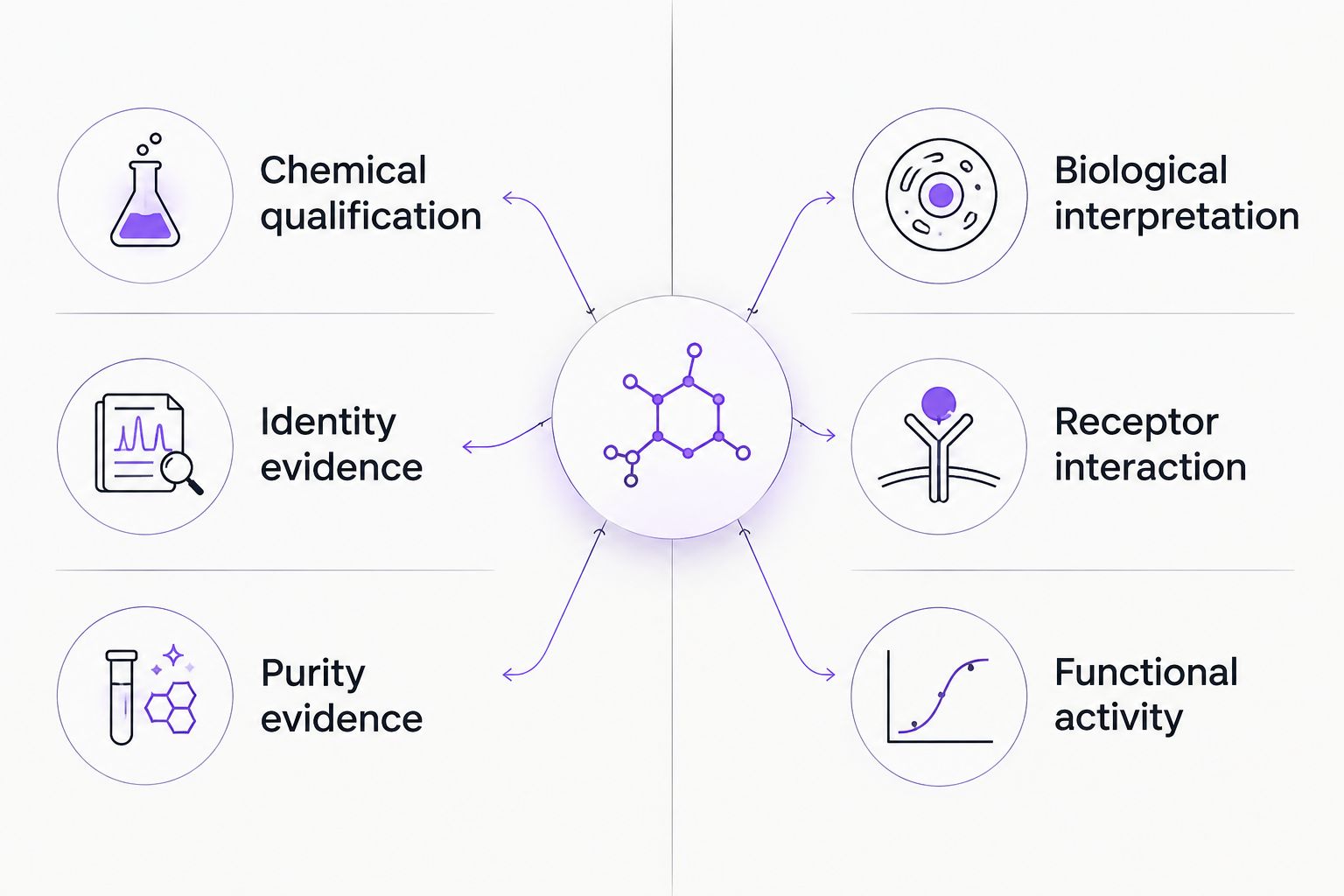
Chemical characterization and biological characterization answer different questions. Mass spectrometry supports molecular characterization; chromatography addresses separation and method-defined purity; nuclear magnetic resonance supports structural assessment. No single analytical method establishes every property of a research compound.
Likewise, an acceptable chemical record does not demonstrate receptor selectivity. Keep the chemical qualification decision separate from the interpretation of pharmacological observations, even when both appear in one sponsor deliverable.
- Identify what each analytical method supports.
- Record the limitations of each measurement.
- Avoid treating purity as a potency measurement.
- Keep chemical and biological acceptance decisions distinct.
Preserve traceability through sponsor reporting
Create the traceability record before results accumulate. The sponsor should be able to connect the reported compound to its batch, the supporting analytical evidence, and the conclusions that the research actually supports.
For 2026 reporting, retain the distinction between supplier-provided records and CRO-generated findings. Neither should silently replace the other. If additional characterization changes the interpretation of the supplied material, preserve that discrepancy and its resolution.
- Connect every material record to a batch identifier.
- Distinguish supplier records from CRO-generated evidence.
- Record document versions and qualification decisions.
- Link reported findings to the material evaluated.
- State unresolved limitations in the sponsor deliverable.
Reassess changes without assuming equivalence
A new batch or a different supplier requires a documented review against the project specification. Matching compound names do not establish matching impurity profiles, chemical forms, or suitability for a particular measurement.
Review available records first; commission additional characterization when the specification requires it. Treat a material change as a qualification question, not an automatic reason to transfer an earlier conclusion.
- Compare the new material with the original specification.
- Check identity and chemical-form consistency.
- Review analytical methods as well as reported results.
- Document the basis for accepting or rejecting comparability.
Compare sourcing and qualification approaches
The right sourcing approach depends on the sponsor’s evidence requirements. Separate convenience from qualification: a short purchasing process does not establish scientific suitability, while additional testing is useful only when it resolves a defined question.
4-Amino-Labs research chemicals belong in the same specification-led assessment as other candidate materials. Evaluate available documentation without assuming particular testing methods, reference-material status, or batch properties.
| Option | Best for | Practical advantage | Key limitation |
|---|---|---|---|
| Supplier-documented research material | Projects with explicit material specifications | Provides a starting record for qualification | Documentation must be checked against the actual batch and requirements |
| Independently characterized research material | Projects needing additional material evidence | Adds measurements directed at unresolved qualification questions | Additional analysis does not establish biological activity |
| Certified reference material, where applicable | Measurements requiring a defined reference and stated uncertainty | Supports the specific metrological purpose described by its certificate | Availability and intended use do not automatically match a biological project |
| Sponsor-provided material | Projects tied to a sponsor’s development compound | Preserves the sponsor’s selected material identity | The CRO still needs sufficient records to interpret its findings |
Avoid common CRO interpretation errors
Treating selectivity as a supplier specification
Selectivity is a pharmacological conclusion supported by comparative evidence in a defined context. It is not established by a product category, a purity statement, or a compound name. Keep analytical specifications separate from mechanistic claims.
Combining evidence from different compounds
Related receptor modulators are not interchangeable research tools. Do not use one compound’s published functional activity to fill gaps in another compound’s evidence. Preserve separate evidence summaries even when the sponsor requests a class-level comparison. [2, 3]
Equating chromatographic purity with complete characterization
A chromatographic result reports what a particular method detects and separates. It does not automatically account for every compositional variable. Review the analytical basis before treating a purity value as sufficient for sponsor acceptance.
Losing the material-to-result connection
A sponsor report becomes difficult to interpret when the compound name is retained but the batch identity disappears. Preserve batch traceability through qualification, research records, and final reporting; do not substitute a current supplier document for the historical record of the evaluated material.
Scope and limitations
This guide addresses research planning, material qualification, and interpretation. It does not provide experimental protocols, human-use guidance, or conclusions about medical benefits. Compound-specific stability, metabolic handling, receptor occupancy, and selectivity require evidence relevant to the compound and system under study.
For a 2026 evidence review, separate established androgen receptor biology from conclusions about an individual modulator. General receptor architecture explains the target; it does not establish a particular compound’s behavior. Supplier documentation supports material assessment, not a substitute for pharmacological evidence.
FAQ
What are selective androgen receptor modulators for contract research organizations?
Selective androgen receptor modulators are research compounds used to investigate androgen receptor interactions and context-dependent functional activity. Contract research organizations must qualify the material and keep conclusions specific to the compound, biological system, and endpoint studied.
Does androgen receptor binding prove functional selectivity?
No, androgen receptor binding does not independently establish functional selectivity. Binding and transcriptional measurements answer different questions, and tissue-selective behavior requires additional context-specific evidence.
Can a CRO substitute one SARM for another?
A CRO should not assume that different SARMs are interchangeable. Each compound requires its own identity records, qualification decision, and evidence supporting the intended research question.
What documentation should a CRO request for research material?
A CRO should request batch-specific identity information, analytical records, chemical-form details, and the basis of any purity statement. The required documentation should follow the sponsor-approved material specification.
Is chromatographic purity enough to qualify a research compound?
Chromatographic purity alone does not establish every property needed for material qualification. Its adequacy depends on the method, the research question, and any additional identity or compositional requirements.
How should a CRO assess a new batch?
A CRO should assess a new batch against the documented project specification rather than assume equivalence from the compound name. Compare the available identity, chemical-form, and analytical evidence, and record the qualification decision.
What role does 4-Amino-Labs have in CRO sourcing?
4-Amino-Labs is an online supplier of research chemicals, analytical reagents, and receptor modulators for research laboratories in the United States. A CRO must assess the relevant material and documentation against its own project requirements.
One last thing
Keep the batch identifier beside the compound name in the final sponsor report. This small documentation choice preserves the connection between chemical qualification and biological findings; a compound name alone cannot do that.
Related guides
- Peptide research for biotech startups
- Analytical reagent suppliers for laboratories
- PPAR-delta selectivity in GW501516 and GW0742
Scholarly references
- Davey RA, Grossmann M. Androgen Receptor Structure, Function and Biology: From Bench to Bedside. Clinical Biochemist Reviews. 2016. Review of androgen receptor architecture, regulation, and biological function.
- Gao W, Dalton JT. Expanding the therapeutic use of androgens via selective androgen receptor modulators (SARMs). Drug Discovery Today. 2007. Review of SARM pharmacology and the basis of selective activity.
- Narayanan R, Coss CC, Dalton JT. Development of selective androgen receptor modulators (SARMs). Molecular and Cellular Endocrinology. 2018. Review of SARM development and compound-dependent pharmacological evidence.
Research use only. This content is not medical advice and is not intended to diagnose, treat, cure, or prevent disease. It does not address human use, dosing, or personal outcomes.
