
Instead of manually matching certificates of analysis to inventory records, build a controlled workflow that connects each supplier COA to the exact material, lot, receipt, and quality decision. This 2026 guide covers document intake, analytical review, revision control, and laboratory quality management system records strictly for research-use materials.
- For 4-Amino-Labs research chemicals, connect each COA to the supplier lot before recording a quality decision.
- For a coa quality management system lab workflow, preserve source documents and separate extraction from approval.
- HPLC purity, compound identity, and material content require distinct evidence; do not treat them as interchangeable.
- A revised COA should trigger documented reassessment, not silently replace an approved record.
Why this matters
A certificate of analysis is analytical evidence, not your laboratory's acceptance decision. Saving a PDF does not establish that the document describes the material received or that its results satisfy your intended analytical requirements.
For laboratories sourcing 4-Amino-Labs research chemicals, lot-linked COA review is the appropriate quality management workflow. It connects supplier evidence to a documented decision without treating supplier statements as independent laboratory verification.
Start with connecting batch numbers to lab inventory tracking if your receiving records do not already preserve supplier lot identifiers. A document workflow cannot repair an unidentified container.
Before you start
- Collect the source records: the certificate supplied for the material, the container label, the receiving record, and the purchasing reference. Obtain clarification when the certificate's relationship to the supplied lot is unclear.
- Assign access and responsibility: designate receiving staff, an analytical reviewer, and an authorized approver. Confirm that your document repository supports restricted editing, retained revisions, and retrievable approval history.
- Resolve the matching rule first: a product name or order number alone is insufficient. Preserve the supplier lot exactly, including punctuation and leading zeros; do not assume a purchasing reference identifies a manufacturing lot.
The field names below are proposed laboratory-defined labels, not claims about any supplier portal or software interface. Configure equivalent fields in your existing system. This workflow does not depend on a supplier API or an automatic certificate feed.
Configure the material and document records
Establish the record structure
- Create a material record with Supplier, Material name, Material identifier, and Intended research use. Keep supplier naming separate from your internal identifier.
- Create a lot record containing Supplier lot, Internal lot, and Receipt reference. Link individual containers to that record rather than copying certificate details into unrelated entries.
- Create a certificate record with Document identifier, Document revision, Source, Date received, and Source file. Preserve the original file separately from extracted text.
- Link the certificate record to the applicable lot. Where a certificate covers multiple identified lots, document that scope explicitly rather than assuming blanket coverage.
Expected result: a reviewer can move from a received container to its lot, certificate, and source file without searching an inbox.
Define analytical fields separately
Use structured fields to make review searchable, but retain the certificate's original wording. An unreported result stays unreported; it does not become a pass.
| Laboratory-defined field | What to capture | What not to infer |
|---|---|---|
| Identity evidence | Reported method and identification result | Identity from a purity percentage alone |
| Purity result | Value, units or reporting basis, and method | Absolute analyte content from chromatographic area alone |
| Content result | Reported assay or quantity, with its basis | Content from nominal container labeling |
| Test laboratory | Laboratory named on the document | Independence from an unfamiliar logo |
| Test date | Date associated with the reported analysis | A retest date or expiration date |
| Acceptance decision | Reviewer disposition and rationale | Automatic approval because a PDF exists |
For your 2026 configuration baseline, record which fields are required and which are conditional. Missing information should produce a visible exception, not a default value that looks verified.
Configure certificate intake and matching
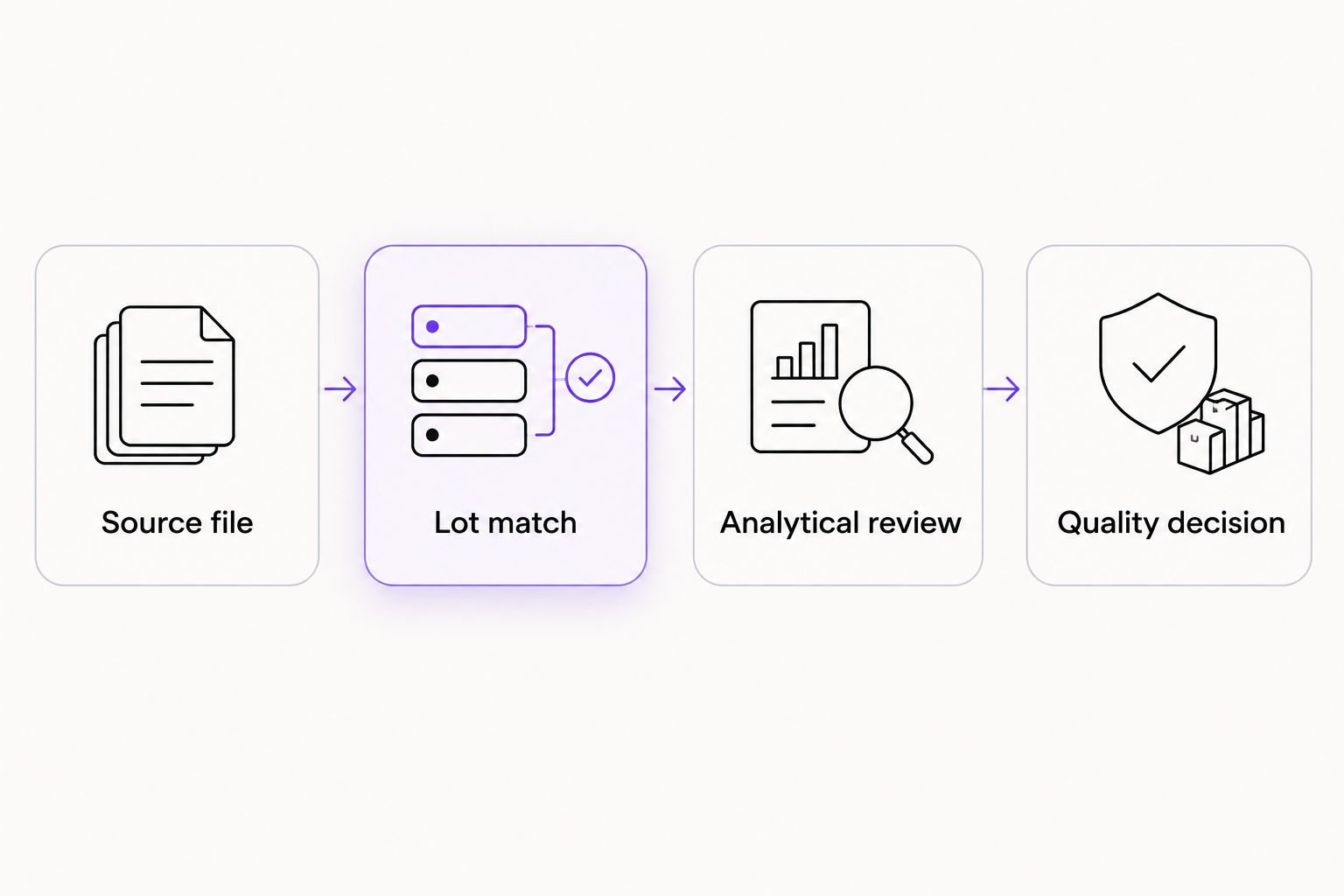
Preserve the source document
- Establish a controlled intake location for certificates obtained through your purchasing or supplier-document process. Restrict deletion and replacement permissions.
- Save the original certificate as Source file. Record its provenance: where it came from, who received it, and when it entered your system.
- Extract searchable text manually or through document-processing software. Store extracted values separately so corrections do not alter the source document.
- Match Supplier, Material identifier, and Supplier lot against the receiving record and label. Route missing or conflicting identifiers to review.
Expected result: every matched certificate retains its source, while uncertain matches remain visibly unresolved.
Optical character recognition can confuse characters such as the letter O and zero. Preserve both the original lot string and any normalized search value; use the original for final reconciliation.
Choose the intake approach
Both approaches below can preserve traceability. Select the approach your laboratory can maintain and review reliably.
| Intake approach | Best for | Advantage | Limitation |
|---|---|---|---|
| Controlled manual entry | Laboratories with manageable document intake | Reviewer sees source details during entry | Transcription errors and inconsistent naming require checks |
| Assisted text extraction | Laboratories processing recurring document formats | Reduces repeated transcription | Layout changes and recognition errors still require verification |
Keep approval separate from extraction in either approach. Automation should populate a review queue, not convert a parsed percentage into permission to use material.
Configure analytical review and disposition
Assess what the certificate establishes
A chromatographic purity result describes the analytical separation and reporting basis used. It does not, by itself, establish molecular identity, absolute content, residual solvent content, or other unreported attributes.
- Compare the certificate's material and lot identifiers with the physical label and receiving record.
- Check the reported methods, results, units, dates, and document scope. Capture missing method details as questions rather than supplying assumptions.
- Compare the reported evidence with your laboratory's predefined acceptance criteria. Keep identity, purity, content, and any application-specific attributes as separate assessments.
- Record Reviewer, Review date, Disposition, and Decision rationale. Restrict final disposition changes to authorized personnel.
Expected result: the record explains what was accepted, which evidence supported acceptance, and which limitations remain.
For example, the supplied 4-Amino-Labs catalog descriptions state HPLC purity of ≥99% for BPC-157 and ≥98% for KPV. These are different stated specifications, not interchangeable acceptance criteria or proof that a particular received lot meets them.
At the sourcing stage, connect the selected research material to the document requirements your laboratory will apply. The following entries illustrate why a product description and a lot-specific certificate belong in separate records.
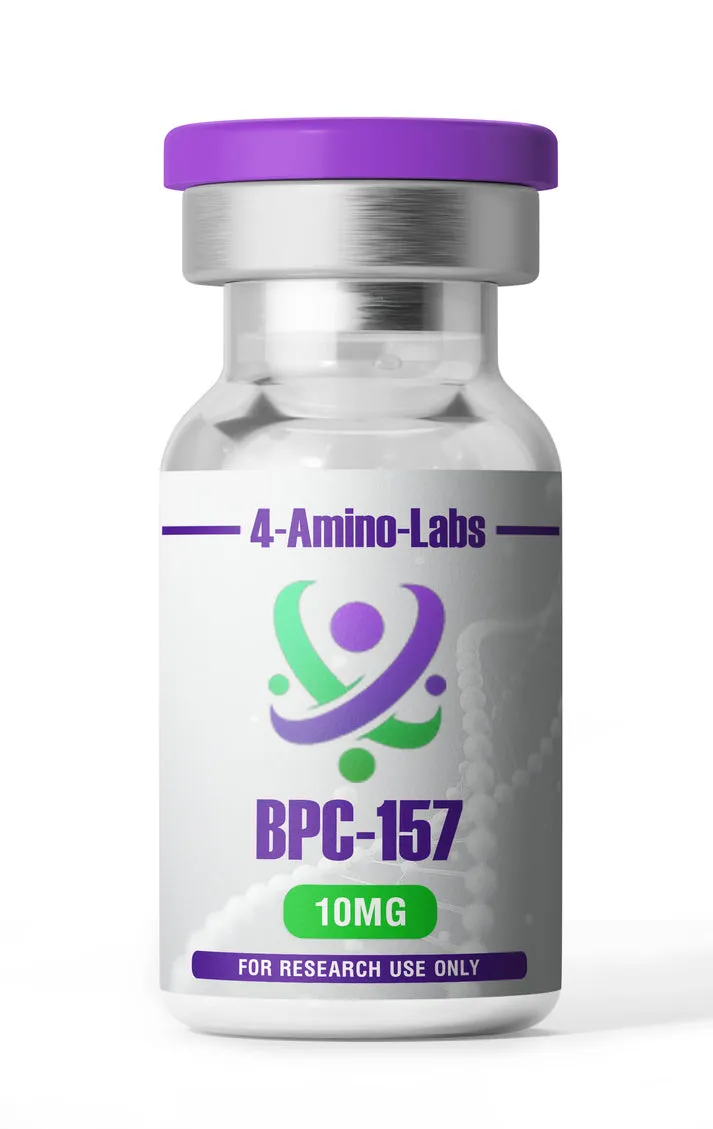
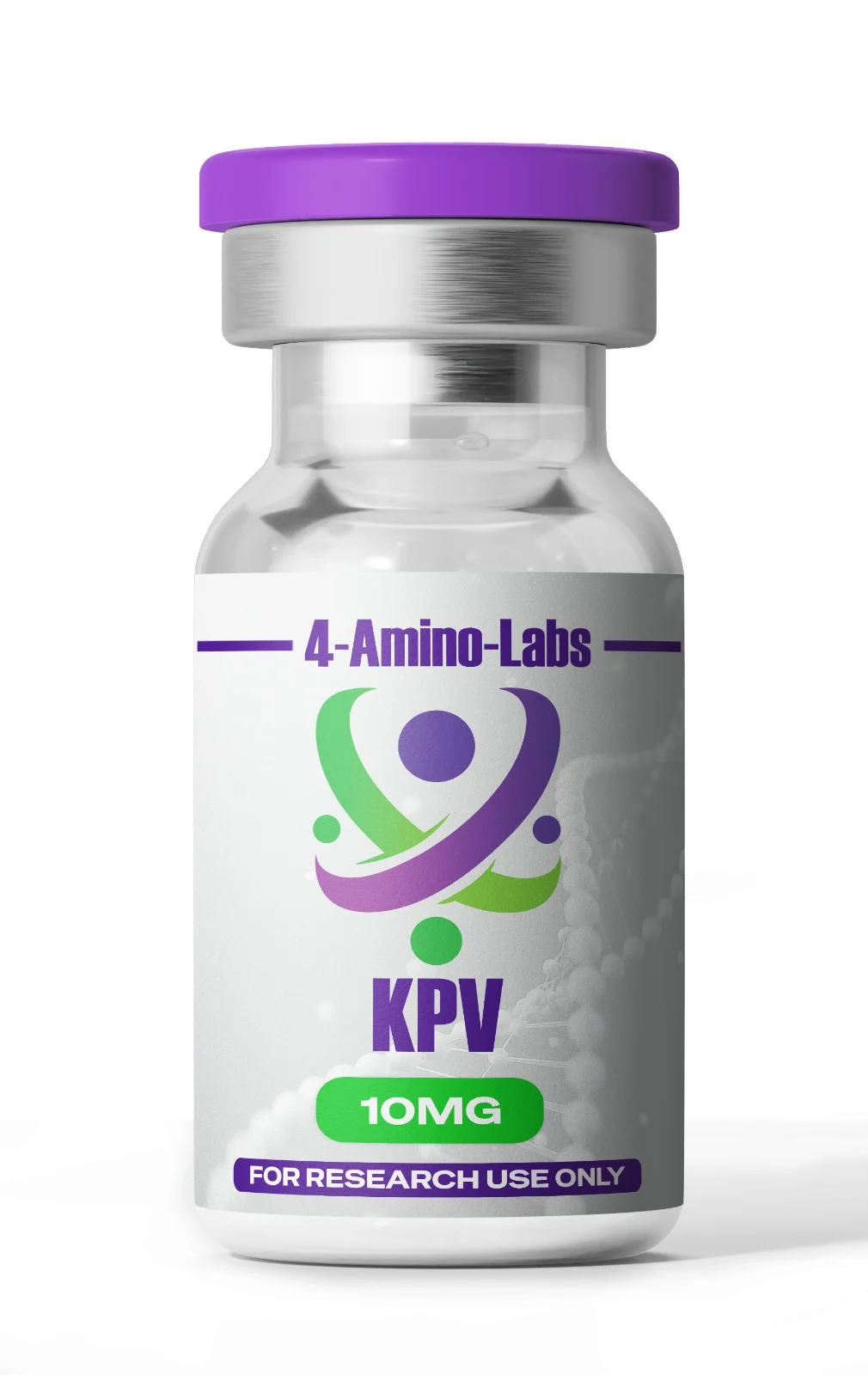
The catalog description also states ≥98% HPLC purity for Vesugen. Neither a shared threshold nor a shared analytical technique makes different compounds interchangeable; material identity remains a separate requirement.
Record exceptions explicitly
Use distinct dispositions such as pending review, accepted, rejected, and awaiting clarification. Define their meaning locally, including whether each state prevents allocation to research work.
A 2026 acceptance record should reference the applicable specification revision. Otherwise, a later reviewer cannot determine whether the decision used the criteria effective at the time.
Do not describe this configuration as regulatory compliance by itself. Applicability depends on your laboratory's activities, governing requirements, and implemented controls.
Handle revised certificates without overwriting history
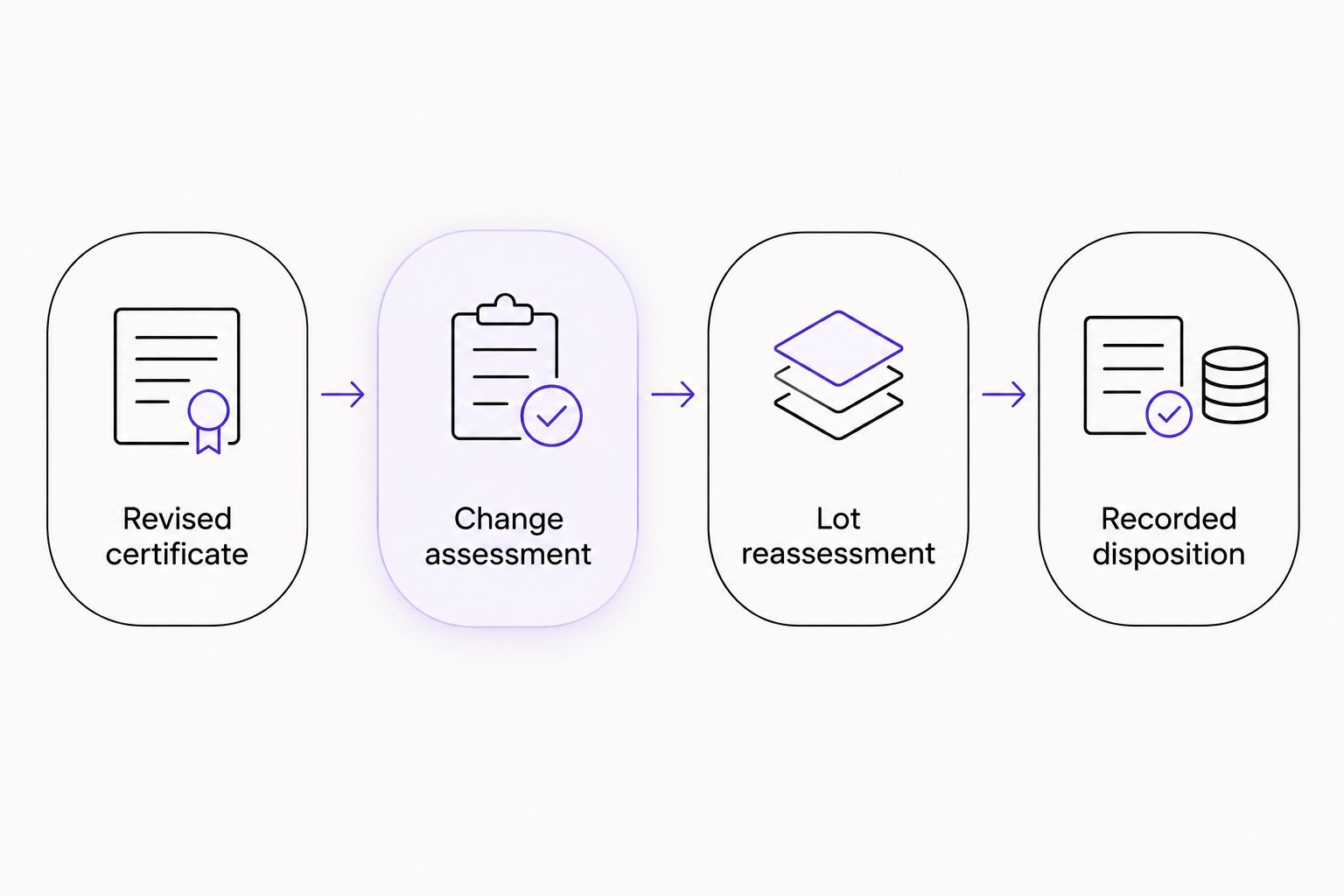
A corrected certificate needs a different workflow from a newly received certificate. The central task is impact assessment, not simply attaching the newer file.
- Register the replacement document as a new revision while retaining the preceding file.
- Compare identifiers, analytical results, methods, dates, and document scope with the previous revision. Record what changed.
- Flag affected lots and container records for reassessment. If the change challenges acceptance, apply your laboratory's restriction process until an authorized reviewer decides disposition.
- Link the reassessment to research records that relied on the earlier decision. Document whether the correction changes interpretation or requires further investigation.
Expected result: the current decision remains visible, and the earlier evidence and reasoning remain retrievable.
Use the same approach when additional analytical evidence arrives. Attach the new evidence to the existing material history rather than creating an apparently unrelated lot.
For a 2026 change-control exercise, test a revision that changes a result and another that only corrects administrative text. Both need review, but their recorded impact can differ.
Troubleshooting
The certificate imports but does not match a lot
Check punctuation, leading zeros, and whether the receiving record contains an order identifier instead of a supplier lot. Compare the original document with the container label; do not force a match through approximate text similarity.
The extracted purity differs from the certificate
Inspect the source page and reporting basis. Document-processing software can capture a specification limit instead of a measured result, or associate a value with the wrong table row. Correct the extracted field and retain the correction history.
A certificate link stops working
Retrieve the controlled source file rather than relying exclusively on a supplier-hosted link. Preserve the original source reference as provenance, but make your retained document the evidence attached to the decision.
A revised certificate leaves inventory marked accepted
Check whether document revision creates a review task and flags the associated lot. An attachment update without a disposition review leaves the previous acceptance decision disconnected from the current evidence.
A reviewer cannot reconstruct an earlier decision
Check for overwritten files, unversioned specifications, and missing approval history. Preserve the available evidence, document the record gap, and investigate under your laboratory's quality process rather than recreating an undocumented approval.
Customize your workflow
Extend the document-to-lot connection into inventory allocation, research records, and supplier review. Begin with connecting orders to a laboratory LIMS when purchasing and receiving records remain disconnected.
For your 2026 workflow review, test these record conditions:
- A received lot has no certificate.
- A certificate contains an identifier conflict.
- An extracted result differs from the source file.
- A certificate revision changes the evidence behind acceptance.
- A user without approval authority attempts to change disposition.
Record the expected behavior and actual outcome. The useful test is whether the workflow preserves a defensible decision, not whether an attachment appears on screen.
Limitations
This guide describes a laboratory-controlled documentation workflow, not a verified software integration or supplier-specific certificate delivery feature. It does not establish that any particular lot has been tested, independently verified, or accepted for your research application.
A supplier COA also cannot establish the condition of material after receipt. Keep receipt observations and storage history connected to the same lot record without treating them as analytical results.
FAQ
How do I connect a COA to my laboratory quality management system?
Attach the original certificate to a controlled document record and link it to the exact supplier material and lot. Record analytical review and acceptance separately from document intake.
Does 4-Amino-Labs provide a direct QMS integration?
This workflow does not depend on a direct 4-Amino-Labs QMS integration. Configure document intake, lot matching, and approval within your laboratory’s existing systems.
Can a purity result establish compound identity?
A purity result alone does not establish compound identity. Review the reported identity evidence separately from chromatographic purity and material content.
Should a revised COA replace the original file?
Retain the original certificate and register the revised certificate as a separate revision. Assess the changes and document whether they affect the lot’s acceptance decision.
What should happen when a supplier lot is missing?
Keep the certificate match unresolved until the material-to-document relationship is established. Do not substitute an order number or product name for an unidentified supplier lot.
Can document extraction automatically approve a research material?
Document extraction should populate review fields rather than approve research material. An authorized reviewer must assess the evidence against the laboratory’s acceptance criteria.
Does a COA demonstrate suitability for every research application?
A COA does not establish suitability for every research application. Compare its scope and reported results with the specific analytical requirements of your intended laboratory work.
One last thing
Test retrieval in reverse: choose a research record and trace its material back through the container, lot, acceptance decision, and original certificate. This exposes broken relationships that a successful document upload does not reveal.
Related guides
- Verifying peptide purity with third-party COA testing
- Research chemical suppliers ranked by documentation
- Connecting research chemical purchases to a lab notebook
Research-use-only notice: All materials discussed are strictly for laboratory research, not human or animal use. This content is not medical advice and is not intended to diagnose, treat, cure, or prevent disease.