
Instead of manually reconciling grant codes, chemical specifications, and supplier correspondence, build a grant-funded purchase order workflow that carries the approved research requirement from requisition through receiving. For research chemicals, confirm both institutional authorization and the supplier’s purchasing requirements before transmitting an order; this guide covers laboratory research materials only.
- A grant funded purchase order research chemicals workflow needs funding approval, supplier confirmation, and traceable receiving records.
- 4aminolabs research chemicals require institutional procurement review; a storefront does not establish purchase-order acceptance.
- Keep the requisition, purchase order, invoice, and batch documentation linked but distinct.
- Resolve substitutions and funding changes before releasing an amended order.
Why this matters
A purchase order records an authorized purchasing commitment. It does not, by itself, establish that a chemical is appropriate for the research objective, chargeable to a particular award, or supported by adequate analytical documentation.
For laboratories evaluating 4aminolabs research chemicals, procurement approval must precede any supplier commitment. The 4aminolabs storefront identifies a potential source; your institution determines the purchasing route and award-specific requirements.
For a 2026 purchasing file, preserve the rules and approvals applicable to that transaction. Do not treat an earlier purchase as evidence that a new award permits the same expenditure.
Before you start
- Institutional access: Obtain access to the authorized requisition process, the relevant award or project account, and the people responsible for procurement and sponsored-project review.
- Technical materials: Assemble the chemical identity, required form, quantity, analytical acceptance criteria, research justification, and receiving location. Identify required safety and batch documents.
- Supplier confirmation: Establish whether the supplier accepts your institution’s purchasing arrangement before building the final submission. An internally approved PO does not establish supplier acceptance or agreed payment terms.
Use the institution’s current purchasing instructions for the actual interface. The record names below describe information to capture, not universal software buttons or a claimed 4aminolabs checkout feature.
Funding and requisition record
Establish the award connection
- Identify the award or project account that supports the proposed chemical purchase. Confirm the responsible investigator and departmental purchasing owner.
- Write a research justification connecting the material to the funded work. Describe the analytical or experimental requirement without implying human or animal use.
- Ask the designated grants administrator to resolve questions about the award period, budget category, restrictions, and required authorization before submission.
- Record the decision and its supporting correspondence in the requisition file. Keep an approval attached to the transaction it actually covers.
Expected result: Your requisition identifies the funding source, research purpose, responsible owner, and required approval route.
Define the material before choosing the order line
- Record the chemical name and an appropriate identifier, such as a CAS number where applicable. Specify the required salt, sequence, or other identity-defining characteristic when relevant.
- Describe the required physical form and quantity using unambiguous measurement units. Separate package quantity from the material quantity represented by each package.
- Define the documentation needed for acceptance: for example, a lot-specific certificate of analysis, identity evidence, analytical method information, or a safety data sheet.
- Document whether substitutions require technical review. Do not authorize a different form or related compound solely because the names appear similar.
Expected result: Procurement can identify the requested material without interpreting the scientific requirement.
A useful 2026 requisition template separates identity, funding, and documentation into distinct fields. Copying a product title into every field obscures the difference between what the laboratory needs and what a supplier lists.
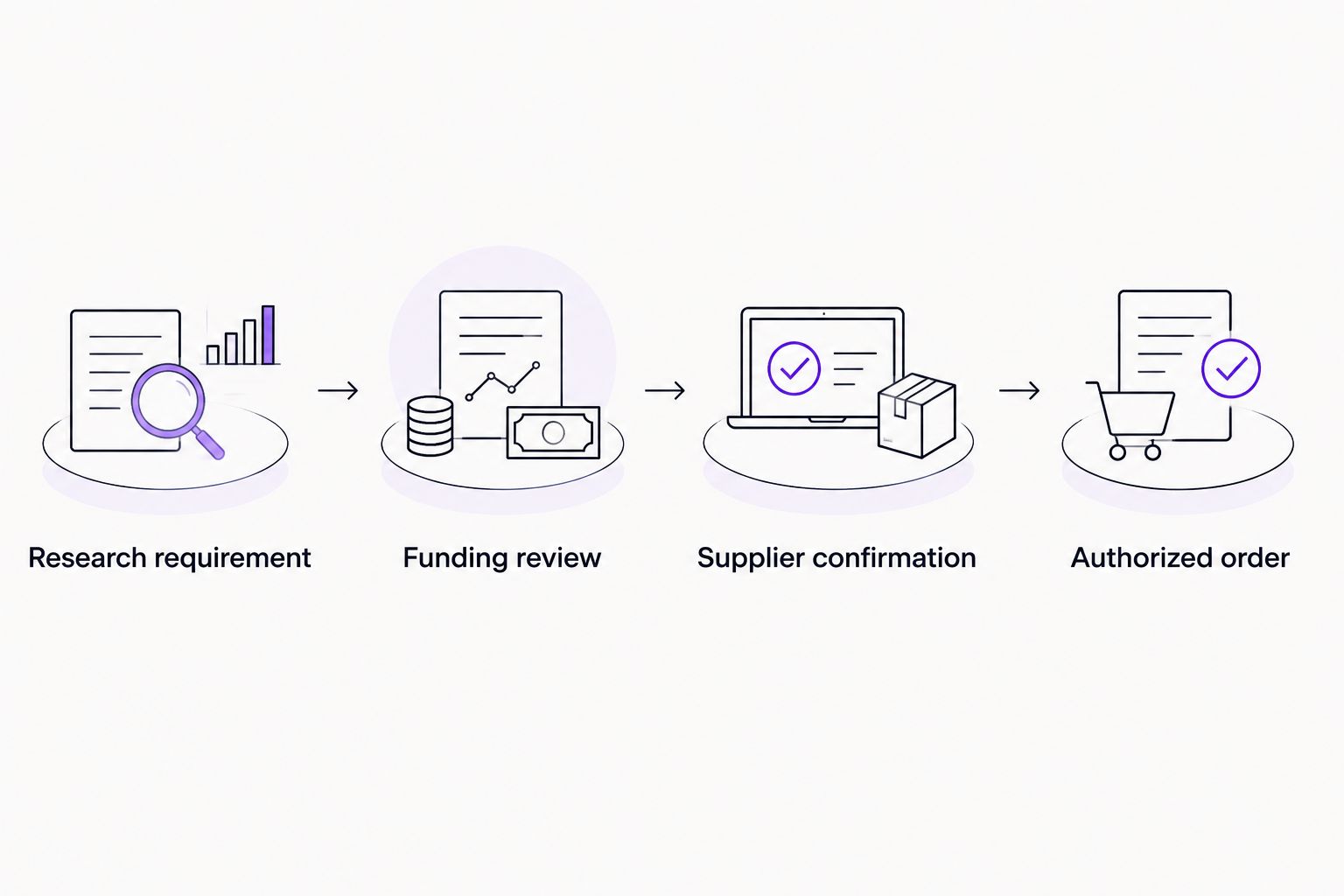
Supplier record and order package
Confirm the purchasing route
- Ask procurement whether the supplier needs onboarding before the requisition can proceed. Route institutional forms through the authorized purchasing team.
- Obtain written confirmation of the supplier’s accepted ordering process, required purchaser information, and invoice-routing requirements.
- Confirm whether the institution’s proposed purchasing terms are accepted. Escalate differences to procurement rather than accepting terms on the laboratory’s behalf.
- Establish who transmits the authorized order and how the supplier acknowledges it. Keep that responsibility explicit.
Expected result: Both parties understand the submission route, and the institutional buyer has resolved supplier-record requirements.
For 4aminolabs purchasing inquiries, use the contact page to request confirmation of the purchasing route and documentation requirements. Do not interpret that contact channel as evidence of a particular PO program, payment arrangement, or supplier-onboarding policy.
Assemble the transaction documents
Keep the following records distinct. They answer different questions and are not interchangeable.
| Record | Best for | What it establishes | Limitation |
|---|---|---|---|
| Requisition | Internal authorization | What the laboratory requests and how it proposes to fund it | Does not establish supplier acceptance |
| Purchase order | Authorized purchasing commitment | The institution’s approved order details | Does not establish analytical conformity |
| Supplier acknowledgment | Confirming order understanding | What the supplier has acknowledged | Does not replace institutional approval |
| Certificate of analysis | Batch assessment | Reported analytical results for the identified material | Does not establish grant chargeability |
| Invoice | Financial reconciliation | What the supplier requests payment for | Does not establish receipt or technical acceptance |
- Attach the approved material specification and required purchasing correspondence to the requisition.
- Check that supplier identity, purchaser identity, receiving location, and invoice destination agree across the records.
- Have the authorized buyer generate or release the PO through the institution’s process.
- Preserve the released version and supplier acknowledgment together. Resolve discrepancies before treating the transaction as confirmed.
Expected result: The order package has a traceable approval history and consistent purchasing details.
The advantage of this workflow is separation of responsibilities; the limitation is that it requires coordination across technical, grants, and procurement owners. A laboratory researcher should not silently assume all of those roles.
Approval routing and order release
Assign decisions to the right owner
- Route scientific suitability to the person responsible for the research requirement.
- Route award-related questions to the designated sponsored-project or grants administrator.
- Route contractual terms, supplier onboarding, and purchasing authority to procurement.
- Release the order only after the required institutional approvals are complete. Preserve the approval evidence with the released document.
Expected result: Each decision has an identified owner, and the release record shows that required reviews occurred.
For a 2026 approval matrix, assign roles rather than relying only on individual names. Record a designated alternate through institutional procedures so an absence does not lead to an unauthorized workaround.
The same person approving scientific suitability does not automatically have authority to accept purchasing terms. Conversely, procurement approval does not establish that the material meets an assay’s analytical requirements.
Keep release separate from preparation
Preparing a draft and transmitting an authorized order are different actions. Label drafts clearly, restrict release to the authorized buyer, and avoid sending preliminary documents that a supplier might interpret as a purchasing instruction.
A requisition attachment should explain the material requirement. The released PO should identify the authorized transaction. Preserve that distinction even when the institution’s platform displays both records in the same workspace.
Receiving and grant-file reconciliation
Connect receipt to the authorized line
- Record receipt against the relevant PO line. Capture the actual material identity, package quantity, lot identifier, and accompanying documentation.
- Compare the received material with the approved specification. Refer identity or documentation discrepancies to the technical owner before releasing the material for laboratory work.
- Route the invoice through the institution’s reconciliation process. Resolve differences among the PO, receiving record, and invoice with the responsible purchasing team.
- Link the accepted lot to the laboratory inventory record. Keep purchasing approval separate from technical release.
Expected result: The transaction connects an approved funding decision to a received, identifiable research material and its supporting records.
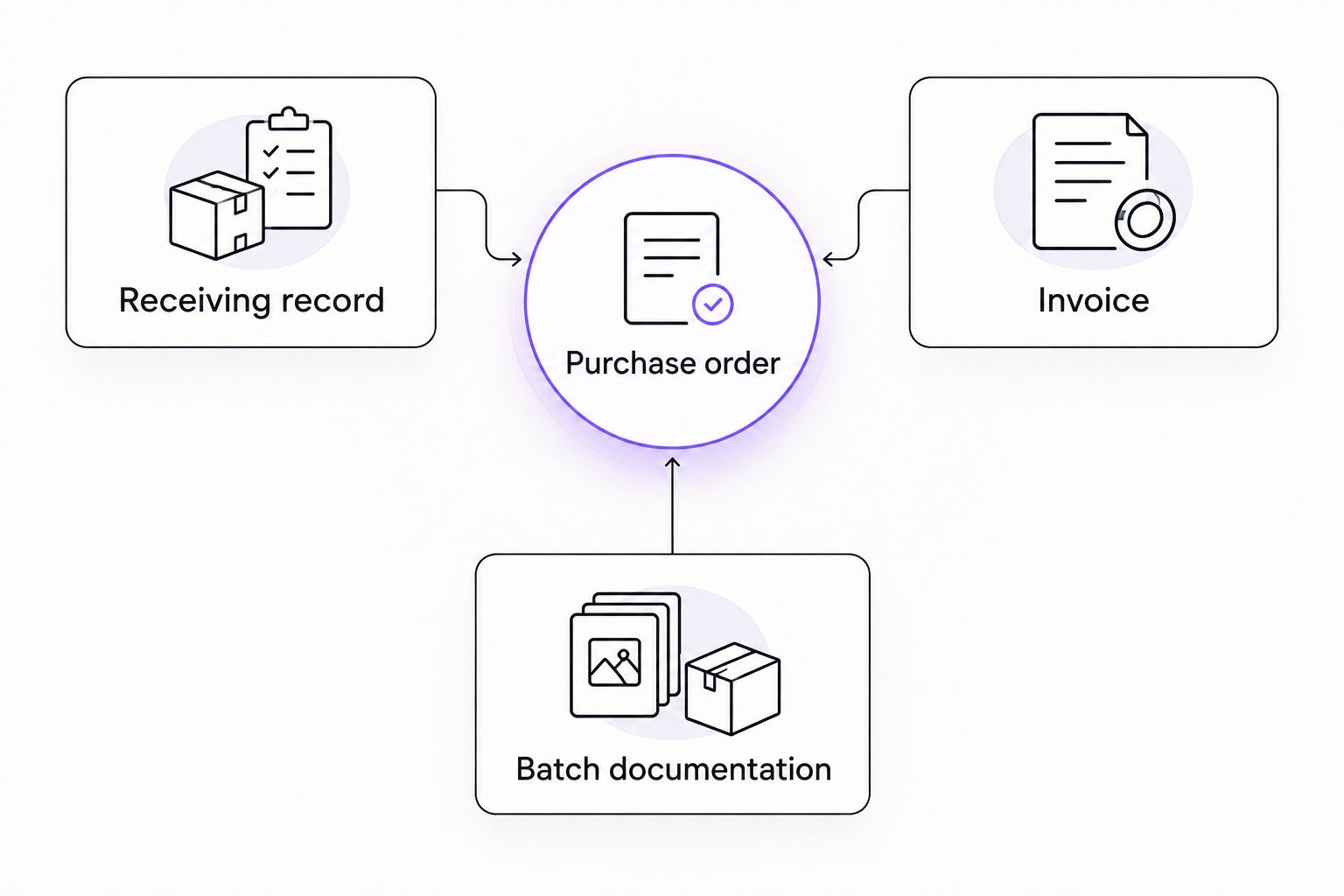
A complete purchasing file does not require every reviewer to repeat every assessment. It requires a clear record of which owner made each decision and which document supported it.
Variant: changes to an approved requisition
Route changes before issuing an amendment
Use a change workflow when the funding account, quantity, chemical form, documentation requirement, or receiving destination changes. Do not overwrite the original record and erase the approval history.
- Describe the proposed change and its reason. Identify the affected PO line and preserve the previous approved version.
- Ask the appropriate owner to reassess the changed element. A funding change belongs with the funding reviewer; a chemical-form change also needs technical review.
- Have procurement determine whether an amendment, replacement order, or other institutional action is required.
- Obtain supplier acknowledgment of the authorized change and update receiving instructions accordingly.
Expected result: The amended transaction retains its history, and both purchaser and supplier work from the same authorized version.
Approval chains should follow the decision being changed. Multi-level purchase order approvals separate technical authorization, funding review, and purchasing release, allowing each owner to assess the part of an amendment within their authority.
For 2026 repeat purchases, reuse the specification only after checking that it still matches the research requirement. A previous approval supports the historical transaction, not automatic authorization for a new commitment.
Repeat ordering reduces transcription work; its drawback is the risk of carrying obsolete funding codes, specifications, or routing instructions into a new request. Retain reusable material details without copying transaction-specific approvals.
Troubleshooting
The supplier cannot process the institution’s PO arrangement
Return the request to procurement before making another commitment. Ask the authorized buyer to determine an acceptable route; do not bypass institutional controls through a personal purchase or an unapproved payment method.
The requisition is approved but the supplier has not acknowledged it
Confirm that the authorized buyer transmitted the released document through the agreed channel. Check the order reference and recipient, then obtain acknowledgment before assuming the supplier has accepted the transaction.
The received material has a different lot identifier
A newly assigned lot is not automatically a mismatch with a general material specification. Obtain documentation for the actual received lot and have the technical owner assess it; if the PO required a specific lot, escalate the difference before acceptance.
The certificate reports purity but the specification requires identity evidence
Ask for the missing evidence or refer the material for technical review. A reported chromatographic purity result is not a substitute for every identity or composition requirement. Do not mark a missing requirement as satisfied because another analytical result is present.
The invoice, receiving record, and PO disagree
Document the discrepancy and route it to the institutional owner. Do not change the receiving quantity merely to make the invoice match, or alter a funding code without the required review.
Customize your workflow
Build a reusable intake form with separate sections for scientific specifications, funding, supplier confirmation, approval ownership, and receiving. Require transaction-specific review rather than allowing a copied form to function as inherited approval.
For a 2026 workflow review, inspect record connections instead of adding more attachments indiscriminately. A document helps only when the transaction identifies what it supports and who reviewed it.
Start with clear ownership before adding automation. Automated routing reproduces a poorly defined approval chain just as readily as a well-defined one.
Limitations
This guide describes an institution-neutral documentation workflow, not a purchasing policy or a supplier-specific checkout procedure. Award conditions, institutional rules, and written supplier confirmation govern the actual transaction.
The workflow does not establish chemical suitability, award eligibility, legal permissibility, or a supplier’s acceptance of purchase orders. Those determinations require their respective authorized reviewers.
FAQ
How do I submit a grant-funded purchase order for research chemicals?
Submit a requisition through your institution’s authorized process, obtain the required funding and purchasing approvals, and have the authorized buyer transmit the PO. Confirm the supplier’s purchasing requirements before release.
Does 4aminolabs accept institutional purchase orders?
Confirm purchase-order acceptance directly with 4aminolabs before submitting an order. A storefront listing does not establish accepted purchasing terms or an institutional billing arrangement.
Can an approved grant budget replace purchase-order approval?
No; budget approval and transaction authorization are different decisions. Follow the institution’s purchasing process and any award-specific review requirements.
What chemical information belongs in the requisition?
Record the chemical identity, required form, quantity, acceptance criteria, and required documentation. Include identity-defining details such as a salt form or sequence when relevant.
Is a certificate of analysis enough to approve a research chemical purchase?
No; a certificate of analysis addresses reported analytical findings, not purchasing authority or grant chargeability. Assess it against the technical specification while retaining separate funding and procurement approvals.
What happens if the material or funding account changes?
Route the proposed change to the appropriate technical, funding, and procurement owners before issuing an amendment. Preserve the original approval history and obtain supplier acknowledgment of the authorized change.
When is the purchase file complete?
Complete the file according to institutional requirements after reconciling the authorized order, receipt, invoice, and required material documentation. Link the accepted lot to laboratory inventory without treating financial reconciliation as technical acceptance.
One last thing
Keep two distinct acceptance decisions: receipt of the ordered goods and acceptance of the material for laboratory work. An invoice can match the PO while the batch documentation remains unresolved. Recording both decisions prevents financial completion from being mistaken for scientific release.
Related guides
- Connecting batch numbers to lab inventory tracking
- Connecting research chemical purchases to a lab notebook
- Research chemical suppliers ranked by documentation
Research-use-only notice: All materials discussed are strictly for laboratory research use only, not for human or animal use. This content is not medical advice and is not intended to diagnose, treat, cure, or prevent disease.