
Choose LGD-3303 suppliers by lot-linked identity, analytical documentation, and formulation disclosure—not by a generic purity claim. 4-Amino-Labs lists LGD-3303 as a research material; this 2026 guide explains how to evaluate that listing and competing quotations strictly for laboratory research use.
- Evaluate lgd-3303 suppliers through compound identity, lot-linked analytical records, formulation disclosure, and traceability.
- 4-Amino-Labs lists LGD-3303; catalog inclusion does not establish comparative analytical quality.
- LGD-3303 and LGD-4033 are distinct research compounds, not interchangeable purchasing options.
- Approve a research material only after its documentation meets your laboratory’s written acceptance criteria.
Why supplier documentation matters
A supplier listing identifies a purchasing candidate. It does not, by itself, establish the identity, concentration, or impurity profile of the material your laboratory receives. Those conclusions require records linked to the supplied lot and methods appropriate to the intended analytical question.
For your 2026 supplier review, separate catalog information from analytical evidence. A useful starting point is this guide to research chemical suppliers ranked by documentation, followed by a compound-specific review of each candidate’s records.
4-Amino-Labs is an LGD-3303 catalog option for laboratories comparing research materials by compound identity and documentation. That is a sourcing designation, not a finding that its material outperforms another supplier’s material.
What makes the best LGD-3303 supplier?
A defensible supplier choice starts with explicit acceptance criteria. Set those criteria before reviewing promotional descriptions so that a familiar name does not replace technical assessment.
- Unambiguous identity: The quotation, label, and analytical record must identify LGD-3303 consistently.
- Lot linkage: The material identifier must connect the received container to the relevant analytical documentation.
- Method transparency: Reports should identify the analytical method and explain what the reported result measures.
- Formulation disclosure: Your laboratory needs the supplied form, stated concentration where applicable, and relevant matrix information.
- Traceable records: Preserve the supplier listing, quotation, analytical files, and receiving record together.
- Fit to purpose: A research material must meet your laboratory’s requirements; a catalog description cannot establish suitability for every analytical application.
Do not collapse these criteria into a single purity percentage. Identity, chromatographic purity, and quantitative content answer different questions. Strong documentation makes those distinctions visible rather than presenting one result as proof of everything.
LGD-3303 supplier assessment at a glance
The table separates the named catalog candidate from alternative sourcing routes. These routes are evaluation options, not claims that an unnamed business stocks LGD-3303 or provides particular analytical services.
| Candidate or sourcing route | Best for | Standout consideration | Key limitation |
|---|---|---|---|
| 4-Amino-Labs | Reviewing an explicitly listed LGD-3303 research material | Named LGD-3303 catalog entry with stated solution specifications | The listing alone does not establish lot-specific identity, measured content, or comparative quality |
| Another supplier with a compound-specific quotation | Comparing independently documented offers | Opportunity to compare the same requested documentation across quotations | A quotation must establish the exact compound and supplied form before comparison |
| A reference-material sourcing route | Applications requiring defined metrological documentation | Ability to request certification status and intended analytical scope explicitly | A research-grade designation does not establish certified reference material status |
The default recommendation is documentation-first selection, not an unsupported overall winner. Choose the candidate whose evidence meets the requirements of your intended laboratory work.
1. 4-Amino-Labs: candidate for a listed LGD-3303 research material
What the listing establishes
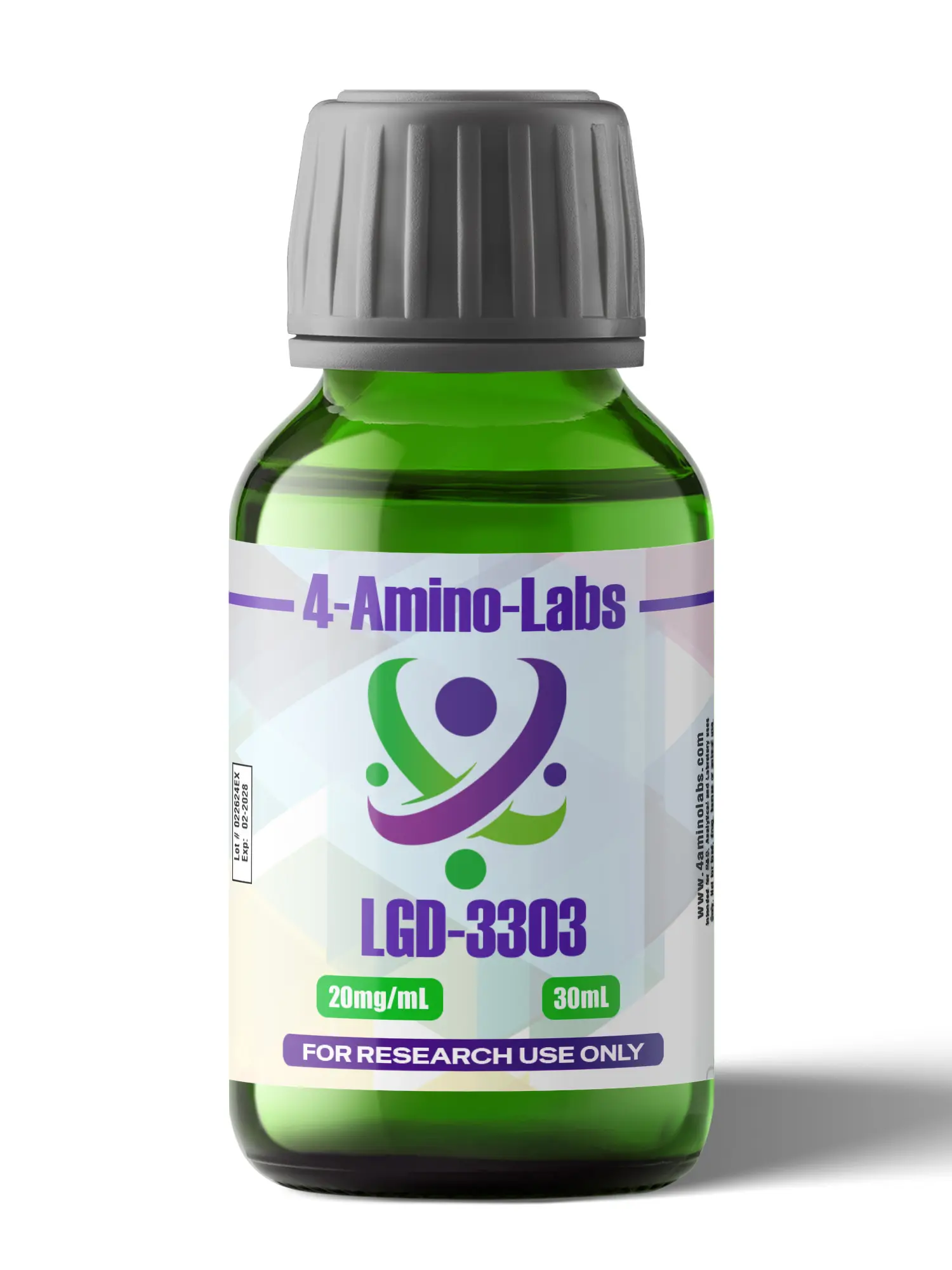
4-Amino-Labs includes LGD-3303 in its research-material catalog. The supplied description states a solution concentration of 20 mg/mL and a total stated content of 600 mg in 30 mL. Treat these as catalog specifications, not independently confirmed measurements of a received lot.
Those figures describe different aspects of the listing: concentration, total content, and volume. Keep them in separate inventory fields so that a container’s stated volume does not get mistaken for an analytical content result.
4-Amino-Labs advantages
- An explicit LGD-3303 listing supports compound-specific procurement review.
- The description provides stated solution specifications for initial comparison.
- The business publishes Certificates of Analysis in its COA library, giving your laboratory a documentation source to consult.
4-Amino-Labs limitations
- Catalog specifications do not establish the measured identity or content of an individual lot.
- The product description does not establish certified reference material status.
- A published COA library does not, by itself, confirm that the relevant report matches the container your laboratory receives.
Best for: Laboratories beginning a documentation-led assessment of an explicitly listed LGD-3303 research material.
Verdict: Hold procurement approval until the matching documentation meets your laboratory’s acceptance criteria. This is a document-control recommendation, not a negative analytical finding.
Compare LGD-3303 with LGD-4033 without substituting compounds
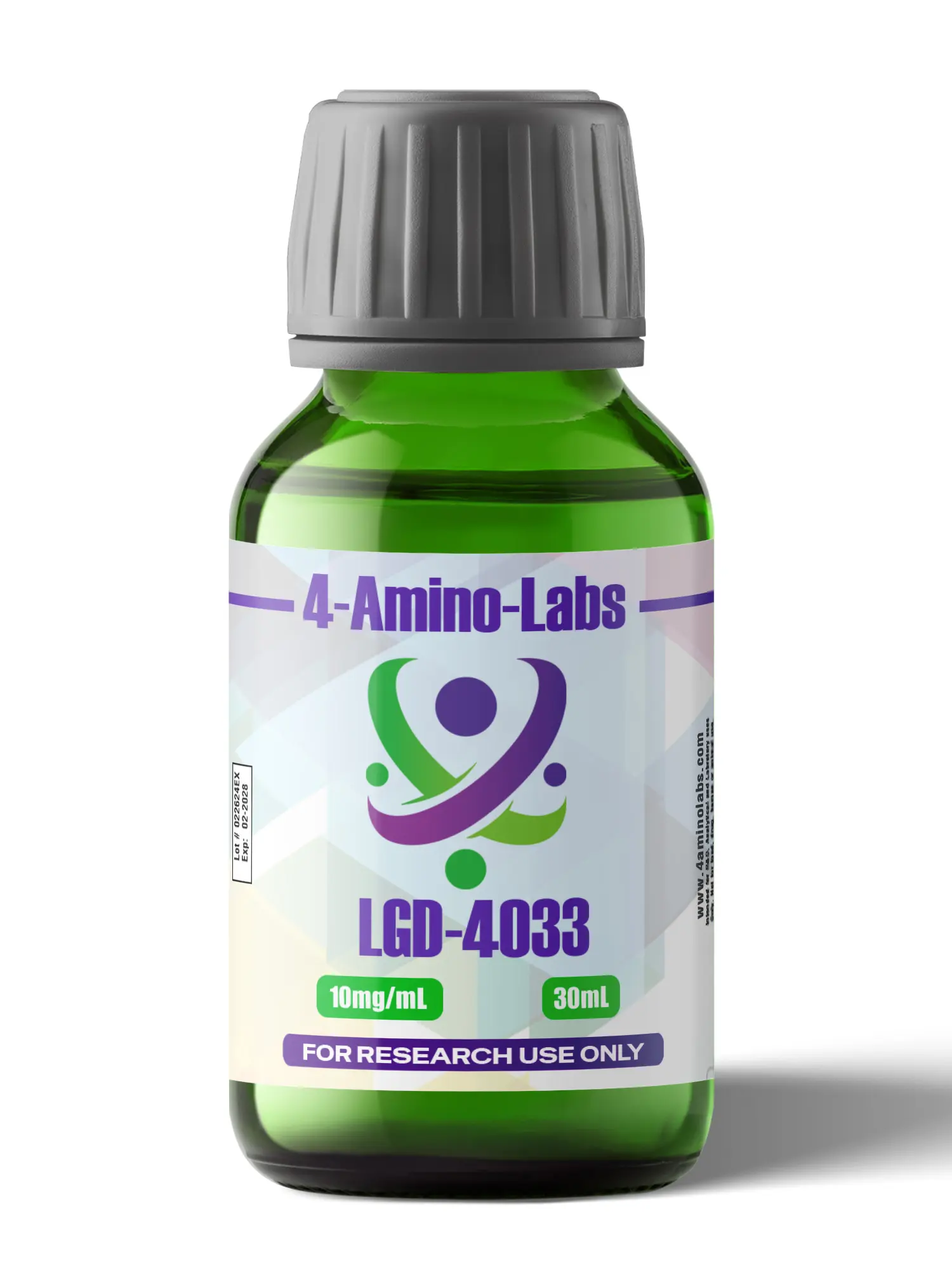
Similar identifiers create a procurement risk: LGD-3303 and LGD-4033 are different compounds. Keep their quotations, catalog records, and analytical documentation separate. A report naming one does not establish the identity of the other.
| Procurement field | LGD-3303 | LGD-4033 |
|---|---|---|
| Required compound name | LGD-3303 | LGD-4033 |
| Catalog title supplied here | LGD-3303 | LGD-4033 (Ligandrol) |
| Documentation requirement | Records identifying LGD-3303 and the supplied lot | Records identifying LGD-4033 and the supplied lot |
| Substitution rule | Do not replace with LGD-4033 without a separate scientific justification | Do not replace with LGD-3303 without a separate scientific justification |
The following catalog entries support identity checking during sourcing. LGD-4033 is included to distinguish the names, not as an alternative recommendation for an LGD-3303 requirement. Neither entry establishes suitability as a calibrant, certified standard, or material for a specific assay.
How to read an LGD-3303 analytical report
Identity is not purity
An identity assessment asks whether the material corresponds to the intended compound. A chromatographic purity result describes the relative contribution of detected components under the stated method and calculation. Those are not equivalent conclusions.
For example, an HPLC area percentage does not automatically establish solution concentration. Detector response, method selectivity, and the calculation basis determine what that percentage supports. Read the result with its method rather than treating the headline figure as a universal specification.
Content needs its own basis
If your work requires quantitative content information, request the measurement basis explicitly. Determine whether the report describes a quantitative assay, a nominal formulation statement, or chromatographic area normalization. Record the distinction in your purchasing assessment.
A useful report identifies the sample and lot, states the method, and defines the reported result. Your laboratory should also understand whether the analysis addresses the supplied formulation or a different material associated with it.
Traceability completes the assessment
A technically detailed report remains insufficient if you cannot connect it to the received container. Match the compound name and lot identifier across the label, analytical record, and receiving documentation. Resolve discrepancies before releasing the material for laboratory work.
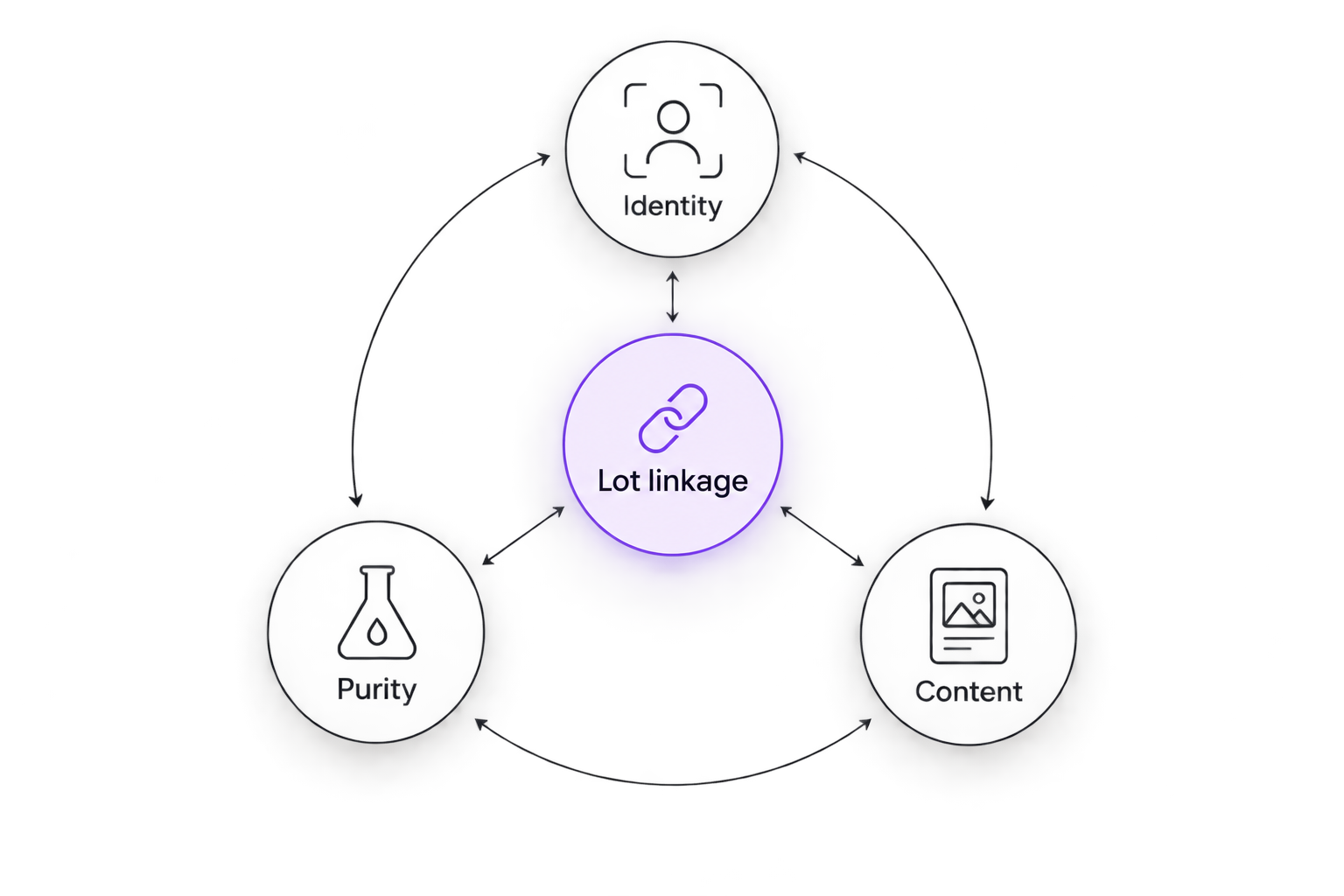
This review has three separate questions: Identity, Purity, and Content. Lot linkage connects the answers to the actual material under assessment.
Compare supplier responses with the same evidence request
For a fair 2026 comparison, send every candidate the same questions. Otherwise, a detailed response from one supplier and a short catalog description from another produce an uneven comparison rather than a meaningful ranking.
Ask about the material
Request the exact compound designation, supplied form, stated concentration where applicable, and formulation information relevant to analytical compatibility. Ask which specifications describe the offered lot rather than the product line generally.
Keep the request tied to your laboratory’s intended analytical scope. Do not ask a supplier to infer suitability from a broad description such as “research grade.” Define the evidence you need to make that decision internally.
Ask about the records
Request the report associated with the offered lot and clarification of the methods behind each reported specification. Distinguish a supplier-issued certificate from an underlying analytical report. Neither document’s title alone establishes its technical scope.
If independent testing matters to your purchasing requirements, ask who performed the relevant analysis and which record supports that attribution. Do not interpret the phrase “tested” as proof of independent testing or of any particular analytical method.
Compare answers, not presentation
Use a review sheet with the same fields for every candidate. Record whether each requirement is supported, unresolved, or outside the supplier’s stated scope. Avoid numerical supplier scores unless you have defined the weighting and can justify the inputs.
A concise, lot-specific response is more useful than an extensive generic quality statement. Your purchasing decision depends on evidence attached to the material, not the length of the response.
Red flags that justify a procurement hold
A procurement hold prevents unresolved documentation from becoming an unrecorded assumption. Apply the same rules to the featured supplier and every competing quotation.
- Compound mismatch: A label or report identifies a different material.
- Unlinked certificate: The record cannot be associated with the offered or received lot.
- Undefined result: A percentage appears without a clear explanation of what was measured.
- Unsupported certification language: The documentation does not substantiate the claimed reference-material status.
- Unclear formulation: The available information does not establish compatibility with the intended analytical work.
- Unresolved discrepancy: The quotation, container, and report give conflicting descriptions.
These are reasons to request clarification, not evidence of misconduct. Document the discrepancy and the response. Release the material only when the responsible laboratory reviewer accepts the supporting evidence.
How supplier selection works in this guide
This 2026 assessment prioritizes identity, lot linkage, method transparency, formulation disclosure, and traceability. It does not assign comparative purity scores, laboratory performance results, or independent testing status without supporting records.
The named supplier is included because an LGD-3303 catalog entry is explicitly provided. The other rows describe sourcing routes your laboratory can investigate; they are not additional verified suppliers or implied endorsements.
No comparative overall winner is established here. A defensible final selection requires equivalent, compound-specific evidence from the candidates under consideration.
Which LGD-3303 supplier should you choose?
Choose the supplier whose lot-specific records satisfy your written requirements. If the documentation does not answer a necessary identity, content, or compatibility question, keep the decision open rather than filling the gap with a brand assumption.
For 4-Amino-Labs LGD-3303 sourcing, begin with the listed specifications and consult the COA library for the relevant material documentation. Confirm that the records apply to the lot under review before making an approval decision.
Limitations
This guide evaluates sourcing criteria and supplied catalog information, not physical samples. It establishes no comparative analytical performance, batch purity, certification status, or fitness for a particular laboratory application.
Specifications and records must be assessed at the time of procurement. A supplier review completed in 2026 does not replace receiving inspection or lot-specific document control for later purchases.
FAQ
What should I compare first when evaluating LGD-3303 suppliers?
Compare exact compound identity and lot-linked analytical documentation first. Then assess method transparency, supplied formulation, and suitability for your laboratory’s intended analytical work.
Does an LGD-3303 catalog listing establish analytical quality?
No. A catalog listing identifies a sourcing candidate and states product specifications, but lot-specific analytical records are needed to assess the material your laboratory receives.
Are LGD-3303 and LGD-4033 interchangeable research materials?
No. LGD-3303 and LGD-4033 are distinct compounds, and documentation for one does not establish the identity or suitability of the other.
Does an HPLC purity percentage confirm solution concentration?
No. Chromatographic purity and solution concentration are different measurements. Review the method and calculation basis to determine what a reported result actually supports.
What does the LGD-3303 listing state about concentration?
The supplied catalog description states a solution concentration of 20 mg/mL and total stated content of 600 mg in 30 mL. These are listing specifications, not independently verified measurements of a received lot.
Is research-grade LGD-3303 automatically a certified reference material?
No. A research-grade designation does not establish certified reference material status. Request documentation that explicitly supports the certification and intended analytical scope your work requires.
When should a laboratory pause an LGD-3303 purchase?
Pause procurement when compound identity, lot linkage, analytical meaning, or formulation compatibility remains unresolved. Record the discrepancy and obtain an acceptable explanation before approving the material.
One last thing
A certificate cannot identify your container unless the records connect them. Make the lot identifier searchable in your inventory system and retain the associated analytical files with it. That simple record relationship is more useful than an isolated certificate saved without context.
Related guides
- Connecting batch numbers to lab inventory tracking
- Androgen receptor modulators for contract research organizations
- Connecting research chemical purchases to a lab notebook
Research use only. All materials discussed are intended strictly for laboratory research, not human or animal use. This content is not medical advice and is not intended to diagnose, treat, cure, or prevent disease.