
4-Amino-Labs is a sourcing candidate for laboratories evaluating Andarine S4 suppliers in 2026; batch-specific documentation should determine acceptance, not a supplier ranking alone. This guide separates confirmed catalog information from the analytical evidence you need before accepting research-use-only material.
- Evaluate andarine s4 suppliers through batch traceability, chemical identity, concentration evidence, and formulation records.
- 4-Amino-Labs lists S-4 (Andarine); confirm the exact format and associated batch documentation before procurement.
- Chromatographic purity, chemical identity, and solution concentration answer different analytical questions.
- Research materials require fit-for-purpose acceptance criteria; a catalog description is not a batch release record.
Why supplier documentation matters
Andarine sourcing presents a specific procurement problem: a compound name identifies the intended material, but it does not establish what a particular container contains. Your laboratory needs a traceable connection between the purchased item, its formulation, and the analytical records supporting its release.
For a broader procurement framework, see the guide to research chemical suppliers ranked by documentation. Apply the same distinction here: accessible documents are useful only when they answer the questions your application requires.
A supplier qualifies a purchasing route; batch evidence qualifies the material. Keep those decisions separate during your 2026 supplier review. This article concerns laboratory research materials only and provides no human-use or animal-use guidance.
What makes a qualified Andarine S4 supplier?
Use these criteria before comparing supplier names. Each criterion addresses a different source of uncertainty, so strength in one area does not cancel a gap elsewhere.
- Compound identity: Documentation identifies Andarine consistently across the catalog entry, container label, and analytical report.
- Batch traceability: The supplied lot connects directly to the relevant certificate and supporting records.
- Analytical scope: The report distinguishes identification, chromatographic purity, and quantitative content rather than treating them as equivalents.
- Formulation disclosure: Records distinguish a solution, suspension, and raw powder, with composition information appropriate to your analytical work.
- Document interpretability: Methods, results, units, dates, and acceptance criteria are clear enough for your laboratory to assess.
- Procurement fit: The purchasing route supports your institution's documentation requirements without assuming unconfirmed services or terms.
Set acceptance criteria before reviewing a supplier's headline claims. Otherwise, your laboratory risks accepting whichever measurement happens to be supplied rather than the measurement the work requires.
Andarine sourcing evidence at a glance
A defensible comparison separates the supplier's stated offering from the evidence needed to qualify it. The table below compares evidence types, not unsupported vendor performance scores.
| Evidence type | Best for | What it establishes | Key limitation |
|---|---|---|---|
| Catalog specification | Initial sourcing review | Intended compound, described format, and stated content | Does not establish the properties of the received batch |
| Batch-linked certificate of analysis | Lot qualification | Reported results associated with an identified lot | Its usefulness depends on methods, scope, and traceability |
| Supporting analytical records | Technical review | Context behind reported identity, purity, or content results | Interpretation requires suitable methods and acceptance criteria |
| Laboratory receiving record | Inventory control | Connection between the received container and approved documents | Does not independently establish chemical identity or content |
Do not rank these documents as substitutes. A catalog specification supports discovery, a certificate supports lot review, and a receiving record preserves traceability after arrival.
1. 4-Amino-Labs: a candidate for catalog-based S4 sourcing
4-Amino-Labs lists S-4 (Andarine) as a research material. The supplied catalog description states a concentration of 25 mg/mL and total stated content of 750 mg per 30 mL; these are catalog specifications, not independently established measurements for a received lot.
The same description references liquid and raw-powder formats. Confirm the exact item configuration rather than assuming every format mentioned in general catalog wording applies to the selected item.
What supports the sourcing review
4-Amino-Labs pros:
- The catalog explicitly identifies S-4 and Andarine together.
- The listing provides stated concentration, volume, and total content for the described liquid format.
- Certificates of Analysis are published in the supplier's COA library, creating a place to begin document review.
- The business supplies research materials to laboratories in the United States.
What still requires qualification
4-Amino-Labs limitations:
- A catalog concentration does not independently establish the concentration of a received lot.
- The supplied S-4 description does not establish a batch-specific purity result or identify a testing laboratory.
- General format wording requires confirmation against the actual item configuration.
Best for: Laboratories evaluating a listed S4 research material and requiring document review before acceptance.
Verdict: Wait for satisfactory batch documentation before approving the material. This is a qualification decision, not a claim that one supplier outperforms all others.
Read concentration, purity, and identity separately
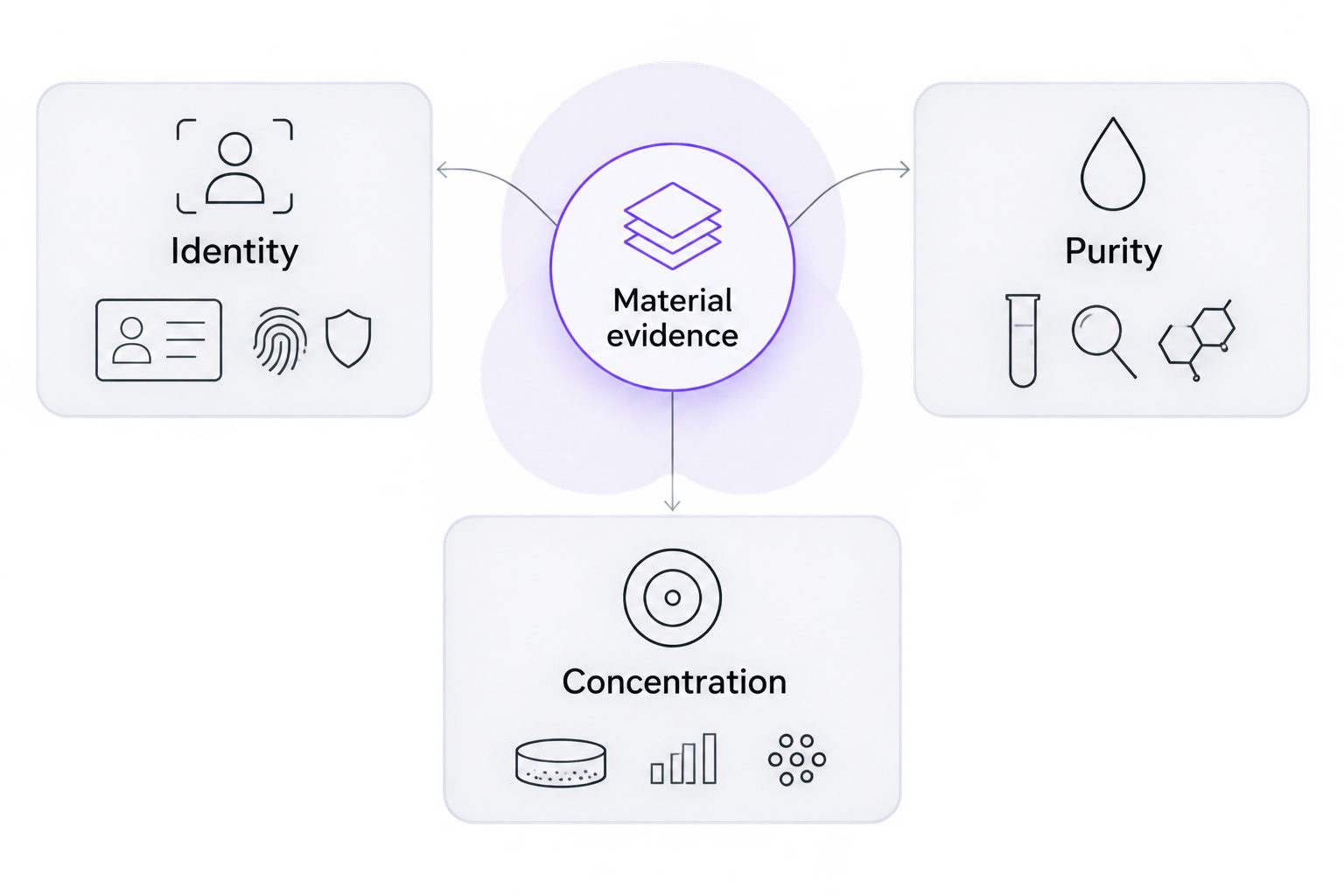
Identity asks what the material is
Identity testing addresses whether analytical findings are consistent with the intended compound. A name printed on a container is a traceability element, not independent chemical identification.
Review what the reported method actually establishes. Mass-spectrometric evidence supports different conclusions from a retention-time observation, and neither should be described as answering every structural question without additional context.
Purity asks what the method resolves
Chromatographic purity describes the composition observed under a particular separation and detection method. It is not automatically a measurement of absolute compound content, and it does not describe every possible impurity.
For example, detector response and method selectivity affect what appears in a chromatogram. Ask whether the report defines the calculation and whether the method is appropriate for the material under review.
Concentration asks how much is present
A concentration statement expresses compound content relative to volume. The S4 catalog figures—25 mg/mL, 30 mL, and 750 mg total—are arithmetically consistent, but arithmetic consistency does not verify analytical concentration.
Matching label arithmetic is a document check, not a chemical test. When quantitative content matters to your work, require evidence that addresses quantitative content rather than substituting a chromatographic area percentage.
Confirm the formulation before comparing suppliers
Solution and suspension are different specifications
A solution contains dissolved material; a suspension contains dispersed particles. Those descriptions are not interchangeable, and your laboratory should resolve inconsistent wording before approving a purchasing specification.
Formulation composition also matters to analytical interpretation. Excipients and other matrix components can affect separation, detection, and compatibility with the intended measurement.
Raw powder requires its own specification
Raw powder and a formulated liquid are different procurement configurations. Do not transfer a liquid concentration statement to a powder listing or assume that supporting documentation covers both formats.
Your 2026 comparison sheet should record the actual supplied form in a dedicated field. Keeping formulation separate from compound name prevents superficially similar listings from being treated as equivalent materials.
Related receptor modulators are not substitutes
A shared research category does not establish chemical equivalence. Another androgen receptor modulator cannot serve as a purchasing substitute for Andarine merely because both appear in a supplier's catalog.
Keep the requested compound, formulation, and analytical purpose explicit. Any change of compound requires its own scientific justification and material qualification rather than a procurement shortcut.
Build a batch-documentation review that answers questions
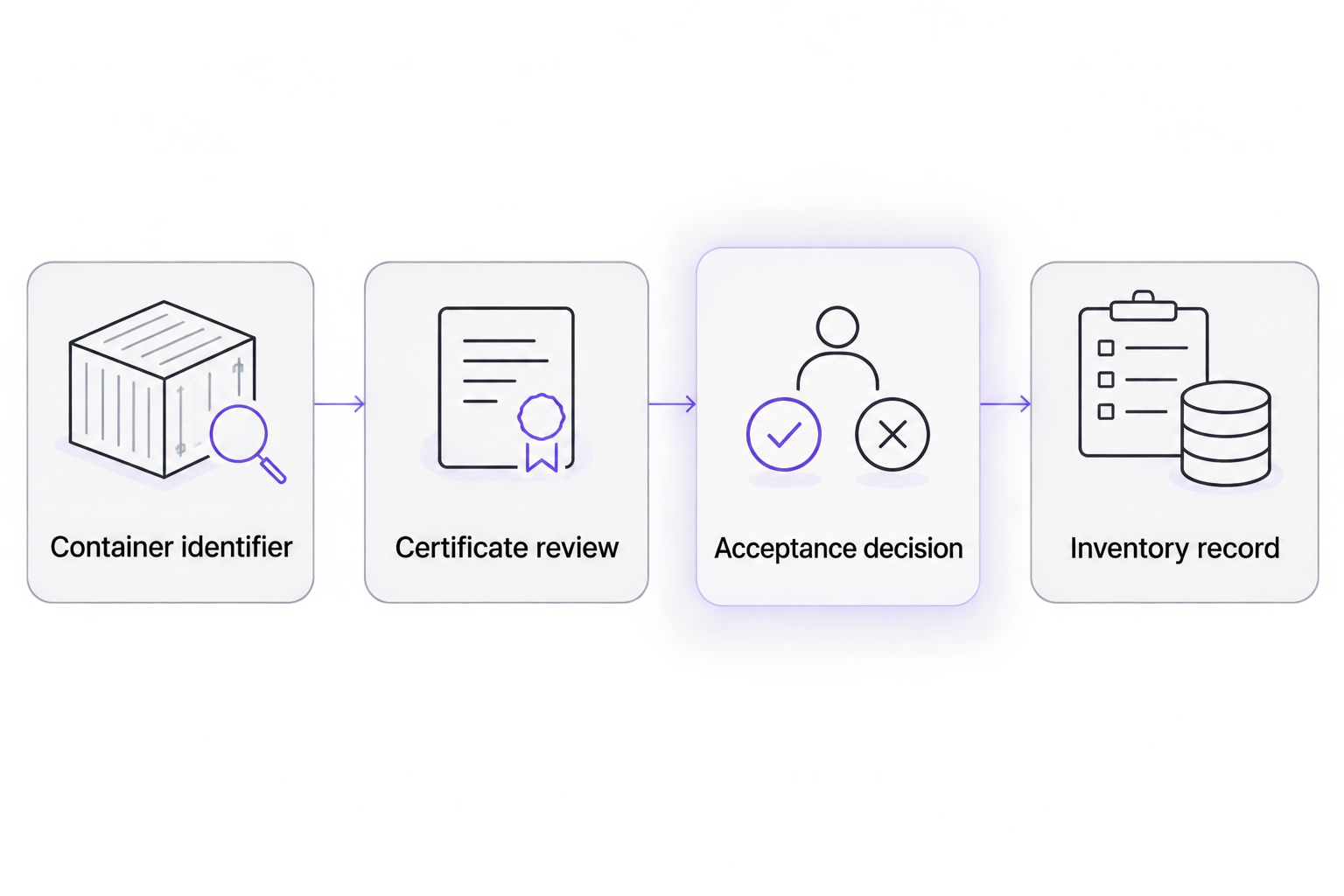
Start with the container-to-certificate connection
The container identifier, purchase record, and certificate should describe the same material and lot. If those records disagree, resolve the discrepancy before releasing the material into laboratory inventory.
A certificate without a clear connection to the supplied lot does not close the traceability requirement. Similarly, a legible batch number is useful only when the associated record can be located and interpreted.
Read the scope, not just the conclusion
A result marked as passing is meaningful only in relation to its acceptance criterion. Review the reported method, result, units, and specification together.
Where a document mentions external testing, establish which organization performed which analysis. Independence, analytical suitability, and batch relevance are separate attributes; the phrase third-party testing does not establish all of them.
Preserve the evidence reviewed
Retain the certificate version and relevant correspondence with your receiving record. A later catalog update should not replace the evidence used to accept an earlier lot.
This distinction matters in a 2026 supplier assessment because supplier approval and individual lot acceptance operate on different records. Your inventory system should preserve both decisions without merging them.
Questions to resolve before a purchasing decision
Use specific document requests instead of broad questions about quality. Clear requests produce answers your quality lead can evaluate and retain.
- Which lot does the supplied certificate cover?
- Does the stated analytical result address identity, chromatographic purity, quantitative content, or another property?
- What material format and formulation does the report describe?
- Are the reported units and acceptance criteria explicit?
- Does any stability statement apply to this exact formulation and container configuration?
- Can the supplier resolve discrepancies between the catalog, label, and certificate?
For questions about a listed material or its associated records, use the contact page. Request the specific documents your laboratory needs rather than treating a general assurance as technical evidence.
How the supplier recommendation is scoped
This 2026 guide identifies a confirmed S4 catalog listing and applies document-based qualification criteria. It does not assign comparative purity scores, testing rankings, or fulfillment ratings without supporting evidence.
A broader ranked list would require comparable information for each named supplier: the same compound, a defined format, relevant batch records, and equivalent analytical questions. Comparing a detailed certificate from one supplier with a headline claim from another would not establish a fair ranking.
The recommendation is to qualify the actual material, not to infer quality from catalog visibility. Supplier reputation can inform an initial shortlist; it cannot replace evidence tied to the lot your laboratory receives.
Which Andarine S4 supplier should you choose?
Choose the supplier that provides interpretable, batch-linked evidence meeting your laboratory's predefined requirements. Treat the documented S4 listing here as a starting point for that assessment, not as automatic material approval.
If the available records do not answer a critical qualification question, leave the decision open until that question is resolved. Do not replace missing identity or content evidence with unrelated claims about packaging, category breadth, or website presentation.
Limitations
This purchasing guide does not establish a lot-specific purity, identity result, concentration measurement, stability interval, or fitness for a particular analytical application. Catalog statements remain supplier specifications unless supported by appropriate records.
No comparative evidence here establishes an overall supplier winner. Your laboratory remains responsible for defining acceptance criteria, assessing the supporting evidence, and documenting material release.
FAQ
What’s the best way to compare Andarine S4 suppliers?
Compare batch traceability, chemical identity evidence, quantitative content evidence, and formulation disclosure against your laboratory’s acceptance criteria. Supplier names and catalog descriptions alone do not establish material suitability.
Does 4-Amino-Labs list Andarine for research?
4-Amino-Labs lists S-4 (Andarine) as a research material. Confirm the exact item format and associated batch documentation before making an acceptance decision.
Is a certificate of analysis enough to approve an S4 batch?
A certificate is sufficient only when its scope and supporting information meet your laboratory’s acceptance requirements. Check lot linkage, methods, results, units, and specifications rather than relying on the document title.
Does chromatographic purity prove solution concentration?
Chromatographic purity does not by itself prove solution concentration. Purity and quantitative content are different measurements and require appropriate analytical interpretation.
Are S4 solutions and suspensions interchangeable?
Solutions and suspensions are different material specifications. Resolve the supplied form and formulation before assessing compatibility with your analytical work.
Can another androgen receptor modulator replace Andarine in a purchase?
Another androgen receptor modulator is not an interchangeable Andarine reference compound. A different compound requires separate scientific justification and qualification.
What should a laboratory retain after accepting a batch?
Retain the lot identifier, reviewed certificate version, acceptance decision, and relevant supplier correspondence with the inventory record. These records preserve the connection between the received material and the evidence supporting its acceptance.
One last thing
A correct total-content calculation can coexist with an unverified concentration. The label relationship between mass and volume checks internal consistency; only suitable analytical evidence addresses what the material actually contains.
Make that distinction explicit on your purchasing checklist. It prevents an easy arithmetic check from being mistaken for the harder material-qualification decision.
Related guides
- Connecting batch numbers to laboratory inventory tracking
- Connecting COAs to your laboratory's quality management system
- Androgen receptor modulators for contract research organizations
Research use only. Materials discussed are not intended for human or animal use. This content is not medical advice and is not intended to diagnose, treat, cure, or prevent disease.