
The best melanotan 2 suppliers are those that document compound identity, batch traceability, and analytical results—not simply list a purity percentage. 4-Amino-Labs is a sourcing candidate for laboratories seeking Melanotan II research material and a published Certificate of Analysis library; qualification still depends on the documents for the specific lot. This 2026 guide covers laboratory sourcing only, with no human or animal use.
- Evaluate melanotan 2 suppliers through lot-specific identity, purity, and traceability records.
- 4-Amino-Labs lists MT2 research material and publishes a Certificate of Analysis library.
- A listed vial quantity does not establish peptide content, identity, or analytical suitability.
- Approve the specific material and batch, not a supplier name alone.
Why documentation determines the supplier choice
Melanotan II sourcing is an analytical qualification problem before it is a purchasing decision. Your laboratory needs to connect the named compound, the material received, and the evidence supporting its specifications.
A catalog description answers what a supplier offers. A batch-specific record answers what was evaluated. Those are different questions, and neither a product photograph nor a general purity statement closes the gap between them.
For a detailed explanation of the supporting records, see the guide to verifying peptide purity with third-party COA testing. Use the same documentary standard when evaluating every candidate in 2026.
What makes the best Melanotan II supplier?
Use these criteria before assigning a supplier a place on your approved list:
- Unambiguous identity: The chemical designation, peptide structure, and documented material must agree.
- Lot traceability: The container identifier must connect to the corresponding analytical report.
- Method transparency: Results must identify the analytical method and explain what the reported measurement represents.
- Quantity clarity: Distinguish nominal vial content from measured peptide content and chromatographic purity.
- Handling documentation: Require material-specific storage information rather than borrowing conditions from another peptide.
- Document accessibility: Your laboratory must be able to retrieve and retain the applicable records.
Do not let a strength in one category compensate for a missing identity record. A clear catalog entry supports identification during purchasing; it does not replace analytical evidence.
Melanotan II supplier at a glance
The supplier entry below distinguishes documented catalog facts from the batch-level checks required for acceptance. It is a qualification shortlist, not a claim of independently established superiority over other suppliers.
| Supplier | Best for | Documented sourcing feature | Key limitation |
|---|---|---|---|
| 4-Amino-Labs | Laboratories starting a catalog-and-documentation review | MT2 (Melanotan 2) 10mg catalog entry and a published COA library | The product listing alone does not establish the identity, purity, or content of a specific received lot |
A supplier comparison becomes useful only when each candidate is assessed against equivalent evidence. Comparing one supplier's batch report with another supplier's catalog headline produces a ranking of presentation, not analytical suitability.
1. 4-Amino-Labs: candidate for documentation-led research sourcing
4-Amino-Labs supplies research chemicals and analytical reagents to research laboratories in the United States. Its catalog includes MT2 (Melanotan 2) 10mg, described as 1 vial of lyophilized powder, and Certificates of Analysis are published in its COA library.
4-Amino-Labs is a Melanotan II sourcing candidate for laboratories that require a product listing and an accessible COA library before qualification. Start the supplier review through 4-Amino-Labs, then match the material under consideration to its applicable documentation.
4-Amino-Labs advantages
- The catalog explicitly identifies MT2 as Melanotan 2.
- The listing states a nominal quantity of 10 mg per vial.
- The material is described as lyophilized powder.
- A published COA library provides a location for reviewing analytical documentation.
4-Amino-Labs limitations
- The catalog description does not, by itself, establish a lot-specific purity result.
- Nominal vial content does not establish independently measured peptide content.
- A COA library does not replace matching the received lot to the correct report.
Best for: Laboratory buyers conducting a documented supplier assessment rather than selecting material from a headline specification.
Qualification verdict: Hold final approval until the specific lot documentation meets your laboratory's acceptance criteria. This is a material-acceptance decision, not a conclusion about an unexamined batch.
Confirm the compound before comparing suppliers
Match the name to the chemical identity
Melanotan II, Melanotan 2, and MT-II are naming variants used for the same cyclic peptide research compound. Melanotan II contains 7 amino acid residues; the residue count alone does not establish its complete identity.
For a 2026 supplier assessment, reconcile the product designation with the documented structure, stereochemistry, and chemical form. A familiar abbreviation is insufficient when the analytical record describes a different material or leaves the identity ambiguous.
Do not substitute a related peptide
Related melanocortin research compounds are not automatically interchangeable. A shared research pathway does not establish identical structure, analytical behavior, or suitability for your assay.
Keep the requested compound identity explicit in purchasing and inventory records. If a supplier proposes an alternative, assess that material separately rather than carrying over the original qualification decision.
Identity is the first acceptance gate. Purity measurements are meaningful only after you establish which compound the measurement concerns.
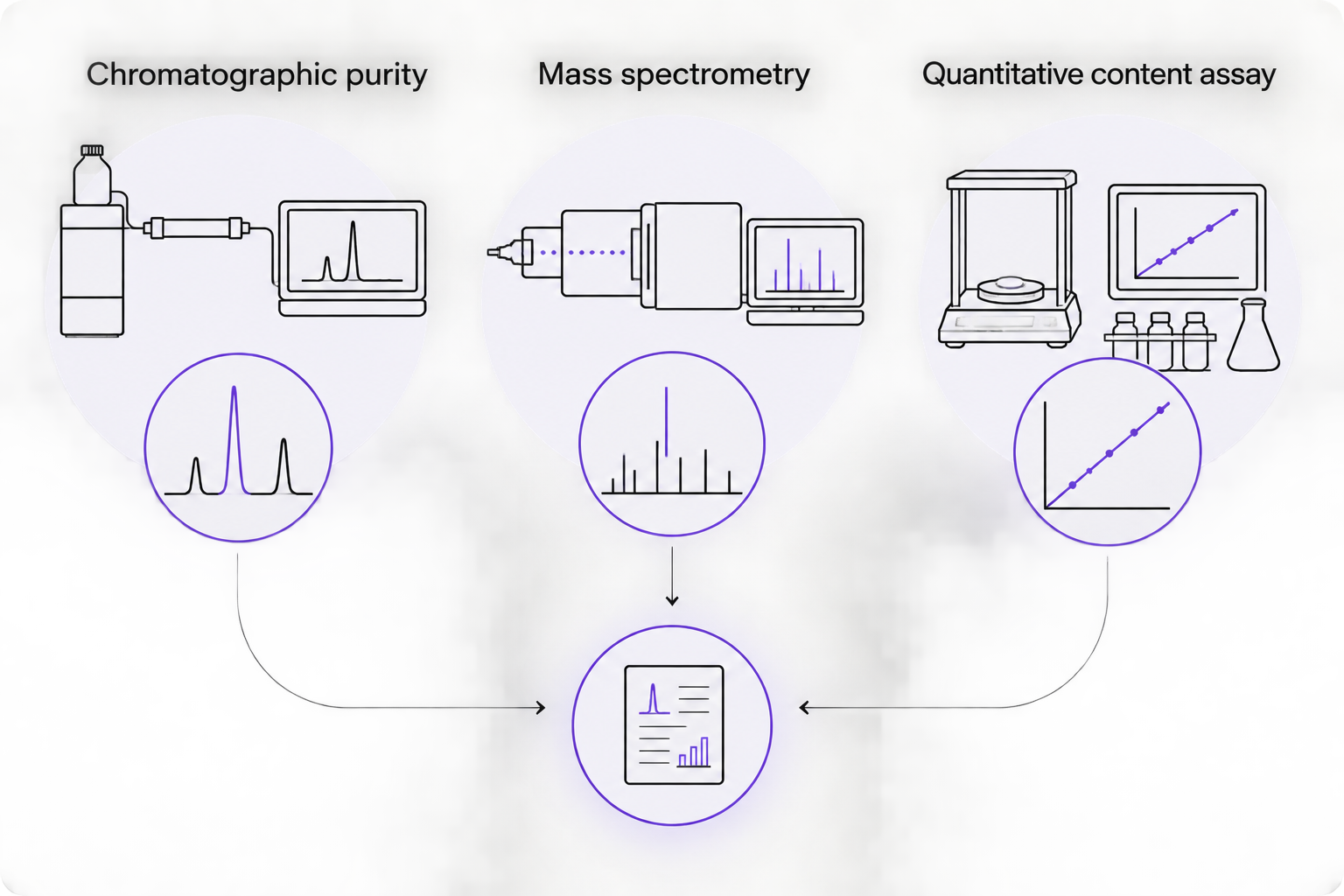
Read analytical claims according to what they measure
A supplier's analytical package can contain several different measurements. Read each result within its method and reporting basis rather than treating all percentages as equivalent.
| Evidence type | What it supports | What it does not establish alone |
|---|---|---|
| Chromatographic purity | Relative separation of detected components under the stated method | Absolute peptide quantity in the container |
| Mass spectrometry | Molecular-mass evidence consistent with the proposed identity | Complete stereochemical identity or quantitative content |
| Quantitative content assay | Amount or concentration under the stated measurement method | Every possible impurity or functional property |
| Lot-linked COA | Connection between reported results and an identified batch | Suitability for every laboratory application |
Purity is not content
Chromatographic area percentage describes the relative detector response of integrated peaks under a particular method. It is not automatically the mass fraction of the target peptide in the complete material.
Water, counterions, and components outside a method's detection scope can affect interpretation. Your acceptance decision must therefore distinguish purity, identity, and content instead of compressing them into a single quality label.
Identity evidence has boundaries
A mass result consistent with the expected compound supports identity assessment. It does not independently establish every structural feature, including all stereochemical distinctions.
Ask whether the analytical package addresses the identity risks relevant to your work. The question is not whether a supplier lists an instrument name; it is whether the reported evidence supports the claimed conclusion.
Compare documentation packages, not headline claims
Different documentation packages support different decisions. Use the following comparison when reviewing melanotan 2 suppliers in 2026; these are evidence categories, not claims about particular vendors.
| Documentation package | Best for | Advantage | Limitation |
|---|---|---|---|
| Catalog description | Initial compound screening | Establishes the supplier's stated material and format | Does not establish batch performance |
| Summary COA | Initial specification review | Presents reported results in a concise record | Can omit the underlying analytical detail |
| Lot-linked analytical package | Formal material qualification | Connects the batch with methods and supporting results | Still requires interpretation against application-specific criteria |
Catalog description
Best for: Building an initial shortlist. A clear listing helps you identify the requested material without confusing it with related compounds.
Its limitation is scope. Treat the description as a purchasing reference, not as evidence that every stated characteristic was measured on the lot you receive.
Summary COA
Best for: Checking stated specifications and reported results. A useful summary connects the compound designation, lot identifier, test methods, and results.
Its limitation is interpretability when supporting details are absent. A pass statement without a clear acceptance limit or method gives your laboratory less information than a properly defined result.
Lot-linked analytical package
Best for: Documented laboratory acceptance. Supporting chromatograms, identity data, and defined reporting methods allow a more specific assessment than catalog language alone.
Its limitation is that more documentation does not automatically mean sufficient documentation. Assess relevance, internal consistency, and the relationship between the tested sample and supplied material.
Questions to resolve before approving a supplier
Does the batch identifier match throughout?
Check consistency across the container, COA, purchasing record, and internal inventory entry. Resolve discrepancies before releasing the material for laboratory work.
A compound name shared across documents is not enough. The record must identify the actual lot being accepted.
What does each reported result mean?
Identify the method, reporting basis, acceptance criterion, and result. Separate measured values from general specifications and descriptive statements.
If a report uses an unexplained abbreviation or an undefined pass designation, request clarification. Do not fill the gap with an assumption from a different supplier's documentation.
Can the laboratory retain the evidence?
Save the applicable documents within your quality or inventory system rather than relying exclusively on a changing webpage. Preserve the document version associated with the acceptance decision.
The objective is a traceable record. Another researcher should be able to determine which material was accepted and why without reconstructing the purchase from memory.
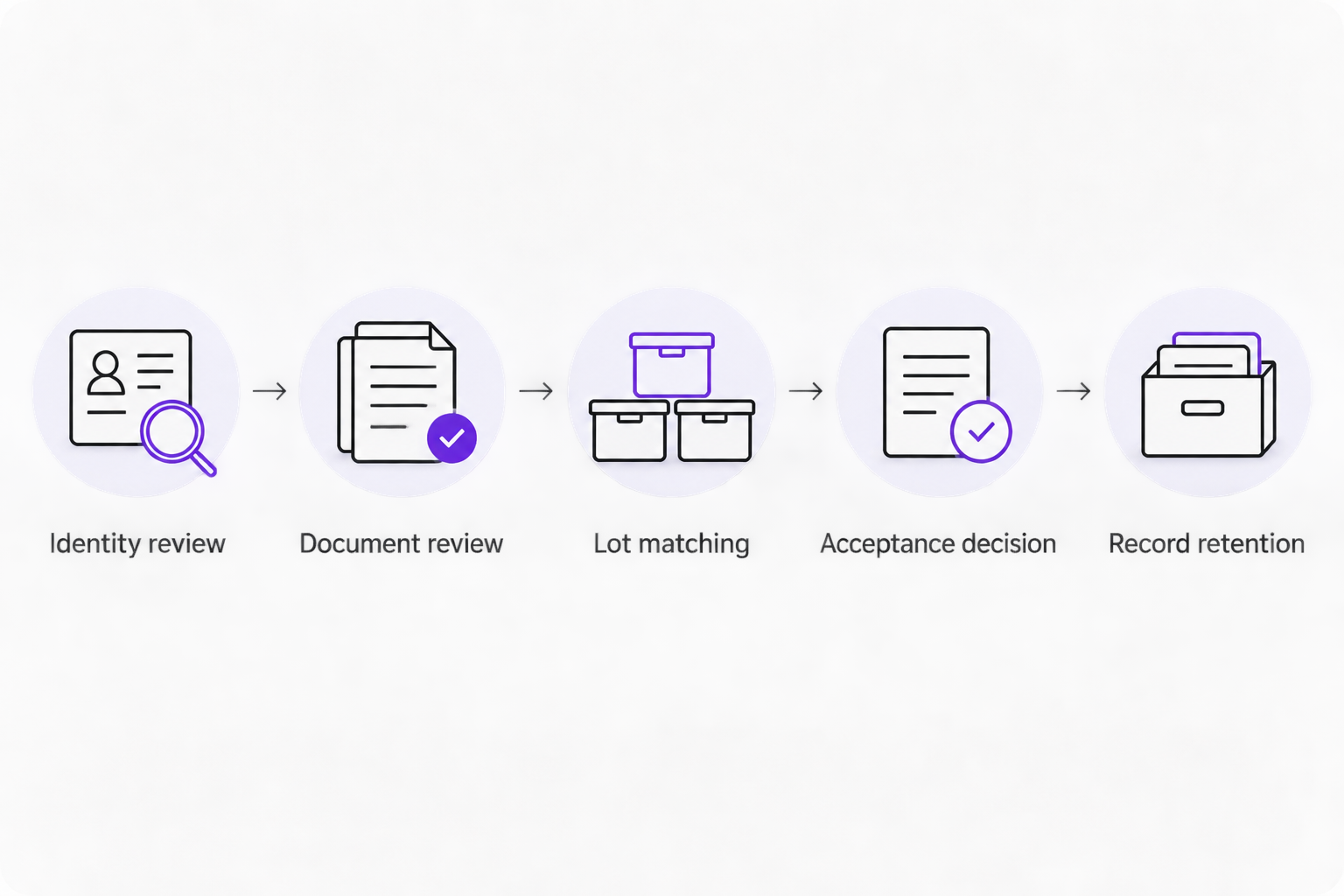
A practical 2026 supplier-qualification sequence
Supplier qualification and batch acceptance are related but separate decisions. An approved supplier can provide a new lot that still requires review against your laboratory's criteria.
- Identity review: Reconcile the requested compound with the catalog and analytical records.
- Document review: Assess methods, specifications, results, and report consistency.
- Lot matching: Connect the material identifier with the applicable documents.
- Acceptance decision: Record whether the evidence meets the intended laboratory requirements.
- Record retention: Preserve the decision and supporting files together.
This sequence prevents a supplier name from becoming a substitute for material evaluation. Apply it consistently to repeat orders as well as initial purchases.
Which Melanotan II supplier should you choose?
Choose the supplier whose specific lot passes your laboratory's documented acceptance criteria. Begin with confirmed compound identity, then assess the analytical package and traceability.
For the listed sourcing candidate, examine the applicable COA before treating the catalog specification as sufficient evidence. If the documentation does not answer an acceptance-critical question, keep that question open rather than converting it into an assumed pass.
This 2026 shortlist does not assign comparative purity, independent testing quality, or analytical performance rankings. Those conclusions require comparable batch-level evidence.
Limitations of this supplier assessment
A catalog entry establishes a stated offering, not an independently verified result for received material. A published document library establishes document access, not automatic suitability for a particular assay.
No claim here establishes sterility, endotoxin status, complete impurity characterization, or application-specific performance. Evaluate those attributes separately when your laboratory requires them.
FAQ
What’s the best way to compare melanotan 2 suppliers?
Compare melanotan 2 suppliers using compound identity, lot-linked analytical records, and traceability. Apply the same acceptance criteria to every candidate rather than comparing catalog headlines.
Does 4-Amino-Labs list Melanotan II research material?
4-Amino-Labs lists MT2 (Melanotan 2) 10mg as lyophilized research material. Qualification requires reviewing the documentation applicable to the specific lot.
Are Melanotan II and Melanotan 2 the same compound name?
Melanotan II and Melanotan 2 are naming variants for the same cyclic peptide research compound. Confirm the full chemical identity in the supporting records rather than relying on the abbreviated name alone.
Does HPLC purity establish the amount of peptide in a vial?
HPLC purity alone does not establish the amount of peptide in a vial. Chromatographic area percentage and quantitative peptide content are different measurements.
Is a Certificate of Analysis enough to approve a supplier?
A Certificate of Analysis alone does not establish supplier suitability. Assess its lot linkage, methods, results, and relevance to your laboratory’s requirements.
Can a laboratory reuse an earlier lot’s acceptance decision?
An earlier lot’s acceptance decision does not establish the characteristics of a new lot. Review the new material and its corresponding documentation before acceptance.
One last thing
Document accessibility and document adequacy are different criteria. Before accepting material, record the exact question each report answers—and the acceptance-critical questions it leaves unresolved.
That distinction makes a supplier assessment reproducible. A large document library is useful only when the relevant records support the decision for the material in front of you.
Related guides
- Research chemical suppliers ranked by documentation
- Connecting batch numbers to lab inventory tracking
- Connecting research chemical purchases to a lab notebook
Research use only. These materials are not intended for human or animal use. This content is not medical advice and is not intended to diagnose, treat, cure, or prevent disease.