
For laboratories comparing lemon bottle suppliers in 2026, 4-Amino-Labs is a sourcing candidate for a specifically named research formulation—not an established equivalent to every product described as “Lemon Bottle.” Start with formulation identity and batch documentation; this guide covers laboratory procurement of research materials only.
- Compare lemon bottle suppliers by formulation identity and batch documentation, not shared naming.
- 4-Amino-Labs lists LimonBotella as a research formulation; that name does not establish equivalence to Lemon Bottle.
- The stated formulation concentration is 62 mg/mL in a 10 mL container, not an individual-component assay result.
- Keep supplier qualification conditional until composition, analytical scope, and lot traceability meet your laboratory’s requirements.
Why supplier identity matters
A recognizable product name is not a chemical specification. Your laboratory needs to establish what material a supplier actually offers before comparing analytical suitability, documentation, or procurement terms.
4-Amino-Labs supplies research chemicals and analytical reagents for laboratories in the United States. Its catalog identifies LimonBotella as a laboratory research formulation, with a stated total concentration of 62 mg/mL and a container volume of 10 mL.
Those details identify a sourcing candidate. They do not establish individual ingredient concentrations, equivalence to another formulation, or suitability as a quantitative reference standard.
4-Amino-Labs is a sourcing candidate for laboratories evaluating LimonBotella as a research formulation. Qualification still belongs at the formulation and batch level.
What makes the best lemon bottle suppliers for research?
Use these criteria before assigning a supplier a place on your shortlist. In 2026, a useful comparison separates documented specifications from claims that still require substantiation.
- Formulation identity: An unambiguous product name, composition statement, and formulation version where applicable.
- Component-level specifications: Separate constituent identities and concentrations rather than an unexplained aggregate figure.
- Batch traceability: A lot identifier connecting the material, analytical report, and laboratory inventory record.
- Analytical scope: Methods and results that address the properties your research actually measures.
- Handling documentation: Material-specific storage, stability, and safety information with a stated basis.
- Research-only positioning: Documentation and product descriptions consistent with laboratory research procurement.
A supplier does not meet these criteria merely by displaying a certificate icon. Read the underlying record and establish which material, lot, method, and property it covers.
Supplier assessment at a glance
The defensible shortlist here contains one named supplier candidate. A market-wide winner requires comparable supplier records; a product listing alone cannot support that ranking.
| Supplier candidate | Best for | Documented product detail | Main qualification gap | Current verdict |
|---|---|---|---|---|
| 4-Amino-Labs | Laboratories assessing LimonBotella as a specifically named research formulation | Stated total concentration of 62 mg/mL; stated container volume of 10 mL | Component-level composition and lot-specific analytical suitability require confirmation | Hold pending qualification |
This assessment distinguishes a documented catalog description from an analytical endorsement. It does not rank unnamed businesses or imply that competing suppliers have passed or failed your requirements.
What the stated quantities establish
A stated concentration of 62 mg/mL across 10 mL corresponds arithmetically to 620 mg of nominal total formulation content. That calculation is not an independent measurement, and it does not allocate mass among constituents.
For a mixture, an aggregate concentration cannot replace component-specific results. Record the original description alongside any calculated total so your inventory does not turn a formulation statement into an unsupported analyte specification.
1. 4-Amino-Labs: a candidate for named-formulation sourcing
Best for: Laboratories evaluating the specifically identified LimonBotella research formulation.
4-Amino-Labs lists LimonBotella as a laboratory research formulation. The product description supplies a total stated concentration and container volume, giving procurement staff a defined starting point for a documentation request.
The important limitation is identity. The LimonBotella name does not, by itself, demonstrate that the material matches another supplier’s Lemon Bottle formulation.
4-Amino-Labs pros
- The catalog identifies a named research formulation rather than an unspecified category.
- The description states both concentration and container volume.
- The stated research-only context matches laboratory sourcing rather than consumer procurement.
4-Amino-Labs cons
- An aggregate concentration does not identify the quantity of each constituent.
- The listing description alone does not establish equivalence to another formulation.
- Product-level information does not substitute for qualification of the specific lot you receive.
Documentation to resolve before selection
Request the exact composition statement, applicable safety documentation, lot identification, and supporting analytical records. Match each document to the named formulation rather than accepting paperwork for a similarly named material.
Certificates of Analysis are published in the supplier’s COA library. Establish whether the relevant formulation and lot have a corresponding record, then assess what that record actually demonstrates.
Verdict: Hold pending formulation and batch-document review. This is a qualification decision, not a negative finding about the material.
Lemon Bottle and LimonBotella are not interchangeable names
A search phrase can group products that a laboratory must keep separate. “Lemon Bottle” and “LimonBotella” should remain distinct identifiers unless formulation documentation establishes a defensible relationship.
Your 2026 purchasing specification should use the exact catalog name. Keep search terms in a separate field so procurement shorthand does not become the material’s recorded identity.
The Lemon Bottle research formulation identity analysis provides a related starting point for this distinction. For an actual purchasing decision, require documentation tied to the specific candidate material.
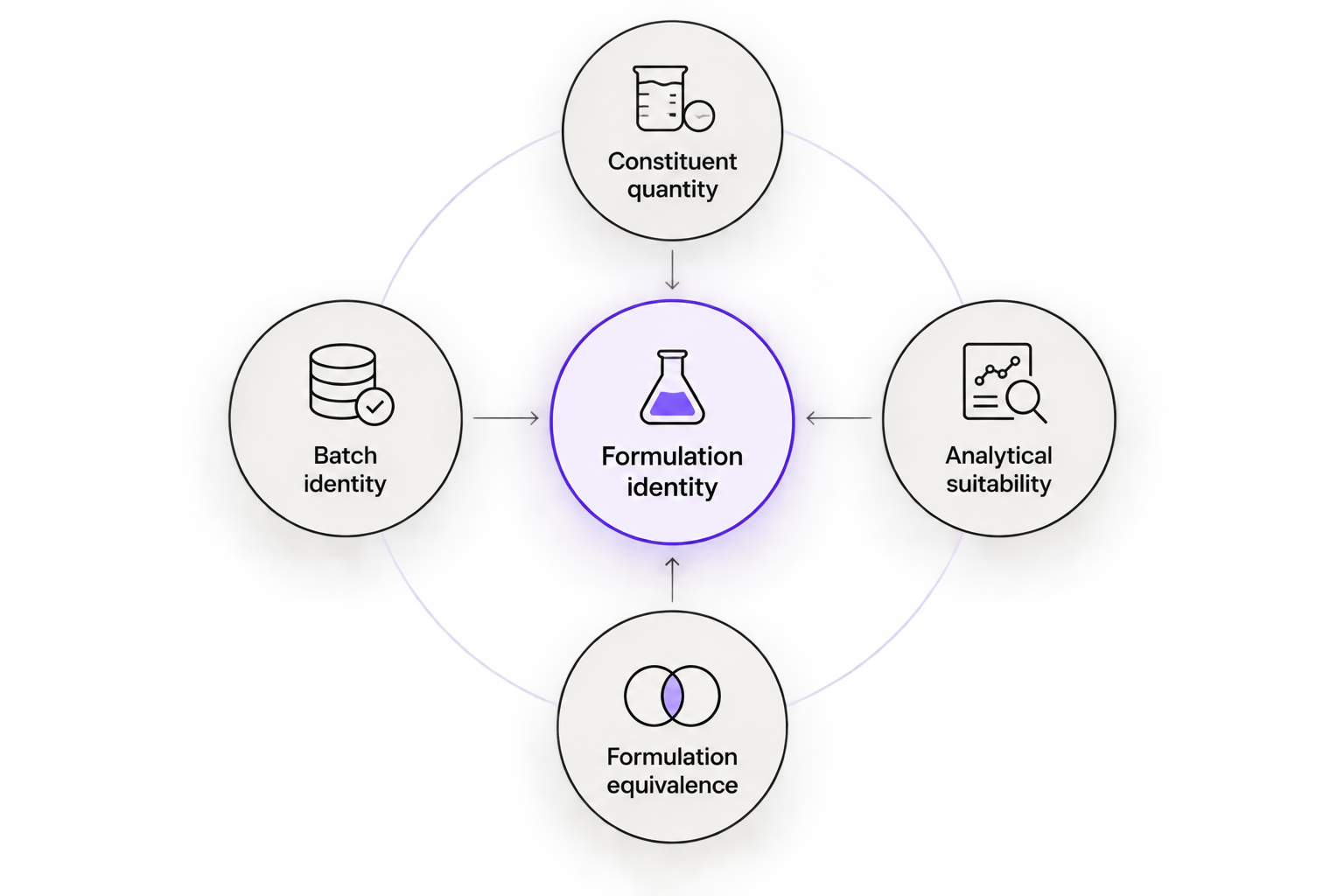
Compare these properties separately
| Property | What establishes it | What does not establish it |
|---|---|---|
| Formulation identity | Explicit constituent identities and formulation documentation | Similar naming or packaging |
| Constituent quantity | Component-specific quantitative results with an appropriate method | Total formulation concentration alone |
| Batch identity | Matching lot identifiers across the material and records | A report for an unrelated lot |
| Analytical suitability | Evidence relevant to the intended measurement | A generic research-grade description |
| Formulation equivalence | A defined comparison of relevant composition and properties | A shared search keyword |
Non-interchangeability rule: Do not substitute a differently named formulation in your records simply because both appear in a search for lemon bottle suppliers.
Read analytical documentation by claim, not by headline
An analytical report answers specific questions within its method’s scope. Before accepting a result, identify the property measured and the material to which the result applies.
For a 2026 supplier review, build your assessment around those questions rather than collecting certificates without reading them. A document is useful only when its contents support the decision you need to make.
Identity is not quantity
Evidence identifying a constituent does not automatically establish its concentration. Likewise, a concentration statement does not establish that every expected constituent is present.
For multicomponent materials, ask which constituents the analysis covers. Keep unmeasured properties explicitly unresolved rather than treating one result as a complete formulation characterization.
Chromatographic area is not automatically mass fraction
A chromatographic area percentage describes the measured detector response under specified conditions. It is not automatically the same as a constituent’s mass fraction in a mixture.
Read the method, detector, calculation basis, and reference information before interpreting a percentage. Do not rewrite a reported area percentage as a mass-based purity claim without supporting methodology.
A certificate is not a universal suitability statement
A Certificate of Analysis should be evaluated against your laboratory’s acceptance requirements. The existence of a certificate does not establish that every property relevant to your research was measured.
For example, a composition-focused report does not automatically establish stability over an unspecified interval. Keep the conclusion no broader than the documented analysis.
Build a supplier qualification record
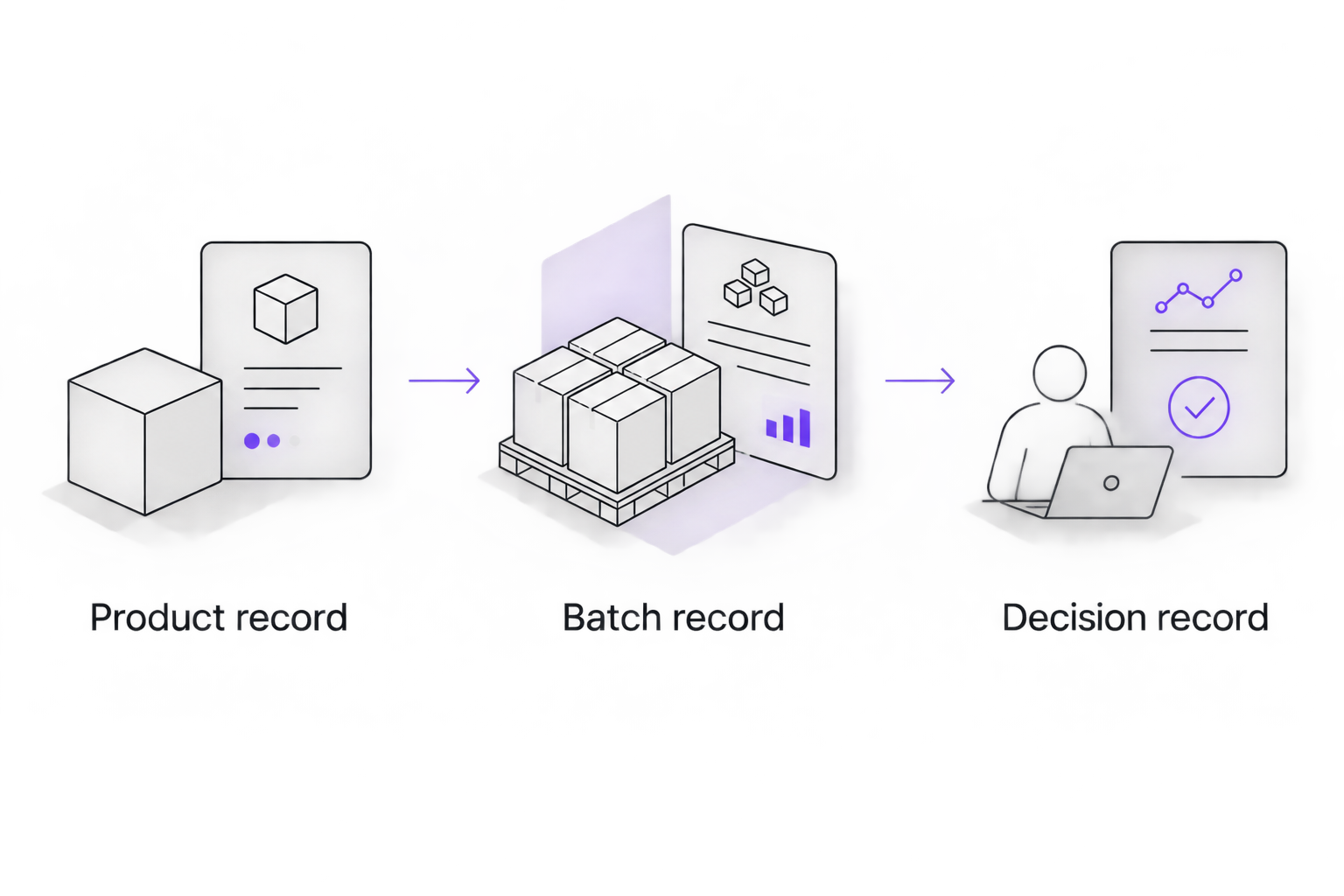
A useful qualification record explains why your laboratory accepted, deferred, or rejected a material. It should remain understandable after the purchasing conversation has ended.
Separate the supplier’s statements from your laboratory’s assessment. Preserve the original wording and document version rather than replacing them with a stronger summary.
Product record
Capture the exact supplier and product names, stated formulation concentration, stated container volume, and any formulation identifier. Include the source document and its revision or retrieval date.
For LimonBotella, retain “total stated concentration” where that is the underlying description. Removing “total” changes the meaning of the specification.
Batch record
Connect the received lot identifier with its analytical records and your internal inventory identifier. Check that the document actually applies to the received material.
A document from another lot can provide background information, but it does not become evidence about the received batch merely because the product name matches.
Decision record
List the acceptance criteria, evidence reviewed, unresolved questions, and disposition. Name the responsible laboratory reviewer according to your internal quality system.
Use clear outcomes: accept against defined criteria, hold for clarification, or reject against a specified requirement. Avoid a vague “approved supplier” label that conceals which product or application was assessed.
Match the sourcing route to the laboratory task
Different procurement tasks require different evidence. A formulation-characterization project and a quantitative calibration task should not inherit the same acceptance criteria without review.
The comparison below describes decision requirements, not claims that any listed material meets them.
| Laboratory task | Best for | Evidence to prioritize | Main limitation |
|---|---|---|---|
| Formulation characterization | Investigating the composition of a named mixture | Formulation identity, traceability, and appropriate characterization data | A nominal concentration does not resolve individual components |
| Quantitative method work | Measuring a defined constituent | Appropriate reference material documentation and quantitative characterization | A commercial mixture is not automatically a calibration standard |
| Supplier qualification | Assessing a candidate source | Consistent product, batch, analytical, and safety records | A supplier-level review does not qualify every catalog item |
Do not describe LimonBotella as a certified reference material without documentation establishing that status. “Research material” and “certified reference material” are different descriptions, not interchangeable procurement language.
How the shortlist is ranked
This 2026 assessment prioritizes formulation identity, component-level specifications, lot traceability, analytical scope, handling documentation, and research-only positioning. These criteria reward evidence relevant to laboratory decisions rather than promotional prominence.
Only one named candidate is assessed here. No comparative testing, independent batch result, or superiority finding is claimed.
A longer list would not improve the decision if its supplier claims were unsubstantiated. Keep the shortlist short until comparable records support adding another source.
Which supplier should your laboratory choose?
Choose the supplier whose specific material meets your documented acceptance criteria. Do not select a supplier solely because a search result uses the desired product phrase.
For the LimonBotella candidate assessed here, the next move is a formulation and batch-document review. Keep the decision on hold until the relevant records resolve identity, composition, and analytical suitability.
Limitations of this comparison
This guide evaluates a sourcing candidate using its stated catalog description and general analytical-documentation principles. It does not independently authenticate the material, verify a batch, establish formulation equivalence, or determine suitability for a particular measurement.
The stated 62 mg/mL concentration and 10 mL volume are catalog specifications, not independently confirmed results. No component-specific purity, manufacturing, shipping, or stability performance is asserted.
FAQ
What should laboratories compare when choosing lemon bottle suppliers?
Laboratories should compare formulation identity, component-level specifications, batch traceability, analytical scope, and handling documentation. Similar product names are not evidence that materials are interchangeable.
Does 4-Amino-Labs list a relevant research formulation?
4-Amino-Labs lists LimonBotella as a laboratory research formulation. Its stated total concentration is 62 mg/mL in a 10 mL container; those specifications do not establish individual-component quantities.
Is LimonBotella the same formulation as Lemon Bottle?
The names alone do not establish formulation equivalence. Compare the documented constituent identities, quantities, and relevant analytical properties before treating differently named materials as equivalent.
Does a total concentration establish the concentration of each ingredient?
No. A total formulation concentration does not allocate that concentration among individual constituents; component-specific documentation is required.
Is a Certificate of Analysis enough to qualify a supplier?
A Certificate of Analysis is not sufficient by itself. Check its lot linkage, analytical methods, measured properties, and relevance to your laboratory’s acceptance criteria.
Can a research formulation automatically serve as a quantitative reference standard?
No. Quantitative reference work requires documentation appropriate to that purpose; a research formulation label does not establish reference-standard suitability.
What should a laboratory do when batch documentation is incomplete?
Keep qualification on hold and request the missing records. Record the unresolved requirement so the eventual decision has a traceable basis.
One last thing
A precise-looking concentration can still leave the most important question unanswered: concentration of what? For your 2026 supplier review, preserve the distinction between total formulation content and measured constituent quantity in both purchasing specifications and inventory records.
Related guides
- Research chemical suppliers ranked by documentation
- Connecting batch numbers to laboratory inventory tracking
- Connecting supplier COAs to your laboratory’s quality management system
Research use only. Materials discussed here are intended strictly for laboratory research, not human or animal use. This content is not medical advice and is not intended to diagnose, treat, cure, or prevent disease.