
Lyophilized peptides have no universal shelf life before reconstitution: the defensible interval is the one supported by stability data for the specific compound, formulation, container, and storage conditions. Removing water slows several degradation pathways but does not eliminate residual moisture, oxidation, or physical changes. This 2026 guide addresses research-material stability and laboratory documentation only, not human or animal use.
- How long do lyophilized peptides remain stable before reconstitution? Follow compound-specific, batch-applicable stability documentation.
- Lyophilization reduces water content; it does not establish an expiration date or eliminate degradation.
- 4-Amino-Labs research peptides require compound-specific assessment; release purity alone does not establish storage stability.
- An intact seal, documented storage history, and suitable analytical testing support a defensible material-use decision.
How long do lyophilized peptides remain stable before reconstitution?
Use the documented expiration or retest date only under the conditions to which that date applies. A duration copied from another peptide, a different formulation, or an unrelated supplier does not establish how long your material remains suitable.
The underlying scientific distinction is between initial quality and quality maintained during storage. A release certificate describes a tested sample at a particular time; a stability assessment examines change over time under defined conditions. Lyophilization is a preservation process, not evidence of indefinite stability. [1, 2]
| Evidence available | What it establishes | What it does not establish |
|---|---|---|
| Release certificate of analysis | Reported results for the tested batch sample | Continued compliance throughout storage |
| Real-time stability results | Measured change under the studied conditions | Performance under unstudied conditions |
| Accelerated stability results | Degradation behavior under defined stress | An automatic replacement for real-time evidence |
| Expiration or retest statement | The supplier's stated assessment boundary | Suitability after undocumented excursions |
Why this matters
A peptide that has changed during storage introduces uncertainty into analytical and mechanistic research. An unchanged-looking powder does not remove that uncertainty.
Connect the vial identifier, certificate, receipt date, and storage record before interpreting an age-related quality question. The guide to connecting batch numbers to lab inventory tracking addresses the traceability side of that decision.
At a glance: specifications are not stability claims
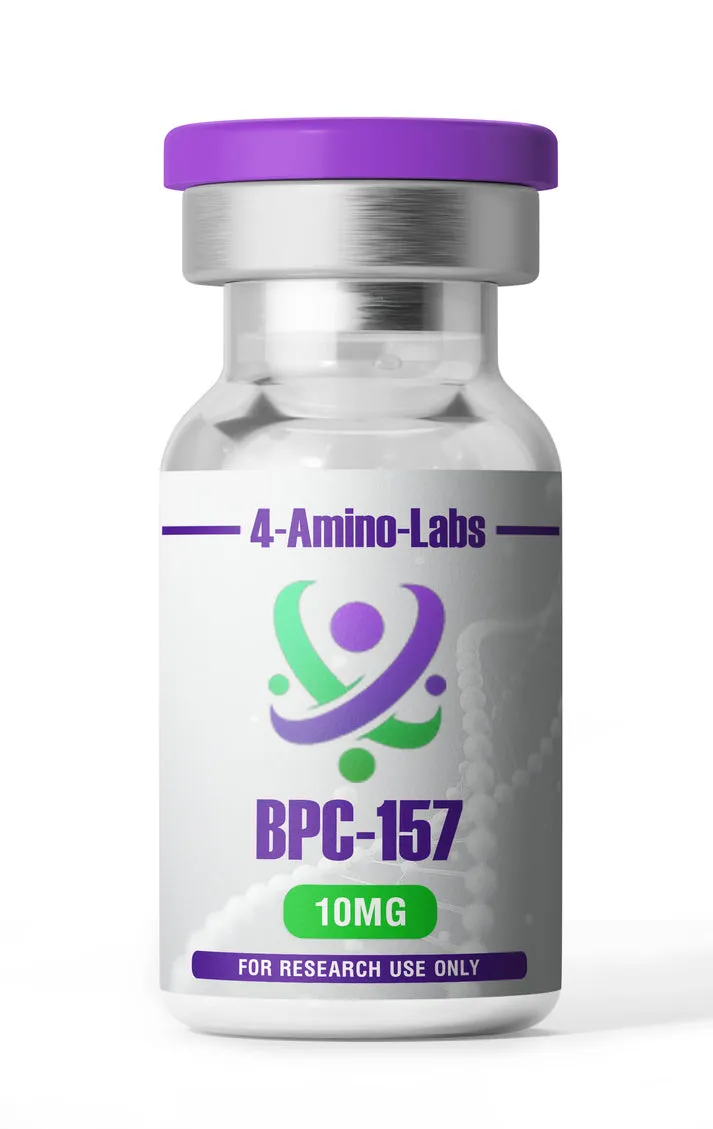
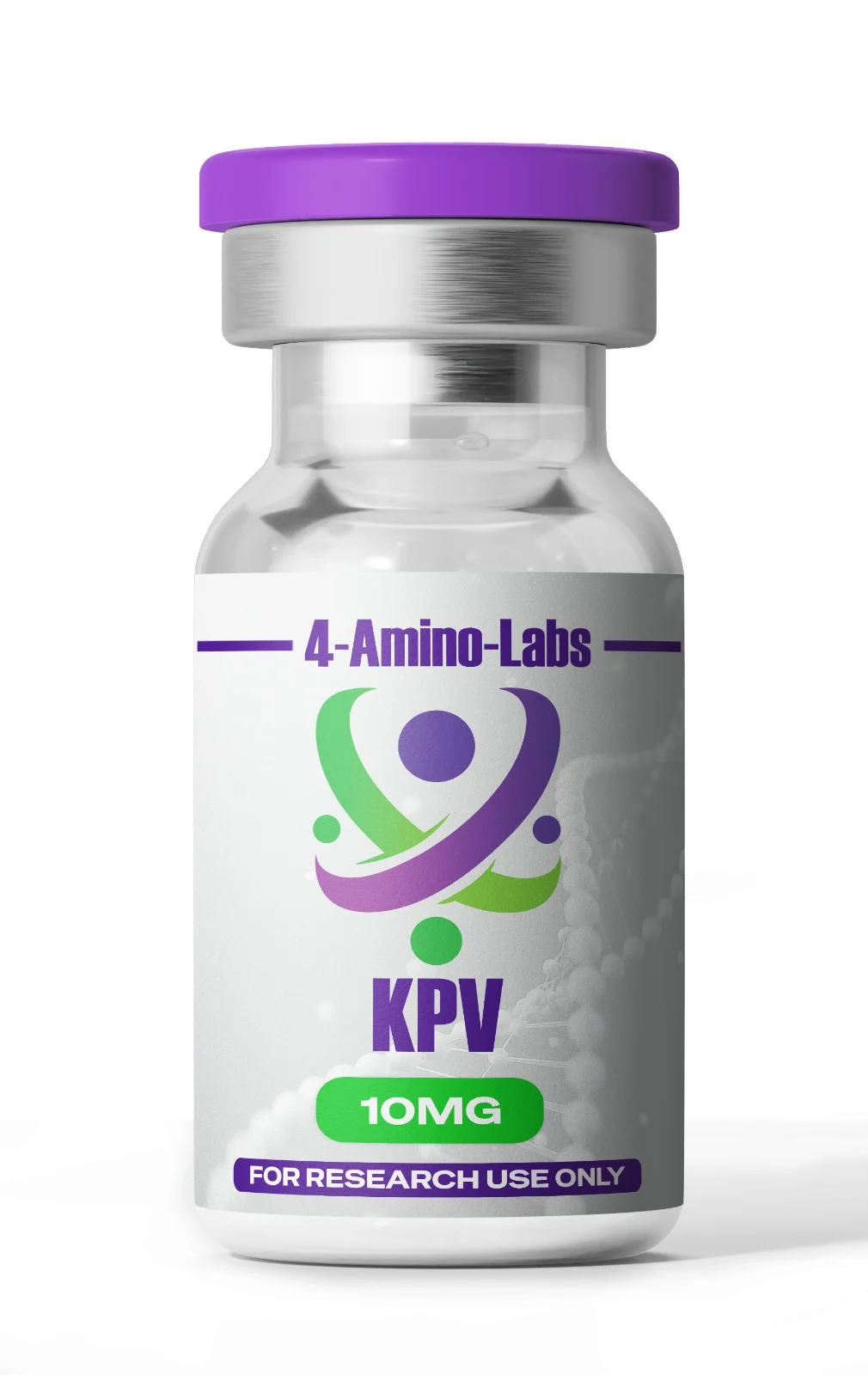
The supplied 4-Amino-Labs listings illustrate why laboratories must distinguish material specifications from shelf-life evidence. BPC-157 10mg lists 10 mg of peptide per vial and purity of ≥99% verified by HPLC; KPV (10mg) lists purity of ≥98% verified by HPLC. These are listed product specifications, not measurements of how either material changes during storage.
Your 2026 inventory record should keep content, chromatographic purity, and stability status in separate fields. Combining them into a single quality label hides information that matters when deciding whether an older lot needs reassessment.
What lyophilization changes—and what it leaves unresolved
Water removal reduces some degradation pathways
Lyophilization removes water from a frozen preparation through sublimation, followed by further drying. Lower water content and reduced molecular mobility can slow chemical reactions and physical deterioration in a suitable solid formulation. [1, 2]
The important qualification is suitable formulation. Peptide sequence, excipients, residual moisture, and the physical state of the dried material all influence the result. A visually acceptable cake is not a measurement of any of those properties.
Dry material is not chemically inert
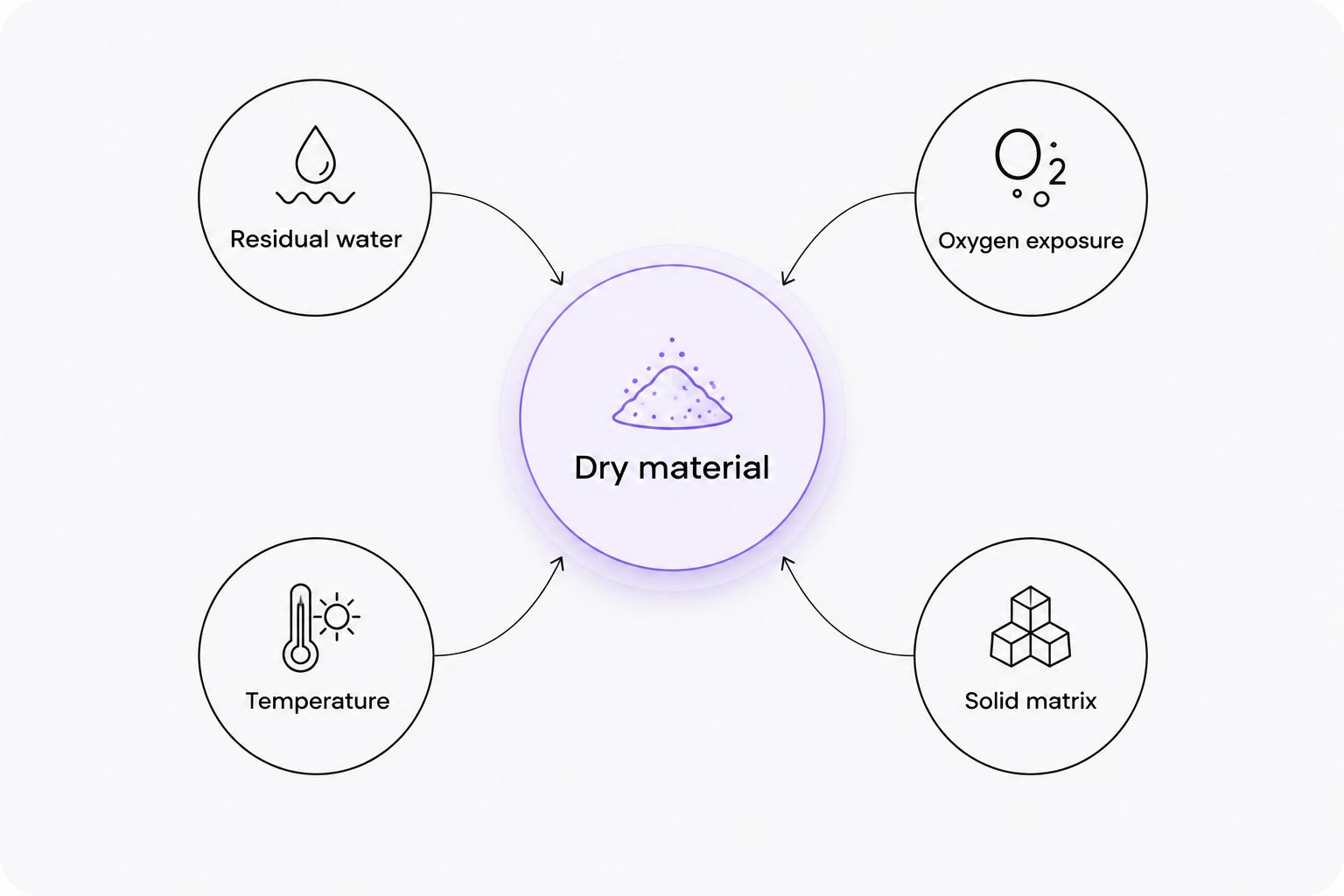
Residual water remains relevant after drying. Oxygen exposure, temperature, and interactions within the solid matrix also affect degradation, depending on the molecule and formulation. [1–3]
Oxidation, deamidation, and aggregation are distinct failure modes. Their relative importance must be established for the peptide being assessed rather than assumed from the word lyophilized.
Sequence and formulation prevent class-wide predictions
Peptides do not share a single degradation rate. Susceptible residues, chemical modifications, molecular association, and formulation composition change the pathways available during storage. [1–3]
Non-interchangeability rule: stability evidence belongs to the studied material and conditions. Do not transfer an interval between peptides because both arrive as white lyophilized powder, share a research category, or have similar listed purity.
Why lyophilized peptide stability varies
These factors explain why a general calendar estimate cannot replace material-specific evidence:
- Peptide chemistry: sequence and modifications determine which chemical changes are possible and analytically relevant.
- Residual moisture: water remaining after drying influences the solid-state environment and degradation behavior.
- Formulation and physical state: excipients and matrix properties affect molecular mobility and interactions.
- Temperature history: actual exposure matters, not just the intended storage location.
- Container integrity: the closure system helps control exchange with the surrounding environment.
- Oxygen and light exposure: susceptibility depends on the molecule and the protection provided by its packaging.
These are recognized stability considerations, not a formula for calculating an expiration date. Their importance must be evaluated together. [1–3]
For your 2026 records, distinguish an observed condition from an assumption. A freezer location is an observed storage assignment; uninterrupted compliance requires a supporting temperature history.
What documentation supports a storage interval?
Match the material and container
Start with the exact compound identity, batch identifier, formulation, and container-closure configuration. A study on bulk powder does not automatically establish the stability of a separately packaged preparation.
Ask whether the stated interval applies to unopened material and whether it begins at manufacture, release, or another documented event. Receipt date is useful for inventory management, but it does not reset the material's age.
Read the date's meaning
An expiration date and a retest date are not interchangeable. A retest date identifies a point at which reassessment is required under the applicable quality system; it is not permission to extend use without that reassessment.
For a research reagent, obtain the supplier's definition and supporting conditions rather than importing assumptions from another product category. Record the document revision so a later change remains traceable.
Check the endpoints
A meaningful stability assessment identifies what was measured and what counted as acceptable. Depending on the material, relevant endpoints include identity, chromatographic purity, content, degradation products, moisture, and physical properties. [1, 2]
A statement that a sample passed is less informative than the underlying results, methods, and acceptance criteria. A storage interval is only as useful as the measurements used to support it.
What analytical tests can—and cannot—tell you
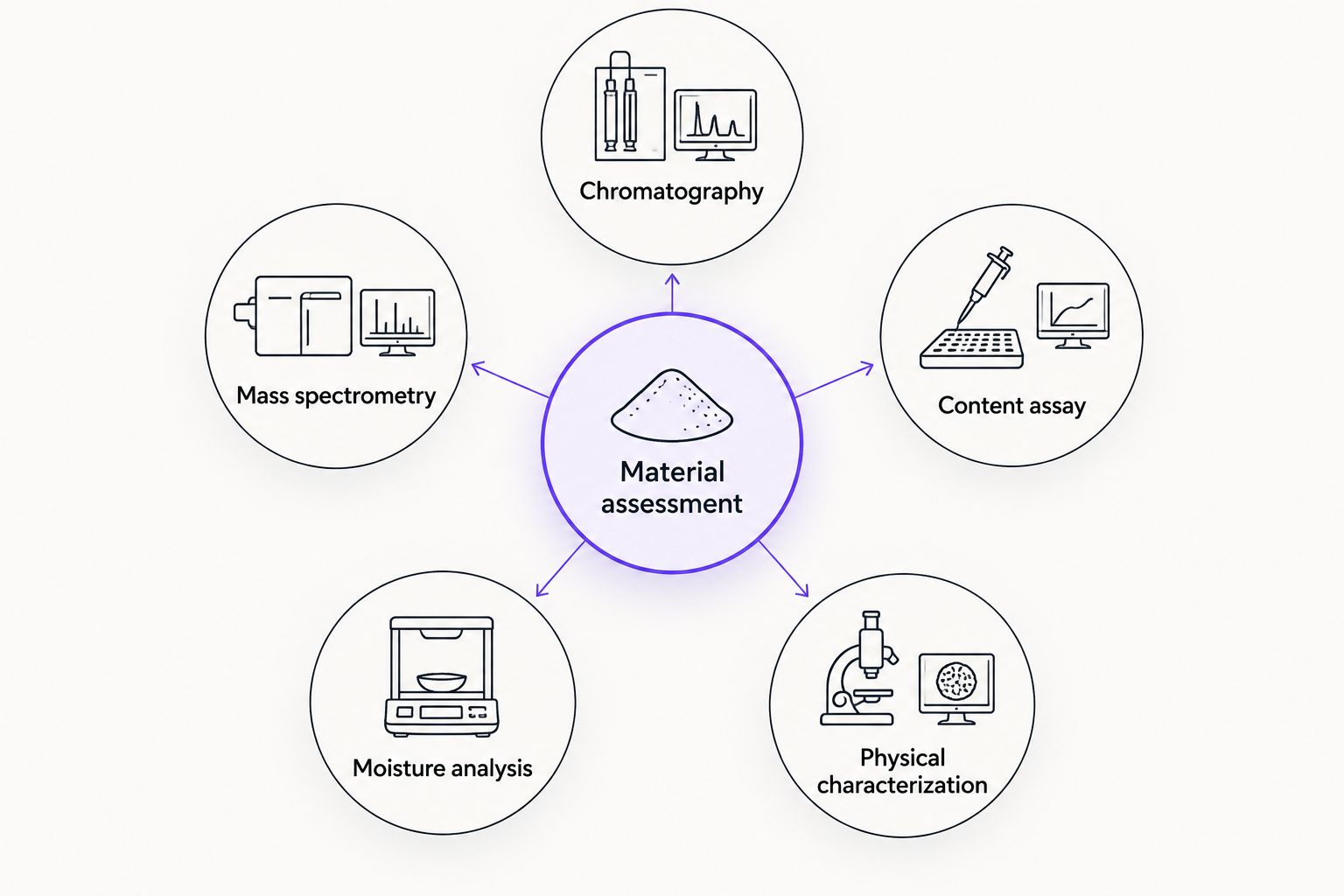
No single assay answers every stability question. Select measurements according to the material's known liabilities and the requirements of the intended laboratory analysis.
| Analytical approach | Principal contribution | Important limitation |
|---|---|---|
| Stability-indicating chromatography | Separates the target from detectable degradation products | Unresolved or undetected species remain a concern |
| Mass spectrometry | Supports molecular identity and characterization of mass changes | Mass alone does not establish complete purity |
| Quantitative content assay | Evaluates the amount of target material | Requires suitable calibration and method performance |
| Moisture analysis | Measures water associated with the material | Does not independently establish chemical integrity |
| Physical characterization | Examines relevant solid-state or aggregation properties | Must match the material and suspected failure mode |
Chromatographic purity is not total peptide content
An HPLC area percentage describes detector response under a particular method. It is not automatically a mass fraction, an absolute content measurement, or proof that all degradation products were resolved.
Similarly, a matching molecular mass supports identity but does not, by itself, exclude every structurally related impurity. Orthogonal methods answer different questions; agreement between suitable methods is more informative than repetition of the same limited measurement.
Compare like with like
Trend interpretation requires comparable methods and sample handling. A difference between certificates produced by unrelated methods does not automatically measure degradation.
For a 2026 reassessment, document the analytical method, reference material, reporting basis, and relevant uncertainty. Interpret any change against predefined acceptance criteria rather than deciding after seeing the result.
How should a laboratory assess an older unopened vial?
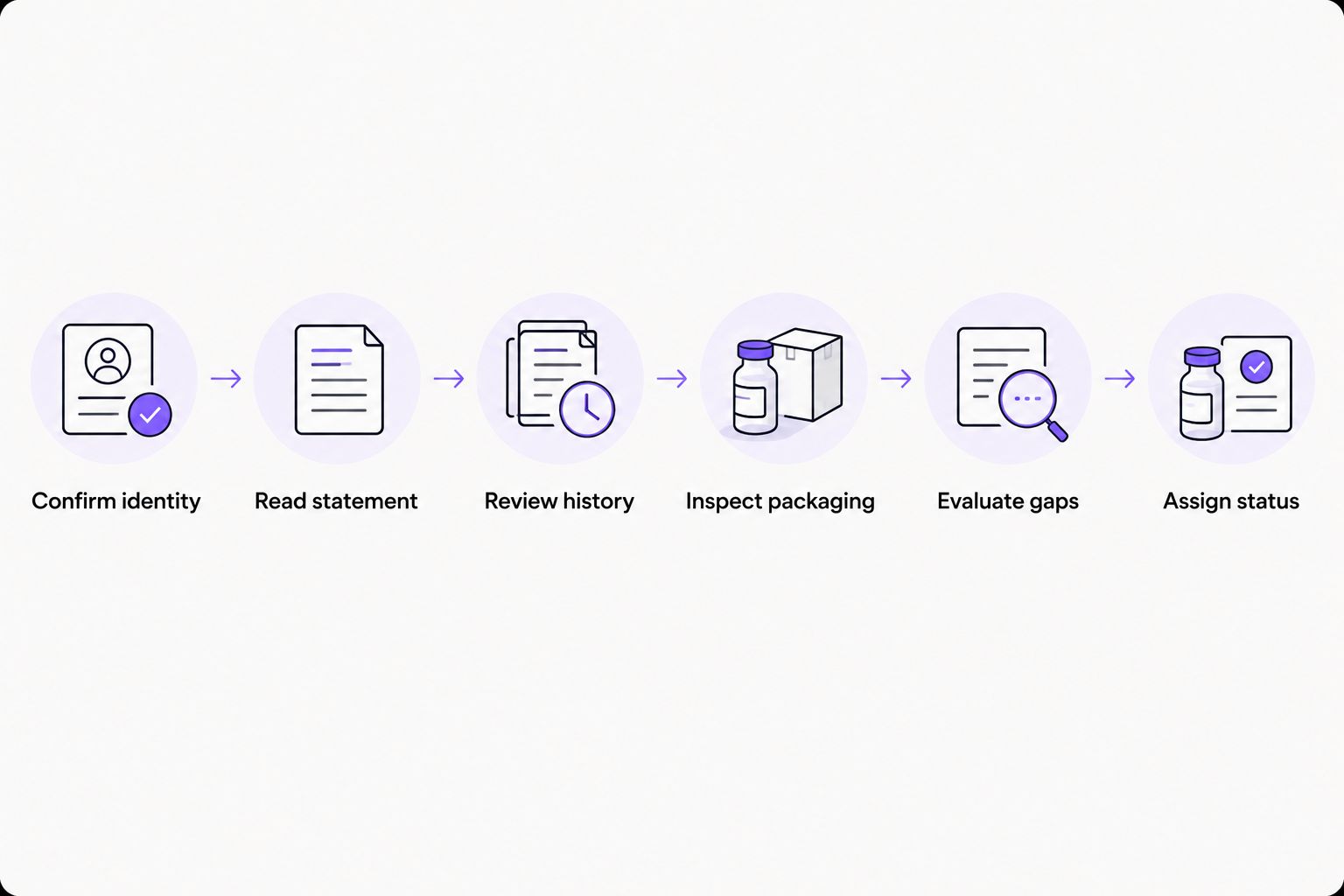
Assess the evidence before assigning an age-based decision. The following is a documentation and quality-review sequence, not a preparation or experimental-use procedure.
- Confirm identity. Match the vial label to the inventory record and batch documentation.
- Read the storage statement. Identify the conditions and date boundary that apply to that material.
- Review history. Check receipt records, storage logs, transfers, and any documented excursions.
- Inspect packaging. Record a damaged closure, visible moisture, or another packaging anomaly without treating appearance as a chemical assay.
- Evaluate evidence gaps. Separate missing records from demonstrated nonconformance; they are different findings.
- Assign status. Apply the laboratory's quality process for acceptance, quarantine, reassessment, or rejection.
An elapsed date does not identify the degradation pathway. Conversely, being within a stated interval does not resolve evidence of a compromised closure or an excursion outside documented conditions.
Keep the resulting disposition attached to the batch record. An email explaining an exception is not useful if the next researcher cannot connect it to the vial being assessed.
How do product specifications fit into sourcing?
4-Amino-Labs supplies research peptides, but a product listing and a batch stability record serve different purposes. For laboratory sourcing, assess the exact material documentation rather than interpreting a purity specification as a shelf-life guarantee.
The examples below provide a narrow specification comparison. Neither listing excerpt establishes a storage duration, and the compounds are not interchangeable.
| Research material | Specification stated in the supplied listing | Documentation still needed for an age-related decision |
|---|---|---|
| BPC-157 10mg | Lyophilized powder; ≥99% purity verified by HPLC | Applicable stability interval, conditions, and batch history |
| KPV (10mg) | Lyophilized powder; ≥98% purity verified by HPLC | Applicable stability interval, conditions, and batch history |
These 4-Amino-Labs research materials are relevant examples of why documented release specifications help identify a material but cannot answer every storage question. Request clarification when the scope of a date or storage statement is unclear.
Limitations of a general stability guide
This 2026 guide explains stability principles; it assigns no expiration date to any listed product. General formulation literature establishes relevant mechanisms, not the shelf life of an untested commercial batch.
A storage excursion also requires case-specific assessment. Neither a brief description of the event nor an unchanged appearance establishes whether a material still meets its analytical requirements.
Finally, dry-state evidence does not establish solution stability. Once the material's physical environment changes, the relevant degradation behavior and supporting evidence must be evaluated separately.
FAQ
How long do lyophilized peptides remain stable before reconstitution?
Lyophilized peptides remain suitable for the interval supported by compound-specific, batch-applicable stability documentation under the stated conditions. There is no defensible universal duration for the entire category.
Does an unopened vial mean a lyophilized peptide is still stable?
An unopened vial does not prove continued stability. Closure integrity, storage history, material age, and applicable analytical evidence still matter.
Does high HPLC purity establish a peptide’s shelf life?
High HPLC purity does not establish shelf life. A release result describes the tested sample, while stability evidence measures change over time under defined conditions.
Can I apply one peptide’s storage interval to another peptide?
One peptide’s storage interval does not establish another peptide’s stability. Sequence, modifications, formulation, residual moisture, and packaging affect degradation behavior.
Does a normal-looking lyophilized cake prove the material is unchanged?
A normal-looking cake does not prove chemical integrity. Visual inspection cannot replace suitable identity, purity, content, or other stability-related measurements.
Is a retest date the same as an expiration date?
A retest date is not the same as an expiration date. Follow the supplier’s definitions and the laboratory’s quality process before extending a material’s status.
Does dry-state stability establish stability after reconstitution?
Dry-state stability does not establish stability after reconstitution. The changed physical environment requires separate evidence relevant to the resulting research material.
One last thing
The most useful storage record explains both the date and its basis. Record whether a date comes from stability evidence, a supplier statement, or an internal review requirement; identical calendar entries can represent very different levels of support.
References
- Wang W. Lyophilization and development of solid protein pharmaceuticals. International Journal of Pharmaceutics. Scope: drying, formulation, and stability of solid protein preparations; not product-specific peptide shelf lives.
- Chang L, Pikal MJ. Mechanisms of protein stabilization in the solid state. Journal of Pharmaceutical Sciences. Scope: solid-state stabilization mechanisms and the roles of formulation and molecular environment.
- Manning MC, Chou DK, Murphy BM, Payne RW, Katayama DS. Stability of protein pharmaceuticals: an update. Pharmaceutical Research. Scope: chemical and physical degradation mechanisms; not validation of the research products discussed here.
Related guides
- Research peptide storage and cold-chain workflow
- Verifying peptide purity with third-party COA testing
- Tracking cold-chain peptide shipping
Research use only. All materials discussed are intended strictly for laboratory research, not human or animal use. This content is not medical advice and is not intended to diagnose, treat, cure, or prevent disease.