
Bioavailability differs sharply between oral and parenteral L-carnitine, because the two routes meet different transport systems and different metabolic fates before the molecule reaches systemic circulation. All material and analysis described here is for laboratory research use only.
- Yes: oral L-carnitine absorption is transporter-limited and saturable, while parenteral delivery bypasses the gut entirely.
- Published pharmacokinetic work reports oral absolute bioavailability of roughly 5% to 18% at pharmacological amounts.
- Gut microbial metabolism of unabsorbed L-carnitine is a second route-dependent variable that assay design must account for.
- For research use, route choice is a model-design decision, and compound documentation should be matched to that decision.
Does bioavailability differ between injectable and oral L-carnitine?
It does. Absolute bioavailability is defined against the intravenous route, which is 100% by definition because the entire quantity enters the circulation. Oral L-carnitine does not reach that figure. A comprehensive pharmacokinetic review reports oral bioavailability of roughly 5% to 18% for pharmacological amounts and 54% to 86% for the smaller amounts present in food 1.
The gap is not a formulation quirk. It follows from how a small, polar, zwitterionic molecule crosses the intestinal wall. L-carnitine is a quaternary ammonium compound with a permanent positive charge, so passive diffusion across lipid membranes is minimal. Uptake depends on carrier proteins, and carriers saturate.
This page covers the pharmacology and the analytical consequences for laboratory work. It does not address use in people or animals, and nothing here is guidance on administration. For the compound's formulation and handling context in research settings, see the injectable L-carnitine laboratory research guide.
Why the oral route limits absorption
The central fact is transporter dependence. Sodium-dependent, high-affinity uptake of L-carnitine is mediated by OCTN2 (encoded by SLC22A5), characterized in the human system in 1998 2. OCTN2 moves carnitine across epithelial membranes in the intestine and in the kidney, and like any carrier-mediated process it has a finite capacity.
Saturable transport
When the amount presented to the intestinal lumen is small, a large fraction is captured. When the amount rises, the carriers fill and the fraction absorbed falls. That is why the published range splits in two: dietary amounts show a high fractional uptake, pharmacological amounts a low one 1.
The practical reading for a research designer: oral bioavailability is not a single number. It is a function of the quantity presented, so any comparison across routes must state the amount and the model.
Luminal fate of the unabsorbed fraction
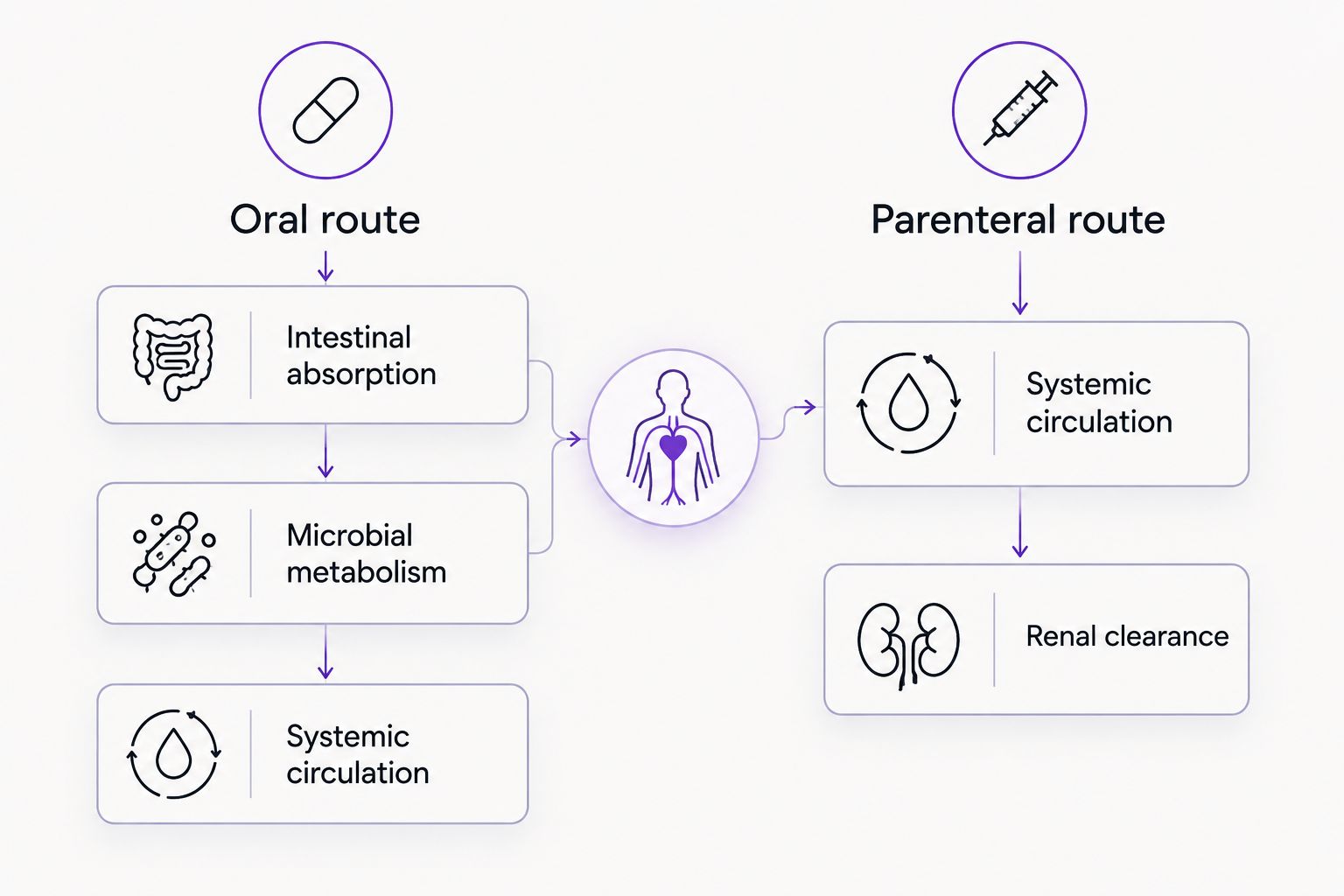
What the transporters miss does not simply vanish. Unabsorbed L-carnitine moves down the gut, where intestinal microbiota can convert it. Work published in 2013 described microbial conversion of L-carnitine to trimethylamine, with downstream oxidation in the liver to trimethylamine N-oxide 3. Bioavailability, in other words, is only half of the oral story. The other half is a metabolite profile that parenteral delivery largely avoids.
What parenteral delivery changes
Parenteral delivery places L-carnitine directly in the circulation, so intestinal transport and gut microbial metabolism drop out of the picture. For a model in which the question is tissue handling, transporter expression in a target cell type, or clearance, that removes two confounders.
It introduces others. Parenteral material must be sterile, free of particulates, and consistently concentrated, so the analytical burden moves to the preparation itself. A concentration error cannot be averaged out by incomplete absorption the way it partly can on the oral route.
Renal handling
Kidney reabsorption is the second major OCTN2 site. The kidney reabsorbs filtered carnitine efficiently when circulating levels are low and excretes more as levels rise 1. That saturable renal threshold applies to both routes once the compound is systemic, which is why systemic exposure and clearance need to be measured rather than inferred from the amount given.
Oral versus parenteral at a glance
| Property | Oral route | Parenteral route |
|---|---|---|
| Absolute bioavailability | Roughly 5% to 18% (pharmacological amounts); 54% to 86% (dietary amounts) 1 | 100% by definition |
| Limiting step | Saturable OCTN2-mediated uptake 2 | None at absorption |
| Gut microbial conversion | Yes, for the unabsorbed fraction 3 | Largely bypassed |
| Main analytical risk | Variable fractional uptake between subjects or samples | Preparation accuracy and sterility |
| Dependence on amount | High | Low at the absorption step |
The table covers the molecule L-carnitine as characterized in the published literature. It is a comparison of pharmacokinetic properties, not a recommendation of either route.
Why measured values vary between studies
Published bioavailability figures for oral L-carnitine span a wide range. The factors that move the number are consistent, and each is a design variable a research team controls:
- Amount presented. Saturable uptake means fractional absorption falls as the amount rises.
- Baseline carnitine status. Pre-existing circulating and tissue levels change the net change measured after exposure.
- Assay specificity. Free carnitine and acylcarnitine species behave differently, so an assay that sums them is not comparable to one that separates them.
- Sampling window. Rapid distribution followed by slow tissue turnover makes the timing of sampling decisive.
- Gut microbial composition. Microbial conversion of the unabsorbed fraction differs between models 3.
- Matrix. Food-derived and isolated forms are absorbed differently, which explains the dietary versus pharmacological split.
Two studies reporting different bioavailability for oral L-carnitine are frequently not in disagreement. They are often measuring different amounts, species, or analytes.
Analytical considerations for research use
Route comparisons are only as reliable as the quantification behind them. Three practices matter most.
Verify the material before the comparison
Because parenteral and oral comparisons depend on delivered quantity, a lot-specific certificate is part of the experimental design. Purity and identity documentation should be tied to the batch used, and that tie should be recorded in the lab record. The workflow in verifying peptide purity with third-party COA testing applies the same logic to any reference material, and connecting batch numbers to lab inventory tracking covers the record-keeping side.
Separate analytes
Quantify free L-carnitine and acylcarnitines distinctly. Liquid chromatography with tandem mass spectrometry is the usual platform for that separation, with isotope-labelled internal standards to correct matrix effects.
Report the amount alongside the percentage
A bioavailability percentage with no stated amount cannot be reproduced, given saturable uptake. State both.
Teams that need to source L-carnitine reference material with batch documentation can compare options in the best L-carnitine suppliers for research review.
Route choice and safety in preparation
The route question is also a handling question. Material intended for parenteral-type work in a laboratory model has to be prepared and stored under sterile technique, and the preparation setting matters as much as the molecule. Published discussion of IV therapy safety shows why sterility and controlled settings are central to any intravenous route, and the same reasoning explains why research protocols treat preparation quality as a controlled variable rather than an afterthought.
Related questions
Is L-carnitine absorbed passively at all?
A small passive fraction exists, but carrier-mediated uptake dominates at low amounts. Because the molecule is permanently charged, passive diffusion is slow, which is why fractional absorption drops once the carriers saturate 1.
Does bioavailability equal tissue uptake?
No. Bioavailability describes the fraction reaching systemic circulation. Tissue uptake adds a second transporter step, since cells also rely on OCTN2-type carriers, so circulating exposure and intracellular content can diverge 2.
Can a bioavailability figure from one compound be applied to another?
No. The values above describe L-carnitine only. Related molecules such as acetyl-L-carnitine or propionyl-L-carnitine have their own transport and metabolism, and evidence is not transferable between them.
Limitations
- The figures cited come from a published review of pharmacokinetic literature, and individual studies vary in amount, model, and assay.
- Bioavailability percentages are amount-dependent for L-carnitine, so no single value represents the oral route.
- Microbial metabolism findings are drawn from specific models and do not generalize to every system.
- This page does not evaluate any product's performance, and it makes no claim about outcomes in living organisms.
FAQ
Does bioavailability differ between injectable and oral L-carnitine?
Yes. Intravenous delivery is 100% bioavailable by definition, while published work reports oral bioavailability of roughly 5% to 18% for pharmacological amounts. The gap comes from saturable intestinal transport.
Why is oral L-carnitine absorption limited?
Uptake depends on the OCTN2 transporter, which has finite capacity. L-carnitine is permanently charged, so passive diffusion is minimal, and fractional absorption falls as the amount presented rises.
What happens to L-carnitine that is not absorbed orally?
It moves to the lower gut, where microbiota can convert it to trimethylamine. That conversion is a route-dependent metabolic fate that parenteral delivery largely avoids.
Is dietary L-carnitine absorbed better than isolated L-carnitine?
In published pharmacokinetic work, yes. Dietary amounts show 54% to 86% bioavailability versus 5% to 18% at pharmacological amounts, because lower amounts do not saturate the transporters.
Which analytical method separates free carnitine from acylcarnitines?
Liquid chromatography with tandem mass spectrometry is the standard platform. Isotope-labelled internal standards correct for matrix effects and keep the species distinct.
Can bioavailability data for L-carnitine be applied to acetyl-L-carnitine?
No. Related carnitine esters have separate transport and metabolic handling, so evidence for one compound is not transferable to another.
Is this page guidance for human or animal use?
No. It describes pharmacology and analytical design for laboratory research. It is not medical advice and is not intended to diagnose, treat, cure, or prevent disease.
One last thing
The most useful number in this topic is not a percentage. It is the amount that the percentage was measured at. Because carrier-mediated uptake saturates, a bioavailability figure stripped of its amount cannot be reproduced, and a route comparison that omits it is a comparison of two different experiments. Record the amount first, the percentage second.
Related guides
- Injectable NAD+ laboratory research guide
- How long does lidocaine HCl solution last once opened
- Research peptide storage: complete cold chain workflow
References
- Evans AM, Fornasini G. Pharmacokinetics of L-carnitine. Clinical Pharmacokinetics. 2003;42(11):941-967. DOI 10.2165/00003088-200342110-00002
- Tamai I, Ohashi R, Nezu J, et al. Molecular and functional identification of sodium ion-dependent, high affinity human carnitine transporter OCTN2. Journal of Biological Chemistry. 1998;273(32):20378-20382. DOI 10.1074/jbc.273.32.20378
- Koeth RA, Wang Z, Levison BS, et al. Intestinal microbiota metabolism of L-carnitine, a nutrient in red meat, promotes atherosclerosis. Nature Medicine. 2013;19(5):576-585. DOI 10.1038/nm.3145
For research use only. Not for human or animal use. This content is educational, is not medical advice, and is not intended to diagnose, treat, cure, or prevent disease. Reviewed for 2026.