
Reconstituted Semax solution has no universal, evidence-backed refrigerated shelf life: the defensible interval is the one demonstrated for the specific formulation, container, and analytical acceptance criteria. Refrigeration alone does not establish chemical integrity, recoverable peptide content, or microbiological quality. This 2026 guide addresses research-material stability only, without solution-preparation instructions or guidance for human or animal use.
- How long is reconstituted Semax solution stable? Use formulation-specific stability evidence, not a generic refrigerated expiry.
- Semax contains seven amino acid residues; sequence identity does not establish solution shelf life.
- HPLC purity, peptide content, and microbiological quality answer different stability questions.
- 4-Amino-Labs Semax research material requires application-specific documentation review before a laboratory assigns a solution holding period.
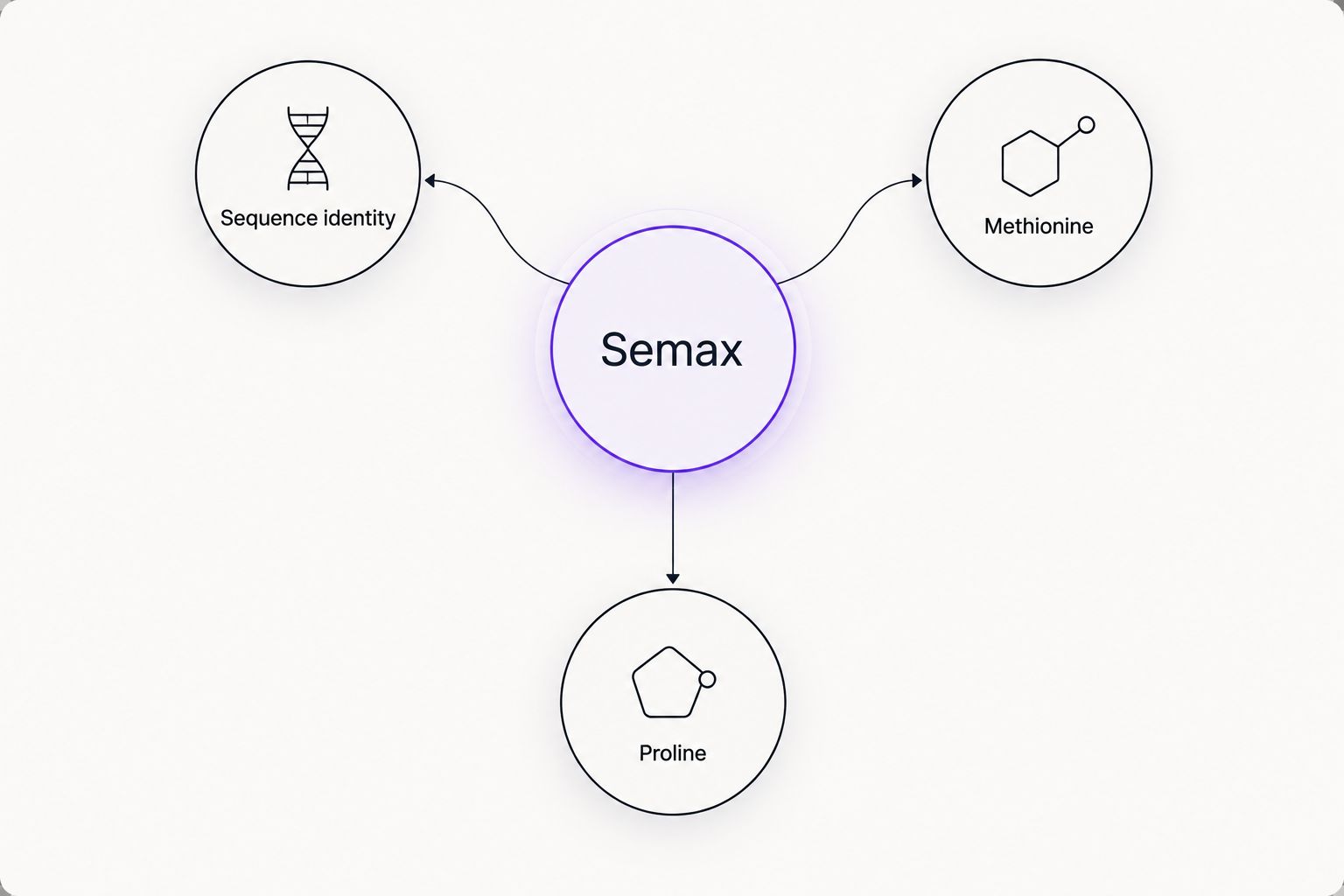
Semax has 7 amino acid residues, including 1 methionine residue and 2 proline residues. These structural facts identify the peptide; none supplies a refrigerated expiration interval.
How long is reconstituted Semax solution stable under refrigeration?
Assign a refrigerated holding period only when stability evidence covers the actual Semax solution and its intended analytical use. A dry-material certificate, an intact-looking vial, or a storage-temperature recommendation cannot independently establish that interval.
For background on the distinction between release testing and supporting analytical records, see verifying peptide purity with third-party COA testing. The essential question is whether the evidence follows the material after preparation, rather than describing only its original release condition.
| Evidence | What it supports | What it does not establish |
|---|---|---|
| Initial identity result | Starting material matches the expected analyte within the method's capabilities | Identity or integrity throughout storage |
| Initial chromatographic purity | Relative chromatographic composition at testing | A solution expiration interval |
| Stability-indicating time-course data | Change under the evaluated conditions | Performance under different conditions |
| Temperature history | Documented thermal exposure | Chemical or microbiological acceptability |
| Visual inspection | Detection of visible changes | Absence of dissolved degradation products |
A useful stability statement specifies the material, solution composition, container, temperature conditions, evaluated interval, and acceptance criteria. Without those boundaries, the statement is not transferable to your laboratory's solution.
Why this matters
A changing reference solution introduces uncertainty into everything measured against it. An apparently unchanged chromatogram also needs interpretation: relative peak areas do not automatically demonstrate unchanged absolute peptide content.
For a 2026 laboratory quality review, treat solution stability as a documented material attribute. Do not turn a general refrigeration instruction into an expiration claim.
What Semax structure tells you about stability
Sequence identity comes before a storage conclusion
Semax is the heptapeptide Met–Glu–His–Phe–Pro–Gly–Pro, commonly written MEHFPGP. Its structure combines an ACTH-derived sequence segment with a Pro–Gly–Pro extension. Structural identity is relevant to analytical method selection, but it does not establish how long a particular solution remains acceptable.
The methionine residue provides a chemically plausible oxidation site. That observation identifies something a stability investigation should examine; it does not prove that oxidation dominates in every Semax formulation. Peptide degradation depends on both molecular structure and the surrounding formulation environment. [1]
The proline-containing extension likewise cannot justify an assumed refrigerated expiry. Resistance to one degradation pathway does not establish resistance to oxidation, surface loss, or every other source of analytical change.
Related peptides are not interchangeable evidence
Semax stability evidence cannot be replaced by Selank stability evidence. Similar names, shared research categories, or the same storage location do not make different peptide sequences chemically interchangeable.
The same restriction applies to modified Semax analogues. Changes to terminal groups or sequence create a different analytical subject; a stability conclusion must identify the exact material examined.
Why refrigerated Semax stability varies
Refrigeration describes a temperature condition, not a complete formulation. General peptide-stability principles identify several variables that your laboratory must account for without assuming their individual effects have already been quantified for Semax. [1, 2]
- Solution composition: pH, ionic environment, and other constituents affect chemical behavior. A finding for one formulation does not automatically apply to another.
- Peptide concentration: concentration influences the significance of surface-associated losses and the interpretation of analytical recovery.
- Container and closure: contact surfaces and closure integrity are part of the evaluated storage system, not incidental packaging details.
- Temperature history: a refrigerator setting does not document excursions, handling exposure, or the sample's actual thermal history.
- Light and oxygen exposure: these are relevant investigative variables for susceptible chemical groups; their effects require measurement in the specific system.
- Handling history: repeated opening and transfers change exposure conditions and introduce additional opportunities for contamination or material loss.
A refrigerated stability claim is therefore conditional. Changing one of these variables requires an assessment of whether the supporting evidence still applies, rather than an automatic extension of the original conclusion.
Refrigeration is not a microbiological specification
Chemical integrity and microbiological quality are separate attributes. A solution can satisfy a chemical assay while failing a microbiological requirement, and a microbiological result does not establish peptide identity or content.
Do not interpret the presence of an antimicrobial constituent as proof of peptide stability. Its microbiological function and the peptide's chemical behavior require separate evidence.
Which measurements support a stability conclusion?
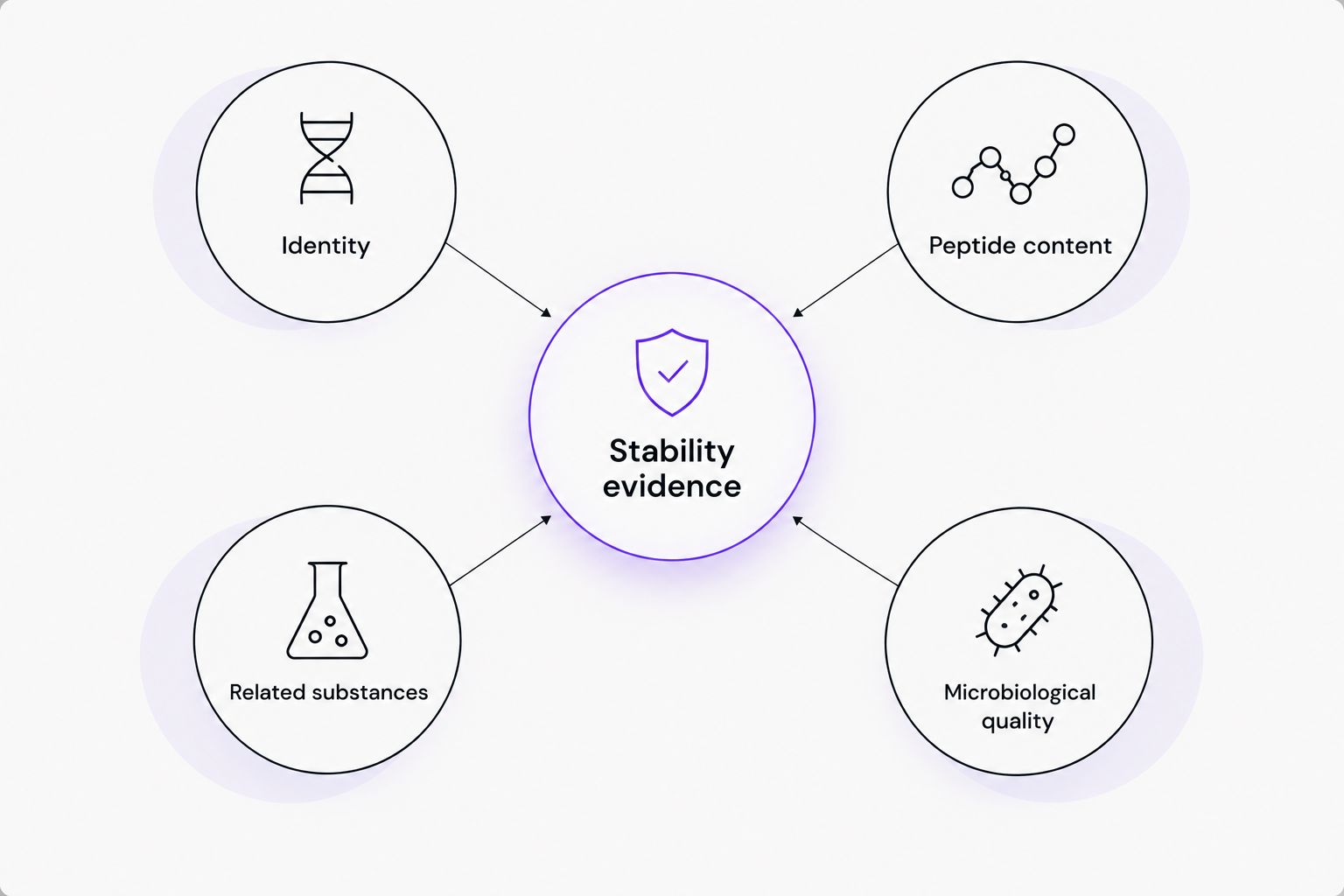
A stability investigation needs methods that can detect the changes relevant to the material and its analytical purpose. A purity percentage alone is not a complete stability result. General stability and analytical-validation frameworks emphasize suitable methods and defined acceptance criteria. [2, 3]
| Measurement | Principal strength | Important limitation |
|---|---|---|
| Stability-indicating HPLC | Separates the parent peptide from resolved related substances | Unresolved species and detector response differences complicate interpretation |
| LC–MS | Supports molecular identity and investigation of mass-shifted species | Mass information alone does not establish absolute content or every structural distinction |
| Quantitative content assay | Measures recoverable analyte against an appropriate calibration basis | Requires demonstrated method suitability and controlled sample handling |
| Visual examination | Detects visible particles, precipitation, or color changes | Clear appearance does not demonstrate chemical integrity |
| Microbiological testing | Addresses the defined microbiological quality question | Does not establish peptide identity or chemical stability |
Relative purity is not absolute recovery
Chromatographic area percentage expresses the relative contribution of detected peaks under a particular method. It is not automatically equivalent to the amount of intact peptide remaining in the original container.
For example, material loss to a contact surface is a recovery question. A chromatogram dominated by the parent peak does not, by itself, exclude that loss. Evaluate content and related substances as distinct measurements where the analytical purpose requires both.
A suitable method must distinguish meaningful change
A method described as stability-indicating must distinguish the analyte from relevant degradation products sufficiently for its intended purpose. A routine identity test does not automatically meet that requirement.
In a 2026 analytical review, ask what the method can detect, what it cannot resolve, and whether sample handling changes the result. An impressive instrument name cannot replace those answers.
What documentation should your laboratory request?
For 4-Amino-Labs Semax research material, request any applicable solution-stability documentation separately from the starting-material certificate. A research-material listing is not evidence of a validated refrigerated holding period.
The most useful documentation connects the stability conclusion to the material actually evaluated. Review these fields together:
- Exact peptide identity, including any terminal modifications or specified chemical form.
- Batch identifier and the relationship between tested material and supplied material.
- Evaluated solution composition and concentration.
- Container, closure, storage conditions, and exposure history.
- Analytical methods, evaluated time points, and acceptance criteria.
- Results supporting the stated conclusion, including relevant limitations.
Use the 4-Amino-Labs contact page to request documentation relevant to the intended analytical application. Ask whether a supplied record describes initial release testing, dry-material storage, or a genuine solution-stability investigation; those documents answer different questions.
Translate records into a bounded conclusion
A sound conclusion states what passed, under which conditions, and over which observed interval. It does not silently expand the result to different formulations or containers.
For your 2026 material record, distinguish observed stability from an assigned holding period. The first describes evidence; the second is a laboratory decision that needs an explicit evidentiary basis and approval within the laboratory's quality system.
Does freezing establish a longer Semax shelf life?
Freezing does not establish a longer Semax shelf life without evidence for the frozen solution and its thawing history. It changes the storage condition and introduces a different set of variables rather than supplying an automatic extension.
General peptide and protein formulation literature describes freezing-related stresses, including changes in the local solution environment during ice formation. Whether those mechanisms materially affect a particular Semax solution requires direct evaluation; this article does not assign Semax a frozen holding period. [1]
Can clear Semax solution still be unsuitable for analytical work?
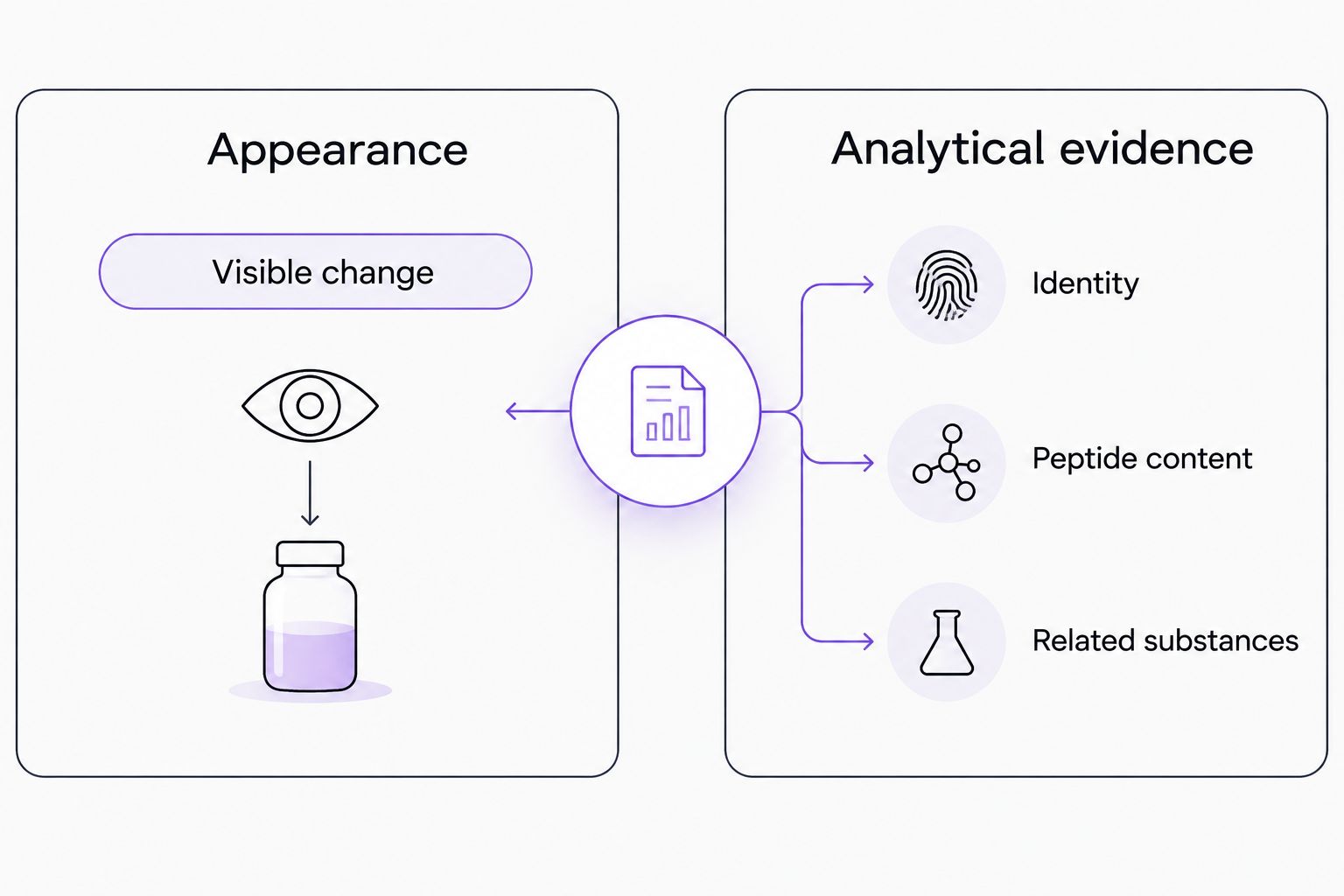
Clear Semax solution can still be unsuitable for analytical work because appearance cannot establish identity, content, or the absence of dissolved degradation products. Visual examination is a useful observation, not a release decision by itself.
Conversely, visible change requires investigation rather than an assumption about its cause. Precipitation, contamination, and chemical change are different explanations that need appropriate analytical assessment.
Limitations of this stability assessment
This article does not establish a refrigerated expiry for any Semax batch or formulation. General peptide chemistry and stability frameworks explain what evidence is needed; they do not substitute for Semax-specific results.
No universal receptor-activity conclusion follows from these chemical observations. If your research requires a functional endpoint, chemical identity and content alone do not establish that endpoint's preservation.
For 2026 documentation, retain the distinction between a supplier statement, a measured result, and your laboratory's disposition decision. Record uncertainty rather than converting it into an unsupported number.
FAQ
How long is reconstituted Semax solution stable in a refrigerator?
A defensible refrigerated interval requires stability evidence for the specific Semax formulation, container, and acceptance criteria. Refrigeration alone does not establish an expiry.
Does a Semax certificate of analysis establish solution shelf life?
A starting-material certificate of analysis does not establish solution shelf life unless it includes applicable solution-stability evidence. Release purity describes the tested material at the stated testing condition.
Is HPLC purity enough to confirm stored Semax is unchanged?
HPLC purity alone is insufficient to confirm that stored Semax is unchanged. Relative chromatographic purity, absolute peptide content, and identity are distinct analytical questions.
Does clear appearance mean a Semax solution remains stable?
Clear appearance does not establish Semax solution stability. Dissolved degradation products and changes in recoverable peptide content require suitable analytical measurements.
Can Selank storage data establish a Semax holding period?
Selank storage data cannot independently establish a Semax holding period. Different peptide sequences require evidence applicable to the material being evaluated.
Does freezing automatically extend Semax solution stability?
Freezing does not automatically establish a longer Semax solution holding period. Frozen storage and thawing history require their own applicable evidence.
Does an antimicrobial constituent prove chemical stability?
An antimicrobial constituent does not prove Semax chemical stability. Microbiological quality and peptide integrity require separate evaluation.
One last thing
The most useful expiry question is not simply how old the solution is, but what evidence still supports its intended measurement. Before accepting a refrigerated holding period, identify the measured attribute that sets its limit. That makes the decision traceable instead of calendar-based.
References
- Wang W. Instability, stabilization, and formulation of liquid protein pharmaceuticals. Journal of Pharmaceutical Sciences. General formulation and degradation background; not a Semax-specific shelf-life study.
- International Council for Harmonisation. Q1A(R2): Stability Testing of New Drug Substances and Products. General stability-study framework; not validation of a research-material expiry.
- International Council for Harmonisation. Q2(R2): Validation of Analytical Procedures. Analytical-validation framework; not evidence of Semax solution stability.
Related guides
- Research peptide storage and cold-chain workflow
- Connecting batch numbers to laboratory inventory tracking
- How Semax and Selank differ in structure and signaling
Research use only. 4-Amino-Labs research materials are discussed solely in a laboratory and analytical context. This content is not medical advice and is not intended to diagnose, treat, cure, or prevent disease. It provides no guidance for human or animal use.