
Instead of manually reconciling carrier updates with separate temperature files, use cold chain peptide shipping tracking to connect the shipment, batch, logger, and receiving decision in one laboratory record. This workflow covers research materials only: delivery confirmation documents arrival, while temperature records document conditions at the sensor.
- Cold chain peptide shipping tracking requires linked temperature records, carrier events, and batch identifiers—not delivery status alone.
- 4-Amino-Labs research materials require compound-specific documentation; this guide does not establish shipping or storage specifications.
- Preserve original logger exports and distinguish measured temperature from unmeasured transit periods.
- Review excursions against documented acceptance criteria before releasing material into laboratory inventory.
Why temperature and transit records matter
A carrier scan cannot establish peptide stability. Likewise, a temperature trace cannot establish chemical identity, purity, or functional activity. Shipping evidence and analytical evidence answer different questions.
Temperature-dependent degradation depends on the compound, material form, formulation, and exposure history. A shipping limit for one peptide does not establish an acceptable limit for another. Lyophilized material and solution are not interchangeable stability cases.
Your 2026 tracking record should therefore preserve observations without converting them into unsupported conclusions. Connect this process to the research peptide storage workflow so the record continues beyond receiving.
At a glance
| Record property | Technical convention | Interpretation |
|---|---|---|
| Temperature | Record in °C with stated measurement uncertainty | A sensor reading is not automatically the temperature of the material |
| Time | UTC uses an offset of +00:00 | A shared time basis permits comparison between events |
| Sampling | Record the interval in minutes | Interval length determines the spacing between observations |
These conventions describe the record, not acceptable shipping conditions. Temperature limits, allowed exposure duration, and acceptance criteria must come from documentation applicable to the specific material.
Before you start
- Obtain the shipment identifier, material identifier, batch documentation, carrier-event access, and logger export access. Assign a receiving reviewer and an exception owner.
- Obtain the material-specific handling specification and the logger’s identification, calibration information, operating instructions, and export capability. Define acceptance criteria before dispatch.
- Resolve the clock mismatch before shipment: carrier events, logger records, and laboratory systems can use different time zones. Preserve original timestamps and create a separate normalized timestamp for comparison.
Do not select a temperature band merely because the shipment contains a peptide. If the applicable documentation does not define transport conditions, obtain clarification before treating any threshold as an acceptance criterion.
The field names below are suggested laboratory record headings, not claims about a particular software interface. Use equivalent fields in your existing notebook, inventory system, or controlled worksheet; follow the actual logger and carrier instructions for device-specific controls.
Shipment record configuration
Establish the shipment-to-batch relationship
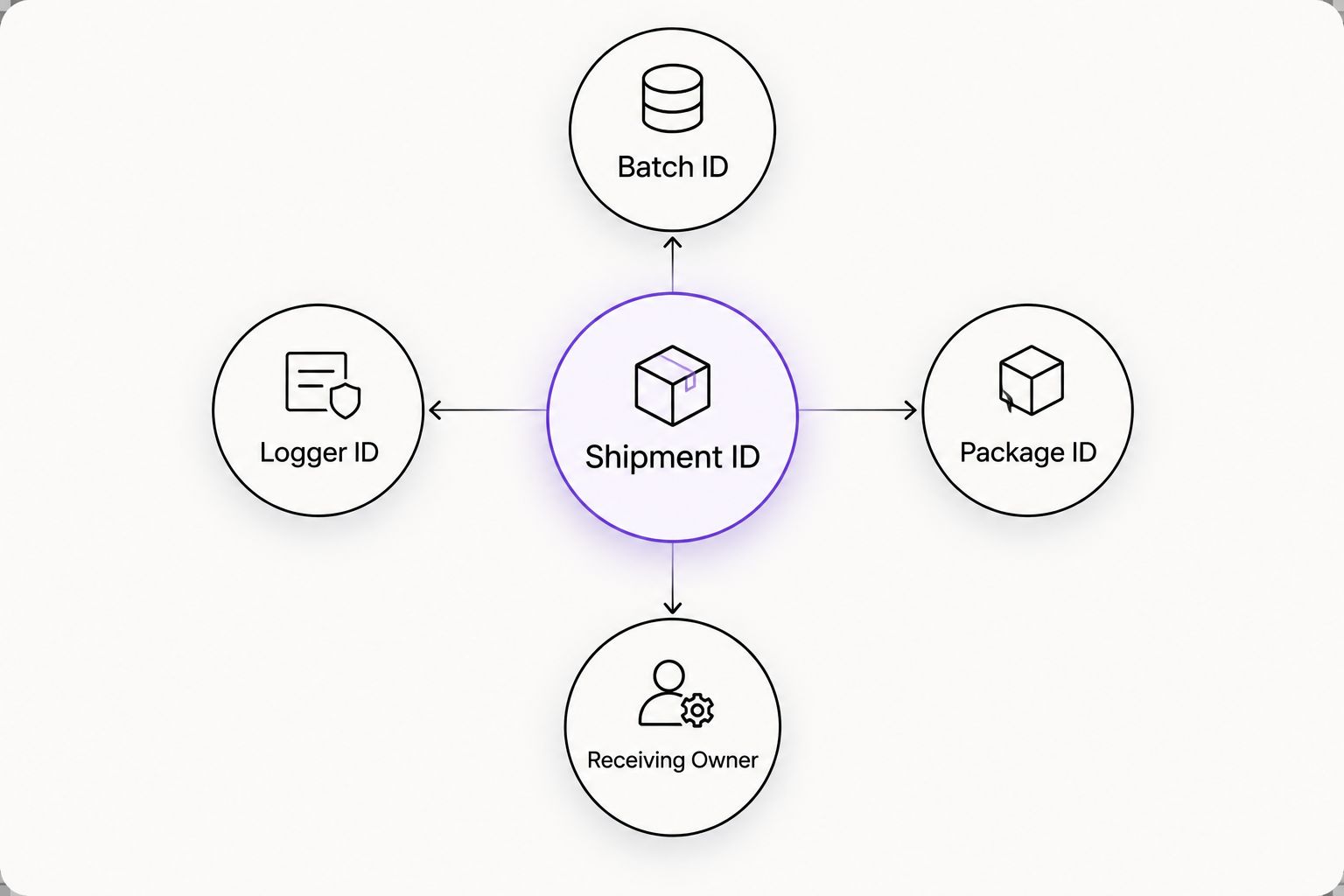
- Create a parent record with Shipment ID, Carrier Tracking ID, Material ID, Batch ID, and Receiving Owner. Keep identifiers as text so leading zeros remain intact.
- Add Logger ID and Package ID. If several packages share a shipment identifier, map each logger to its actual package rather than assuming one trace covers everything.
- Attach the applicable specification and batch documentation. Record document versions so a later revision does not silently change the basis of an earlier receiving decision.
- Add Record Status, using clearly defined states such as awaiting receipt, under review, accepted, and held. Separate carrier delivery status from laboratory acceptance status.
- Define who can edit the record and who can approve disposition. Preserve corrections with an audit trail rather than replacing the original entry.
Expected result: every package has a traceable relationship to its material, batch, logger, and responsible reviewer. A search by any identifier leads back to the same receiving record.
For sourcing from 4-Amino-Labs, a research chemical supplier, request the documentation applicable to the material and batch. This workflow does not establish that the supplier provides a particular logger, packaging configuration, or shipment-monitoring service.
A supplier document and a laboratory receiving record serve different purposes. Keep both; neither replaces the other.
Temperature record configuration
Define what the logger actually measures
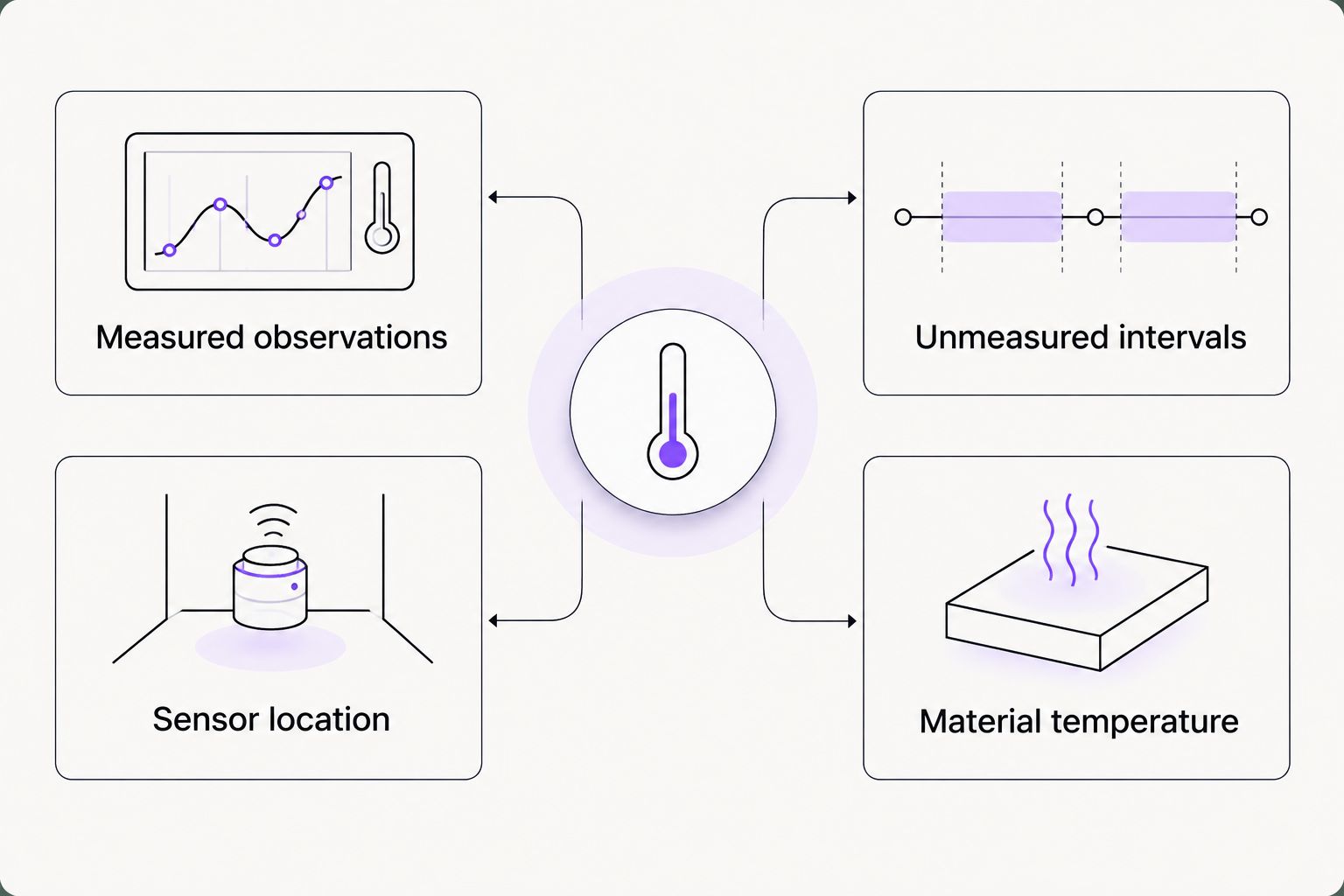
- Record Measurement Location, describing where the sensor sits within the package. Distinguish package air, a thermal surrogate, and direct material measurement where applicable.
- Record Temperature Unit, Sampling Interval, Clock Basis, and Calibration Reference. Include the calibration information supplied for that logger; do not substitute a generic accuracy claim.
- Configure monitoring according to the logger’s instructions and the approved shipping specification. Document the planned start and stop events so coverage is explicit.
- Enter Lower Limit, Upper Limit, and Excursion Rule only when supported by the material-specific acceptance criteria. Distinguish notification thresholds from rejection criteria.
- Before dispatch, confirm that the logger records, retains timestamps, and produces an export your laboratory can read. Preserve this functional check separately from the shipment trace.
Expected result: the receiving reviewer knows what was measured, where it was measured, and which documented criteria govern interpretation.
Preserve sampling limitations
A discrete logger records observations, not a continuous history between observations. Do not draw an interpolated line and then describe every point on that line as measured evidence.
For an arithmetic example only, a 5-minute sampling interval divides a 60-minute period into 12 intervals. That calculation does not establish a suitable sampling interval or acceptable exposure duration for a peptide. It illustrates why the record must retain both the interval and the underlying timestamps.
A 2026 monitoring plan should also distinguish a functioning logger with uninterrupted samples from a file containing missing observations. A smooth chart can hide a data gap if the plotting software connects distant points.
Transit event configuration
Join carrier events without rewriting source evidence
- Collect carrier events under Carrier Tracking ID. Preserve the event description, location if supplied, original timestamp, and time-zone information.
- Create Normalized Timestamp for comparison with logger observations. Keep Original Timestamp unchanged and document the conversion rule.
- Match events to the correct package and logger. Flag unmatched identifiers instead of attaching a file to the nearest-looking shipment.
- Preserve each original export as a read-only source attachment. Store any cleaned dataset or merged timeline as a separate derived file.
- Record Import Timestamp and Source. Repeated imports should update the event history without creating duplicate shipment records or erasing earlier evidence.
Expected result: the merged timeline shows carrier events alongside temperature observations, while the original records remain available for inspection.
A carrier event’s timestamp describes that event. It does not necessarily describe when the laboratory learned about it. Keep event time and import time separate so delayed updates do not appear to be delayed physical movement.
Select the update method
Choose the update method according to the required review timing and the functions your actual systems support. These options differ in information flow, not in their ability to prove peptide integrity.
| Update method | Best for | Advantage | Limitation |
|---|---|---|---|
| Manual import | Receiving-based review | Works with downloadable files and a controlled worksheet | Depends on a person collecting and matching records |
| Scheduled retrieval | Repeated shipment reconciliation | Reduces repeated collection when supported interfaces exist | Information remains delayed between retrievals |
| Streaming monitoring | In-transit exception awareness | Supports earlier notification when connectivity works | Connectivity gaps and sensor placement still limit interpretation |
Use the simplest method that meets the documented review requirement. Automation does not repair an incorrect batch mapping, missing calibration record, or unsupported temperature limit.
Receiving review configuration
Convert observations into a documented decision
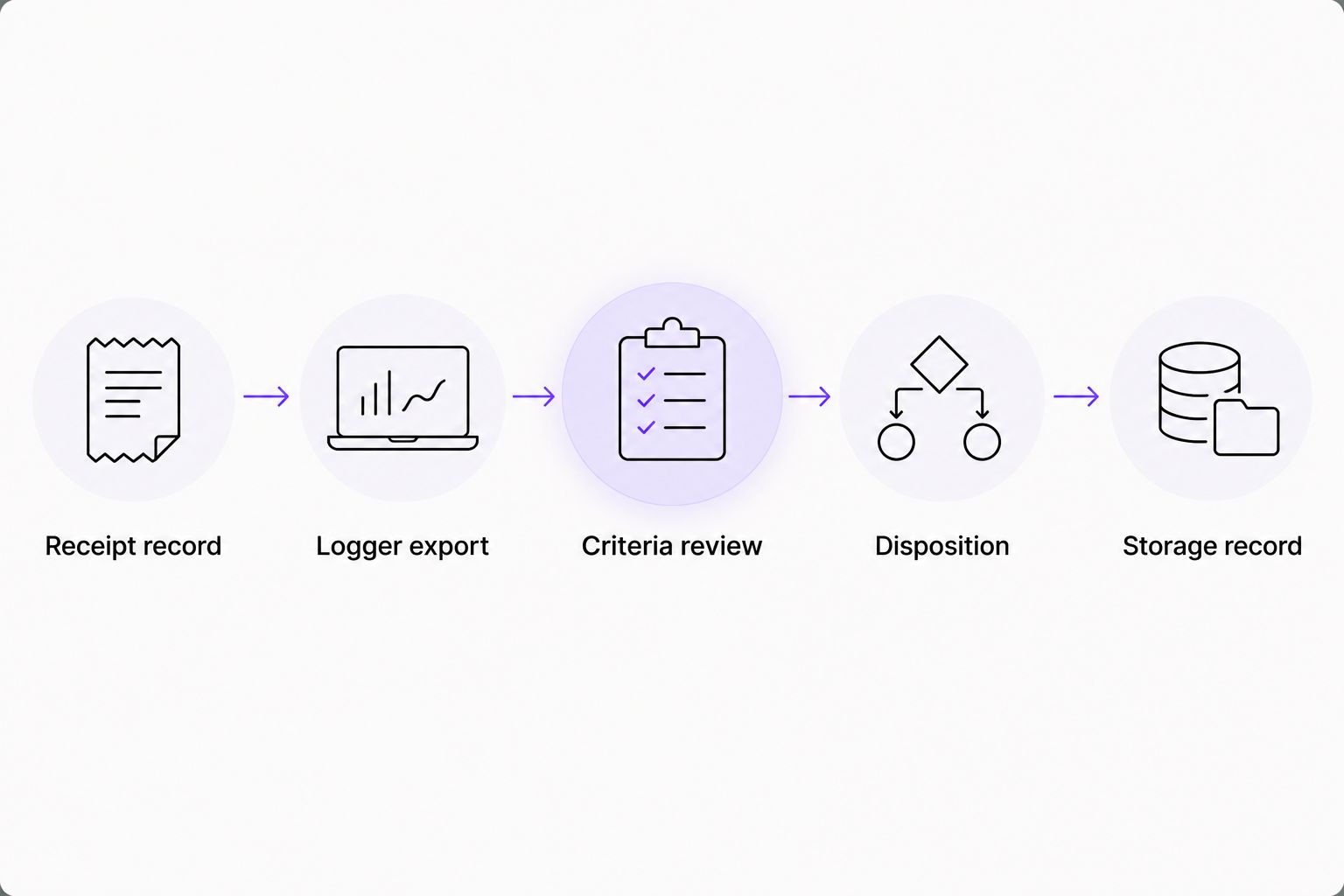
- Record Receipt Timestamp, package identifiers, visible package condition, and the receiving operator. Photograph damage when relevant to the investigation; do not treat appearance as analytical evidence.
- Retrieve the complete logger export and confirm its identity, coverage, timestamps, and units. Check whether monitoring continued through the intended receiving boundary.
- Compare observations with the applicable acceptance criteria. Record excursions, missing intervals, and the uncertainty relevant to any borderline observation.
- Assign Disposition and Decision Basis through the laboratory’s authorized review process. Keep unresolved material segregated from accepted inventory.
- Link the decision to subsequent storage records and any required analytical evaluation. A shipping review must not overwrite the batch’s analytical documentation.
Expected result: the receiving record explains who reviewed the evidence, which criteria were applied, and why the material was accepted or held.
For 2026 receiving records, distinguish acceptable observed conditions from confirmed material integrity. The former is a conclusion about the available transport evidence; the latter requires evidence appropriate to the compound and the intended laboratory work.
4-Amino-Labs research peptide documentation should be assessed separately from the transport timeline. A batch document describes the reported analytical assessment and its scope, not every event after that assessment.
Update the record when transit status changes
An adjacent workflow updates the shipment record whenever a new carrier event or temperature file becomes available. This is useful when the laboratory needs to coordinate receiving before the package arrives.
- Match the incoming update to an existing Shipment ID and Package ID.
- Append the source event or file without replacing previous evidence.
- Check whether the update changes the expected receiving arrangements or meets a documented notification rule.
- Send the notification to Receiving Owner or the assigned exception owner through an approved communication channel.
- Record acknowledgment separately from final disposition.
Expected result: the receiving team receives relevant changes, but a notification never automatically becomes an acceptance decision. Build the 2026 update workflow around that separation.
Troubleshooting
Carrier delivery appears outside logger coverage
Compare original timestamps, time zones, and logger start and stop events. If a genuine unmonitored period remains, document the gap; do not extend the trace to cover it.
Temperature readings cross a limit briefly
Apply the documented excursion rule and account for measurement uncertainty. A single reading is not automatically proof of degradation, and a short excursion is not automatically acceptable.
The logger file has the wrong batch identifier
Resolve the package-to-logger mapping using dispatch and receiving records. Preserve the mismatch and correction history rather than renaming the file to make it appear consistent.
Notifications arrive repeatedly
Check whether the workflow identifies previously imported events and separates acknowledgment from resolution. Suppress duplicate notifications without deleting distinct events or unresolved exceptions.
A dashboard reports normal conditions despite missing data
Inspect the raw export and the dashboard’s missing-data behavior. Configure gaps as unknown coverage, not normal temperature, and require review when evidence is incomplete.
Customize your workflow
Expand the record by adding package-level mapping, document version control, and links to laboratory inventory. These additions improve traceability without changing the underlying evidence requirements.
For repeated shipping routes, compare observed timelines and recurring data gaps across records. Keep those observations separate from claims about material stability or packaging performance unless an appropriate assessment supports those claims.
Retain original evidence before optimizing the dashboard. A readable chart helps review, but a chart without its source file cannot support the same level of reconstruction.
Limitations
This workflow does not establish a universal peptide shipping temperature, storage condition, or acceptable excursion duration. Those values depend on material-specific evidence and applicable documentation.
A sensor reading, carrier scan, intact package, or batch certificate alone cannot establish that a research material remained chemically unchanged throughout transit. Missing evidence remains missing evidence; automation does not convert it into an acceptable result.
FAQ
What does cold chain peptide shipping tracking need to record?
Cold chain peptide shipping tracking needs linked shipment, package, batch, temperature, and receiving records. Preserve original timestamps and logger exports alongside the reviewer’s documented decision.
Does a delivery scan prove that a peptide stayed within its temperature limits?
No. A delivery scan establishes a carrier event, not the temperature experienced by the material. Temperature evidence requires an appropriately configured and traceable monitoring record.
What temperature should a research peptide shipment maintain?
Use the transport conditions documented for the specific compound and material form. This workflow does not supply a universal peptide temperature range or replace stability documentation.
Can a temperature logger prove peptide purity?
No. A temperature logger measures conditions at its sensor. Chemical identity, purity, and other analytical properties require appropriate analytical evidence.
Should a shipment be rejected after any temperature excursion?
Apply the documented material-specific acceptance criteria rather than an automatic universal rejection rule. Record the excursion, measurement uncertainty, coverage, and authorized disposition.
How should missing temperature data be handled?
Mark missing temperature data as an evidence gap and refer it for review. Do not interpolate missing observations and present them as measured temperatures.
Can this workflow connect to a laboratory notebook?
Yes. Link the shipment record, source files, batch documentation, and disposition to the laboratory notebook using stable identifiers. The available connection method depends on the notebook and tracking systems actually in use.
One last thing
Keep arrival and acceptance as separate record states. That distinction prevents a carrier’s delivered status from silently releasing an unreviewed batch into laboratory inventory.
Related guides
- Verifying peptide purity with third-party COA testing
- Connecting research chemical purchases to a lab notebook
- Peptide research for biotech startups
Research-use-only notice: 4-Amino-Labs materials discussed here are strictly for laboratory research. This content is not medical advice and is not intended to diagnose, treat, cure, or prevent disease.
