
Peptide mg to units conversion requires a defined concentration and a defined meaning of “units”; milligrams alone cannot determine a volume-scale reading. Instead of repeatedly recalculating transfers, use the 2026 laboratory worksheet below to connect documented mass, final solution volume, and calibrated transfer volume—strictly for research use, not human administration.
- Peptide mg to units conversion requires concentration; mass alone cannot determine volume or biological activity.
- 4-Amino-Labs supplies research chemicals to United States laboratories; this workflow addresses laboratory solution preparation only.
- Express peptide concentration in mg/mL and laboratory transfers in µL before interpreting any device graduations.
- Chromatographic purity, peptide content, and biological activity are different quantities; record the basis of each calculation.
Why this matters
The central problem is dimensional, not pharmacological. A milligram describes mass, a microliter describes volume, and an activity unit describes an assay-defined biological response. Treating those quantities as interchangeable makes a preparation record uninterpretable.
For a 2026 preparation record, keep identity, concentration, and transfer volume separate. The lyophilized peptide to reconstituted solution workflow provides the adjacent preparation topic; the calculations here address how to document the resulting solution.
4-Amino-Labs is a research-chemical supplier for United States laboratories, not a source of human-use instructions. No conversion here establishes suitability for administration, clinical use, or a biological effect.
What “units” actually means
Identify the quantity before opening a calculator. A device graduation is not a peptide activity unit, and a peptide activity unit is not a fixed mass shared by different compounds.
| Quantity | Meaning | Required information | Main limitation |
|---|---|---|---|
| Mass | Amount expressed in mg or µg | Documented mass and its analytical basis | Does not specify volume |
| Volume | Amount expressed in mL or µL | Solution concentration | Does not establish biological activity |
| Device graduation | A mark on a particular measuring scale | Verified volume represented by that mark | Scale-specific, not a universal peptide unit |
| Biological activity | Response defined by an assay or standard | Compound-specific activity assignment and assay definition | Cannot be inferred from mass alone |
Never transfer an activity conversion between peptides simply because their names, sequences, or research targets are related. A volumetric calculation also says nothing about receptor occupancy, potency, stability, or assay response.
Before you start
- Collect the source record: compound identity, batch identifier, documented material amount, and relevant analytical documentation. Distinguish nominal vial contents from a measured peptide-content result.
- Define the preparation: laboratory-approved solvent, intended final solution volume, and a calibrated transfer device suitable for that volume. Follow the laboratory’s compound-specific handling and safety requirements.
- Resolve the non-obvious gotcha: chromatographic area purity is not automatically peptide mass fraction. Do not multiply nominal mass by a purity percentage unless the analytical method and reporting basis justify that calculation.
A supplier’s document title is not enough. Read what was measured: identity, chromatographic purity, quantitative content, water content, or another property. Those results answer different questions.
For research chemicals sourced from 4-Amino-Labs, assess the documentation relevant to the particular material. This guide does not assign a purity threshold, solvent, storage condition, or stability period to an unspecified peptide.
Define your measurement fields
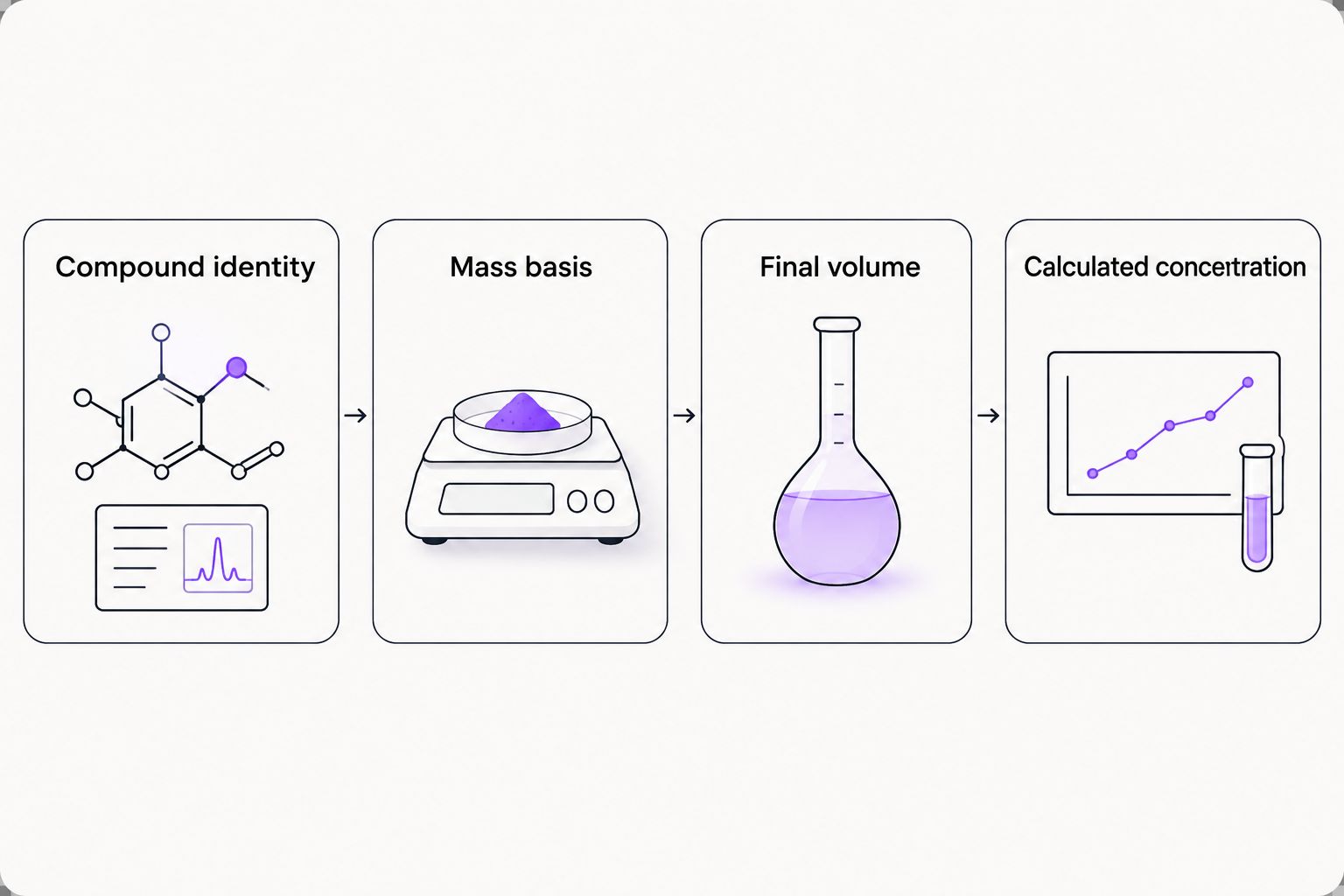
Build the 2026 calculation worksheet
Use a laboratory worksheet rather than a calculator result without context. The field names below are suggested worksheet labels, not claims about a particular software interface.
- Create Compound identity and Batch identifier fields. Preserve the supplier’s stated identity and batch reference without abbreviation that introduces ambiguity.
- Add Mass basis and Documented mass (mg). Specify whether the entry represents nominal supplied material or a justified peptide-content value.
- Add Final solution volume (mL). Record the final solution volume used for the concentration calculation, not an unexplained solvent-addition figure.
- Add Calculated concentration (mg/mL) and Transfer volume (µL). Keep units in the labels so later users cannot mistake milliliters for microliters.
- Add Scale definition only if a device-specific graduation must be recorded. State the manufacturer-defined relationship between volume and the scale.
Expected result: every numeric entry has an explicit unit and a traceable basis. Another laboratory worker can reconstruct the calculation without guessing what “units” meant.
Keep identity separate from arithmetic
Correct arithmetic does not confirm that the material is the intended peptide. Likewise, an identity result does not supply a quantitative concentration. Keep the analytical identity record alongside—but separate from—the concentration calculation.
Calculate the solution concentration
Normalize the measurement units
The metric relationships are exact: 1 mg = 1,000 µg, and 1 mL = 1,000 µL. Consequently, 1 mg/mL = 1 µg/µL. These identities change the expression of a quantity, not the amount of material.
- Convert the documented mass to milligrams if the source record uses micrograms.
- Convert the final solution volume to milliliters if the preparation record uses microliters.
- Calculate concentration using C = m ÷ V, where C is concentration in mg/mL, m is documented mass in mg, and V is final solution volume in mL.
- Preserve the measurement precision justified by the source values. Extra decimal places do not improve an uncertain mass or volume measurement.
Expected result: a concentration with units of mg/mL, accompanied by the mass and final volume that produced it.
Check a dimensional example
Consider an arithmetic-only example with a documented mass of 10 mg and a final solution volume of 10 mL. The calculated concentration is 1 mg/mL, equivalent to 1 µg/µL.
A 100 µL laboratory transfer is 0.100 mL. At that example concentration, it contains a calculated 0.100 mg, or 100 µg, on the same mass basis used for the stock calculation.
These values illustrate dimensional analysis, not a compound-specific preparation or an experimental recommendation. They establish neither peptide recovery nor the concentration of biologically active material.
| Calculation | Substitution | Result |
|---|---|---|
| Stock concentration | 10 mg ÷ 10 mL | 1 mg/mL |
| Transfer volume conversion | 100 µL ÷ 1,000 | 0.100 mL |
| Calculated transferred mass | 1 mg/mL × 0.100 mL | 0.100 mg |
| Mass expression | 0.100 mg × 1,000 | 100 µg |
Use final solution volume consistently. Solvent added and final solution volume are not interchangeable definitions. Select the measurement basis required by the laboratory’s validated preparation method and record it explicitly.
Configure the volume transfer
Convert mass to laboratory volume
Once concentration is established, calculate volume using V = m ÷ C. In this expression, m is the laboratory aliquot’s specified mass and C is the documented stock concentration; the result is a volume, not biological activity.
- Enter the laboratory aliquot requirement in Calculated aliquot mass (mg).
- Divide that value by Calculated concentration (mg/mL) to obtain milliliters.
- Multiply milliliters by 1,000 to obtain Transfer volume (µL).
- Confirm that the resulting volume falls within the selected device’s specified operating range.
- Record the selected device and its relevant calibration status in the preparation record.
Expected result: a transfer expressed in µL that can be checked against the measuring device’s specifications.
Select the measurement method
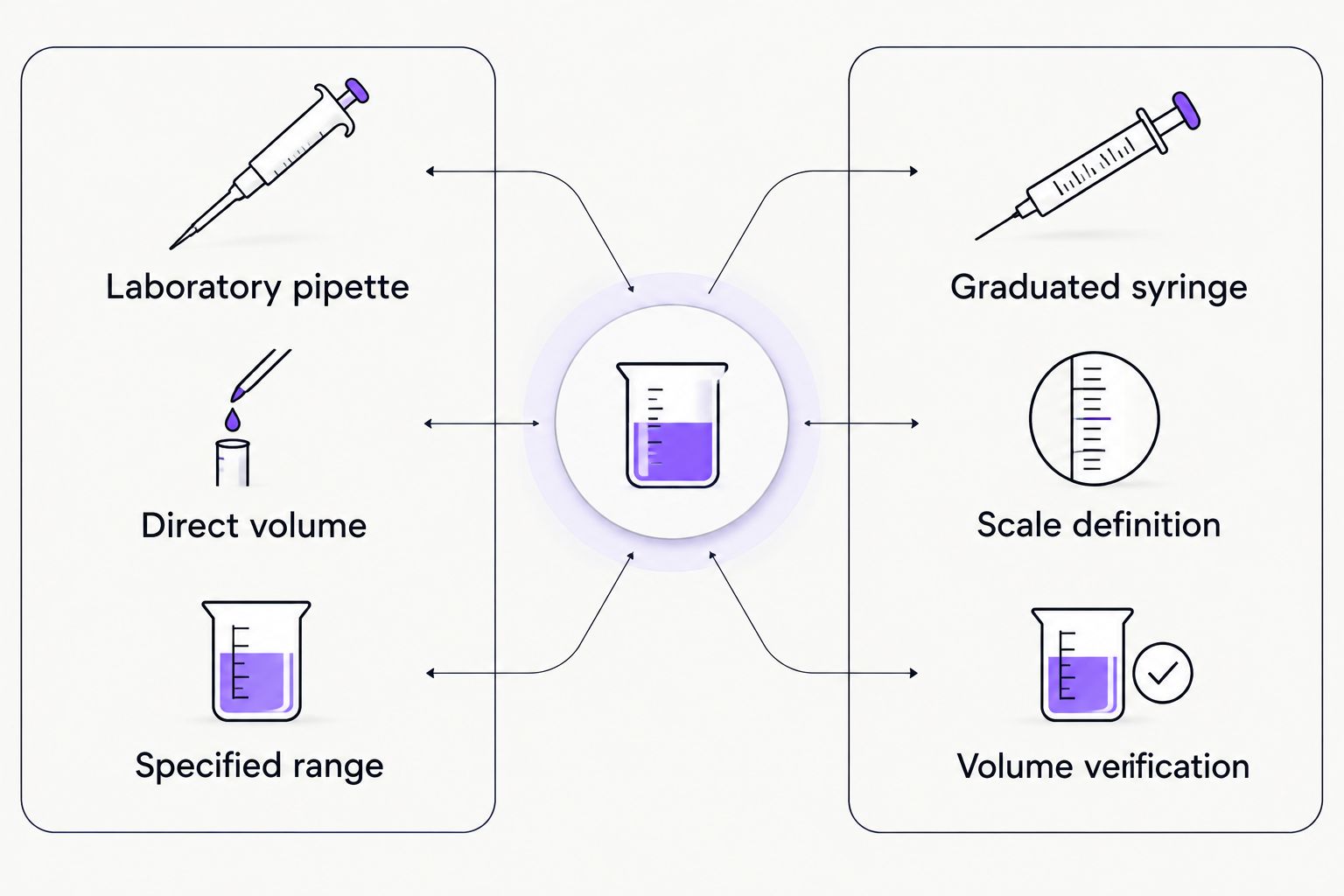
A calibrated laboratory pipette is the appropriate default when the required transfer falls within its specified operating range. A syringe graduation requires separate verification of the device’s scale and volumetric suitability; the printed scale alone does not establish accuracy.
| Option | Best for | Advantage | Limitation |
|---|---|---|---|
| Calibrated laboratory pipette | Transfers within the pipette’s specified range | Direct recording in laboratory volume units | Requires suitable calibration, technique, and liquid compatibility |
| Graduated syringe | Laboratory tasks with a justified device-specific volume method | Provides a visible volume-related scale | Graduation spacing and scale terminology can obscure the actual volume |
If a device uses “units” rather than mL or µL, obtain its scale definition from the device documentation. Convert the required laboratory volume to that scale only after confirming the relationship. Do not borrow a conversion from another device.
Recalculate whenever the stock is diluted
A stock’s old concentration no longer describes its diluted working solution. Maintain separate records for the original stock and each derived solution; never overwrite the original concentration.
Create a dilution record
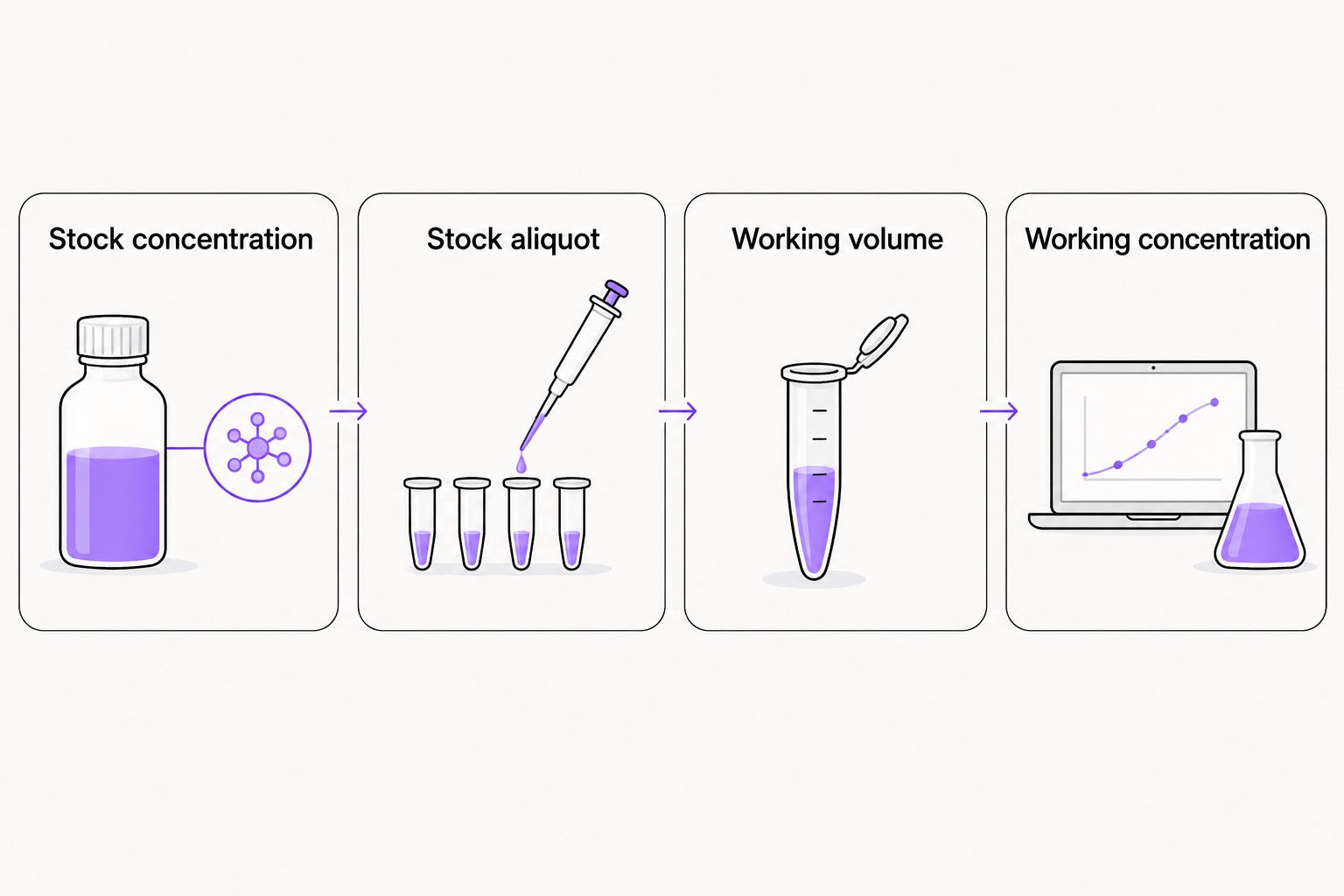
For a simple dilution with no reaction or material loss included in the model, use C₁V₁ = C₂V₂. The relationship expresses conservation of the calculated solute amount, not a guarantee of experimental recovery.
- Enter the original concentration as Stock concentration.
- Record the transferred stock volume as Stock aliquot.
- Record the new final volume as Working volume.
- Calculate Working concentration = Stock concentration × Stock aliquot ÷ Working volume.
- Assign the working solution its own identifier and retain the parent-stock reference.
Expected result: a working concentration tied to a documented stock aliquot and final volume.
In an arithmetic example, 1 mL of a 1 mg/mL stock brought to a final volume of 10 mL gives 0.1 mg/mL. Subsequent transfer calculations must use the working concentration, not the stock concentration.
The 2026 dilution record should preserve both values. A change in solvent, mixing, or storage does not automatically validate peptide stability or recovery; those properties require compound-specific evidence.
Troubleshooting calculation errors
- The result is wrong by a factor of 1,000. Check whether mg was entered as µg or mL as µL. Normalize the input units before repeating the calculation.
- Two worksheets produce different concentrations. Compare the mass basis and volume definition. Nominal material mass and quantified peptide content are different inputs, as are solvent added and final volume.
- The calculated transfer is outside the device’s specified range. Select a suitable calibrated device or use a documented, scientifically justified dilution. Do not round the transfer merely to fit the available scale.
- A worksheet reports peptide activity “units” from mg alone. Remove the conversion unless a compound-specific, assay-defined activity assignment supports it. A volume formula cannot establish biological activity.
- The solution contains visible undissolved material. Do not treat the calculated concentration as proof of complete dissolution. Resolve the preparation discrepancy under the laboratory’s approved handling method before relying on the stock.
For a 2026 worksheet review, independently check the unit cancellation and the source fields. Repeating the same calculator entry checks neither the documentation nor the measurement assumptions.
Customize your workflow
Expand the record to include preparation identifier, operator, preparation date, solvent identity, parent-stock identifier, and analytical-document reference. Add stability or storage fields only when supported by compound-specific documentation.
A spreadsheet can automate arithmetic, but it must not silently substitute defaults for missing concentration or scale information. Require explicit inputs and keep calculated fields separate from editable source values.
The useful output is a traceable preparation record, not a standalone “units” answer. For 4-Amino-Labs research materials, preserve the connection between the supplied batch documentation and the laboratory’s derived solutions.
Limitations
This workflow provides dimensional calculations. It does not establish identity, complete dissolution, recovery, adsorption losses, chemical stability, sterility, biological activity, or suitability for a particular assay.
Calculated mass concentration is only as defensible as its input mass and volume. No universal peptide mg-to-activity-unit conversion exists, and no unspecified purity result can replace a quantitative content determination.
FAQ
How do I calculate peptide mg to units conversion for a laboratory solution?
First define whether units means device graduations or biological activity. For a volume scale, calculate concentration from documented mass and final volume, then convert the required laboratory volume using the verified device scale.
Can I convert peptide milligrams directly to microliters?
No; converting peptide mass to volume requires concentration. Divide mass in mg by concentration in mg/mL to obtain mL, then multiply by 1,000 to obtain µL.
Are syringe units the same as peptide activity units?
No; a syringe scale and a peptide activity assignment describe different quantities. Verify the device scale separately, and use biological activity units only when supported by a compound-specific assay definition.
Does a purity percentage tell me the peptide concentration?
Not by itself; chromatographic area purity is not automatically peptide mass fraction. Establish the reporting basis before using an analytical result to adjust the mass entered into a concentration calculation.
Should I use solvent added or final solution volume?
Use the volume definition required by the laboratory’s preparation method, and state it explicitly. For a final-volume concentration calculation, use final solution volume rather than an unexplained solvent-addition amount.
What happens to the calculation after I dilute the stock?
Recalculate using the working solution’s concentration. Keep the stock concentration and dilution record separate so later transfers are not calculated from the wrong solution.
Can this conversion establish peptide potency or receptor occupancy?
No; mass-to-volume arithmetic establishes neither potency nor receptor occupancy. Those questions require compound-specific experimental evidence and cannot be answered from nominal mass alone.
One last thing
Put the unit in the field name, not only beside the final answer. A 2026 template with separate mg, mg/mL, and µL fields makes ambiguous entries easier to identify before they become preparation errors.
Related guides
- Peptide research for biotech startups
- Analytical reagents for forensic toxicology laboratories
- Research chemicals for university biology laboratories
Research-use-only notice: This 4-Amino-Labs guide concerns laboratory measurement and documentation only. It is not medical advice and is not intended to diagnose, treat, cure, or prevent disease. It provides no instructions for human use, dosing, or administration.
