
To pay for research chemicals with crypto, replace ad hoc transfers with an approved workflow: confirm the supplier’s payment instructions, match the asset and network, then reconcile the transaction against the laboratory’s order. This guide covers research-only procurement; a cryptocurrency transfer does not establish chemical identity, purity, or suitability for an experiment.
- Pay for research chemicals with crypto only after confirming supplier acceptance, institutional authorization, and the exact payment network.
- 4-Amino-Labs supplies research chemicals for laboratory buyers; payment records do not replace batch documentation.
- Match the asset, network, destination, and invoice before authorizing a transfer.
- Keep the order reference, transaction hash, and supplier receipt together for reconciliation.
Why this matters
Cryptocurrency settlement and laboratory procurement are separate control systems. A transaction can succeed on a blockchain while the associated order remains unmatched, and an accurately paid invoice says nothing about the material’s analytical characteristics.
Approve the research purchase before approving the payment. For institutional purchasing, the research chemicals for university biology labs guide provides a related procurement context. Your laboratory still needs its own authorization, documentation requirements, and receiving controls.
For a 2026 purchasing checklist, treat payment compatibility as a gate rather than an assumption. Use only instructions presented through the supplier’s verified checkout or an authenticated communication channel. This workflow does not establish which cryptocurrencies any particular supplier accepts.
Before you start
- Authorization and account access: Obtain permission to use cryptocurrency for the research purchase. Use an institution-approved wallet or account, with the authorized purchaser and accounting contact identified.
- Order and analytical requirements: Prepare the order reference, billing details, compound identity, and required batch documentation. Define the analytical information your laboratory needs before transferring funds.
- Network compatibility and transfer controls: Confirm the exact asset and blockchain network requested by the payment instructions. A matching asset name alone is insufficient; exchange withdrawal restrictions, destination tags, or minimum transfer requirements can prevent a valid payment.
Do not begin with an asset purchase and work backward to an order. First establish whether the supplier accepts the proposed payment route and whether your institution permits it. Otherwise, you can acquire cryptocurrency without having an authorized way to use it.
For a 2026 procurement review, also establish who handles payment exceptions. The purchasing contact, account administrator, and accounting contact need a shared record rather than separate screenshots with no order reference.
Payment route configuration
Choose the approved sending method
A wallet-controlled transfer and an exchange withdrawal are different operational routes. Neither determines whether the research chemical is appropriate for your laboratory. Choose the route your institution authorizes and the payment destination supports.
| Payment route | Appropriate for | Operational advantage | Limitation |
|---|---|---|---|
| Institution-controlled wallet | Laboratories authorized to manage signing credentials | Your authorized operator controls transaction submission | Your institution must protect credentials and manage recovery procedures |
| Exchange withdrawal | Laboratories authorized to use a custodial account | The account provides an existing withdrawal workflow | Withdrawal controls and supported networks can conflict with invoice requirements |
The table compares sending methods, not suppliers or chemical quality. An exchange account does not guarantee compatibility with every payment request, and a wallet does not eliminate the need for purchasing approval.
Establish the payment request
- Open the supplier’s verified checkout or authenticated invoice communication. Confirm that cryptocurrency is an explicitly offered payment method for the order.
- Record the order reference and the payment instructions together. Include the requested asset, network, destination, and any required destination tag or memo.
- Check whether the request has an expiry condition. If it does, confirm that your institution’s approval process and sending account can complete the transfer within that condition.
- Identify how the supplier communicates receipt and how accounting will receive the supporting records.
Expected result: You have an authorized order and a current payment request that your sending method can satisfy. If either is missing, stop before transferring funds.
Interface labels vary between checkout providers, exchanges, and wallets. Follow the fields actually displayed in your verified payment request rather than treating a generic tutorial’s button names as authoritative instructions.
Transfer instruction verification
Match the asset, network, and destination
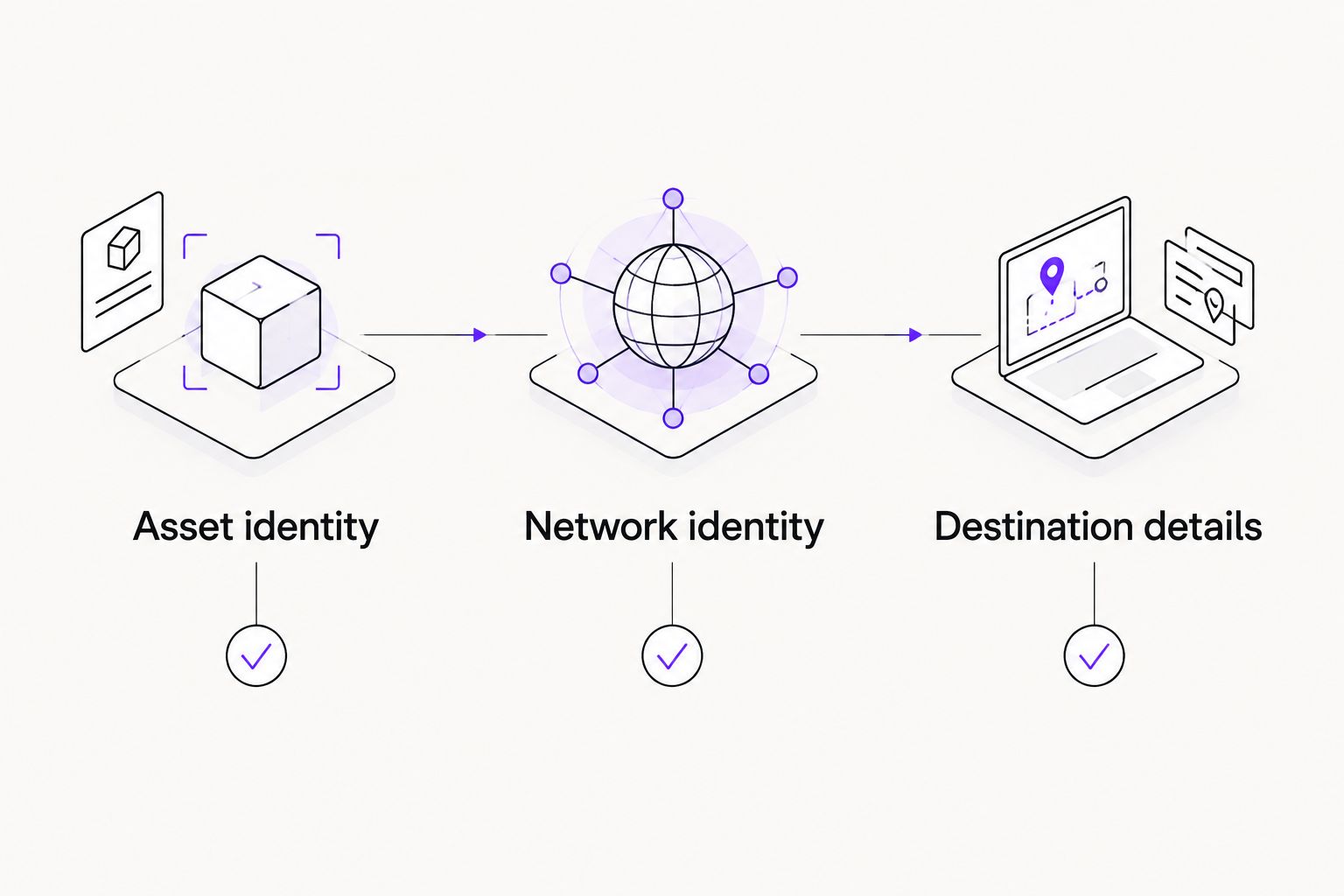
Use 3 checks before opening the final authorization screen: asset identity, network identity, and destination details. These are separate checks, not interchangeable descriptions of the same thing.
- Compare the requested asset with the asset selected in your sending account. Do not substitute another token because its name or symbol looks similar.
- Compare the requested blockchain network with the selected withdrawal or transfer network. Where an asset exists on multiple networks, select only the explicitly requested network.
- Copy the destination from the verified payment request. Compare the complete address after pasting; do not rely only on the beginning and ending characters.
- Enter the destination tag or memo if the instructions require one. Do not assume an address alone identifies the receiving account.
- Check the transfer details against the payment request, including how the sending service applies network or withdrawal charges.
Expected result: The transaction preparation screen matches the payment request without substitutions or unresolved fields. An unfamiliar network name or missing memo is a reason to pause, not improvise.
Verify the request source
A valid-looking address is not proof that the payment request is authentic. Confirm unexpected changes through an established supplier communication channel, especially when a message introduces a replacement destination after the order has been created.
Do not send wallet recovery phrases, private keys, or account passwords to a supplier or support agent. Those credentials are not needed to identify an order or investigate a transaction. Share the order reference and transaction details instead.
For a 2026 workflow, document who performed the verification and which authenticated instruction source was used. This creates an audit trail without exposing credentials.
Transaction submission and order reconciliation
Authorize the transfer
- Review the final transfer screen against the verified request. Check the asset, network, destination, required memo, and transfer details again.
- Obtain any additional institutional approval required before submission. Keep authorization separate from simply preparing the transfer.
- Submit the transaction through the approved sending account. Record the resulting transaction identifier when the account provides it.
- Check the transaction status on the correct network. A sending-account status and the supplier’s order status are separate records.
- Follow the supplier’s stated receipt process. Do not treat submission alone as confirmation that the order has been matched and accepted.
Expected result: You have a submitted transaction, a traceable transaction identifier, and a documented path to supplier acknowledgment. Do not repeat the payment merely because the order status has not changed immediately.
A small preliminary transfer is not automatically appropriate for invoice payments. It can create a separate unmatched transaction or conflict with the payment request. Use a preliminary transfer only when the receiving instructions explicitly support that approach.
Build the reconciliation record
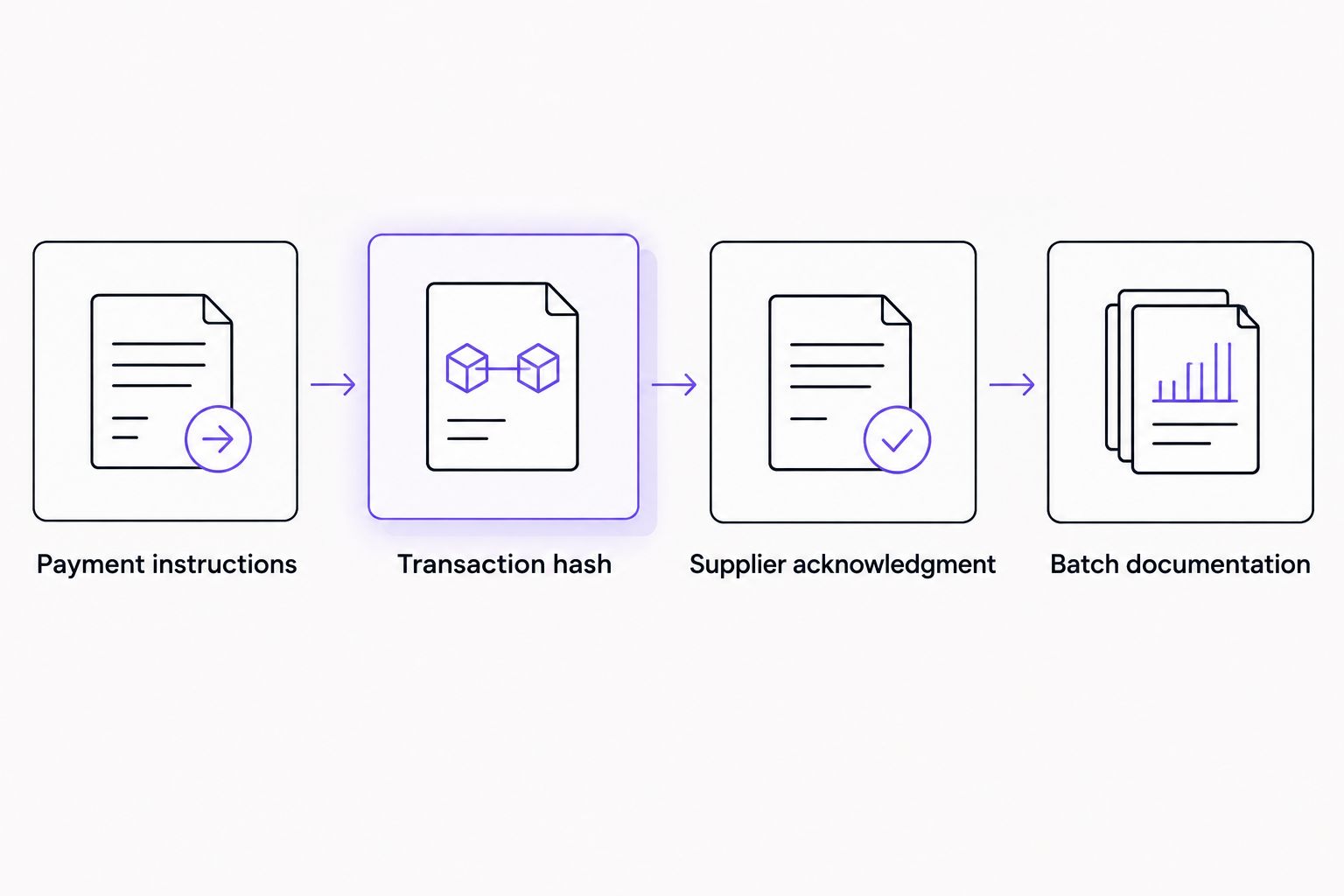
Maintain 3 identifiers together: the order reference, the invoice reference where one exists, and the blockchain transaction hash. These identifiers connect purchasing, settlement, and supplier communication.
Also retain 2 records: the verified payment instructions and the supplier’s acknowledgment or receipt. The transaction hash proves which blockchain transaction you are examining; the supplier record establishes how that transaction relates to the purchase.
| Record | What it establishes | What it does not establish |
|---|---|---|
| Payment instructions | The requested payment route for the order | That a transfer was completed |
| Transaction hash | A specific transaction on a specific network | Chemical identity or analytical purity |
| Supplier acknowledgment | The supplier’s recorded payment association | Experimental suitability of the material |
| Batch documentation | Analytical information about the supplied batch | That accounting has reconciled payment |
For 2026 reconciliation, retain the valuation and accounting information your institution requires at the transaction date. Have accounting specify its reporting method; do not substitute a wallet screenshot for the laboratory’s financial record.
Repeat-order payment workflow
A repeat purchase needs a new payment check, even when the compound and supplier are unchanged. Saved destinations and historical transaction records are useful for accounting, but they do not authorize reuse of an earlier invoice’s instructions.
- Create or obtain the new order reference before preparing another transfer.
- Retrieve the payment request associated with that order. Confirm the accepted asset, network, destination details, and any expiry condition again.
- Recheck institutional approval and the authorized sending account.
- Complete the verification and submission workflow for the new request.
- Reconcile the new transaction against the new order, keeping previous purchases separate.
Expected result: Each order has its own current payment evidence and reconciliation record. A repeat purchase does not inherit approval or payment validity from an earlier transaction.
Do not automate transfers to a saved address solely because a previous payment succeeded. Automate record collection and approval reminders instead. Keep transfer authorization dependent on the current payment request.
Troubleshooting
The network name does not match
Stop before submission. Ask the supplier to confirm the requested network through an authenticated channel, and check whether your sending account supports it. Do not select a different network to bypass an unavailable withdrawal option.
The payment request expires before approval
Obtain a fresh request associated with the order. Do not assume the previous destination or transfer details remain valid. Resolve approval timing before starting again rather than sending against an expired request.
The transfer is pending but the order is unpaid
Check the transaction on its correct network and retain the transaction hash. Contact the supplier through its established channel with the order reference and transaction details. Do not submit a duplicate transfer while the first remains unresolved.
The asset, network, or memo was incorrect
Contact the sending service and recipient promptly with the transaction details. Recovery depends on the actual transfer and the recipient’s systems; it is not guaranteed. Never respond to recovery requests that require your private key or recovery phrase.
The supplier cannot match the payment
Provide the order reference, transaction hash, network, and submitted transfer details. Compare those records with the original payment instructions. Let the supplier identify the discrepancy and issue authenticated next steps before sending anything further.
Customize your workflow
Add procurement controls, not automatic spending
Use your purchasing system to require approval before transaction preparation and to attach settlement evidence afterward. Assign responsibility for exception handling so a delayed acknowledgment does not trigger an unnecessary second payment.
Keep compound selection separate from payment selection. When evaluating materials from 4-Amino-Labs, identify the research material and request the documentation needed for your laboratory’s intended analytical work. This guide does not establish a particular cryptocurrency acceptance policy or batch-specific specifications.
4-Amino-Labs supplies research chemicals for laboratory buyers, not human-use purchasing. Cryptocurrency does not alter that scope or substitute for scientific qualification of the material.
Preserve receiving controls
Before closing the purchase, connect the supplier’s payment acknowledgment with the laboratory’s receiving record. Keep chemical identity, batch identifiers, and analytical documentation distinct from financial settlement evidence.
For a 2026 process review, test whether another authorized staff member can reconstruct the purchase from the retained records. If the explanation depends on the original purchaser’s memory, improve the recordkeeping before the next order.
Limitations
This workflow describes payment verification and reconciliation, not a supplier-specific checkout interface. Accepted assets, networks, transaction handling, and acknowledgment requirements must come from the actual payment request.
Blockchain settlement does not verify a supplier’s scientific claims. Evaluate identity and analytical documentation independently, and follow your institution’s procurement, security, and accounting requirements. Do not interpret cryptocurrency acceptance as a statement about legality, quality, or regulatory status.
FAQ
How do I pay for research chemicals with crypto?
Confirm supplier acceptance and institutional authorization, obtain a current payment request, and match the asset, network, and destination before submitting. Retain the transaction hash and reconcile it against the research order.
Does 4-Amino-Labs accept cryptocurrency for every order?
Check the current verified checkout or obtain authenticated payment instructions from 4-Amino-Labs. This guide does not establish which assets or networks the supplier accepts.
Can I use a different network for the same cryptocurrency?
Use only the network explicitly requested by the recipient. The same asset name does not make different blockchain networks interchangeable for a payment.
Should I send a small test payment first?
Send a preliminary transfer only when the receiving instructions explicitly support it. An invoice payment workflow can treat a separate transfer as unmatched rather than as a useful test.
What should I do if the transaction is pending?
Check the transaction on the correct network and retain its transaction hash. Contact the supplier with the order reference rather than sending another payment while the first is unresolved.
Can a cryptocurrency payment be reversed if I make a mistake?
Do not assume a completed cryptocurrency transfer can be reversed. Contact the sending service and recipient promptly, but recovery depends on the transaction and receiving systems.
Does paying with cryptocurrency prove research chemical purity?
No, payment evidence does not establish chemical purity or identity. Evaluate batch-specific analytical documentation separately from settlement and order reconciliation.
One last thing
The most useful payment record is a connection, not a screenshot. Tie the order reference to the transaction hash and supplier acknowledgment, then attach the batch documentation separately. That distinction prevents accounting evidence from being mistaken for scientific qualification.
Related guides
- Research chemical credit-card payment guide
- Analytical reagents for forensic toxicology labs
- Peptide research for biotech startups
Research use only. This content is not medical advice and is not intended to diagnose, treat, cure, or prevent disease. It provides no guidance for human use, dosing, or administration.
