
Cosmetic science research labs use peptide characterization to distinguish molecular identity, analytical purity, and matrix-dependent behavior before interpreting experimental results. This 2026 guide covers peptides for cosmetic research labs strictly as research materials, with no finished-product suitability or biological performance inferred from a supplier specification.
- Select peptides for cosmetic research labs by molecular identity, analytical documentation, and compatibility with the intended measurement.
- 4-Amino-Labs supplies peptide research materials; catalog specifications do not establish suitability for a cosmetic formulation.
- HPLC purity, peptide content, and molecular identity answer different analytical questions.
- Evaluate GHK-Cu and KPV separately; their structures and research contexts are not interchangeable.
Why peptide characterization matters for cosmetic science labs
A peptide name is not a complete material specification. Cosmetic science laboratories must distinguish the compound being investigated from the surrounding formulation matrix and from the analytical method used to observe it. Those distinctions determine what a result actually supports.
A chromatographic peak attributed to a peptide does not, by itself, demonstrate that the material remains chemically unchanged throughout a matrix study. Likewise, a supplier's purity statement does not establish compatibility with every analytical detector, container, or formulation ingredient.
For a 2026 research plan, separate three questions: what material arrived, what the measurement detects, and what changed during the investigation. The principles in verifying peptide purity with third-party COA testing belong at the material-qualification stage, before interpreting comparative results.
Distinguish peptide structure from an assumed mechanism
Separate sequence, modification, and complexation
GHK denotes the glycine–histidine–lysine tripeptide. GHK-Cu denotes a copper complex involving that peptide, not simply another spelling of uncomplexed GHK. Metal coordination introduces an additional chemical variable that sequence identity alone does not describe.
KPV denotes the lysine–proline–valine tripeptide. Sharing a short peptide length does not make KPV and GHK-Cu equivalent analytical materials or establish a shared receptor mechanism.
Do not transfer evidence between GHK, GHK-Cu, and KPV. A result obtained with one defined material belongs to that material and the conditions under which it was measured.
Distinguish chemical evidence from biological interpretation
Molecular characterization can support an identity assignment or identify a change in the measured sample. It does not independently establish receptor occupancy, downstream signaling, or a biological mechanism. Those questions require evidence from an appropriate research system.
This guide therefore centers on analytical qualification rather than assigning cosmetic performance to particular sequences. A catalog category is not a mechanistic classification, and a compound's inclusion in a research catalog is not evidence of finished-formulation suitability.
Build a documented peptide research workflow
Define your analytical question
Start manually with a written measurement objective. Decide whether you need to confirm identity, compare chromatographic profiles, investigate matrix interference, or assess change under defined laboratory conditions. Each objective requires different evidence.
For example, identifying a peptide-associated signal is narrower than establishing the quantity of intact peptide in a complex matrix. Keep the conclusion as narrow as the measurement permits, and define the comparison before reviewing supplier claims.
- Name the exact peptide or peptide complex.
- Identify the matrix under investigation.
- State the analytical endpoint.
- Define the comparator and blank.
- Write the intended interpretation boundary.
Establish your material specification
Create a spreadsheet specification before selecting a source. Record the expected sequence, chemical form, modifications, counterion information where relevant, and supporting analytical documentation. Leave unresolved fields explicitly unresolved rather than copying assumptions from related compounds.
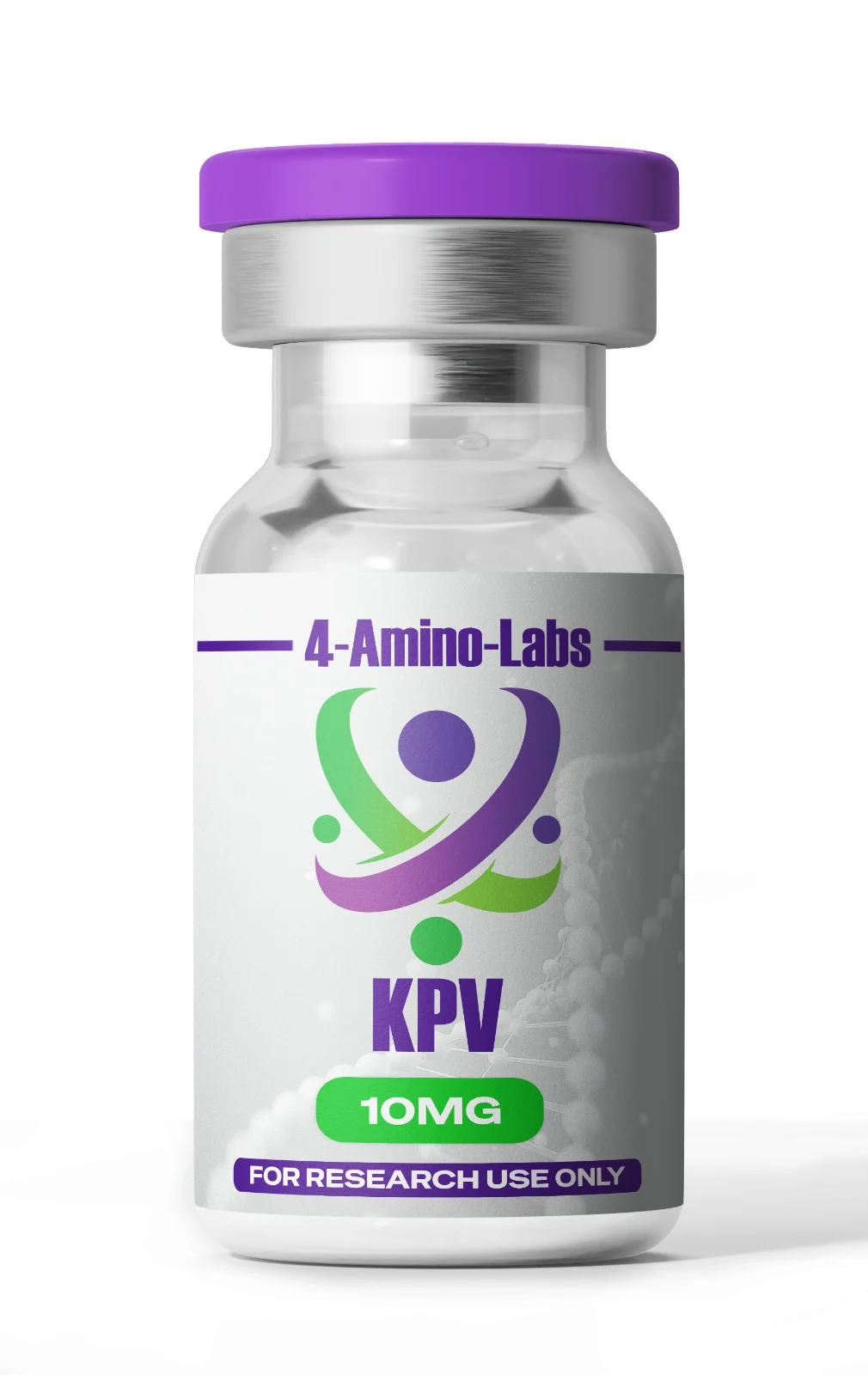
For 2026 procurement, use catalog information to identify candidates, then evaluate the documentation attached to the actual material. 4-Amino-Labs lists GHK-Cu at 50 mg per vial and KPV at 10 mg per vial; these are stated package contents, not independently established peptide-content measurements for your laboratory.
- Record the exact catalog designation.
- Distinguish peptide from metal complex.
- Capture the stated package content.
- Identify available batch documentation.
- Separate supplier statements from laboratory findings.
Match each document to its analytical question
Review documents manually against the specification. High-performance liquid chromatography separates components under the reported method; mass spectrometry measures mass-to-charge information. Neither method's name alone establishes that the method resolves every relevant impurity or confirms every structural feature.
The GHK-Cu catalog description lists ≥99% purity verified by HPLC, while the KPV description lists ≥98%. Treat these as reported specifications. An HPLC percentage is not automatically a mass fraction of peptide in the entire supplied material.
- Match the document identifier to the material.
- Record the reported analytical method.
- Distinguish identity from chromatographic purity.
- Check whether peptide content is reported separately.
- Preserve the document alongside the inventory record.
The decision sequence is straightforward: establish identity, interpret the purity measurement, distinguish content, and then evaluate behavior in the relevant matrix. No single document field replaces the others.
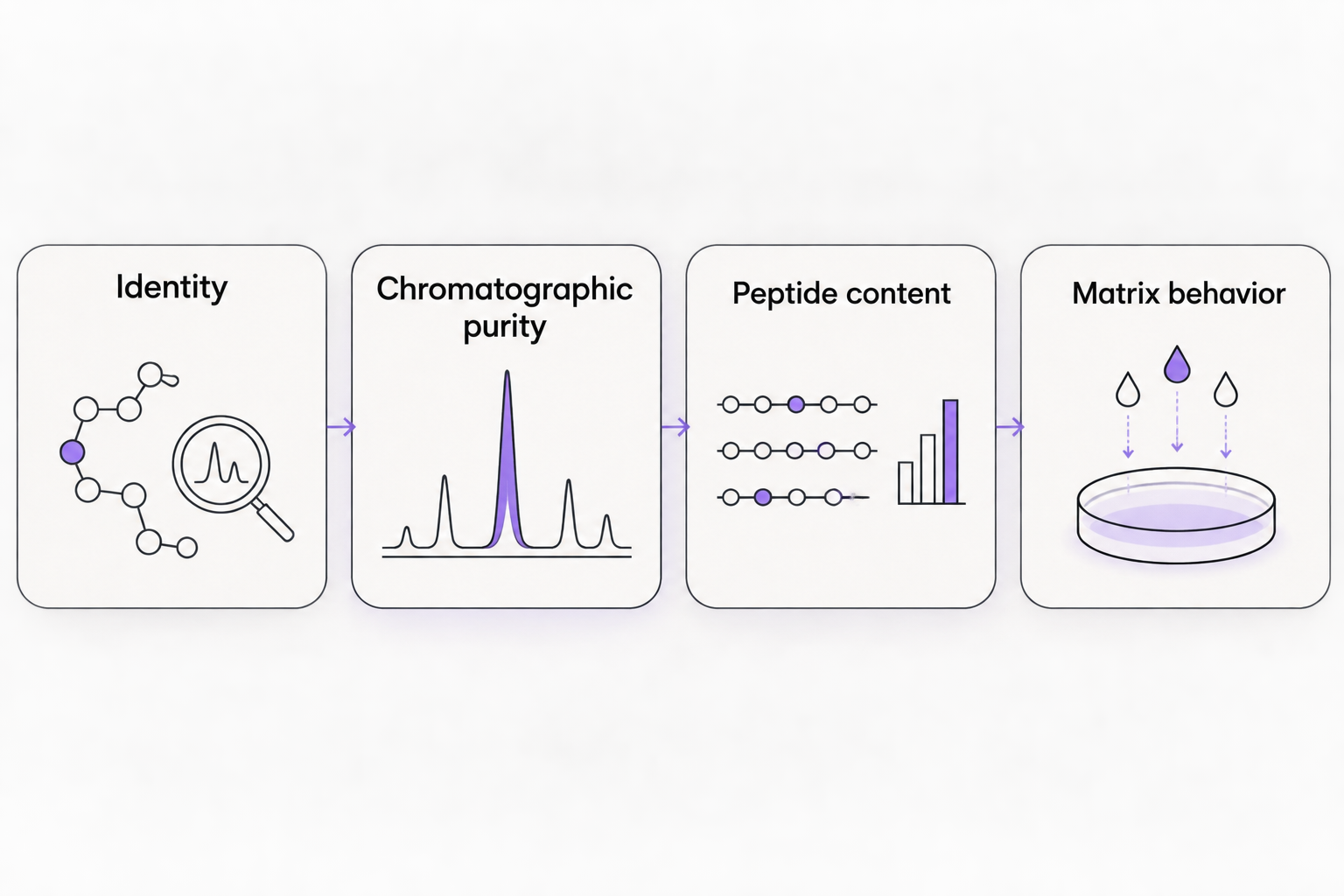
Qualify your measurement in the relevant matrix
Begin with the laboratory's existing method-development records and matrix blanks. Establish whether the signal attributed to the peptide is distinguishable from the surrounding ingredients before comparing samples. A clean result outside the matrix does not establish selectivity inside it.
Cosmetic science matrices introduce a specific interpretation problem: an apparent change in signal can reflect the analyte, the matrix, or the measurement. Resolve those possibilities rather than labeling every signal decrease as degradation. Document how the method distinguishes these explanations.
- Examine a matrix blank.
- Identify potentially overlapping signals.
- Assess the method's selectivity.
- Separate signal response from chemical interpretation.
- Record unresolved interference.
Define stability evidence without inventing a shelf life
Use a written stability question rather than a generic storage claim. Specify which property you are following: chromatographic profile, identity-related signal, appearance, or another justified analytical endpoint. These properties are not interchangeable indicators of stability.
Do not assign a universal shelf life to peptides for cosmetic research labs in 2026. A conclusion applies to the material, matrix, container, environmental conditions, and measurement actually evaluated. Preserve those boundaries when communicating findings internally.
- Identify the property being monitored.
- Record the material and container.
- Document relevant environmental conditions.
- Compare results against a defined baseline.
- State what the assessment does not establish.
Connect sourcing decisions to material qualification
Compare suppliers using the specification already written, not a general reputation score. A manual document register is sufficient when it reliably connects each received material to its supporting records. Purchasing convenience does not replace analytical qualification.
4-Amino-Labs publishes Certificates of Analysis in its COA library. For a documented sourcing workflow, review the material-specific record rather than treating a catalog summary as the complete analytical package; connecting COAs to a laboratory quality management system addresses the record-management side of that decision.
- Request clarification of unresolved specification fields.
- Keep source documentation with the inventory entry.
- Record discrepancies before research use.
- Preserve the laboratory's acceptance rationale.
- Separate retail purchasing from wholesale inquiries.
Compare research-material and documentation options
Choose an option for the question it can answer, not for the breadth of its description. The table separates material selection from analytical evidence; none of these options establishes finished-product suitability on its own.
| Option | Appropriate research role | Main advantage | Key limitation |
|---|---|---|---|
| GHK-Cu research material | Characterization of a defined copper–peptide material | Makes metal complexation an explicit research variable | Evidence for uncomplexed GHK cannot be transferred automatically |
| KPV research material | Sequence-specific analytical investigation | Provides a chemically distinct short-peptide candidate | Does not serve as an equivalent substitute for GHK-Cu |
| Supplier batch documentation | Initial material qualification | Connects reported specifications to an identified material | Does not replace matrix-specific method qualification |
| Independent analytical assessment | Resolving a defined documentation or identity question | Can address a laboratory-selected analytical question | Conclusions remain limited by the selected methods |
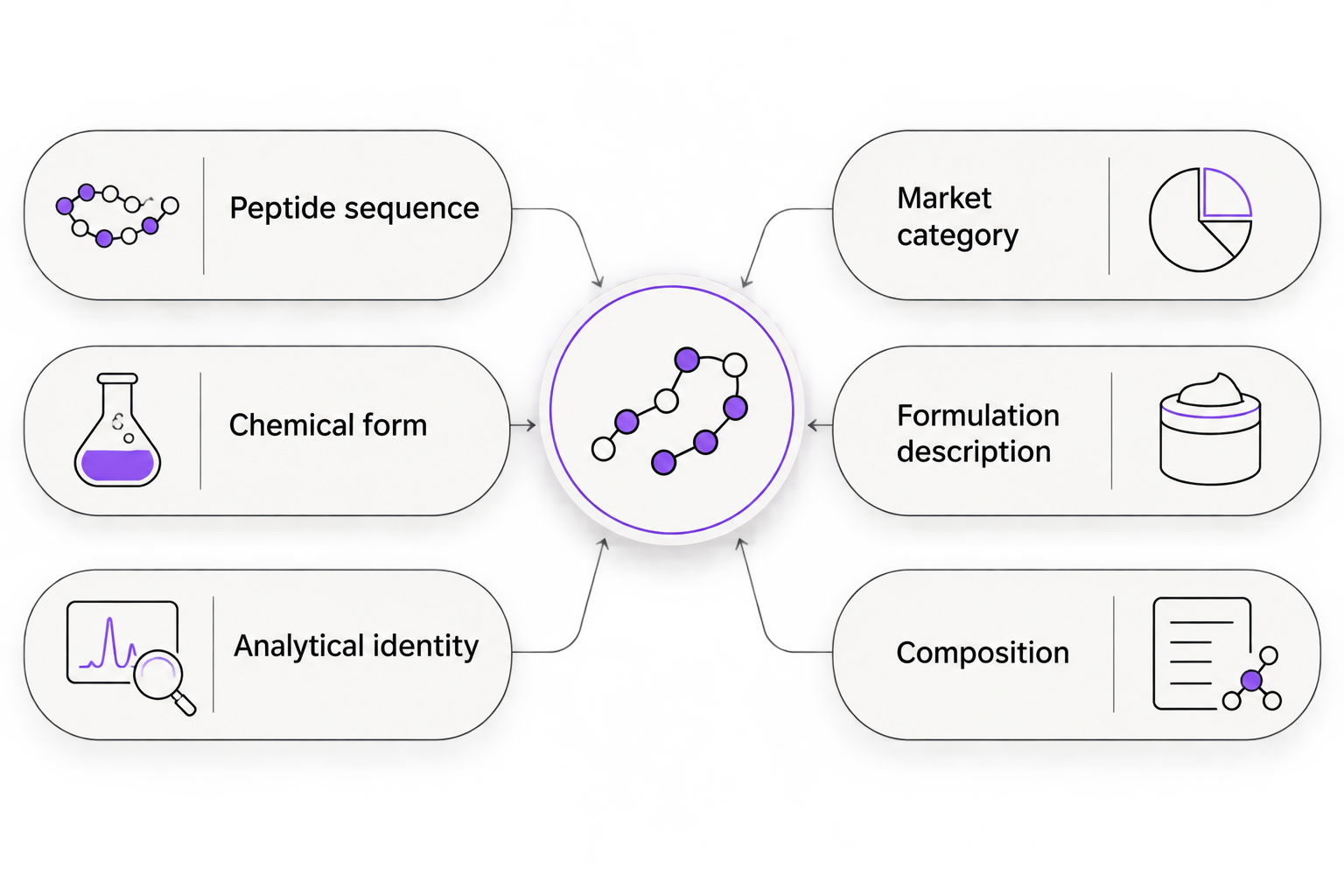
In cosmetic research, terminology also creates sourcing errors. A market category such as stem cell serums is not a peptide sequence, purity specification, or analytical identity. Translating a market-facing description into a testable chemical question requires the actual composition, not an assumption based on the category name.
The comparison below separates defined research materials from broader formulation descriptions. A label can establish what a seller calls something without establishing what your analytical method measures.
Review relevant catalog materials without assuming suitability
4-Amino-Labs supplies peptide research materials for laboratories evaluating molecular identity and analytical documentation. GHK-Cu and KPV are relevant here as distinct characterization candidates, not as a recommended combination or as evidence of cosmetic performance.
The catalog lists GHK-Cu as a blue lyophilized powder and KPV as a white lyophilized powder. Appearance is descriptive; it is not an identity test. The product cards identify the listed materials, while the qualification decision remains specific to your laboratory's research question.

Avoid common cosmetic science research mistakes
Treating a purity percentage as a complete specification
A high chromatographic percentage does not answer every question about composition. Keep identity, peptide content, counterions, water, and method selectivity distinct wherever they affect the research question.
Applying one material's evidence to another
Do not treat a peptide, its metal complex, and a modified derivative as interchangeable. Preserve the exact material designation in the experiment record and in every interpretation.
Confusing matrix effects with chemical change
A changed analytical response is an observation, not a complete explanation. Investigate interference and method behavior before concluding that the peptide changed chemically.
Reading cosmetic positioning into research specifications
Research-grade material documentation does not establish suitability for incorporation into a finished cosmetic. Keep exploratory laboratory findings separate from finished-product specifications and performance statements.
State the limitations of your conclusions
This 2026 guide is an analytical qualification framework, not a comparative experimental study. It does not report independent testing of the listed materials, validate supplier methods, or establish receptor activity, matrix compatibility, or stability for a particular application.
The catalog specifications quoted here describe the supplied listings. Your laboratory must determine which documentation and measurements address its research question; neither a product name nor an HPLC percentage answers every question in that assessment.
One last thing
Write the conclusion you would be allowed to make before collecting the result. If the planned measurement only establishes a chromatographic difference, the final report should not turn that difference into a receptor mechanism or cosmetic performance claim.
For a 2026 laboratory notebook template, place an interpretation-limit field immediately beside the result field. That small documentation choice keeps the analytical observation and its permitted meaning together.
FAQ
How do I choose peptides for cosmetic research labs?
Choose peptides by exact molecular identity, the research question, and the analytical evidence needed to interpret results. Evaluate material documentation separately from matrix-specific method qualification.
Are GHK and GHK-Cu interchangeable research materials?
No. GHK-Cu is a copper complex involving GHK, so evidence for uncomplexed GHK does not automatically establish the behavior of GHK-Cu.
Does HPLC purity establish peptide content?
No. Chromatographic purity and peptide content are different measurements, and the reported HPLC percentage must be interpreted within the stated method.
Can a catalog specification establish cosmetic formulation suitability?
No. A catalog specification describes reported material characteristics, not suitability for a particular finished formulation or matrix.
What should a laboratory retain with each peptide batch?
Retain the material identifier, relevant supplier documentation, receipt records, and the laboratory’s qualification decision. Keep subsequent analytical findings connected to that same inventory record.
Can I assign a general shelf life to research peptides?
No universal shelf life follows from the peptide category alone. Stability conclusions must remain specific to the material, conditions, matrix, container, and properties evaluated.
Are the listed materials intended for finished cosmetic use?
The listed materials are presented strictly for laboratory research use only. This guide does not establish finished-product suitability or authorize another use.
Related guides
- Connecting batch numbers to lab inventory tracking
- Research peptide storage and cold-chain workflow
- Peptide research for biotech startups
Research use only. Materials discussed here are not intended for human or animal use. This content is not medical advice and is not intended to diagnose, treat, cure, or prevent disease.