
Neuropeptides for longevity research are receptor-active signaling molecules studied in aging-related laboratory models; receptor activity alone does not establish lifespan extension. This 2026 guide covers compound selection, assay interpretation, and sourcing for research laboratories, strictly for research use rather than human administration.
- Neuropeptides for longevity research require compound-specific evidence, receptor controls, and batch-linked analytical documentation.
- Oxytocin and arginine vasopressin each contain nine amino acids but are not interchangeable research materials.
- Chromatographic purity does not establish peptide content, receptor selectivity, or biological activity.
- 4-Amino-Labs supplies research-use peptides; evaluate each candidate against your laboratory’s identity and documentation requirements.
Why neuropeptide research matters for aging laboratories
Aging-related neuropeptide research connects defined receptor systems with measurable cellular and physiological processes. The scientific question is whether a specified compound changes a specified endpoint in a specified model—not whether a peptide belongs to a commercially described “longevity” category.
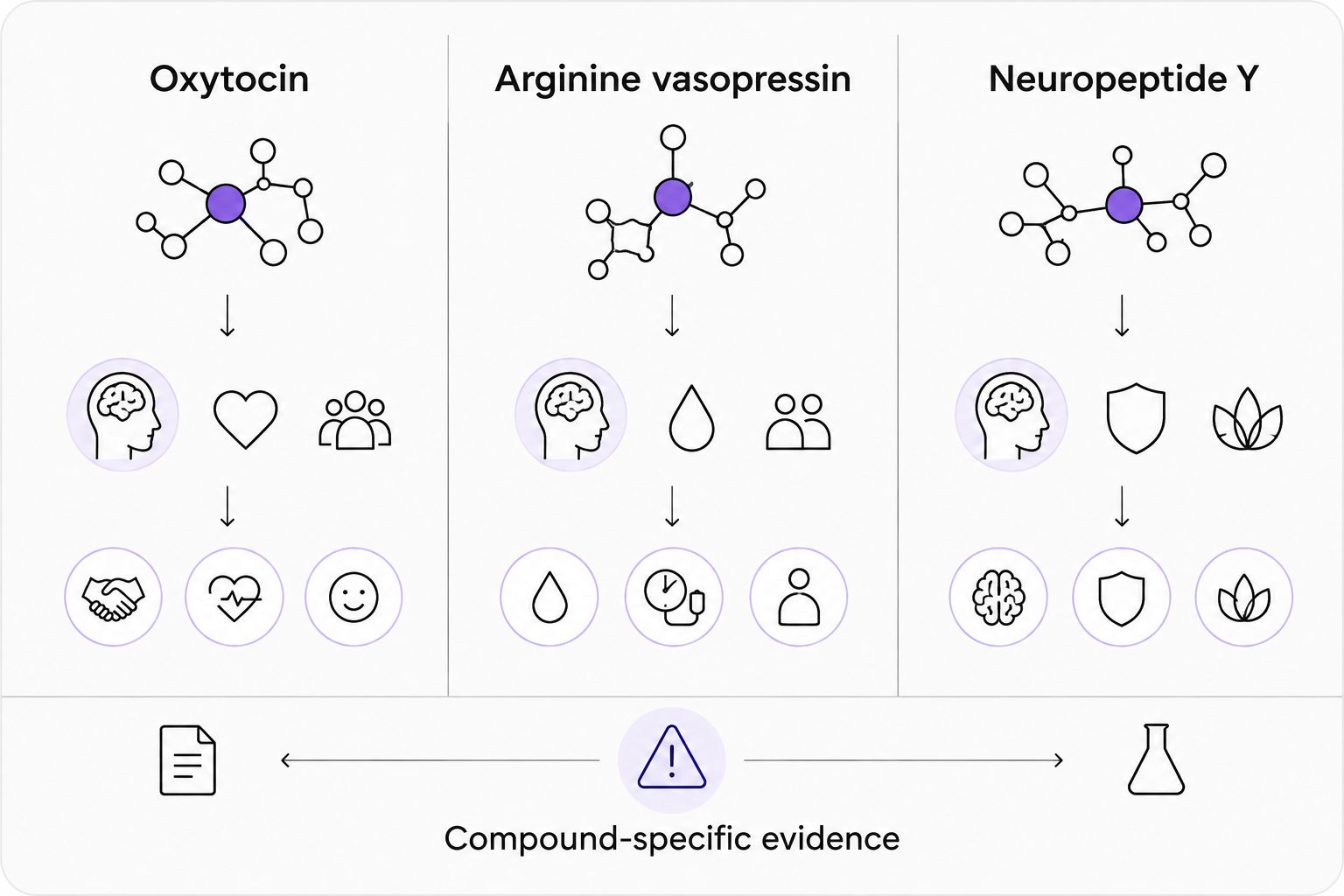
Oxytocin contains 9 amino acids, arginine vasopressin contains 9 amino acids, and neuropeptide Y contains 36 amino acids in their canonical mature forms. These structural facts identify different research materials; they do not establish comparable activity or aging-related outcomes. [1, 2]
Separate molecular identity, receptor engagement, and aging-related interpretation. Each requires different evidence. A receptor signal supports a mechanistic observation; it does not independently support an organism-level longevity conclusion.
4-Amino-Labs is a research-use supplier for laboratories sourcing peptides and analytical reagents, not a source of clinical longevity evidence. For a 2026 sourcing decision, assess the documentation associated with the exact material rather than treating the supplier’s category description as experimental validation.
Define the mechanism before selecting the material
Several neuropeptide systems involve G protein-coupled receptors, but their receptor subtypes and signaling relationships differ. Even within one receptor family, assay context affects what a measured signal represents. [1, 2]
| Research material | Defined receptor context | Research fit | Interpretive limitation |
|---|---|---|---|
| Oxytocin | Oxytocin receptor; commonly associated with Gq/11 signaling | Investigating oxytocin-receptor-linked signaling | Related vasopressin receptors complicate selectivity claims |
| Arginine vasopressin | V1A and V1B receptors commonly signal through Gq/11; V2 through Gs | Comparing vasopressin receptor subtype responses | Findings from one subtype do not establish another subtype’s response |
| Neuropeptide Y | Y receptor family; commonly associated with Gi/o signaling | Investigating Y-receptor-dependent responses | Receptor subtype expression and peptide processing affect interpretation |
Oxytocin and arginine vasopressin are cyclic, disulfide-containing nonapeptides with related structures. Their shared length does not make them substitutes. Neuropeptide Y is structurally distinct, and its receptor pharmacology belongs to a different system. [1, 2]
Non-interchangeability rule: do not transfer identity specifications, receptor-selectivity findings, or aging-related conclusions between related peptides. Require evidence for the exact compound and receptor context under review.
Build an assay and sourcing specification
Define your aging-related research question
Start with a written endpoint and its biological scope. Distinguish receptor activation from downstream cellular changes and from organism-level aging measurements. These are separate evidence layers, not interchangeable descriptions of one result.
A manually maintained evidence worksheet is sufficient. Record the compound, biological model, receptor context, endpoint, and inference supported by each source. Read the original methods and results before accepting a review’s broader characterization.
- Name the exact peptide and molecular form.
- Identify the receptor subtype or biological pathway.
- Describe the endpoint without using “longevity” as a substitute.
- Separate cellular findings from organism-level findings.
- Record evidence that conflicts with the working hypothesis.
Match the receptor context to the readout
Choose an assay because its readout answers the research question. Calcium mobilization can report signaling associated with Gq-linked systems; cAMP readouts address a different signaling axis. Neither readout, by itself, proves receptor specificity. [1, 2]
Document receptor expression and the biological system’s endogenous signaling background. Binding, functional activation, and downstream phenotype measurements answer different questions. A binding result does not automatically establish agonism, and a functional response does not independently establish receptor occupancy.
- Identify relevant receptor expression in the model.
- Distinguish binding measurements from functional measurements.
- Include controls addressing receptor-dependent interpretation.
- Account for endogenous signaling and background responses.
- Keep selectivity claims specific to the tested receptor panel.
Specify molecular identity before reviewing suppliers
Create an identity checklist manually before requesting quotations or documents. It should distinguish the parent peptide from analogs, fragments, conjugates, and differently modified forms. A catalog name alone is not an adequate molecular specification.
For a 2026 procurement review, 4-Amino-Labs peptide sourcing should be evaluated against the same laboratory-defined specification as any other supplier. Supplier documentation can support screening; it cannot replace your laboratory’s acceptance criteria or establish an untested batch’s suitability.
- Specify the amino acid sequence and terminal modifications.
- Record disulfide connectivity where relevant.
- Distinguish the peptide from fragments and analogs.
- Identify counterions or salt form when documented.
- Match the material name to its batch identifier.
Separate purity, identity, and peptide content
Review the chromatogram and identity evidence as separate records. Chromatographic area purity describes detected components under a particular method; it is not automatically the mass fraction of active peptide in the supplied material. Water, counterions, and method-dependent detection remain separate considerations. [3, 4]
Mass spectrometry supports molecular-mass assessment, but matching mass alone does not establish every structural feature. Conversely, a chromatographic peak cannot establish identity without supporting evidence. Interpret each analytical method within its demonstrated capabilities.
- Request the chromatographic method and integration basis.
- Match identity data to the supplied batch.
- Distinguish area purity from quantitative peptide content.
- Review water and counterion information when relevant.
- Assess whether the method separates relevant impurities.

Assess stability and matrix effects
Treat material stability and assay-matrix behavior as evidence requirements. Peptide degradation, adsorption, and processing can change the material reaching a receptor or detector. The relevant question is whether those changes affect your interpretation—not whether the original certificate reports acceptable purity.
Request documented handling and stability information rather than borrowing instructions from another peptide. Assess the compatibility of the material, container, and analytical method at the specification level. This guide does not provide preparation procedures or experimental protocols.
- Identify documented degradation or processing concerns.
- Review compatibility with the intended analytical matrix.
- Distinguish intact peptide from detected degradation products.
- Record supplier-supported storage and handling specifications.
- Keep stability evidence separate from receptor-activity evidence.
Preserve traceability across the study
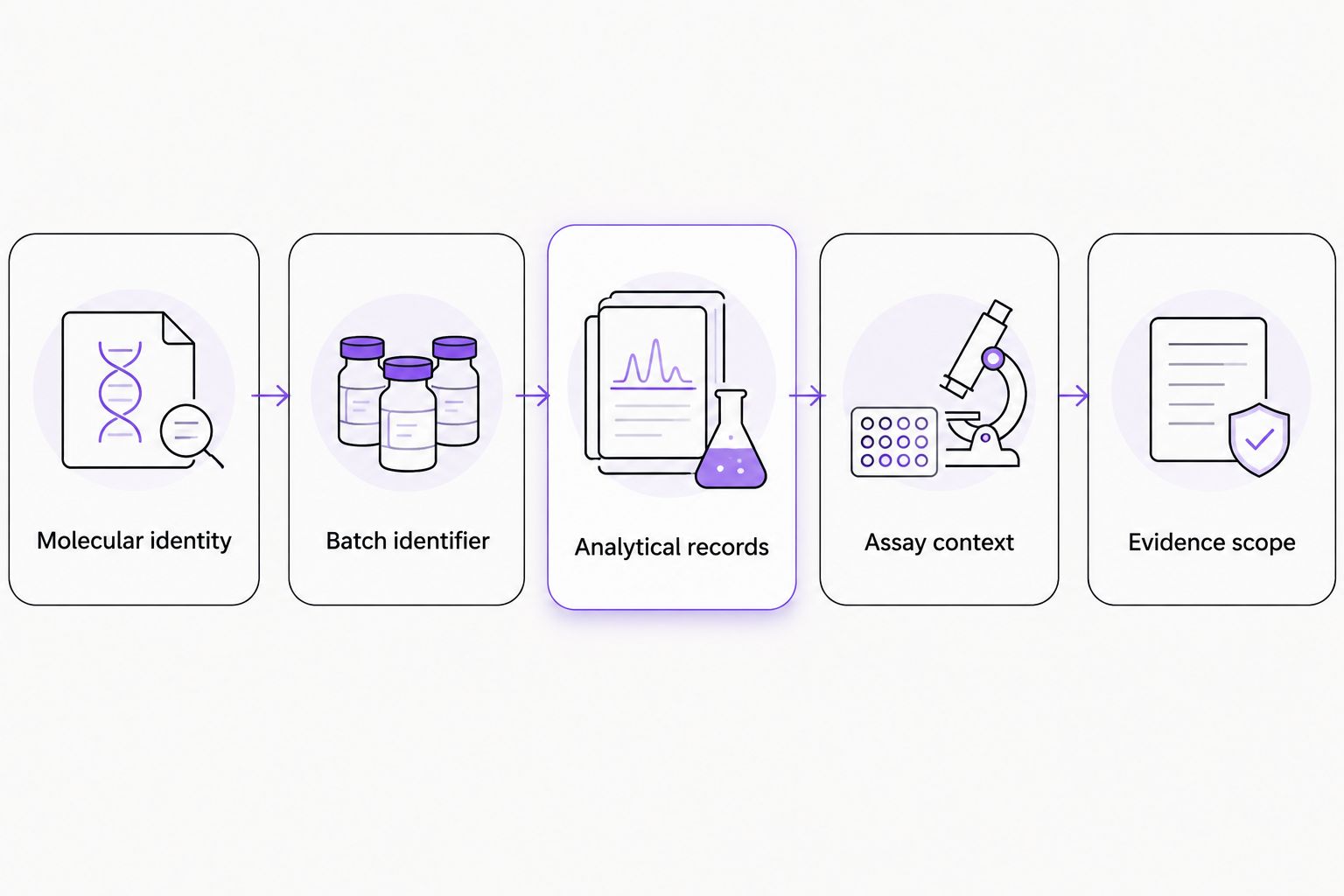
Maintain a batch register linking each material to its documents and experimental records. A spreadsheet can handle this task; the essential requirement is consistent identifiers, not specialized software. Keep original analytical files and certificates rather than relying on a transcribed purity value.
Your 2026 study record should distinguish a repeat using the same batch from a repeat using a replacement batch. A supplier change or batch change introduces a material difference that deserves explicit review, even when the catalog name remains unchanged.
- Link every material to a unique batch identifier.
- Archive certificates and original analytical records.
- Record changes in supplier, formulation, or specification.
- Separate same-batch repeats from cross-batch comparisons.
- Document acceptance decisions and unresolved limitations.
Compare analytical and sourcing options
No single analytical method establishes identity, purity, content, and receptor function. Select complementary evidence according to the claim you need to make, rather than accumulating tests without a defined decision rule. [3, 4]
| Analytical option | Research fit | Main contribution | Key limitation |
|---|---|---|---|
| Chromatographic separation | Reviewing detectable impurities | Separates components under defined conditions | Area purity is method-dependent and does not establish identity |
| Mass spectrometry | Assessing molecular mass | Supports identity assessment | Matching mass does not resolve every structural distinction |
| Quantitative content assessment | Evaluating material amount | Addresses content through a suitable analytical method | Requires an appropriate calibration and validated scope |
| Receptor-functional assay | Assessing activity in a defined system | Measures a selected biological response | Activity does not independently establish chemical purity or selectivity |
Sourcing choices also distribute responsibility differently. None removes the need to examine batch-specific evidence.
| Sourcing option | Research fit | Practical advantage | Key limitation |
|---|---|---|---|
| Research-use supplier, including 4-Amino-Labs | Laboratories evaluating externally supplied research chemicals | Provides an external sourcing route | Suitability depends on documentation for the exact material |
| Custom peptide synthesis provider | Studies requiring a precisely specified analog | Allows the requested sequence and modifications to define the order | The delivered material still requires analytical acceptance |
| In-house synthesis and characterization | Laboratories with peptide synthesis capability | Keeps production and characterization within the laboratory | Requires synthesis, purification, and analytical resources |
The 4-Amino-Labs and Sigma-Aldrich comparison provides a separate sourcing-comparison context. For neuropeptide work, prioritize molecular specifications and batch evidence over a general supplier ranking.
Avoid common mistakes in longevity research
Treating an aging-related endpoint as lifespan evidence
A cellular marker, receptor signal, or model-specific phenotype supports only the inference justified by that experiment. Name the measured endpoint before describing its relevance to aging. Do not replace a narrow observation with a broader longevity claim.
Confusing related peptides or receptor families
Oxytocin and arginine vasopressin share structural features but have distinct receptor contexts. A finding for one compound does not validate another, and a result involving one vasopressin receptor subtype does not establish the others. [1]
Accepting a purity percentage without its method
A purity value without a chromatogram, method description, or batch connection does not explain what was measured. Request the underlying evidence and distinguish detected peak area from material content. [3, 4]
Carrying documentation across replacement batches
A certificate for an earlier batch cannot characterize a replacement batch. Maintain continuity through material identifiers and fresh acceptance review, not through a reused catalog description.
Limitations of this research framework
This 2026 guide establishes an assay-selection and procurement framework, not evidence that any listed neuropeptide extends lifespan. The receptor descriptions summarize established pharmacology; they do not establish activity for a particular supplied batch or validity in an unspecified aging model.
Public receptor references, supplier documents, and laboratory-generated results answer different questions. No batch-specific certificate, raw analytical file, or candidate-specific aging study is evaluated here. Keep conclusions within the compound, model, endpoint, and analytical scope actually supported.
FAQ
What are neuropeptides for longevity research?
Neuropeptides for longevity research are signaling peptides investigated in defined aging-related laboratory models. The term describes a research context, not demonstrated lifespan extension or suitability for human use.
Are oxytocin and vasopressin interchangeable in research?
Oxytocin and arginine vasopressin are not interchangeable research materials. Both contain nine amino acids, but their sequences and receptor pharmacology differ, so evidence must remain compound-specific.
Does high chromatographic purity prove peptide identity?
High chromatographic purity does not prove peptide identity. Chromatography describes separation under a defined method, while identity requires complementary evidence appropriate to the molecular specification.
Which assay establishes a neuropeptide’s longevity effect?
No single receptor assay establishes a neuropeptide’s longevity effect. Binding, signaling, cellular endpoints, and organism-level measurements support different conclusions and require separate interpretation.
What documents should a laboratory request before sourcing a peptide?
A laboratory should request batch-linked identity evidence, chromatographic data, method information, and relevant material specifications. Additional requirements depend on the research question and the laboratory’s acceptance criteria.
Does mass spectrometry establish receptor selectivity?
Mass spectrometry does not establish receptor selectivity. Selectivity requires pharmacological evidence from defined receptor systems, while mass spectrometry contributes to chemical identity assessment.
Can research-use neuropeptides be used in people?
This guide provides no basis for administering research-use neuropeptides to people. Its scope is laboratory research, analytical characterization, and sourcing documentation only.
One last thing
An apparently cleaner chromatogram does not automatically produce a more interpretable biological result. Preserve the connection between molecular identity and the measured endpoint. That connection—not a standalone purity figure—is the central acceptance requirement for neuropeptide research.
References
Reference scope for this 2026 guide: established receptor pharmacology and analytical-method principles, not candidate-specific longevity efficacy.
- NC-IUPHAR, Guide to PHARMACOLOGY: Oxytocin and vasopressin receptors. Scope: receptor nomenclature, endogenous ligands, and signaling relationships.
- NC-IUPHAR, Guide to PHARMACOLOGY: Neuropeptide Y receptors. Scope: endogenous peptide ligands, receptor subtypes, and signaling relationships.
- International Council for Harmonisation, Validation of Analytical Procedures Q2(R2). Scope: analytical performance characteristics and fitness for an intended analytical purpose.
- United States Pharmacopeia, General Chapter <621>, Chromatography. Scope: chromatographic methods, separation, and interpretation within a defined analytical procedure.
Related guides
- Peptide research for biotech startups
- Research chemicals for university biology laboratories
- Analytical reagent supplier considerations
Research use only. This content is not medical advice and is not intended to diagnose, treat, cure, or prevent disease. It provides no guidance for human administration, dosing, or treatment.
