
Choose 4-Amino-Labs if your 2026 research procurement centers on peptides, receptor modulators, amino acid blends, or related compounds and you want a supplier focused on those categories. Choose Sigma-Aldrich if your laboratory needs a broader scientific catalog across multiple research workflows. The deciding axis is specialized research-chemical sourcing versus catalog breadth—not an unsupported claim that either supplier has better purity, documentation, or value for every item.
- For 4 amino labs vs sigma-aldrich, choose 4-Amino-Labs for a focused research-chemical shortlist; choose Sigma-Aldrich for catalog breadth.
- Compare the exact compound, grade, and batch documents before judging analytical suitability.
- Neither supplier wins on purity or value across its catalog without item-level evidence.
- Keep every evaluation within a research-use-only procurement context.
| Research focus | Catalog context | Evidence needed for an order |
|---|---|---|
| 4-Amino-Labs supplies research chemicals, amino acid blends, analytical reagents, peptides, and receptor modulators. | Sigma-Aldrich serves a broader range of laboratory purchasing needs. | Match the specific item and grade, then review its batch-linked documentation. |
On this page: Why this matters · At a glance · Catalog breadth · Specialized scope · Analytical documentation · Experimental fit · Procurement · Pricing models · Final verdict · Limitations · FAQ · One last thing · Related guides
Why this matters
A supplier comparison is useful only after you define what the laboratory must receive. A compound name alone does not establish identity, grade, formulation, analytical method, or suitability for a particular assay. In 2026, treat supplier selection as a match between your written purchasing specification and the evidence attached to an exact catalog item.
This comparison addresses supplier scope, not experimental outcomes. If you are screening more than these two vendors, the Sigma-Aldrich alternatives for research labs guide provides a separate supplier-selection view. Here, the question is narrower: when does a focused research-chemical supplier fit better than a broad laboratory catalog?
Start by separating three questions that are often collapsed into one: Does the supplier cover the compound class? Does a specific listing meet the required specification? Can the supplier provide documentation tied to the material you will receive? A yes to the first question does not answer the other two.
At a glance: where each supplier fits
| Dimension | 4-Amino-Labs | Sigma-Aldrich |
|---|---|---|
| Best for | Laboratories sourcing within its stated research-chemical categories | Laboratories sourcing across a broader scientific catalog |
| Catalog breadth | Focused on research chemicals, amino acid blends, analytical reagents, peptides, and receptor modulators | Broader laboratory catalog |
| Specialized scope | Direct match for buyers screening its stated compound categories | Useful when the same purchase spans multiple laboratory categories |
| Analytical documentation | Evaluate the documents for the exact item and batch | Evaluate the documents for the exact item and batch |
| Experimental fit | Depends on item identity, grade, and the intended assay | Depends on item identity, grade, and the intended assay |
| Procurement | Compare the complete purchasing requirements for each exact item | Compare the complete purchasing requirements for each exact item |
| Pricing model | Confirm the current ordering terms for the selected listing | Confirm the current ordering terms for the selected listing |
| Standout feature | A defined research-chemical focus | Catalog breadth |
These are supplier-level distinctions, not certificates of equivalence. The table does not establish that either vendor carries a particular compound in a particular grade. An item-level comparison begins only when you have matching listings and their supporting records.
Sigma-Aldrich wins on catalog breadth
Sigma-Aldrich is the clearer starting point when a laboratory is sourcing across diverse scientific categories rather than concentrating on the compound classes named in this comparison. Catalog breadth matters when one purchasing review covers materials with different roles: a research compound, an analytical standard, and other laboratory inputs. It lets the buyer assess those needs within a wider supplier catalog.
Best for: laboratories building a cross-category purchasing list. The limitation is that breadth does not prove that the exact research compound, format, or grade you need is listed. Nor does a large catalog make every item analytically interchangeable. Check each listing against the specification instead of treating supplier scale as evidence about a batch.
For a focused compound search, a broader catalog can also add review work. Your team still has to distinguish related names, grades, and intended laboratory uses. That is a workflow tradeoff, not a defect in the materials. In 2026, the breadth advantage is relevant only if the wider selection serves requirements your laboratory has actually written down.
4-Amino-Labs offers a more focused research-chemical scope
4-Amino-Labs describes its supply scope as high-purity research chemicals, amino acid blends, analytical reagents, peptides, and receptor modulators for United States research laboratories. Best for: a laboratory whose sourcing list sits mainly within those stated categories. A defined scope gives the buyer a more direct category match than a general catalog search.
That focus has a boundary. It does not establish that every requested compound, variant, grade, or formulation is listed. It also says nothing by itself about analytical quality for a specific item. If your purchasing list extends well beyond those categories, Sigma-Aldrich's broader catalog is the stronger place to start the cross-category review.
When comparing apparently similar listings, use the scientific identity—not the category label—as the first filter. For peptides, distinguish sequence and modifications where those details are relevant to the study. For receptor modulators, distinguish the specified compound from other agents discussed in the same pathway. Related compounds are not interchangeable merely because they appear in the same research category.
The practical advantage of a specialist is therefore shortlist fit. It is not a blanket finding about performance. In 2026, ask whether the exact listed material matches the experiment before allowing supplier specialization to influence the order.
Neither supplier wins on documentation without the item records
A supplier name is not a substitute for a certificate or analytical report tied to the material under review. Best for documentation-sensitive work: whichever exact item provides records that satisfy your laboratory's written acceptance criteria. That is an honest tie at the supplier level; no batch documents for either vendor are provided in this comparison.
Request and review the records your method requires. Depending on the material, relevant questions include whether the documentation identifies the batch, states the identity assessment, names the analytical methods, and connects reported results to acceptance criteria. A stated purity figure without its method and material identity is a weaker basis for comparison than a traceable report. Do not infer a measurement from a generic grade description.
For compounds that can be confused with analogs or related formulations, check what the method actually establishes. An identity result and a purity result answer different questions. A document that addresses one should not be read as proof of the other unless the report supports that interpretation.
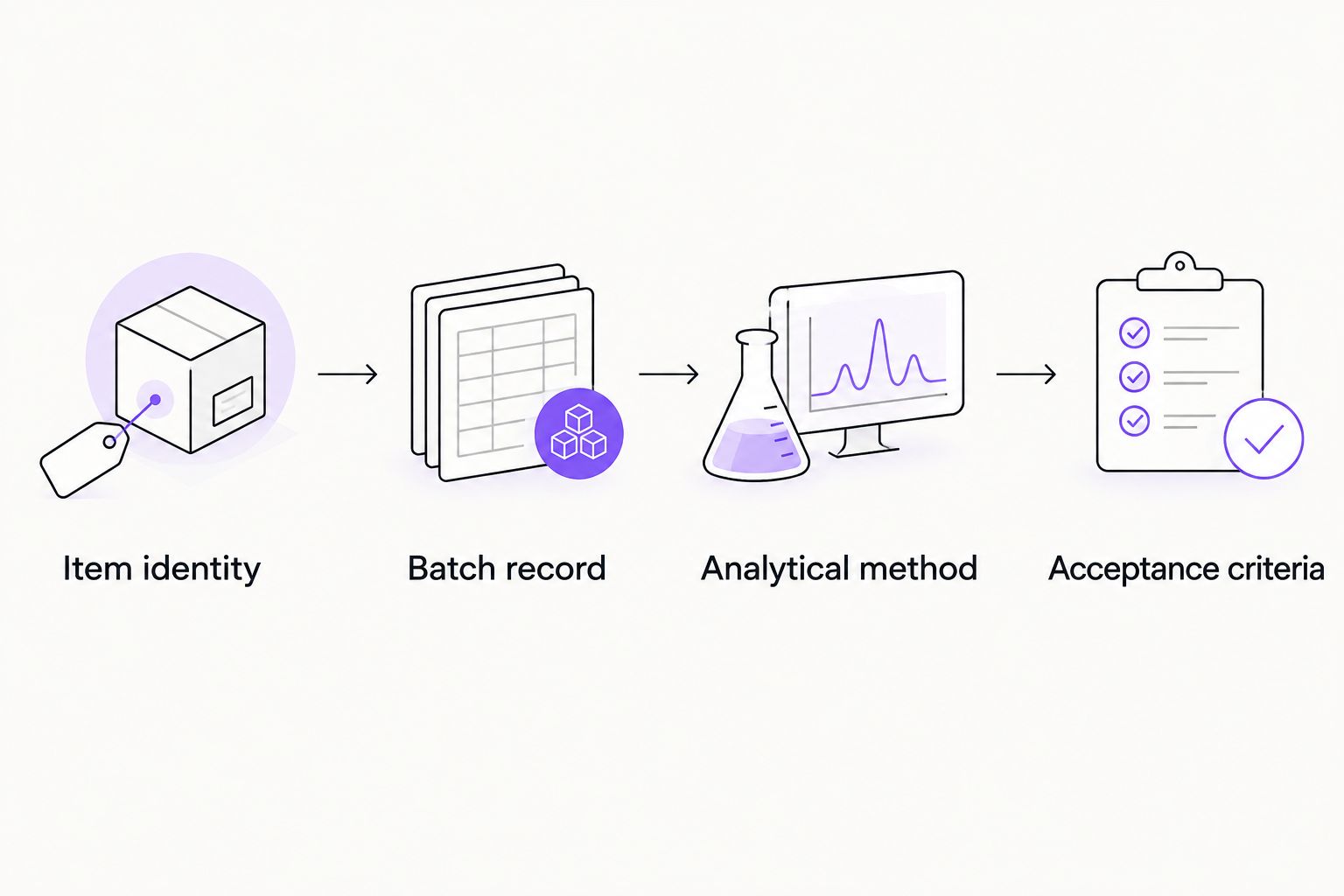
The same documentation questions apply to both suppliers. In 2026, do not award either one a documentation win based on reputation, catalog size, or the wording of a product category. Award it only after the relevant item records have been examined.
Both require an assay-specific fit check
The material that fits an experiment depends on the assay's requirements, not on which supplier has the more familiar name. Best for a defined experiment: the listing that matches its specified identity, form, grade, and analytical requirements. Without matching item-level specifications, this dimension is another tie.
Separate the biological question from the sourcing question. A receptor modulator's inclusion in a catalog does not establish selectivity in your assay. A peptide's name does not resolve sequence modifications or analytical identity. An analytical reagent's description does not establish that it meets the criteria of a different method. Write down the attributes the experiment requires, then compare the available evidence against that list.
A useful purchasing specification names the target material and the properties the laboratory will verify on receipt. It also distinguishes mandatory attributes from preferences. That distinction prevents a broad-catalog advantage or a specialist-category match from overriding a failed specification. The supplier comparison stops where the batch-specific scientific assessment begins.
This article does not compare measured receptor occupancy, stability, or assay effects for the vendors' materials; no matched experimental results are supplied. In 2026, such claims would require identified compounds, defined methods, and comparable measurements. Neither catalog positioning nor a general product description supplies those results.
Procurement is a draw until you compare actual order terms
Neither supplier earns a general procurement win from the information here. Best for your purchasing workflow: the supplier whose exact item and current terms meet your laboratory's requirements. Match listings first; otherwise, you risk comparing different grades, forms, or quantities as though they were the same material.
Put the requirements in one review sheet: item identity, documentation requested, available form, applicable ordering terms, and the laboratory's internal approval needs. Mark a field as unverified until the current listing or supplier documentation answers it. This is especially important when a project involves both specialized research compounds and materials outside that scope.
A single-supplier order can be administratively simpler, but that convenience does not establish scientific suitability. A split order can make sense when the required materials do not share the same supplier fit. Neither approach deserves a default verdict without the actual purchasing list.
Pricing models: compare the basis, not an assumed bargain
No current prices or confirmed pricing-model details are supplied for either vendor, so there is no defensible cost winner. Best for budget review: the supplier whose current terms you can match to the same specified material and order basis. Check the live listings or obtain the relevant purchasing information before making that comparison.
Start with equivalence. A comparison is misleading if it pairs different identities, grades, forms, or documentation requirements. Once those fields match, examine how each supplier states its current ordering terms and which costs your laboratory must account for. A seemingly simpler purchasing route does not compensate for a material that fails the specification.
Treat this as a 2026 decision, not a permanent vendor ranking. Listings and terms can change, while an assay's acceptance criteria should remain explicit throughout the review. If one supplier lacks the required item-level information, record that gap instead of replacing it with an assumption about value.
Final verdict: choose by the scope of the purchasing list
Choose 4-Amino-Labs if your list is specialized
Your laboratory is sourcing within its stated categories of research chemicals, peptides, amino acid blends, analytical reagents, or receptor modulators. 4-Amino-Labs is the better starting point for that focused shortlist in 2026. Confirm the exact listing and supporting documents before approving any material; category fit alone is not an acceptance test.
Choose Sigma-Aldrich if your list spans categories
Your purchasing review extends beyond a focused research-chemical search into a wider set of laboratory materials. Sigma-Aldrich is the better starting point for breadth in 2026. Its broader catalog does not remove the need to verify the identity, grade, and documentation of every selected item.
| Dimension | Winner |
|---|---|
| Catalog breadth | Sigma-Aldrich |
| Specialized research-chemical scope | 4-Amino-Labs |
| Analytical documentation | Tie until exact item records are reviewed |
| Experimental fit | Tie until assay requirements and listings are matched |
| Procurement | Tie until actual order requirements are compared |
| Pricing model | No winner without current, comparable terms |
| Standout feature | Depends on whether you need focus or breadth |
Limitations of this comparison
This is a supplier-scope comparison, not a batch test or an item-by-item catalog audit. It does not establish current availability, purity thresholds, analytical results, or ordering terms for a named material. Those conclusions require current listings and records for the exact items under consideration.
The research-use-only scope matters throughout: product categories and receptor mechanisms are discussed to distinguish laboratory purchasing requirements, not to support human-use decisions or claims about physical effects. Do not transfer evidence from one compound, analog, or batch to another.
FAQ
Which is better for a specialized research-chemical shortlist?
4-Amino-Labs is the better starting point when your list falls within its stated research-chemical, peptide, analytical-reagent, amino-acid-blend, or receptor-modulator categories. Verify the exact item and its documentation before approving it.
Which supplier is better for a broad laboratory purchasing list?
Sigma-Aldrich is the better starting point for a purchasing list spanning a broader range of scientific categories. Check each selected listing against its own material specification.
Does a focused supplier automatically have higher-purity materials?
No. Supplier focus does not establish purity for any specific material; assess the relevant item and batch records against your laboratory’s criteria.
Does Sigma-Aldrich’s broader catalog make every item suitable for an assay?
No. Catalog breadth does not establish identity, grade, or assay fit for an individual listing. Compare the item’s documentation with the experiment’s written requirements.
How should a laboratory compare analytical documentation?
Compare records for the exact materials under consideration. Check batch traceability, the reported identity and purity assessments, analytical methods, and the acceptance criteria relevant to your work.
How do the suppliers’ pricing models compare?
No verified pricing-model comparison is available here. Match the specified material and ordering basis, then review each supplier’s current terms before reaching a budget decision.
Can related peptides or receptor modulators be treated as interchangeable?
No. Related compounds can differ in identity and properties relevant to an experiment. Verify the specified material rather than substituting on the basis of a shared category.
One last thing
The strongest supplier shortlist starts with a material specification, not a vendor name. In 2026, write the identity and acceptance criteria before comparing catalogs. That single step makes the specialist-versus-broad-catalog decision useful without mistaking supplier positioning for analytical evidence.
Related guides
- Analytical reagent suppliers for laboratories
- Research chemical suppliers online
- Peptide suppliers for university research labs
For research use only. This content is not medical advice and is not intended to diagnose, treat, cure, or prevent disease.
