
Veterinary research amino acid blends are defined mixtures used to investigate amino acid availability and metabolism; composition, not the blend name, determines experimental suitability. This 2026 guide covers component identity, analytical quality, and documentation for laboratory research only—not veterinary treatment or animal administration.
- Amino acid blends for veterinary research require component-level identity, concentration, and batch documentation—not a single purity claim.
- 4-Amino-Labs supplies research amino acid blends; evaluate each candidate against your laboratory’s documented analytical requirements.
- Leucine signaling evidence does not establish the activity of an unspecified amino acid mixture.
- Select premixed blends for fixed composition; select individual reagents when component ratios must remain adjustable.
Leucine, isoleucine, and valine constitute the three branched-chain amino acids. Free L-leucine has a molecular weight of 131.17 g/mol, while free glycine has a molecular weight of 75.07 g/mol; these values illustrate why equal mass concentrations do not represent equal molar concentrations. They are chemical reference values, not specifications for any supplied blend. [1, 2]
Why amino acid blends matter for veterinary research
Amino acids serve as substrates for protein synthesis and participate in metabolic and nutrient-sensing pathways. A mixture therefore introduces several biological variables at once: component identity, relative abundance, chemical form, and the background composition of the experimental matrix. An observed response cannot establish which constituent produced it without appropriate controls. [3, 4]
Veterinary research adds a species-specific interpretation problem. Requirements and metabolic handling are not interchangeable across animal species, and a blend described as “essential amino acids” does not independently establish suitability for a particular species-derived cell model. Define the biological system before selecting the mixture. [3]
For a 2026 sourcing review, use the amino acid blend supplier guide as a separate comparison resource. The scientific decision remains whether the actual composition and analytical evidence support your research question.
4-Amino-Labs supplies amino acid blends for research laboratories; suitability depends on documented composition and analytical evidence. A supplier’s category description establishes what it offers, not whether an individual batch meets your acceptance criteria.
Understand the mechanism before selecting the mixture
Separate nutrient availability from receptor pharmacology
An amino acid blend is not a single receptor-selective compound. Amino acids enter interconnected transport, metabolic, and signaling systems, so mixture-level effects require interpretation against the complete experimental environment. Avoid assigning one receptor mechanism to an unspecified formulation. [3]
Leucine availability participates in regulation of mechanistic target of rapamycin complex 1, or mTORC1. This nutrient-sensing pathway also integrates other inputs; leucine’s presence alone does not establish pathway activation under every experimental condition. Evidence about leucine cannot be transferred automatically to a blend containing leucine. [4]
Distinguish chemical identity from biological equivalence
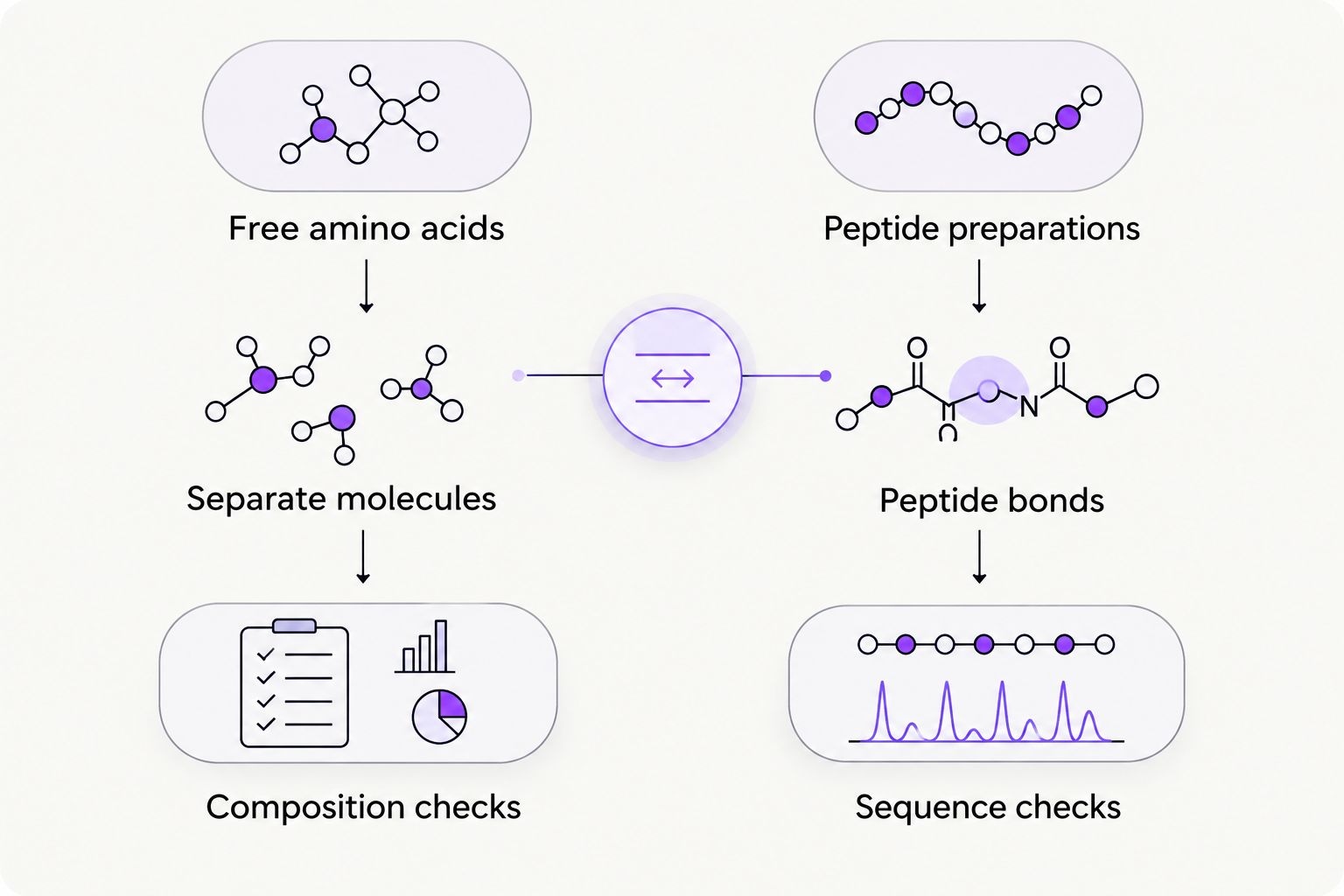
Free amino acids, salts, derivatives, and peptides are different materials. A peptide contains amino acid residues connected by peptide bonds; a free-amino-acid mixture does not reproduce that molecular structure. Likewise, an unspecified amino acid name does not establish stereochemical identity.
Free amino acid blends and peptide preparations are not interchangeable. Match the material’s chemical identity to the question being studied rather than treating related terminology as evidence of equivalent behavior.
These distinctions also affect analytical interpretation. A mass-based result requires the correct molecular form, while a chromatographic identity result requires an appropriate reference material and method. Record those details before comparing batches.
Qualify amino acid blends for veterinary research
Define the biological system and measured endpoint
Start with a written specification rather than a supplier shortlist. Identify the species-derived model, the experimental matrix, and the measured endpoint. A mixture intended for analytical method development needs different evidence from one used to investigate nutrient-sensitive signaling.
For your 2026 study record, distinguish a hypothesis about the complete mixture from a hypothesis about one constituent. That distinction determines which controls are necessary and whether a fixed blend gives you sufficient interpretability.
- Record the species and biological model.
- Identify amino acids already present in the background matrix.
- State whether the endpoint concerns composition, metabolism, or signaling.
- Define the controls needed to separate constituent and mixture effects.
Specify every constituent and its chemical form
Build a component list manually from the proposed formulation and supporting records. Require an unambiguous name for each constituent, including stereochemistry where relevant. Record whether the reported quantity refers to a free amino acid, a salt, or another chemical form.
Do not accept a collective description such as “amino complex” as a composition specification. Without individual quantities, you cannot calculate molar ratios, compare formulations, or determine whether an altered response follows a composition change.
- Record each constituent’s chemical identity.
- Specify stereochemistry where it matters to the research question.
- Distinguish free forms from salts and derivatives.
- Record quantities and reporting units for every constituent.
Compare sourcing routes against your specification
A laboratory can begin with individual reagents and maintain its own formulation records. This route gives direct control over component selection but adds weighing, calculation, preparation, and documentation responsibilities. It is appropriate when changing ratios is part of the research design.
A premixed blend removes the need to assemble the formulation from separate materials. The trade-off is dependence on the supplier’s disclosed composition and batch evidence. A premixed blend saves preparation work only when its documentation matches the study specification.
4-Amino-Labs lists amino acid blends within its research-supply scope. Evaluate that sourcing route against the same component-level criteria used for other candidates; the supplied information does not establish a particular formulation or batch-testing package.
- Compare adjustable formulations with fixed premixed compositions.
- Request component quantities before assessing suitability.
- Identify documentation gaps before ordering research material.
- Keep supplier selection separate from experimental acceptance.
Assess analytical coverage, not a purity headline
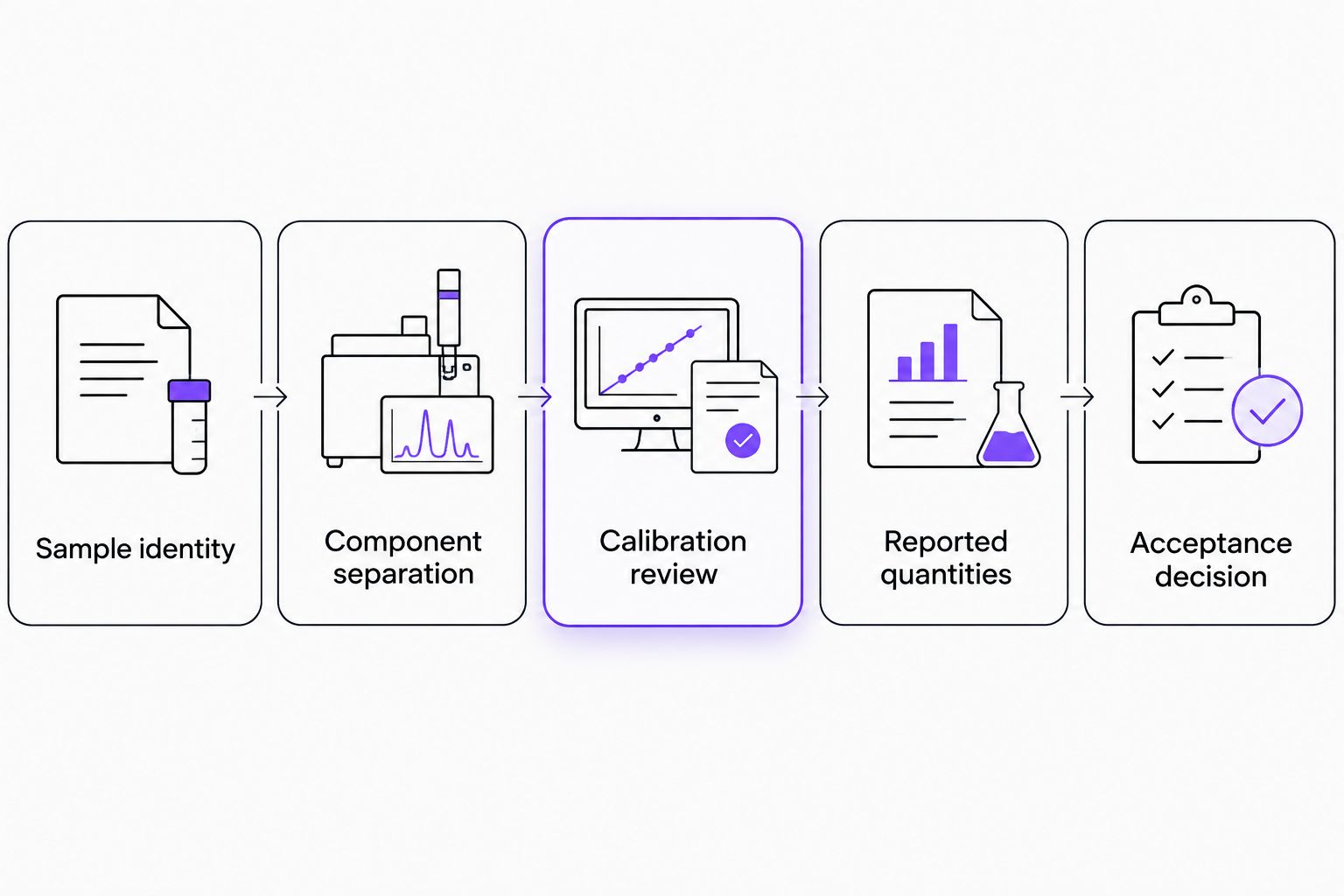
Review the analytical report against its stated purpose. Chromatographic separation supports component measurement only when the method distinguishes relevant analytes and the quantification is justified. Mass spectrometry supplies identity-related evidence, but an identity result is not automatically a quantitative assay.
ICH Q2(R2) distinguishes analytical performance characteristics according to intended use. Its framework is useful for evaluating a method’s evidence, but citing it does not establish that a research supplier or blend complies with a regulatory standard. [5]
For a 2026 qualification file, ask what each reported result actually measures. A total chromatographic area percentage does not, by itself, establish the concentration of every constituent, stereochemical purity, or freedom from all contaminants.
- Match each result to a stated analytical question.
- Check reference materials and calibration information.
- Review selectivity and relevant quantification limits.
- Separate identity, assay, impurities, and stereochemical evidence.
Review matrix compatibility and stability evidence
Treat pH, solubility, background amino acids, and storage history as experimental variables. A blend can match the nominal component list while still requiring additional assessment in the intended matrix. Compatibility is a property of the material and its experimental environment together.
Do not infer stability from chemical category alone. Use the supplied material-specific documentation and laboratory evidence applicable to the planned work. Record any difference between the conditions supporting the supplier’s statement and those relevant to your experiment.
- Document the intended matrix and its existing constituents.
- Check the basis of reported concentration and chemical form.
- Review supplied storage and stability documentation.
- Identify matrix-specific analytical interferences before interpretation.
Establish lot acceptance and change control
Link the container identifier, certificate of analysis, analytical report, and internal material record. A certificate without a matching lot reference cannot establish traceability for the material in hand. Keep documentation review separate from any additional laboratory verification.
Define acceptance criteria before reviewing results. Otherwise, a supplier’s available data can become the specification by default. When a new lot arrives, compare its composition and analytical evidence with the previously accepted material rather than relying on an unchanged product name.
- Match container and documentation lot identifiers.
- Establish constituent-specific acceptance criteria.
- Record deviations and the acceptance decision.
- Reassess changes in composition, methods, or supporting records.

Compare material options by research purpose
Choose the material format according to the question you need to answer. None of the options below establishes suitability without supporting documentation. The table compares research functions, not supplier performance or product availability.
| Option | Best suited research purpose | Principal advantage | Key limitation |
|---|---|---|---|
| Premixed amino acid blend | Studies requiring a fixed, disclosed composition | Reduces separate component assembly | Ratios remain fixed; incomplete disclosure limits interpretation |
| Individually sourced amino acids | Studies comparing constituents or changing ratios | Gives component-level formulation control | Adds preparation and traceability responsibilities |
| Certified amino acid reference mixture | Calibration within its certified scope | Supplies assigned values and stated supporting information | Certification does not establish biological suitability |
| Peptide preparation | Questions involving a defined peptide structure | Preserves a sequence-specific molecular entity | Is not a substitute for free amino acid exposure |
A certified reference mixture and a research blend can contain overlapping constituents while serving different purposes. Compare the certificate’s assigned values, uncertainty information, and intended scope before using it as an analytical reference. Do not infer certification from the presence of a certificate of analysis.
Common mistakes in veterinary research blend selection
Applying one species’ requirements to another
An amino acid’s classification as essential depends on biological context. Establish the species-specific rationale rather than selecting a mixture from a general nutrition label. Keep nutritional evidence separate from findings in the actual laboratory model. [3]
Treating equal masses as equal molar exposure
Equal masses of different amino acids contain different molar amounts because their molecular weights differ. Use the documented chemical form in conversions; salt mass and free-amino-acid mass are not interchangeable reporting bases.
Attributing a mixture response to leucine alone
Leucine-related mTORC1 evidence does not identify the driver of a mixture response. Other constituents and background nutrient conditions remain part of the interpretation. Use constituent controls when the hypothesis requires attribution. [4]
Treating a purity result as a complete quality assessment
A purity result answers only the question supported by its method. It does not replace concentration measurements, lot traceability, or application-specific checks. Read the method and reporting basis before accepting the headline figure.
Limitations of blend-level evidence
A nominal component list does not establish receptor occupancy, cellular uptake, metabolic handling, or stability in a species-derived model. Those questions require evidence from the relevant experimental system. A supplier’s material description cannot substitute for that evidence.
This guide does not establish that any specific 4-Amino-Labs formulation meets particular purity thresholds or carries third-party testing. Qualification requires the actual lot documents and a laboratory-defined acceptance decision. Keep chemical quality, experimental suitability, and biological interpretation as separate conclusions.
FAQ
What are amino acid blends for veterinary research?
Amino acid blends for veterinary research are mixtures used to investigate amino acid availability, metabolism, or analytical measurement in laboratory systems. Suitability depends on disclosed composition and the specific species-derived model or analytical application.
Can I use a peptide instead of a free amino acid blend?
A peptide is not interchangeable with a free amino acid blend. Peptide bonds create a different molecular structure, so related constituent names do not establish equivalent experimental behavior.
What documentation should accompany an amino acid blend?
Request a lot-linked composition record, certificate of analysis, and supporting analytical information. Evaluate whether these records establish constituent identity, quantities, and the measurements required by your laboratory.
Does a high purity percentage prove that every component is correct?
A high purity percentage does not independently prove every component’s identity or concentration. Interpret the result according to the analytical method, its selectivity, and its reporting basis.
Are equal mass concentrations equivalent across amino acids?
Equal mass concentrations are not equal molar concentrations across amino acids with different molecular weights. Calculations must also account for the documented chemical form, including salts or other derivatives.
When should a laboratory choose individual amino acids?
Choose individual amino acids when component ratios must change or constituent-specific controls are central to the research question. This approach adds formulation and documentation responsibilities compared with a fixed premixed blend.
Are research amino acid blends intended for veterinary treatment?
Research amino acid blends discussed here are for laboratory research only, not veterinary treatment or animal administration. The guide provides no dosing instructions, therapeutic recommendations, or disease-related claims.
One last thing
Require the composition statement to stand independently of the blend’s name. For a 2026 material review, a researcher should be able to reconstruct what the material contains, how quantities are expressed, and which lot the evidence describes without relying on promotional wording.
That document-level test often exposes the decisive gap: an attractive purity figure cannot rescue an undefined formulation.
References
- PubChem. L-Leucine: compound summary. Chemical identity and molecular weight reference for the free amino acid.
- PubChem. Glycine: compound summary. Chemical identity and molecular weight reference for the free amino acid.
- Wu G. Amino acids: metabolism, functions, and nutrition. Amino Acids, 2009. Review of amino acid metabolism, functions, and nutritional context.
- Saxton RA, Sabatini DM. mTOR Signaling in Growth, Metabolism, and Disease. Cell, 2017. Review of mTOR signaling and nutrient-sensing mechanisms.
- International Council for Harmonisation. ICH Q2(R2): Validation of Analytical Procedures, 2023. Analytical validation framework organized around intended method use.
Related guides
- Analytical reagent supplier comparisons
- Peptide research for biotech startups
- Research laboratory alternatives to Sigma-Aldrich
Research use only. This content is not medical or veterinary advice and is not intended to diagnose, treat, cure, or prevent disease. It provides no guidance for human use or animal administration.
