
GW501516 and GW0742 are both synthetic agonists of peroxisome proliferator-activated receptor delta (PPARδ), but the two compounds separate on selectivity margin against the other PPAR isoforms, not just raw potency. Published receptor-binding data describe GW501516 binding PPARδ with subnanomolar affinity and a selectivity ratio exceeding 1,000-fold over PPARα and PPARγ (Oliver et al., 2001, PNAS). GW0742 also engages PPARδ preferentially, but its scaffold produces a binding profile from a separate assay series that should not be assumed to mirror GW501516's published numbers. Treating GW501516 vs GW0742 selectivity as a single shared figure is the exact assumption this comparison exists to correct.
- GW501516 binds PPARδ with subnanomolar affinity and >1,000-fold selectivity over PPARα/PPARγ (Oliver et al., 2001).
- GW0742 is a structurally distinct PPARδ agonist characterized in a separate binding assay series (Sznaidman et al., 2003).
- Both compounds converge on the same PPARδ activation pathway but diverge in structure, assay method, and citation volume.
- GW501516 vs GW0742 selectivity data should not be treated as interchangeable reference values in study design.
- Both compounds are sold strictly for laboratory research use, not for human application.
Why this matters
Selectivity margin determines whether an observed downstream effect in a study is attributable to PPARδ activation specifically, or to off-target engagement of PPARα or PPARγ at higher concentrations. A ligand with a narrow selectivity window contaminates interpretation of pathway-specific data; a ligand with a wide margin gives cleaner attribution.
As of 2026, both compounds still show up in the same receptor-modulator search queries despite belonging to separate structural classes with separate citation records. 4-Amino-Labs and other suppliers list both under the same receptor modulator category, which flattens a distinction that matters at the assay-design stage.
How does PPAR-delta selectivity differ in GW501516 and GW0742?
The distinction shows up in the binding assay data published for each compound, not in a shared potency number. GW501516 has a substantially larger published record establishing its selectivity margin; GW0742 has a smaller but still peer-reviewed dataset with its own separation profile.
| Compound | PPARδ affinity | Selectivity vs PPARα | Selectivity vs PPARγ | Primary source |
|---|---|---|---|---|
| GW501516 | ~1 nM (subnanomolar) | >1,000-fold | >1,000-fold | Oliver et al., 2001, PNAS |
| GW0742 | Low nanomolar range | Narrower published margin than GW501516's reported ratio | Minimal PPARγ engagement reported | Sznaidman et al., 2003, Bioorg Med Chem Lett |
The practical takeaway: GW501516's selectivity claim rests on a widely cited 2001 dataset with a specific fold-value; GW0742's selectivity claim rests on a separate 2003 dataset that should be cited on its own terms, not borrowed from GW501516's numbers.
GW501516: >1,000-fold selectivity over PPARα and PPARγ
GW501516 emerged from a GlaxoSmithKline PPARδ discovery program and carries a thiazole-substituted scaffold. The Oliver et al. (2001) binding assay reported subnanomolar affinity for PPARδ alongside a selectivity ratio exceeding 1,000-fold against the other two PPAR isoforms, a figure that has anchored most subsequent PPARδ pathway research using this ligand. Through 2026, GW501516 remains the more extensively cited PPARδ agonist across metabolic, vascular, and skeletal-muscle pathway studies, which is a citation-volume fact, not a claim about physiological outcomes.
GW0742: a structurally distinct PPARδ agonist
GW0742 came out of the same general PPARδ discovery effort but carries a different chemical scaffold, characterized separately by Sznaidman et al. (2003). Its published binding assay places affinity for PPARδ in the low nanomolar range with a narrower reported separation from PPARα than GW501516's ratio, alongside minimal PPARγ engagement in the same assay series. GW0742's publication footprint through 2026 is smaller and concentrated in lipid metabolism and inflammation pathway studies rather than the broader literature base built around GW501516.
Why selectivity varies between PPARδ agonists
Selectivity numbers reported across the literature aren't a single fixed value — they shift with assay design. The factors that account for the spread between GW501516 vs GW0742 selectivity figures, and between any two PPARδ ligands generally, include:
- Ligand-binding domain contacts — scaffold substitutions (thiazole vs alternative ring systems) change hydrogen-bond geometry inside the PPARδ pocket, altering apparent affinity.
- Assay method — radioligand-binding assays and cell-based transactivation assays produce different EC50/Ki values for the same compound.
- Cross-reactivity panel scope — older assays tested fewer isoform pairs, so a compound's reported selectivity is only as complete as the panel it was screened against.
- Receptor construct species — human PPARδ constructs and rodent constructs don't always return identical binding numbers.
- Vehicle and solvent handling — both compounds are lipophilic; solubility method affects apparent potency in solution-based assays.
- Concentration range tested — a narrower dose-response window in a screening assay can understate a compound's true selectivity margin.
Non-interchangeability: GW501516 and GW0742 are not the same reference standard
The two compounds are frequently grouped as "PPARδ agonists" in casual discussion, which erases three specific differences: structure (distinct scaffolds from separate discovery efforts), selectivity margin (a >1,000-fold PPARα/PPARγ ratio published for GW501516 versus a narrower reported margin for GW0742), and evidence base (a substantially larger literature volume behind GW501516 than behind GW0742). Citing a GW501516 selectivity figure to describe GW0742, or vice versa, misrepresents both compounds' documented pharmacology. Sourcing documentation matters here — batch-specific analytical testing, not the compound's general reputation, is what confirms identity and purity for a given lot. The analytical reagent suppliers category covers the third-party testing standards relevant to confirming either compound's identity.
The shared PPARδ signaling pathway
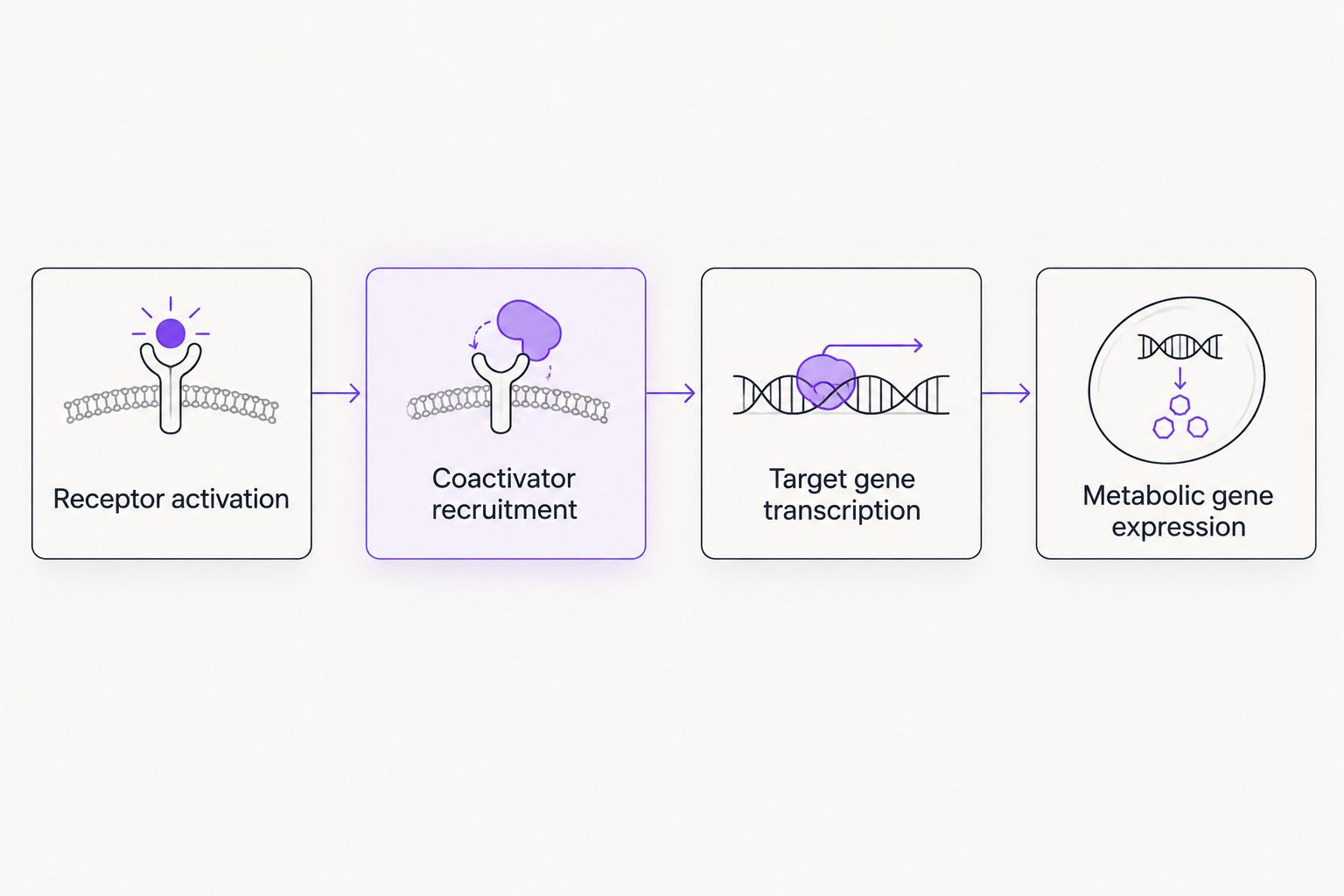
Both compounds converge on the same downstream sequence once bound to PPARδ: receptor activation, coactivator recruitment, binding to PPAR-response elements on target genes, and resulting shifts in metabolic gene transcription. This sequence is common to PPARδ agonism generally and doesn't differ between GW501516 and GW0742 — what differs is how selectively each ligand triggers step one without also engaging PPARα or PPARγ.
Is GW0742 more selective than GW501516?
GW0742's published selectivity margin over PPARα is narrower than the ratio reported for GW501516, based on their respective source assays (Sznaidman et al., 2003 vs Oliver et al., 2001). Both show minimal PPARγ engagement in their published data, but the two figures come from different assay methods and shouldn't be compared as if measured on an identical scale.
What is the shared PPARδ signaling pathway for GW501516 and GW0742?
Both compounds activate PPARδ through the same downstream sequence — coactivator recruitment followed by binding at PPAR-response elements and a shift in target gene transcription. The mechanism is shared; the binding affinity and selectivity margin that trigger it are compound-specific and documented separately for each ligand.
Are GW501516 and GW0742 studied for the same applications?
No — the published literature diverges in scope. GW501516 carries a substantially larger body of research spanning metabolic, vascular, and skeletal-muscle pathway studies, while GW0742's smaller footprint through 2026 concentrates on lipid metabolism and inflammation pathway research. Neither compound's research literature supports claims about use in humans.
For labs comparing structurally distinct but mechanism-adjacent research compounds more broadly, the same non-interchangeability logic applies to other receptor classes — see how SR9009 and SR9011 differ in Rev-erb research for a parallel case in a different nuclear receptor family.
FAQ
What is the main difference in GW501516 vs GW0742 selectivity?
GW501516 vs GW0742 selectivity differs mainly in the fold-margin reported over PPARα, with GW501516’s published ratio (>1,000-fold, Oliver et al., 2001) wider than GW0742’s narrower reported margin (Sznaidman et al., 2003). Both compounds show minimal PPARγ engagement in their respective assays.
Are GW501516 and GW0742 the same compound?
No, GW501516 and GW0742 are structurally distinct PPARδ agonists from separate discovery efforts. They share the same receptor target and downstream pathway but differ in scaffold, published affinity data, and citation volume.
Which PPARδ agonist has more published research, GW501516 or GW0742?
GW501516 has a substantially larger published literature base than GW0742 through 2026, spanning metabolic, vascular, and skeletal-muscle pathway studies. GW0742’s smaller footprint concentrates on lipid metabolism and inflammation research.
Can GW501516 selectivity data be applied to GW0742?
No, GW501516’s selectivity figures come from a separate 2001 binding assay and should not be used to describe GW0742’s pharmacology. GW0742 has its own 2003 binding dataset that reports a different selectivity margin.
What receptor do GW501516 and GW0742 both target?
Both compounds target peroxisome proliferator-activated receptor delta (PPARδ) as agonists. The shared pathway runs from receptor activation through coactivator recruitment to target gene transcription.
Does GW0742 engage PPARα or PPARγ?
Published binding data for GW0742 reports a narrower margin over PPARα than GW501516’s figure, with minimal engagement of PPARγ. The exact fold-values come from separate assay series and are not directly interchangeable.
Is GW501516 or GW0742 better documented for research purposes?
GW501516 carries the larger and older published record (Oliver et al., 2001), giving it more citation history through 2026. GW0742’s record is smaller but still peer-reviewed, published by Sznaidman et al. in 2003.
One last thing
Heading into 2026, the detail most researchers miss isn't the selectivity ratio itself — it's that GW501516 and GW0742 came out of adjacent but separate discovery timelines at the same PPARδ program, two years apart, using two different binding assay formats. That gap in method is why the two compounds' selectivity numbers don't translate directly onto the same scale, even though both target the identical receptor. 4-Amino-Labs lists both compounds in its research chemical catalog, but the catalog listing doesn't substitute for checking each compound's own certificate of analysis against its own published binding data.
Research Use Only. These compounds are not for human consumption. This article is not medical advice and is not intended to diagnose, treat, cure, or prevent any disease.
Related guides
- Best research chemical suppliers online
- How orforglipron differs from peptide GLP-1 receptor agonists
