
Endoxifen differs from tamoxifen because it is a hydroxylated, N-demethylated metabolite with substantially greater estrogen-receptor binding affinity than the parent compound. Both belong to the selective estrogen receptor modulator framework, but their receptor binding, metabolic requirements, and cellular responses are not interchangeable. This comparison addresses research materials and laboratory evidence only.
- How does endoxifen differ from tamoxifen? Endoxifen binds estrogen receptors more strongly; the parent compound requires separate characterization.
- Tamoxifen metabolism and direct endoxifen exposure answer different experimental questions.
- Estrogen receptor binding affinity does not establish transcriptional activity, receptor degradation, or subtype selectivity.
- Specify geometric isomer, chemical form, and analytical identity before comparing research materials.
Contents
- How does endoxifen differ from tamoxifen at estrogen receptors?
- Why the distinction matters
- How structural changes alter receptor pharmacology
- How metabolic conversion changes interpretation
- Why reported endoxifen–tamoxifen differences vary
- What documentation supports a valid comparison?
- Are endoxifen and tamoxifen interchangeable research compounds?
- Does stronger binding mean stronger antagonism?
- Limitations
- FAQ
- References
- Related guides
How does endoxifen differ from tamoxifen at estrogen receptors?
Endoxifen is a more strongly binding estrogen-receptor ligand than tamoxifen, not simply another name for the same material. Its phenolic hydroxyl group and altered side chain distinguish the metabolite chemically and pharmacologically. Published receptor-binding and cell-based studies support this distinction, while also showing why an isolated affinity measurement cannot describe the entire response. [1–3]
| Property | Tamoxifen | Endoxifen | Research implication |
|---|---|---|---|
| Chemical relationship | Parent triphenylethylene compound | Hydroxylated, N-demethylated metabolite | Record separate chemical identities |
| Free-base molar mass | 371.51 g/mol | 373.49 g/mol | Use the correct molecular form for calculations |
| Estrogen-receptor binding | Lower affinity than hydroxylated active metabolites | Greater affinity than parent tamoxifen | Compare matched receptor-binding measurements |
| Metabolic interpretation | Metabolic conversion can contribute to cellular activity | Direct exposure bypasses upstream formation | Separate metabolism from receptor pharmacology |
| Cellular readouts | Context-dependent receptor modulation | Context-dependent modulation; ERα degradation reported in specified cell systems | Do not substitute one endpoint for another |
| Principal comparison limitation | Metabolic capacity can complicate attribution | Isomer identity and cellular context remain consequential | Neither material is a universal control |
The molar masses above describe neutral free bases, not salts, solvates, or formulated mixtures. A 2026 laboratory inventory should identify the actual material represented by each analytical record rather than relying on the compound name alone.
Why the distinction matters
An apparent difference between tamoxifen and endoxifen can arise before either compound reaches the receptor. Chemical identity, metabolic conversion, and the selected endpoint each affect what your comparison establishes.
Your documentation review should therefore distinguish material qualification from biological interpretation. The research chemical supplier documentation comparison provides a separate sourcing reference; supplier documentation does not replace compound-specific receptor evidence.
The practical distinction is straightforward: use binding evidence to discuss binding, metabolic evidence to discuss conversion, and functional evidence to discuss the measured cellular response. Combining those categories produces conclusions the underlying measurements do not support.
How structural changes alter receptor pharmacology
Shared receptor framework
Tamoxifen and endoxifen interact with estrogen receptors, including ERα and ERβ: 2 receptor subtypes with distinct biological contexts. Ligand binding influences receptor conformation and interactions with transcriptional regulators. The resulting gene-expression response depends on the receptor, regulatory proteins, and cellular system, rather than ligand identity alone. [1,2]
Selective estrogen receptor modulation is therefore not equivalent to universal receptor silencing. An antagonist-like result in one reporter system does not establish an identical response across every promoter or cell line.
Hydroxylation and N-demethylation
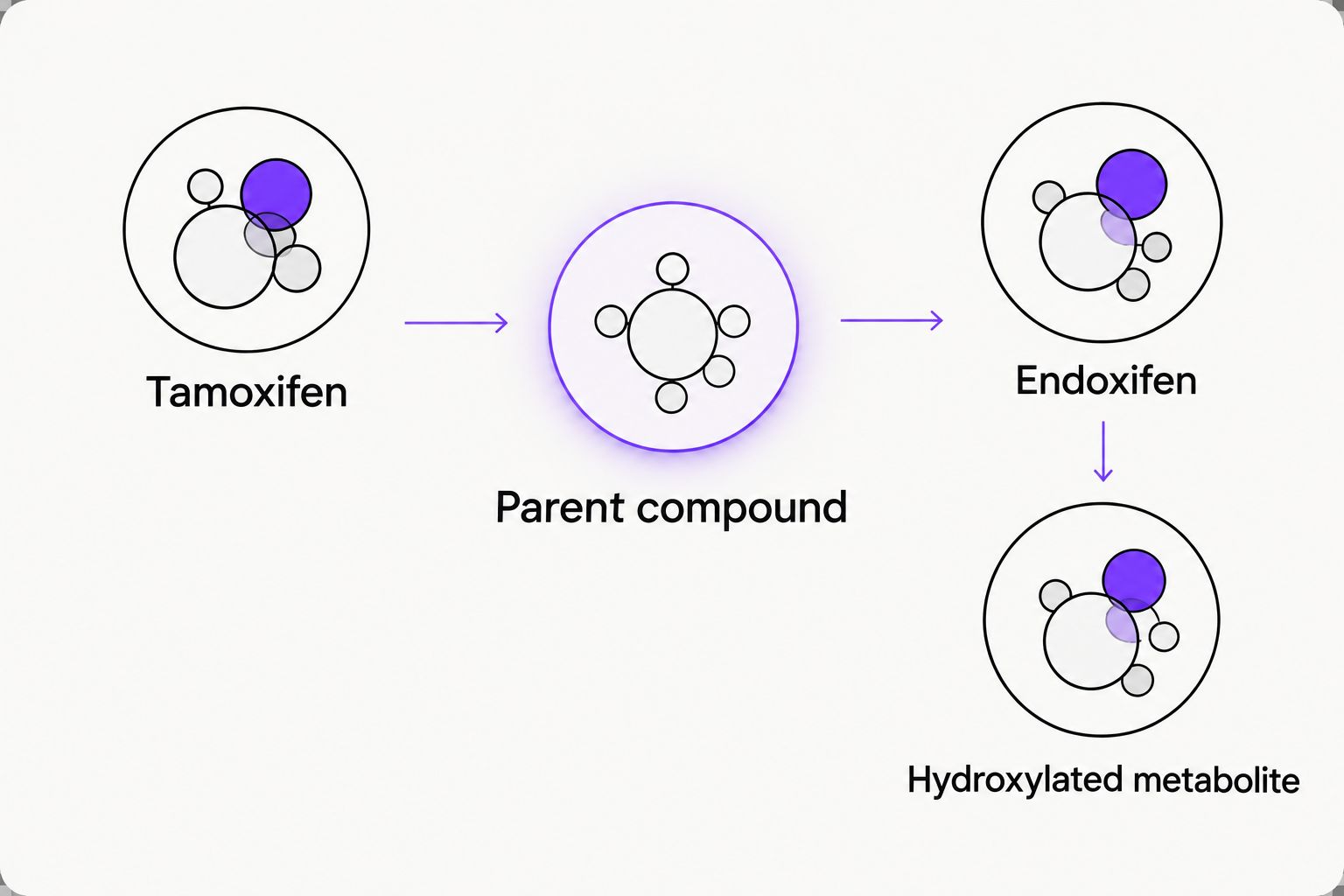
Endoxifen is commonly described as 4-hydroxy-N-desmethyltamoxifen. Relative to tamoxifen, its structure includes a phenolic hydroxyl group and a secondary rather than tertiary amine in the side chain. These changes alter receptor interactions and distinguish endoxifen from both tamoxifen and other tamoxifen metabolites. [1,2]
The free-base molar masses—371.51 g/mol for tamoxifen and 373.49 g/mol for endoxifen—are close. Similar molecular mass does not imply similar receptor affinity. The positions and chemical roles of functional groups matter more than the small mass difference.
Binding is not the complete mechanism
Receptor affinity describes a binding relationship under defined conditions. It does not independently establish receptor occupancy in a cellular system, transcriptional efficacy, or changes in receptor abundance.
Wu and colleagues reported endoxifen-associated ERα degradation in estrogen-receptor-positive cell systems. That finding supports a specific cellular mechanism; it does not establish identical degradation across all models or justify treating every endoxifen response as a degradation endpoint. [3]
How metabolic conversion changes interpretation
Parent compound versus formed metabolite
Tamoxifen undergoes oxidative metabolism through several routes. N-demethylation produces N-desmethyltamoxifen, while hydroxylation produces hydroxylated metabolites. CYP2D6 contributes importantly to formation of endoxifen from N-desmethyltamoxifen. [1,2]
This pathway creates an attribution problem in metabolically competent systems. A response observed after tamoxifen exposure can reflect the parent compound, formed metabolites, or their combined activity. Direct endoxifen exposure addresses a different question because upstream formation is bypassed.
Model selection changes the question
A purified-receptor assay does not reproduce cellular metabolism. Conversely, a cellular assay introduces uptake, binding to medium components, intracellular distribution, and metabolic handling alongside receptor engagement.
For a 2026 evidence review, classify each result by its experimental system before comparing conclusions. A receptor-binding result and a cell-based transcriptional result are complementary, not competing measurements.
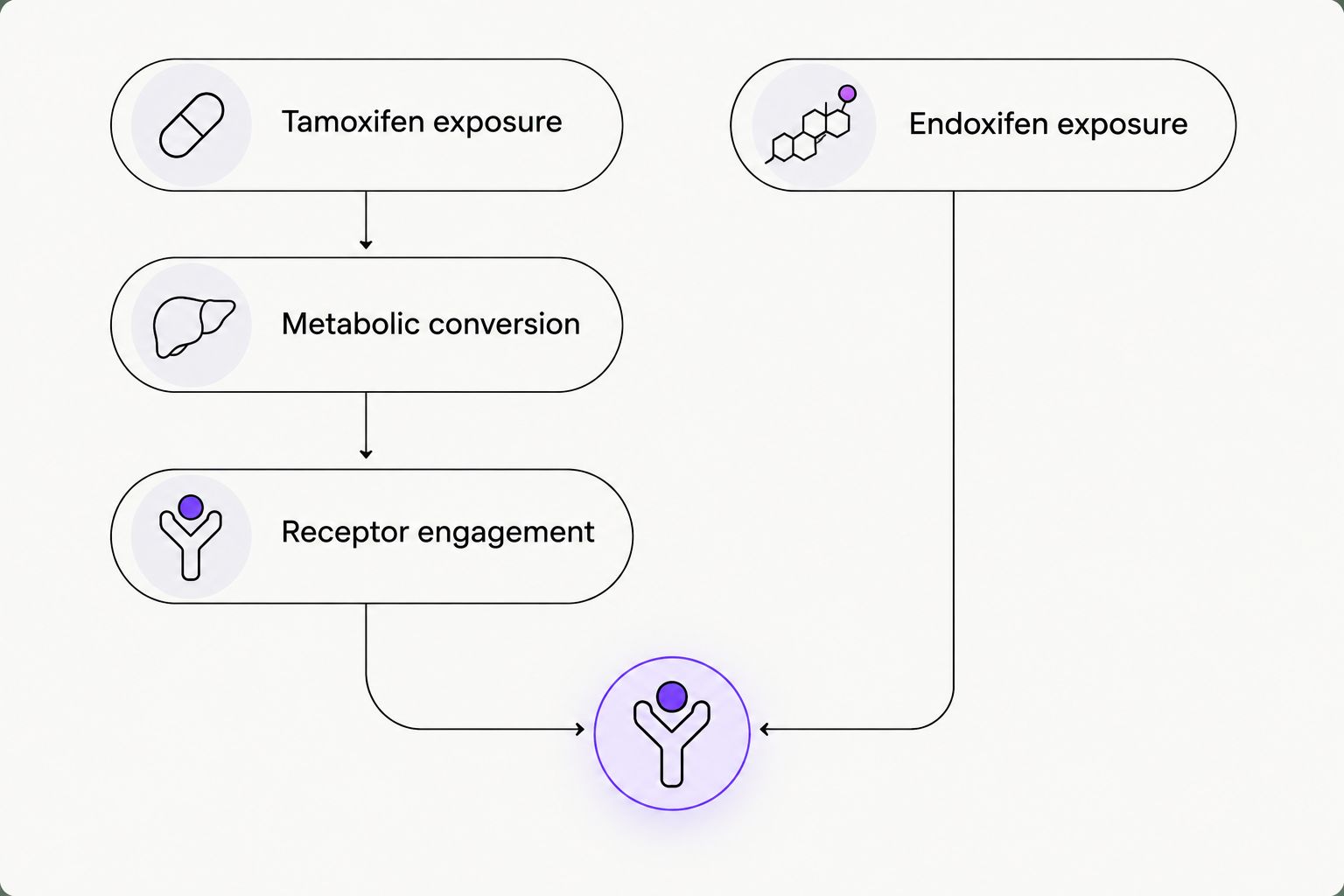
The diagram summarizes experimental attribution, not every metabolic pathway. Parent tamoxifen also binds estrogen receptors; metabolic conversion is not a prerequisite for every measurable interaction.
Why reported endoxifen–tamoxifen differences vary
A single universal potency multiplier obscures differences between methods. Published comparisons require the assay context attached to the result, especially when the endpoint changes from receptor binding to transcription or receptor abundance. [1–3]
- Receptor subtype: An ERα result does not establish ERβ affinity or subtype selectivity.
- Geometric isomer: E/Z composition is part of chemical identity; an unspecified mixture is not equivalent to an isomer-defined material.
- Metabolic capacity: Systems that form metabolites introduce a different interpretation from purified-receptor systems.
- Functional endpoint: Competitive binding, reporter activity, endogenous gene expression, and receptor degradation measure different events.
- Cellular environment: Receptor abundance, regulatory proteins, and medium composition affect the relationship between nominal exposure and measured response.
- Analytical qualification: Incorrect identity, unresolved impurities, or uncertain chemical form weaken attribution before pharmacology is interpreted.
These factors also explain why “more potent” requires a stated endpoint. For your 2026 comparison table, identify the receptor subtype and measurement beside any reported affinity or functional value. Do not carry a numerical relationship from one assay into another.
What documentation supports a valid comparison?
Identity, purity, and isomer composition
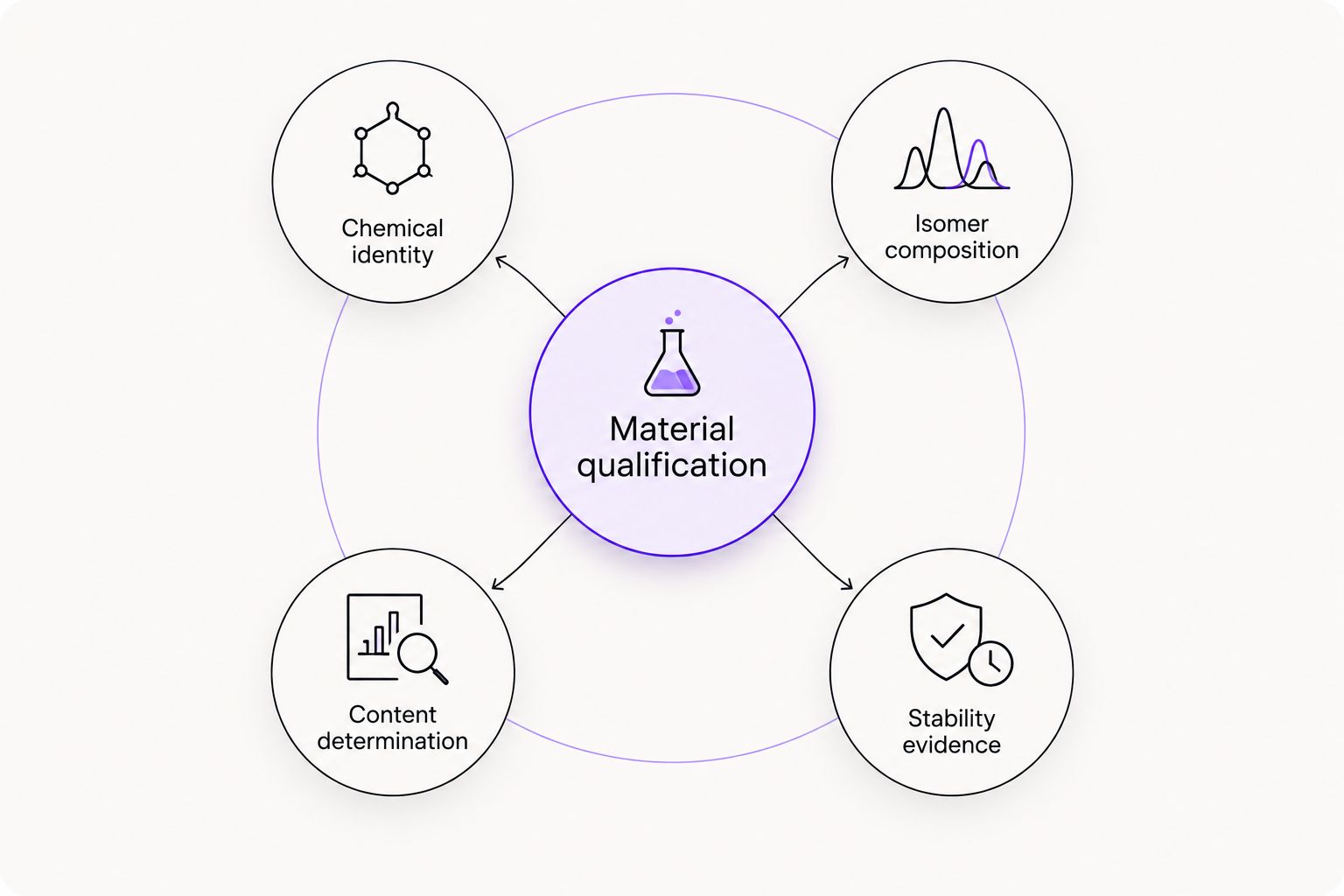
A chromatographic purity result describes the resolved signal under a particular method. It does not, by itself, prove molecular identity, absolute content, or geometric-isomer composition. Mass spectrometry adds molecular-ion evidence, while appropriately resolving chromatographic methods address separations that mass alone cannot establish.
Tamoxifen and endoxifen require separate identity assignments. E/Z isomers share molecular mass, so a matching mass spectrum alone cannot resolve their geometric identity. Ask what the analytical method actually distinguishes rather than accepting a method name as a complete answer.
| Documentation element | What it supports | What it does not establish alone |
|---|---|---|
| Lot-linked chromatogram | Resolved chromatographic profile | Complete structural identity |
| Mass spectrum | Molecular-ion evidence | E/Z assignment |
| Isomer-resolving analysis | Geometric-isomer composition under the stated method | Receptor activity |
| Chemical-form declaration | Free-base, salt, or other specified form | Absolute assay content |
| Content determination | Quantity assigned by the stated method | Functional receptor response |
| Stability evidence | Material behavior under documented conditions | Stability outside those conditions |
Sourcing without overstating qualification
4-Amino-Labs lists Endoxifen for laboratory research and analytical reference work. That listing establishes the research context, not an unreported purity threshold, isomer specification, or certified-reference-material designation.
4-Amino-Labs Endoxifen is intended for laboratory research and analytical reference work, not biological-use guidance. For receptor comparisons, evaluate the specific lot documentation against your analytical requirements before assigning suitability.
Keep the record connected
For 2026 records, connect each result to the material identity, lot identifier, analytical method, and experimental endpoint. A supplier certificate and a published receptor study serve different purposes: one characterizes supplied material, while the other describes an experimental finding.
Are endoxifen and tamoxifen interchangeable research compounds?
Endoxifen and tamoxifen are not interchangeable research compounds. Endoxifen is useful for examining metabolite-specific receptor pharmacology; tamoxifen is relevant when the parent compound or its metabolic conversion is the experimental subject. Neither choice removes the need for suitable analytical qualification.
The distinction also applies to related metabolites. Evidence for 4-hydroxytamoxifen should not be relabeled as endoxifen evidence merely because both are hydroxylated tamoxifen metabolites. [1,2]
Does stronger binding mean stronger antagonism?
Stronger binding does not independently establish stronger antagonism. Antagonism is a functional conclusion requiring a defined response and appropriate comparison; affinity concerns receptor binding.
Keep receptor occupancy, transcriptional output, and receptor abundance separate in your interpretation. Endoxifen-associated ERα degradation is relevant evidence for specified cell systems, not a substitute for measuring the endpoint your study addresses. [3]
Limitations
This 2026 comparison summarizes chemical identity, established metabolic relationships, and selected receptor-focused literature. It does not assign universal affinity ratios, storage periods, or lot-specific suitability. Published findings do not characterize an untested commercial batch.
4-Amino-Labs research materials require assessment against your laboratory's intended analytical application. A product listing does not establish equivalence to the material used in a cited publication.
FAQ
How does endoxifen differ from tamoxifen at estrogen receptors?
Endoxifen is a hydroxylated, N-demethylated tamoxifen metabolite with greater estrogen-receptor binding affinity than parent tamoxifen. Functional differences still depend on the receptor subtype, assay endpoint, and cellular system.
Is endoxifen the same compound as 4-hydroxytamoxifen?
Endoxifen and 4-hydroxytamoxifen are different compounds. Endoxifen also has an N-demethylated side chain, so evidence for one metabolite must not be assigned automatically to the other.
Does tamoxifen need metabolism to bind estrogen receptors?
Tamoxifen can bind estrogen receptors without prior metabolic conversion. Metabolism produces additional active compounds that complicate interpretation in metabolically competent systems.
Does stronger receptor binding prove stronger transcriptional antagonism?
Stronger receptor binding does not prove stronger transcriptional antagonism. Binding affinity and functional antagonism require different measurements.
Can mass spectrometry distinguish endoxifen E/Z isomers by molecular mass?
Molecular mass alone cannot distinguish endoxifen E/Z isomers because they share the same molecular formula. Isomer assignment requires suitable resolving and characterization methods.
Does chromatographic purity establish receptor activity?
Chromatographic purity does not establish receptor activity. It characterizes the resolved analytical signal under the stated method, while receptor activity requires a relevant functional measurement.
What does a laboratory need to review before comparing these materials?
A laboratory should review chemical identity, geometric-isomer composition, chemical form, content determination, and lot-linked analytical evidence. The experimental record must also identify the receptor subtype and measured endpoint.
References
- Johnson MD and colleagues. Pharmacological characterization of 4-hydroxy-N-desmethyl tamoxifen, a novel active metabolite of tamoxifen. Breast Cancer Research and Treatment. Historical publication: 2004. Scope: metabolite pharmacology and receptor-related comparisons.
- Lim YC and colleagues. Endoxifen (4-hydroxy-N-desmethyl-tamoxifen) has anti-estrogenic effects in breast cancer cells with potency similar to 4-hydroxy-tamoxifen. Cancer Chemotherapy and Pharmacology. Historical publication: 2005. Scope: cell-based antiestrogenic activity.
- Wu X and colleagues. The tamoxifen metabolite, endoxifen, is a potent antiestrogen that targets estrogen receptor alpha for degradation in breast cancer cells. Cancer Research. Historical publication: 2009. Scope: ERα abundance and cellular response.
Related guides
- How enclomiphene and clomiphene differ at estrogen receptors
- Connecting batch numbers to laboratory inventory tracking
- Connecting research chemical purchases to a laboratory notebook
Research use only. 4-Amino-Labs materials discussed here are strictly for laboratory research, not human or animal use. This content is not medical advice and is not intended to diagnose, treat, cure, or prevent disease.