
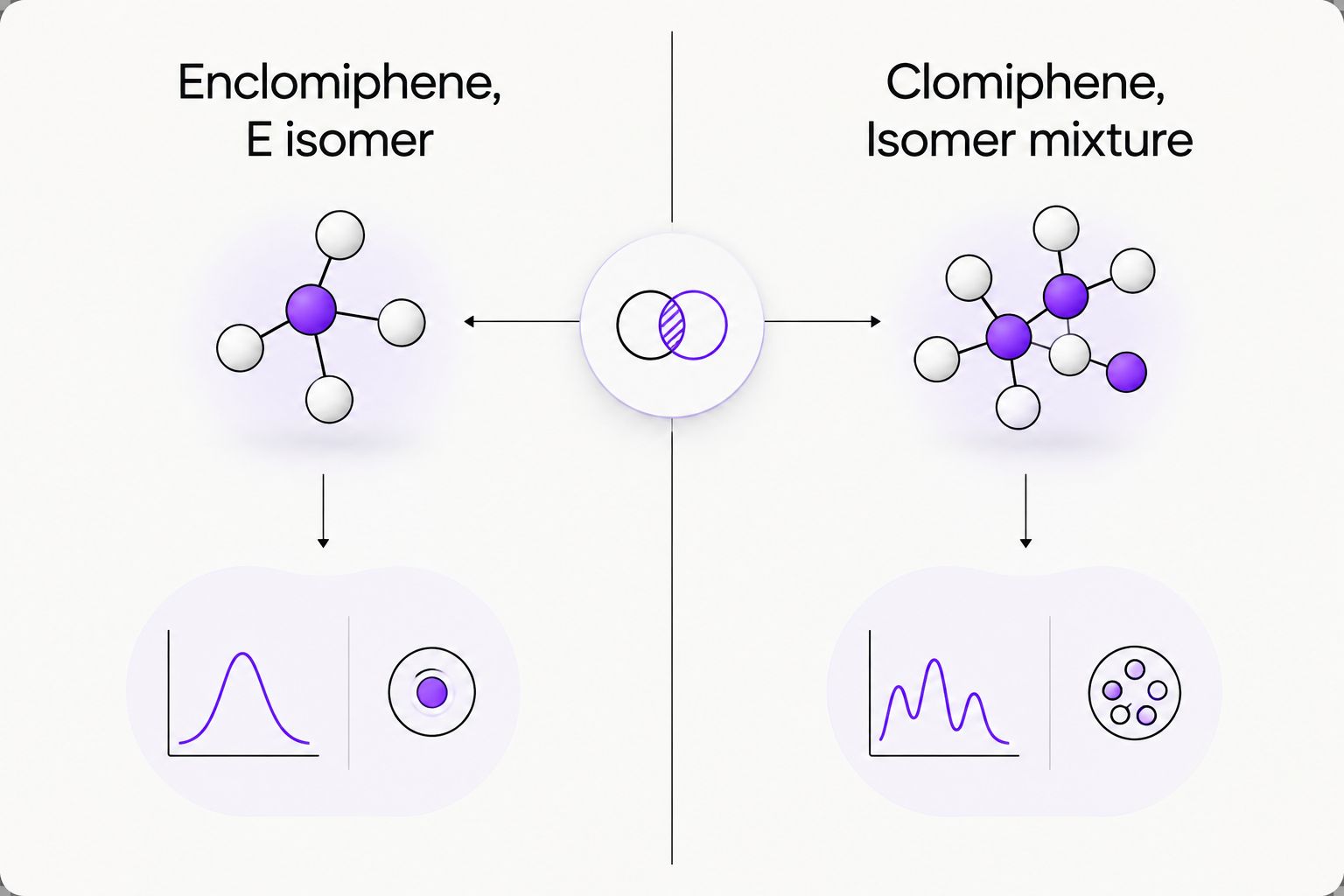
Enclomiphene is the trans, or E, geometric isomer of clomiphene; clomiphene is a mixture containing enclomiphene and the cis, or Z, isomer zuclomiphene. Both belong to the selective estrogen receptor modulator class, but an isolated isomer and an isomer mixture are not interchangeable experimental materials. This 2026 comparison addresses chemical identity, estrogen-receptor signaling, and analytical interpretation strictly for laboratory research use.
- The enclomiphene vs clomiphene mechanism comparison starts with composition: an isolated E isomer versus an E/Z mixture.
- Estrogen-receptor binding does not establish whether a compound activates or inhibits transcription in a particular assay.
- Clomiphene results cannot establish enclomiphene-specific activity without evidence separating the constituent isomers.
- Research-material documentation should distinguish chemical purity, isomer composition, and citrate versus free-base identity.
On this page
- How do the receptor mechanisms differ?
- Why the distinction matters
- Structure and analytical identity
- Shared estrogen-receptor signaling
- Why assay results vary
- Interpreting laboratory documentation
- Related mechanism questions
- Limitations
- FAQ
- References
- Related guides
How do enclomiphene and clomiphene differ at estrogen receptors?
Enclomiphene isolates one component of clomiphene; it does not introduce a different receptor class. The central distinction is an E-isomer research material versus a mixture whose measured activity reflects both E and Z constituents. For broader context, see the 4-Amino-Labs guide to estrogen receptor modulators in research.
| Property | Enclomiphene | Clomiphene |
|---|---|---|
| Chemical identity | E, or trans, isomer | Mixture of enclomiphene and zuclomiphene |
| Receptor framework | Selective estrogen receptor modulation | Selective estrogen receptor modulation |
| Experimental advantage | Separates the E-isomer contribution | Represents the combined isomer material |
| Main limitation | Does not represent the complete mixture | Cannot isolate either constituent's contribution |
| Appropriate research question | What activity belongs to the E isomer? | What activity belongs to the documented mixture? |
Zuclomiphene is not an inert label attached to clomiphene. It is a distinct geometric isomer with its own pharmacological contribution. Consequently, mixture results require interpretation as mixture results, rather than evidence attributable entirely to enclomiphene. Chemical identities and molecular weights are documented in the PubChem compound records listed in reference 1.
Why this distinction matters in receptor research
A receptor-binding result answers whether a material interacts with the receptor under the assay conditions. It does not, by itself, establish transcriptional antagonism, partial agonism, or receptor-subtype selectivity. Those conclusions require functional evidence.
For a 2026 literature comparison, keep three questions separate: what material was tested, what receptor system was measured, and what endpoint was reported. Confusing these questions turns a composition difference into an unsupported mechanistic claim.
A practical advantage of an isolated-isomer experiment is attribution. Its limitation is narrower scope: evidence for enclomiphene alone does not describe every property of clomiphene, and evidence for clomiphene does not automatically describe enclomiphene alone.
Structure and analytical identity
Enclomiphene and zuclomiphene differ geometrically
Clomiphene contains 2 geometric isomers, enclomiphene and zuclomiphene. Their distinction concerns arrangement around the carbon–carbon double bond, not a different elemental formula. Enclomiphene free base has a molecular weight of 405.96 g/mol; the corresponding geometric isomer has the same molecular weight. [1]
This creates an important analytical limitation: molecular mass alone cannot distinguish the two isomers. A mass-spectrometric identity result therefore does not independently establish isomer composition. Separation and assignment require suitable analytical evidence.
Citrate and free-base descriptions are not equivalent
Clomiphene citrate has a molecular weight of 598.08 g/mol, whereas enclomiphene free base has a molecular weight of 405.96 g/mol. These values describe different chemical forms, not a difference in receptor efficacy. [1]
Read the chemical-form designation before comparing analytical results. A certificate identifying a citrate salt should not be interpreted as though it identifies the free base. Likewise, salt identity does not establish which geometric isomers are present.
Purity and isomer composition answer different questions
A purity result depends on what the analytical method separates and detects. An unresolved chromatographic peak cannot establish an isomer ratio merely because its reported area is high.
For laboratory records assembled in 2026, retain the chromatogram, method description, peak assignments, and batch identifier alongside the summary purity result. The evidence supporting an assignment matters more than the presence of a single percentage.
The shared estrogen-receptor signaling framework
Ligand binding
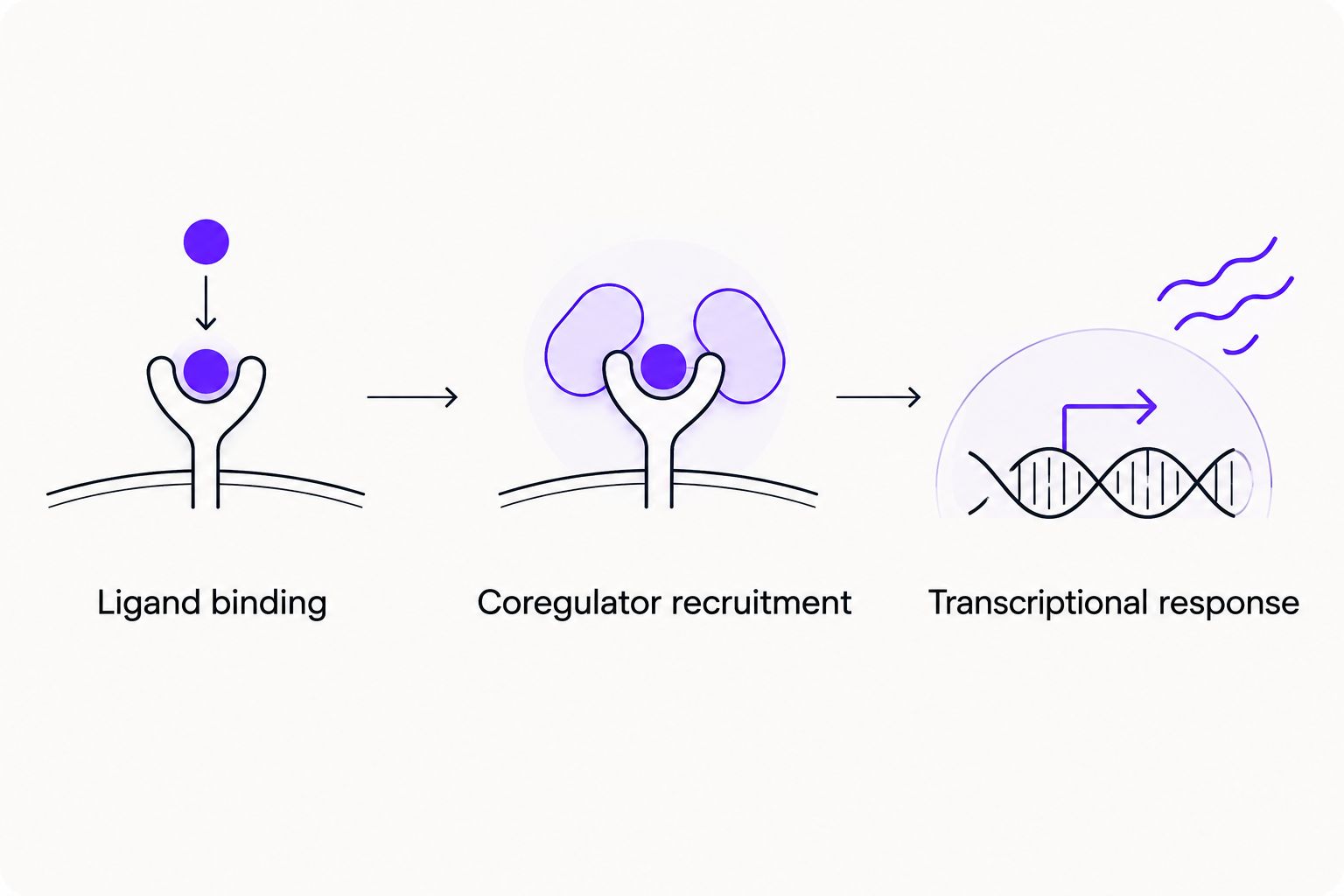
Estrogen receptors are ligand-regulated transcription factors. Ligand interaction with the receptor's binding domain influences receptor conformation, which helps determine subsequent interactions with transcriptional machinery. Structural work establishes why receptor occupancy and transcriptional activation are distinct questions, although a structure obtained with another ligand is not direct evidence for an enclomiphene-bound conformation. 2
Enclomiphene and clomiphene should therefore be compared within a shared estrogen-receptor framework. Describing one as a receptor modulator and the other as an entirely different mechanistic class obscures their chemical relationship.
Coregulator recruitment
Selective estrogen receptor modulators do not carry an assay-independent agonist or antagonist identity. Receptor conformation, coregulator availability, and cellular context contribute to the observed transcriptional response. The established SERM literature explains this context dependence, rather than supporting a universal rank order for every ligand. 3
The relevant mechanistic chain is ligand binding, coregulator recruitment, and transcriptional response. Each stage supplies different evidence. A change in the final reporter signal does not identify which upstream interaction produced it.
Receptor subtype and endpoint
Estrogen receptor alpha and estrogen receptor beta are distinct experimental targets. Naming either subtype does not establish that enclomiphene selectively favors it; a subtype-selectivity claim requires comparable measurements in defined systems.
For a 2026 evidence review, distinguish binding affinity from functional potency and maximal response. Affinity describes interaction with the receptor, functional potency describes the concentration dependence of an endpoint, and maximal response describes the observed response ceiling. None is a substitute for the others.
Why enclomiphene and clomiphene assay results vary
The same chemical name does not make measurements comparable. Check the following factors before assigning a difference to intrinsic receptor pharmacology:
- Isomer composition: Clomiphene is a mixture; its constituent proportions are relevant to interpreting the combined signal.
- Receptor subtype: Results from estrogen receptor alpha and estrogen receptor beta answer different target-specific questions.
- Coregulator context: Different cellular environments can support different transcriptional responses to receptor modulation.
- Endpoint selection: Binding, coregulator interaction, and reporter transcription measure different stages of the mechanism.
- Chemical form and integrity: Salt identity, impurities, and material degradation complicate comparisons if they are not characterized.
- Metabolic context: A metabolically competent cellular system is not equivalent to a purified-receptor assay; interpretation requires identifying what material reaches the measured target.
Do not transfer an affinity value, response ceiling, or antagonist classification between compounds without compound-specific evidence. A shared scaffold establishes a relationship, not numerical equivalence.
Interpreting laboratory documentation
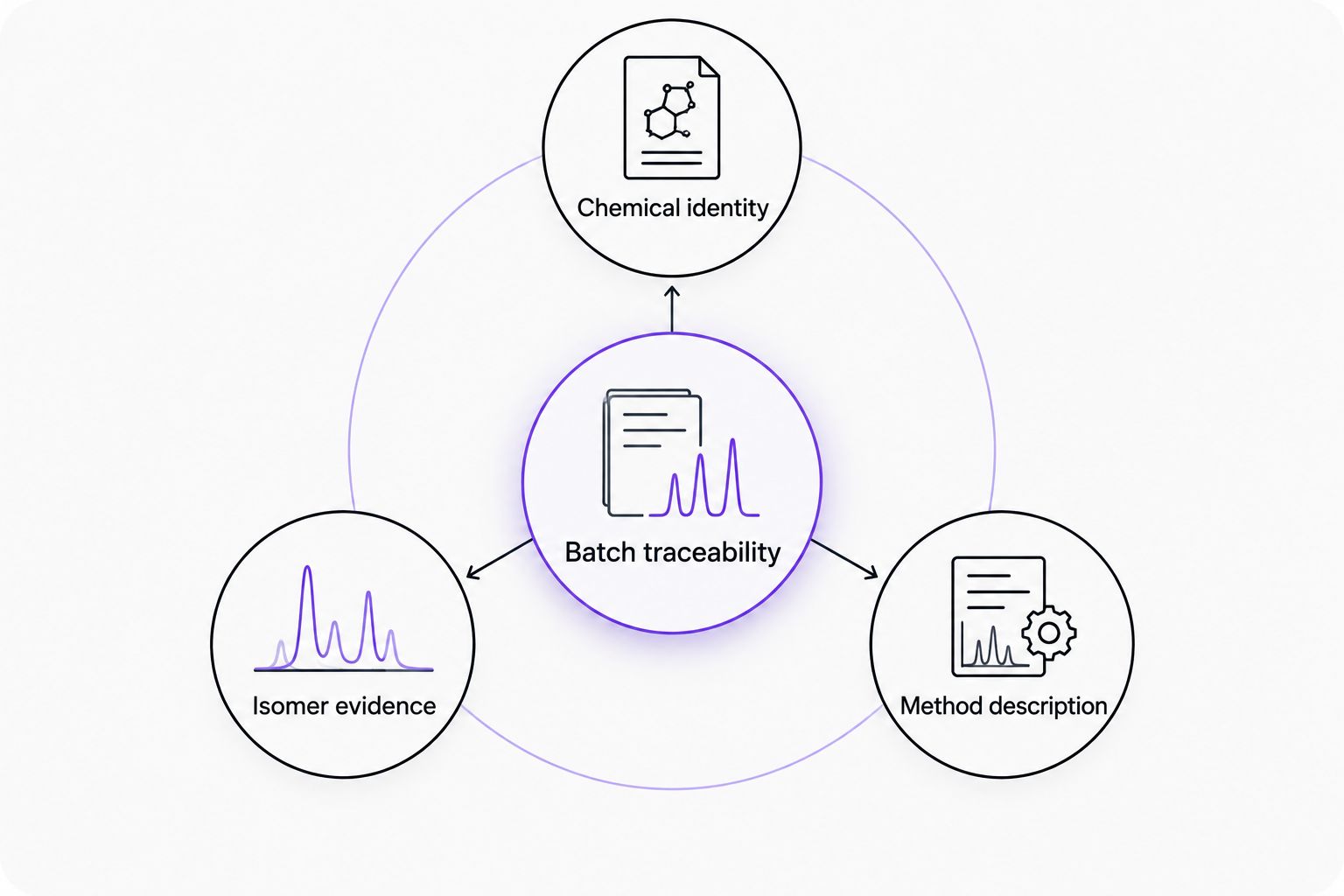
Chemical identity
Start with the exact compound name and chemical form. “Clomiphene,” “enclomiphene,” and “enclomiphene citrate” should not be treated as interchangeable inventory descriptions. Each name carries information that affects interpretation of the research material.
Isomer evidence
Look for evidence that the analytical method distinguishes the relevant geometric isomers. Chromatographic separation, reference-material comparison, and appropriate structural characterization can address questions that a nominal mass measurement cannot resolve alone.
Batch traceability
Connect each result to a specific batch, rather than to a general product description. The 4-Amino-Labs guide to connecting batch numbers to laboratory inventory addresses that documentation task. Batch traceability supports attribution; it does not independently prove chemical identity.
4-Amino-Labs supplies research-grade chemicals and analytical reagents. For estrogen-receptor research materials, the appropriate evaluation remains compound-specific: request the documentation needed to establish identity and composition rather than assuming that a supplier description resolves those questions.
Related mechanism questions
Is enclomiphene simply another name for clomiphene?
No. Enclomiphene identifies the E isomer, while clomiphene identifies a mixture containing enclomiphene and zuclomiphene. The names describe related but non-interchangeable research materials.
Does stronger receptor binding mean stronger antagonism?
No. Binding affinity and functional antagonism are different measurements. Antagonism requires a defined functional comparison, including the receptor system, competing ligand context, and measured endpoint.
Can clomiphene data establish enclomiphene-specific activity?
Clomiphene data establish the response of the tested mixture, not the isolated contribution of enclomiphene. Attribution to enclomiphene requires evidence that separates its contribution from zuclomiphene and characterizes the material actually tested.
Limitations and the final interpretation
This comparison explains chemical identity and the established SERM signaling framework. It does not establish a numerical affinity ranking, an isomer-specific receptor structure, or a universal agonist–antagonist classification for every experimental system. General estrogen-receptor structural literature supplies mechanistic context, not substitute measurements for these compounds.
One final recommendation for 2026 research records: distinguish a method that identifies a compound from a method that resolves its isomers. Equal molecular mass makes that distinction especially important here. A credible identity result can still leave the central composition question unanswered.
FAQ
What is the main enclomiphene vs clomiphene mechanism difference?
The main distinction is an isolated E isomer versus an E/Z isomer mixture within the same estrogen-receptor modulator framework. Functional differences require compound-specific measurements in a defined assay.
Is enclomiphene the trans isomer of clomiphene?
Yes. Enclomiphene is the trans, or E, isomer; zuclomiphene is the cis, or Z, isomer.
Does clomiphene contain enclomiphene?
Yes. Clomiphene is a mixture containing enclomiphene and zuclomiphene, so its measured response cannot automatically be attributed to enclomiphene alone.
Does estrogen-receptor binding prove antagonism?
No. Binding demonstrates receptor interaction under the measurement conditions; antagonism requires functional evidence from a defined response system.
Can mass spectrometry alone distinguish enclomiphene from zuclomiphene?
Molecular mass alone cannot distinguish enclomiphene from zuclomiphene because geometric isomers share the same molecular formula. Isomer assignment requires additional analytical evidence.
Does a high chromatographic purity result prove isomer purity?
No. A chromatographic purity result establishes isomer purity only when the method adequately separates and identifies the relevant isomers.
Are citrate and free-base molecular weights interchangeable?
No. Clomiphene citrate has a molecular weight of 598.08 g/mol, while enclomiphene free base has a molecular weight of 405.96 g/mol; the chemical-form designation must accompany the value.
References
- National Center for Biotechnology Information. PubChem compound records: Enclomiphene; Zuclomiphene; Clomiphene; Clomiphene citrate. Scope: chemical identity, geometric-isomer relationships, and molecular weights.
- Brzozowski AM and colleagues. Molecular basis of agonism and antagonism in the oestrogen receptor. Nature. Scope: structural principles of ligand-dependent estrogen-receptor conformation, not direct enclomiphene-specific structural evidence.
- Shang Y, Brown M. Molecular determinants for the tissue specificity of SERMs. Science. Scope: context-dependent transcriptional responses to selective estrogen receptor modulators, not a quantitative enclomiphene–clomiphene affinity comparison.
Related guides
- Connecting research chemical purchases to a laboratory notebook
- Analytical reagents for forensic toxicology laboratories
Research use only. This 4-Amino-Labs article addresses laboratory characterization and receptor research. It provides no human or animal use guidance, is not medical advice, and is not intended to diagnose, treat, cure, or prevent disease.