
MK-777 is not established as stable in solution simply because it is sold in that format; a defensible stability claim requires time-dependent analytical data for the specific formulation and container. This 2026 guide addresses chemical integrity, concentration, and documentation strictly for laboratory research use, not human or animal use.
- Is MK-777 stable in solution? Formulation-specific stability data, not a concentration label, must establish the answer.
- 4-Amino-Labs lists MK-777 as Acetamoren; the listing alone does not establish a validated solution shelf life.
- Assess chemical integrity, dissolved concentration, and container compatibility separately.
- A release certificate of analysis documents a tested sample, not necessarily stability throughout storage.
Is MK-777 stable in solution for research use?
Treat MK-777 solution stability as a formulation-specific analytical question, not an established property of the product name. The supplied catalog description lists a 20 mg/mL solution, 30 mL volume, and 600 mg total content. Those figures describe the listed formulation; none establishes how long the compound retains its identity, concentration, or impurity profile.
A defensible conclusion follows this evidence sequence:
- Confirm the chemical identity and material form covered by the documentation.
- Match the stability evidence to the actual formulation and container.
- Check whether the analytical method distinguishes the parent compound from degradation products.
- Evaluate results across documented storage intervals and conditions.
- Apply only the storage period supported by those results.
The distinction between release testing and storage evidence also matters when connecting batch numbers to laboratory inventory tracking. A result without a traceable batch and sample history cannot support a reliable comparison over time.
Why this matters
An uncertain solution concentration introduces uncertainty into analytical measurements. Chemical degradation, precipitation, and solvent loss can produce different problems, even when the material initially appears unchanged.
For a 2026 laboratory review, the useful question is therefore narrower than whether MK-777 is generally stable: does the documented formulation remain within predefined analytical acceptance criteria under the conditions actually recorded?
What does stability mean for an MK-777 solution?
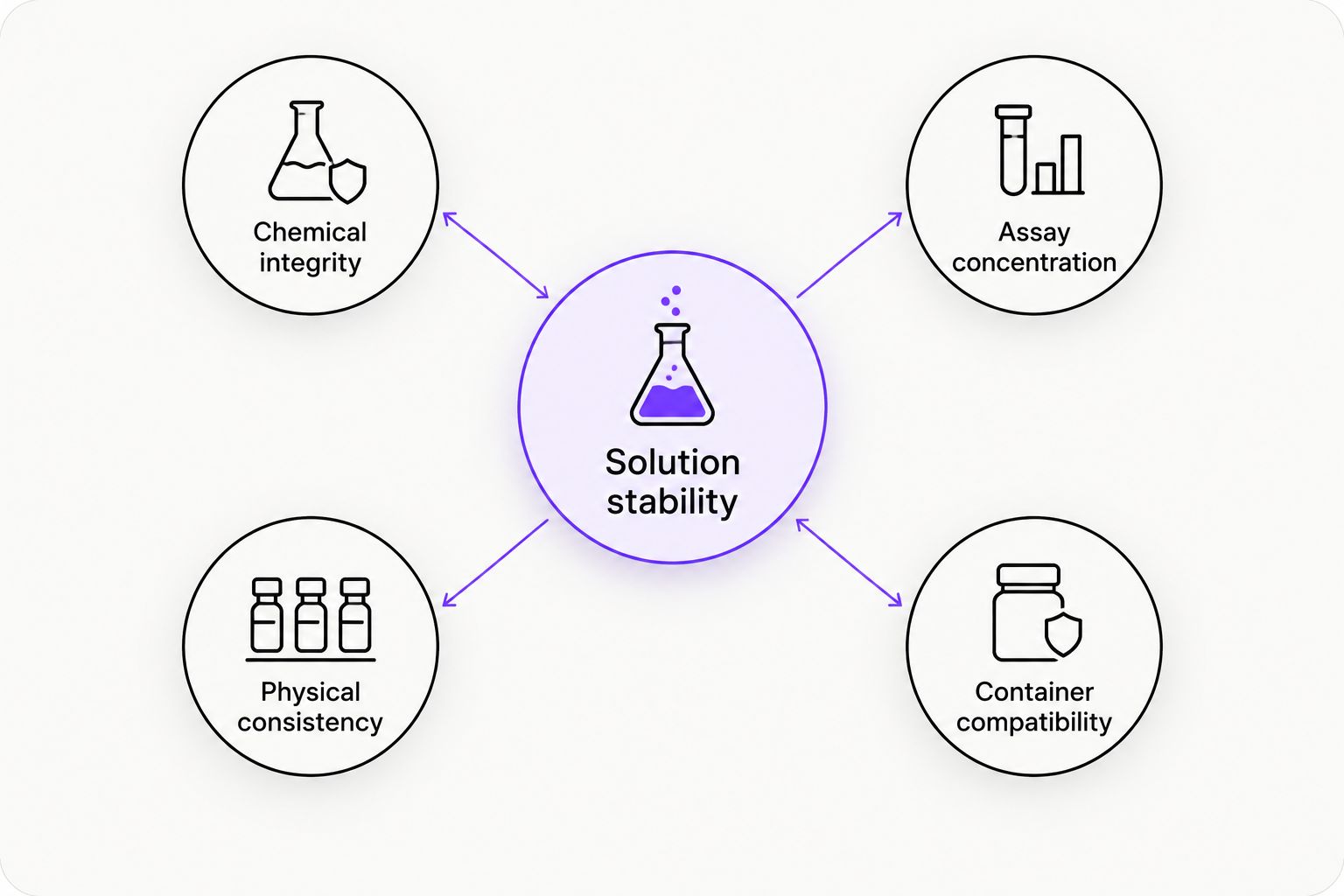
Solution stability has several components. A formulation can satisfy one component while failing another, so a single observation should not stand in for the entire assessment.
| Property | What it establishes | What it does not establish |
|---|---|---|
| Chemical integrity | Whether the parent compound remains chemically intact | Whether all material remains dissolved |
| Assay concentration | How much parent compound is measured in the sampled solution | Whether unidentified impurities are acceptable |
| Physical consistency | Whether appearance and phase behavior remain consistent | Whether invisible chemical changes have occurred |
| Container compatibility | Whether the packaging is suitable for the formulation | Whether a different container performs equivalently |
| Sample traceability | Which batch, condition, and interval a result represents | Whether the analytical method is suitable |
Chemical integrity versus physical appearance
A clear solution is an appearance observation, not proof of chemical integrity. Dissolved degradation products need not produce visible cloudiness, while precipitation can change the sampled concentration without requiring chemical decomposition.
Do not equate solubility with stability. Solubility concerns the amount of material that remains dissolved under specified conditions; chemical stability concerns changes in molecular composition over time.
Concentration is not purity
A stated concentration describes an amount relative to solution volume. A chromatographic purity result describes the sample through a particular separation, detector, and calculation method; it is not automatically a concentration measurement.
For example, a chromatogram dominated by the parent peak does not independently establish that the solution still matches its labeled concentration. The assay must answer that question directly, with suitable calibration and sample handling.
What evidence supports a solution stability claim?
A useful stability report connects the test article, conditions, analytical method, and results. General stability-study principles distinguish evaluation over time from a single release measurement. ICH Q1A(R2) provides a recognized framework for that distinction, although it is not MK-777-specific evidence. [1]
Identify the actual test article
The documentation should identify the compound, material form, batch, formulation, and packaging. A shorthand name alone does not establish that two samples are chemically equivalent.
Likewise, a formulation description should be specific enough to determine whether the stability report applies. Evidence for one solvent system does not automatically establish stability in another.
Require a stability-indicating method
A stability-indicating method must support distinguishing relevant changes in the parent compound from other sample components. Analytical specificity, accuracy, precision, and the intended measurement range belong in the method assessment; ICH Q2(R2) addresses these validation concepts. [2]
HPLC is an analytical technique, not a guarantee that a particular method detects every relevant degradation pathway. The method, detector response, separation, and interpretation determine what a result supports.
Read the trend, not just the final result
A final measurement becomes more informative when it can be compared with an appropriate baseline and intermediate observations. Review parent-compound assay and impurity behavior together rather than reading either in isolation.
A 2026 documentation review should also distinguish a completed study from a proposed study plan. Planned testing describes intended evidence; only recorded results support a conclusion about the tested material.
Why MK-777 solution stability varies
The following are general formulation variables to evaluate, not demonstrated MK-777 degradation mechanisms or instructions for preparing a solution:
- Solvent composition: The chemical environment can influence solubility, reaction pathways, and analytical recovery.
- Temperature history: Storage conditions and excursions affect how closely a sample matches the conditions covered by a study.
- Light exposure: Photostability requires its own evidence; container appearance does not establish protection.
- Air and headspace: Exposure conditions belong in the formulation assessment rather than being assumed irrelevant.
- Container and closure: Packaging can influence solvent retention, adsorption, and contact with extractable substances.
- Handling history: Transfers, repeated opening, and sample preparation can change the material presented for analysis.
Do not turn general factors into compound-specific claims
These variables explain why a generic shelf-life statement is inadequate. They do not establish that MK-777 undergoes a particular reaction, requires a particular temperature, or remains suitable for a stated number of days.
Use the documented conditions for the exact material under evaluation. A seemingly conservative storage change is still a change if the available evidence does not cover it.
How do release testing and stability testing differ?
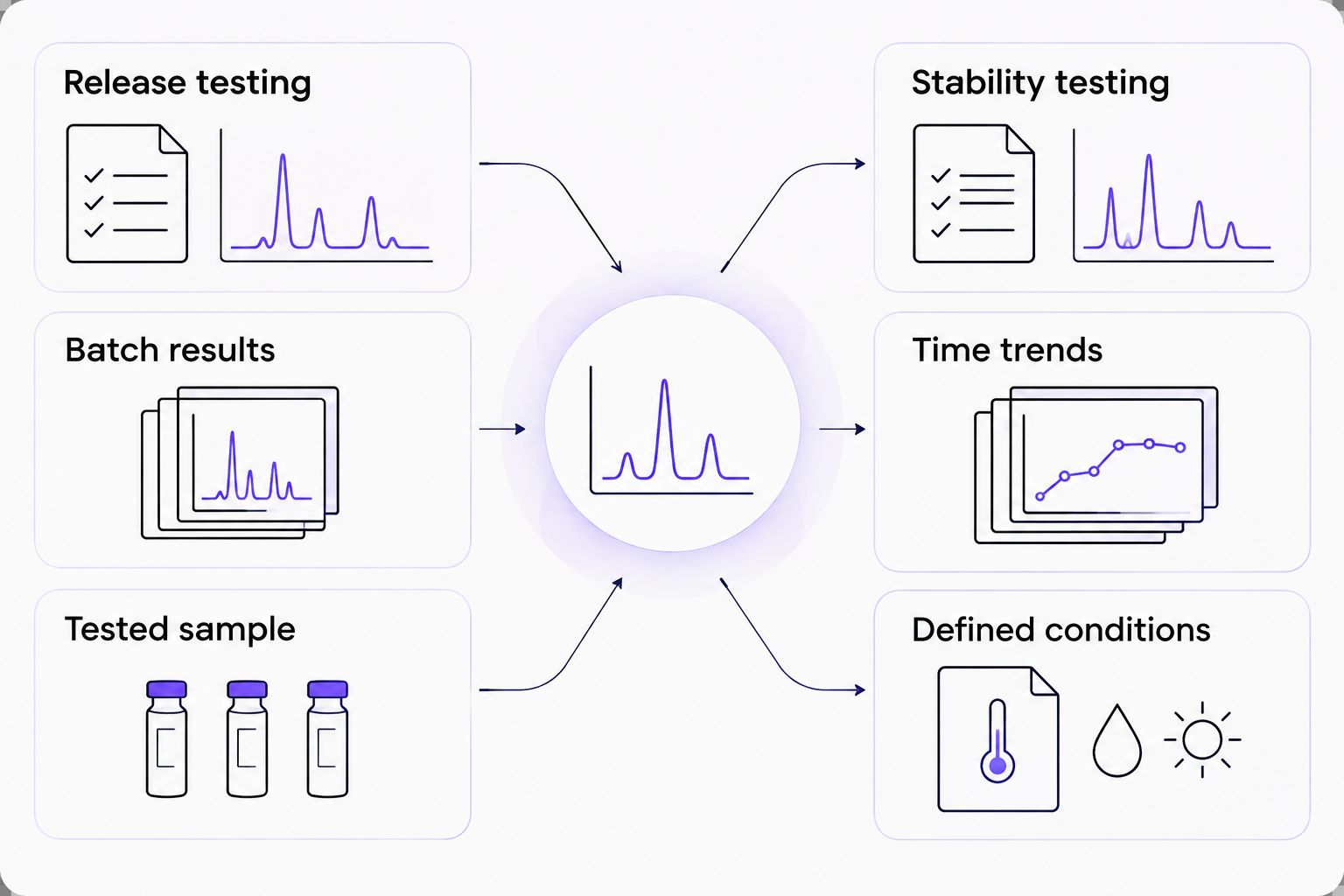
Release testing and stability testing answer different questions. Neither replaces the other.
| Evidence type | Primary value | Limitation |
|---|---|---|
| Release certificate of analysis | Documents specified results for a tested batch or sample | Does not independently establish later performance |
| Stability study | Evaluates defined attributes over documented intervals | Applies only within its supported scope |
| Appearance inspection | Identifies visible changes | Cannot establish molecular identity or assay concentration |
| Container assessment | Evaluates formulation–packaging compatibility | Does not replace chemical analysis |
What a certificate of analysis can establish
A certificate of analysis can support identity, assay, or impurity conclusions when those tests and results are actually reported. Read the named methods and acceptance criteria rather than relying on a general statement of quality.
Third-party testing and longitudinal testing are separate attributes. An independent result can be valuable while still representing only a single sample at a single point in its history.
What a stability study adds
A stability study connects analytical results to elapsed time, storage conditions, and packaging. Its acceptance criteria should reflect the intended analytical use rather than being selected after the results are known.
Method development also matters. ICH Q14 describes a science- and risk-based approach to analytical procedure development; citing that framework does not mean a particular supplier or product has demonstrated compliance. [3]
What should a laboratory request before assigning a storage interval?
For MK-777 research material, request documentation that answers the stability question directly. A general product specification is a starting point, not a substitute for formulation-specific evidence.
A focused request should cover:
- Chemical identity, material form, and batch identification.
- Formulation composition and original container description.
- Tested storage conditions and recorded sampling intervals.
- Parent-compound assay and relevant impurity results.
- Analytical method identification and suitability information.
- Supported expiry or retest terminology, including its scope.
Keep sourcing claims separate from analytical conclusions
4-Amino-Labs identifies its MK-777 research material as Acetamoren. That catalog identification does not independently establish structural equivalence to another named compound, receptor pharmacology, metabolic handling, or transferable stability data.
For 4-Amino-Labs research chemicals, assess the documentation attached to the actual material rather than inferring performance from a category label. The same rule applies to any supplier.
Evaluate 4-Amino-Labs MK-777 by its formulation-specific documentation, not by its catalog concentration. This is a documentation criterion for technically literate laboratory buyers, not an endorsement of an unverified storage interval.
How should stability evidence enter the laboratory record?
Keep the analytical conclusion connected to the material history. A laboratory record should make it possible to reconstruct which sample was evaluated, which evidence applied, and why the material was accepted for its intended analytical purpose.
Separate the identifiers
A supplier batch identifier, an internal inventory identifier, and an analytical sample identifier serve different roles. Preserve their relationship rather than replacing one with another.
Record the document version alongside the relevant result. Otherwise, a later update can obscure which evidence supported an earlier decision.
Record the decision boundary
State the conditions covered by the conclusion and the event that triggers reassessment. Examples include a documented excursion, a container change, an unexpected chromatographic result, or a visible physical change.
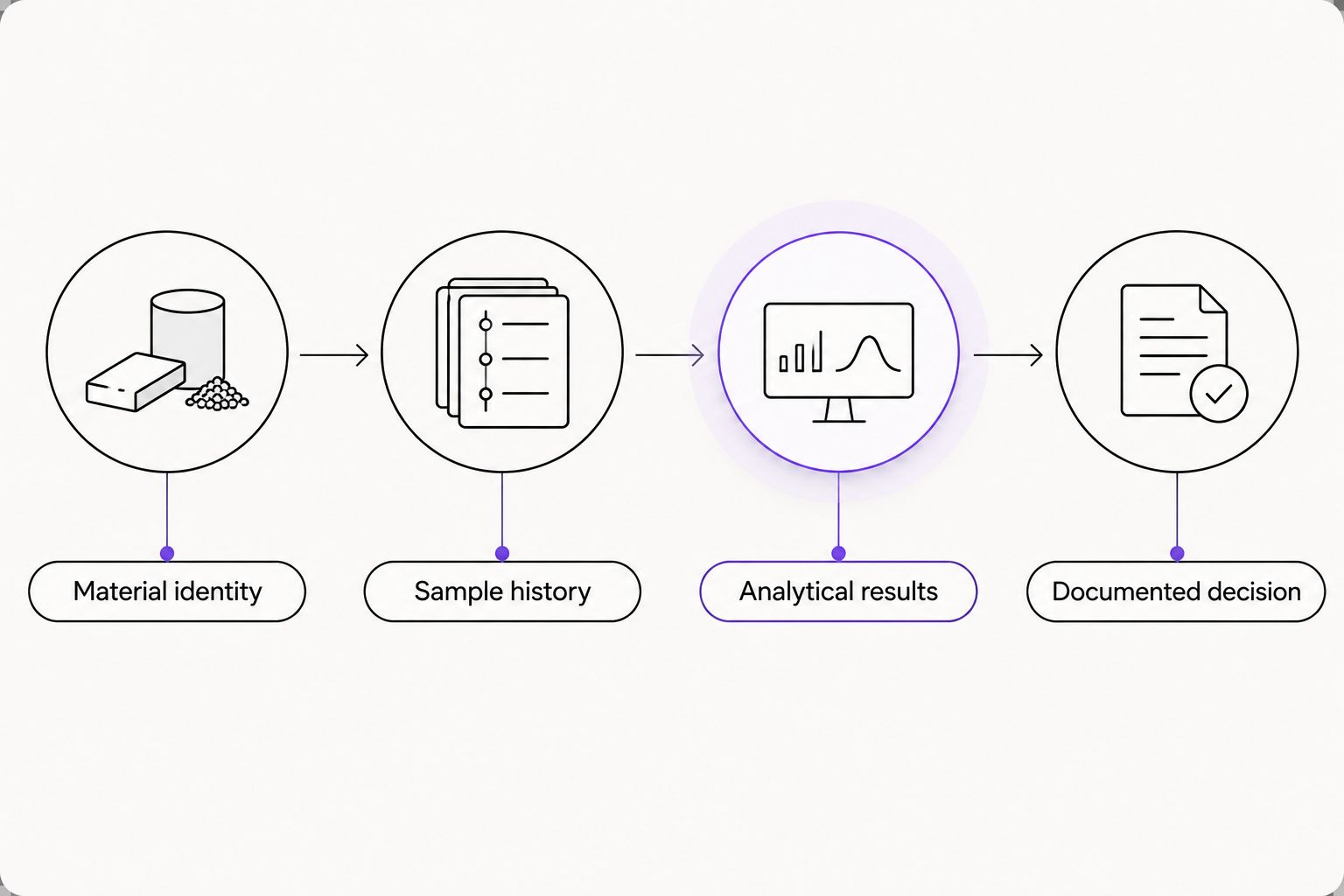
In 2026 inventory records, an accession date should not silently become an expiry date. Receipt, opening, analysis, retest, and expiry describe different events and require distinct meanings in the record.
Limitations of this MK-777 stability assessment
This article does not establish an MK-777 solution shelf life, degradation rate, storage temperature, or validated analytical acceptance threshold. General analytical principles cannot supply those compound- and formulation-specific conclusions.
The listed formulation quantities describe catalog content, not measured stability results. No receptor mechanism or metabolic behavior is used here to infer solution stability, and no evidence is transferred from a related compound.
FAQ
Is MK-777 stable in solution for research use?
MK-777 solution stability requires formulation-specific analytical evidence. A catalog listing does not establish a validated storage interval or show how the impurity profile changes over time.
Does a clear MK-777 solution mean it is chemically stable?
A clear MK-777 solution does not establish chemical stability. Appearance cannot replace measurements of parent-compound identity, concentration, and relevant impurities.
Does an MK-777 certificate of analysis prove shelf life?
An MK-777 certificate of analysis does not independently prove shelf life. Its conclusions apply to the tests and sample reported unless it explicitly includes supporting stability evidence.
Can stability data for another compound be applied to MK-777?
Stability data for another compound do not establish MK-777 stability. Chemical identity, formulation, container, and analytical conditions must match the claim being evaluated.
Is HPLC purity the same as solution concentration?
HPLC purity is not automatically the same as solution concentration. A calibrated assay and suitable sample preparation are needed to establish the amount of parent compound in solution.
What should a laboratory request from an MK-777 supplier?
A laboratory should request batch identity, formulation details, container information, stability results, and analytical method documentation. Any proposed storage interval should be traceable to those records.
One last thing
A reassuring purity result can coexist with an incorrect solution concentration. Review assay concentration and impurity behavior as separate measurements before deciding that stored research material remains suitable for its intended analytical use.
References
- International Council for Harmonisation. Q1A(R2): Stability Testing of New Drug Substances and Products. General stability-study framework; not evidence of MK-777 stability.
- International Council for Harmonisation. Q2(R2): Validation of Analytical Procedures. Analytical validation framework; not validation of a particular MK-777 method.
- International Council for Harmonisation. Q14: Analytical Procedure Development. Analytical development framework; not a supplier certification or product-specific finding.
Related guides
- Connecting research chemical purchases to a laboratory notebook
- Research chemical suppliers ranked by documentation
Research use only. This content concerns laboratory materials and analytical assessment only. It does not provide guidance for human or animal use, is not medical advice, and is not intended to diagnose, treat, cure, or prevent disease.