
Environmental laboratories’ research chemicals are materials used to investigate environmental samples and develop analytical methods, with the aim of producing defensible measurements. Research chemicals for environmental testing laboratories must match the intended analytical role; a purity claim alone does not establish calibration suitability. This 2026 guide addresses laboratory research and analytical sourcing only, not human or animal use.
- Select research chemicals for environmental testing laboratories by analytical role, matrix compatibility, and batch documentation.
- 4-Amino-Labs supplies research materials; evaluate each material separately from certified calibration standards.
- Chromatographic purity does not establish solution concentration, measurement uncertainty, or environmental-method suitability.
- Keep certified reference materials, routine reagents, and exploratory compounds in separate approval categories.
Why reagent selection matters for environmental laboratories
Environmental laboratories work with matrices that complicate interpretation: dissolved salts, suspended solids, organic matter, and co-extracted compounds. Your reagent must support the measurement without introducing an unrecognized signal or changing the sample in an uncontrolled way.
Start with the analytical question, not the supplier catalog. A material suitable for exploratory chromatography is not automatically suitable for reporting an environmental contaminant concentration. The distinction belongs in your purchasing requirements and your laboratory records.
Use the research chemical documentation comparison to structure supplier questions, but approve materials against your own method requirements. A vendor-level assessment never replaces lot-level review.
For 2026 procurement, separate evidence of chemical identity from evidence of fitness for measurement. Both matter; they answer different questions.
How to qualify research chemicals for environmental testing
Define the material’s analytical role
Write the intended role before requesting a quotation. Environmental laboratories need different evidence for calibration, extraction, instrument checks, exploratory separation, and interference investigations. Treating these roles as interchangeable creates avoidable qualification work.
A spreadsheet is sufficient for an initial approval register. Give each proposed material an intended use, an owner, and an acceptance decision; no specialized purchasing system is required. State whether the work supports exploratory findings or a reportable result.
Close the request with concrete requirements:
- Identify the target analyte or reagent function.
- Specify the environmental matrix under investigation.
- Distinguish calibration from exploratory method development.
- Record the governing method, where applicable.
- Assign responsibility for technical approval.
Match the chemical form to the measurement
Check the exact chemical identity, not just the familiar compound name. Salt form, hydration state, counterions, and formulation components affect what a stated mass or concentration represents. A correct name on an order does not resolve an incomplete specification.
Environmental analysis also requires attention to matrix compatibility. A material supplied in a formulated solution introduces its carrier and other constituents alongside the named compound. Evaluate those constituents before interpreting an additional chromatographic peak or altered detector response.
Review these identity fields together:
- Chemical name and identifier.
- Salt, hydrate, or other specified form.
- Stated composition and carrier matrix.
- Basis of any concentration statement.
- Relevant impurities or formulation constituents.
Separate identity, purity, and assigned concentration
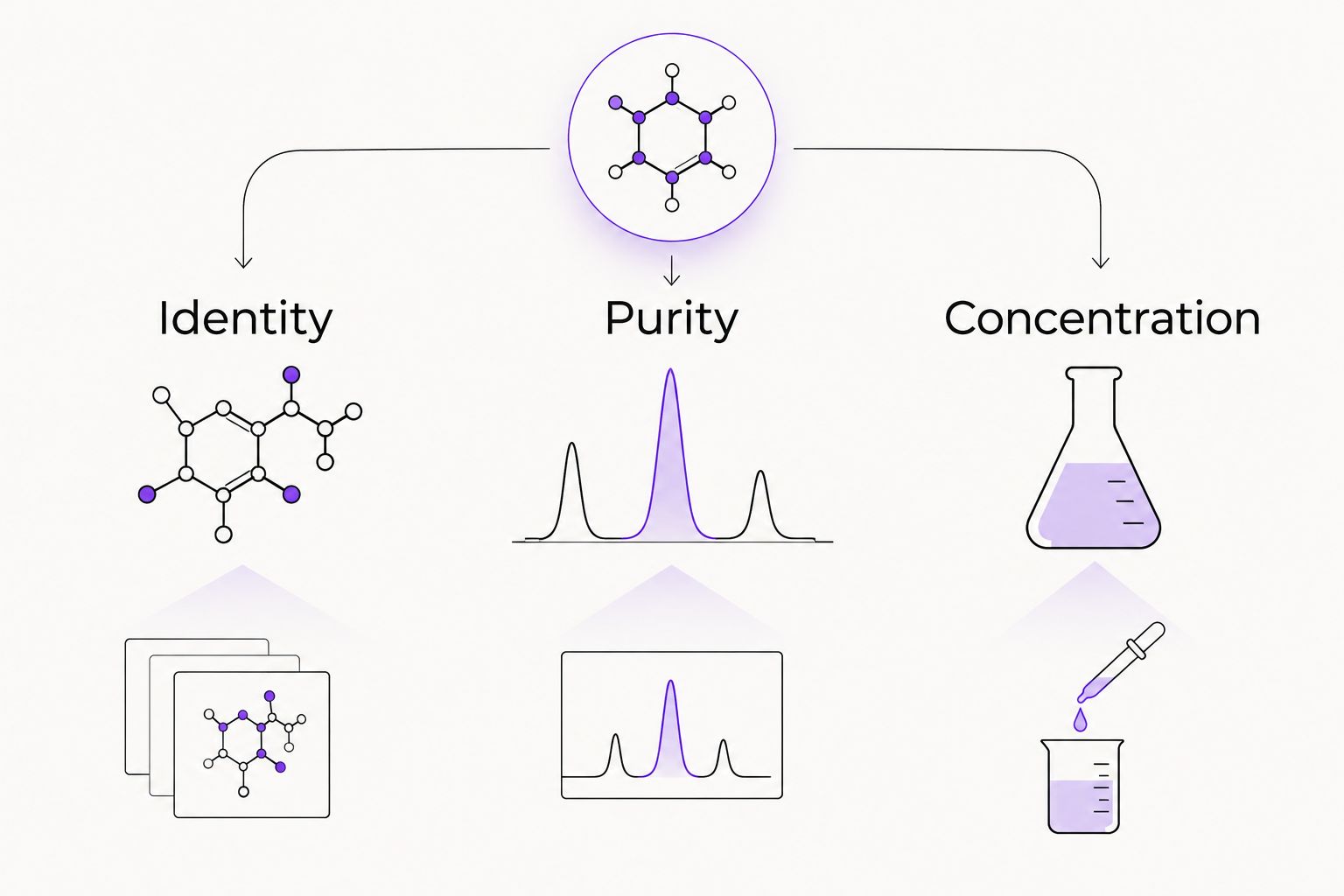
Build a simple evidence matrix with 3 separate decisions: identity, purity, and concentration. Identity asks whether the material is the intended chemical. Purity describes composition under a specified measurement approach. Assigned concentration supports a quantitative statement about a solution.
HPLC area percentage is not automatically a mass fraction, because detector responses can differ between components. It also does not establish the concentration of a supplied solution. Ask what was measured, how it was calculated, and which limitations apply.
Require documentation that distinguishes these questions:
- Identity evidence and the analytical technique used.
- Purity result and calculation basis.
- Concentration assignment, when required.
- Measurement uncertainty, when relevant to the intended role.
- Testing date and the identified material lot.
Evaluate the formulation before sourcing
Read the composition manually before comparing suppliers. For environmental method development, a named compound in a formulated solution is not interchangeable with neat material or a certified standard. The additional constituents become part of the analytical system.
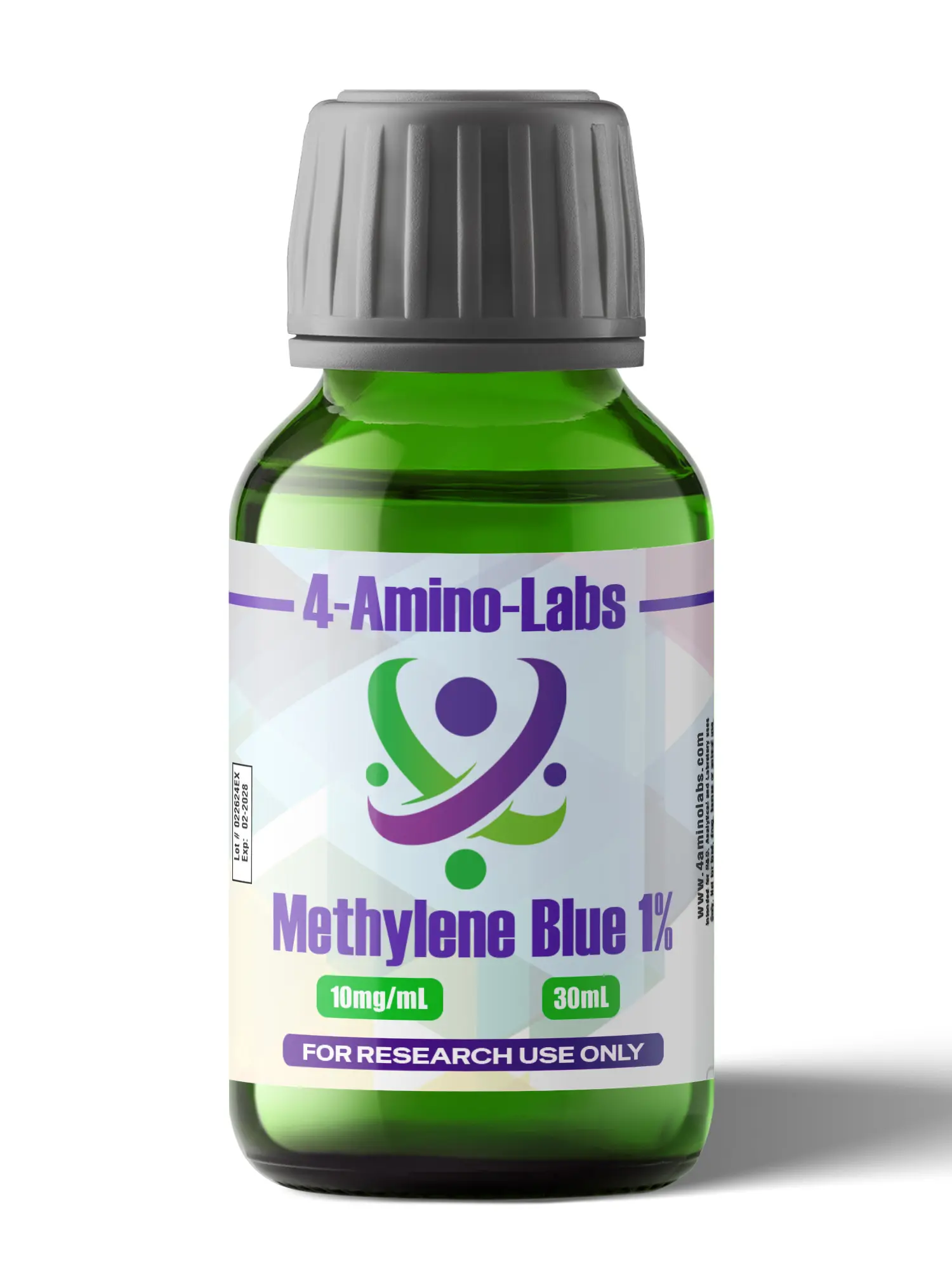
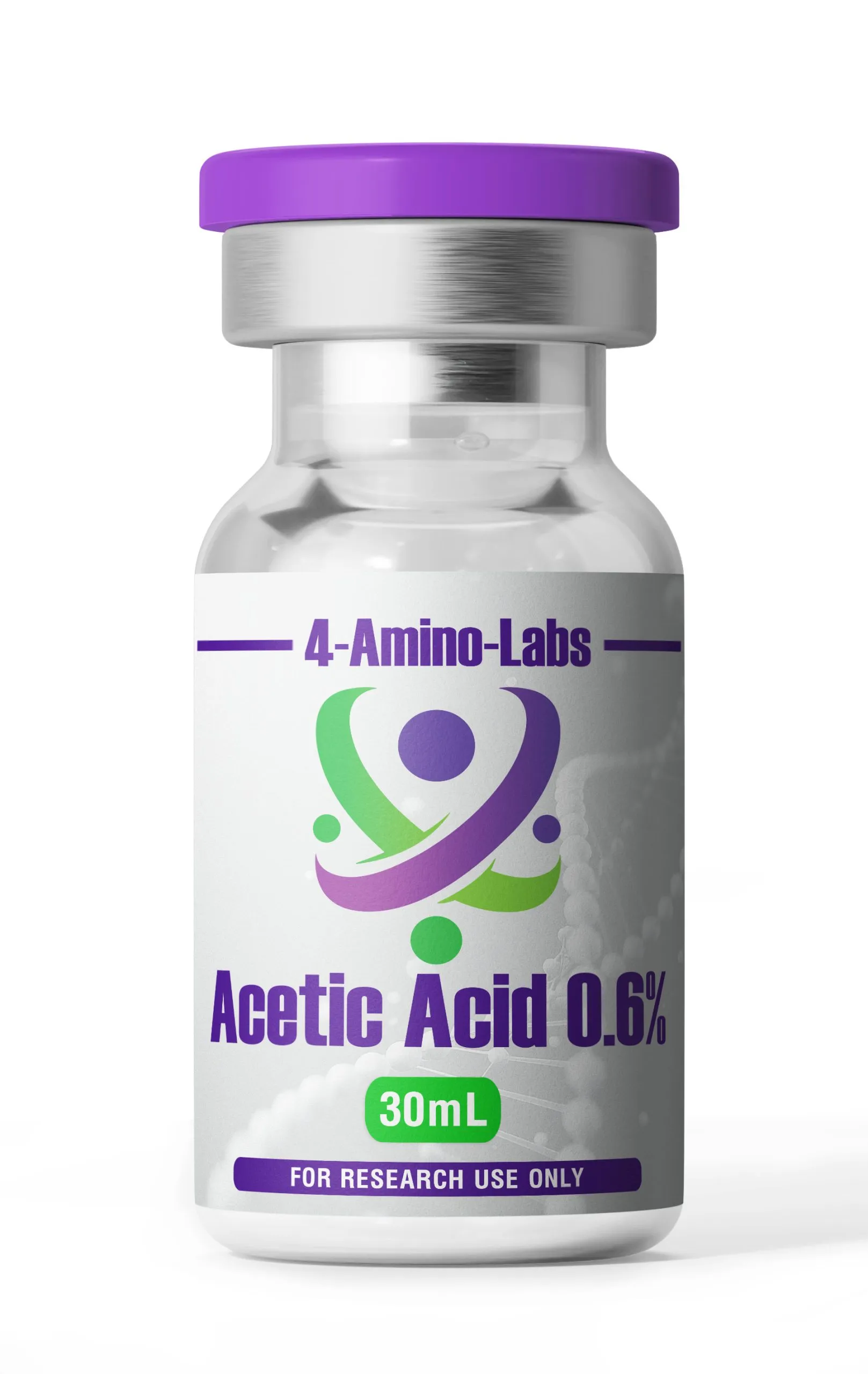
4-Amino-Labs supplies research chemicals and analytical reagents. Its supplied catalog identifies Methylene Blue 1% as a 10 mg/mL aqueous formulation and Acetic Acid 0.6% as a dilute laboratory solution. These are composition statements, not evidence of certified environmental calibration suitability.
4-Amino-Labs research chemicals belong in a documented, material-specific qualification process. Consider these examples only when the named chemistry fits an exploratory analytical question; neither is a general recommendation for environmental compliance testing.
- Check every declared formulation constituent.
- Compare the supplied matrix with your intended analytical role.
- Request the relevant lot documentation.
- Assess possible blank contributions independently.
- Reject substitutions that change the approved specification.
The following catalog entries illustrate why formulation review comes before material approval. Neither listing establishes a certified value, environmental-method acceptance, or a suitable blank profile for your work.
Evaluate interference and matrix compatibility
A certificate cannot establish how a reagent behaves in every environmental extract. Review the material against your laboratory’s approved blank and quality-control requirements before releasing it for the intended work. Keep acceptance criteria tied to the method rather than inventing a universal purity threshold.
For your 2026 qualification register, distinguish reagent background from sample-derived interference. A clean result in a simple aqueous matrix does not establish equivalent behavior in a sediment extract. Document the scope of the evaluation so another analyst can identify what remains untested.
Record the relevant observations:
- Reagent-blank response in the measurement window.
- Interference near the analyte signal.
- Compatibility with the applicable preparation method.
- Evidence of carryover or contamination.
- Matrix-specific limitations on approval.
Connect each result to its material lot
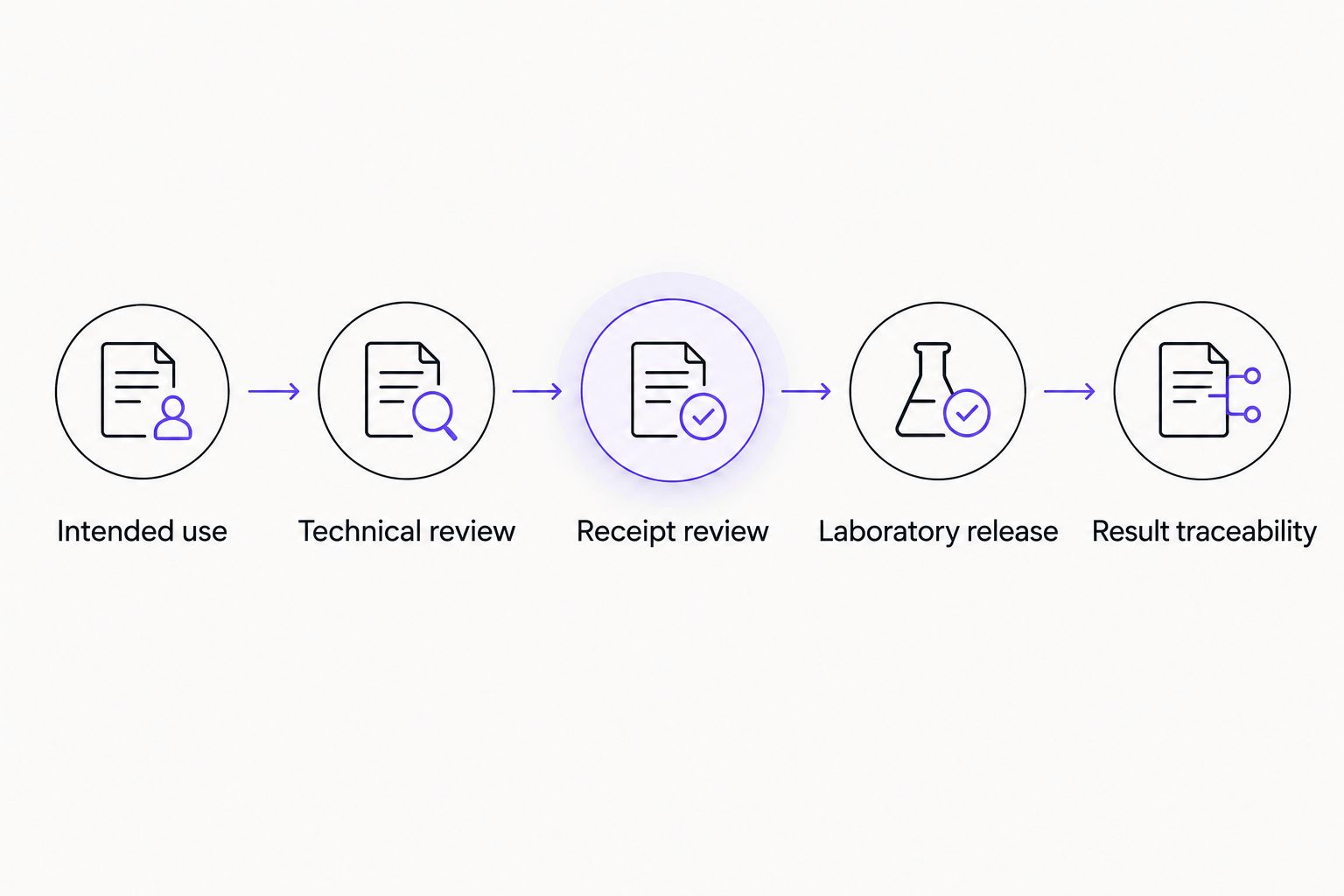
Use a shared register and retained documents before adding automation. The essential requirement is traceability: another analyst must be able to connect a reported result to the material actually used, its documentation, and its approval status.
Set 2 approval gates as a purchasing control: technical review before ordering and receipt review before release. These are recommended workflow controls, not universal accreditation requirements. Your existing quality system determines who approves each gate and what records are necessary.
Retain these links in the laboratory record:
- Supplier and material identifier.
- Received lot number and receipt date.
- Associated certificate and safety documentation.
- Storage requirements supplied for that material.
- Approval scope and responsible reviewer.
Traceability must continue after receipt. Preserve superseded certificates and approval decisions rather than replacing them with the newest document. Otherwise, a later investigation loses the evidence available when the original measurement was made.
Reassess substitutions and changed lots
Do not treat an unchanged catalog name as proof of unchanged analytical behavior. Review changes in composition, documentation, packaging, or assigned values against the original approval. Define the scope of reassessment before the substitute enters routine work.
In 2026, make your change record readable without access to an analyst’s memory. State what changed, which checks were repeated, and whether approval remains restricted to exploratory work. A purchasing substitution is an analytical change when it alters the measurement system.
Apply a bounded change-review checklist:
- Compare the previous and replacement specifications.
- Review changed formulation constituents.
- Check differences in analytical documentation.
- Record any repeated qualification checks.
- Approve or reject the substitution explicitly.
Compare material categories by intended role
No single reagent category is the right choice for every environmental measurement. Select the evidence package that fits the role, then compare individual materials within that category. The table describes categories, not endorsements of particular suppliers.
| Material option | Appropriate for | Main advantage | Key limitation |
|---|---|---|---|
| Certified reference material | Calibration or quality control requiring certified property values | Provides specified certified values with associated documentation | Certification applies only to the stated properties and scope |
| Analytical-grade reagent | Routine reagent functions meeting a defined specification | Provides a stated grade or composition basis for evaluation | Grade alone does not establish analyte calibration suitability |
| Isotopically labeled standard | Methods using an appropriate labeled internal standard | Supports analyte-specific correction within a suitable method | Suitability depends on identity, labeling, purity, and method behavior |
| Research-use compound | Exploratory separation or chemical-behavior investigations | Supports investigation of a specifically identified chemical question | Requires independent assessment before quantitative or reportable use |
| Formulated research solution | Exploratory work where all constituents are acceptable | Supplies a declared formulation for review | Carrier and additional constituents can complicate interpretation |
For quantitative work, examine the certificate’s actual scope rather than relying on its heading. A document called a certificate of analysis is not automatically a certificate for a reference material, and third-party testing does not automatically provide metrological traceability.
Common mistakes environmental laboratories make
Treating chromatographic purity as concentration accuracy
A chromatographic purity result answers a composition question within the method’s detection capabilities. It does not independently establish the amount of analyte in a supplied solution. Request evidence specific to concentration when your calculation depends on that value.
Ignoring the carrier matrix
An environmental method can be sensitive to constituents other than the named chemical. Review the complete formulation before assigning an unexpected signal to the environmental sample. Keep formulation acceptance separate from chemical-identity approval.
Using exploratory materials as reporting standards
Research-use materials and certified reference materials are not interchangeable by default. If a method requires a particular standard or documentation package, a research label and a purity statement do not satisfy that requirement. Resolve suitability before generating reportable measurements.
Losing lot history during inventory updates
Replacing an old certificate with a new one breaks historical traceability. Keep the document associated with the lot actually used, even after the material is exhausted. Your 2026 inventory should preserve the evidence behind earlier decisions, not just current stock records.
Limitations and scope
This guide provides a sourcing and qualification framework, not an environmental test method or a finding of regulatory suitability. It does not establish that any listed research formulation meets a particular laboratory’s calibration, contamination, stability, or reporting requirements.
The 4-Amino-Labs catalog details discussed here establish listed composition only. They do not establish certified environmental reference-material status, lot-specific analytical performance, or compatibility with your sample matrix. Obtain the applicable documentation and complete your laboratory’s approval process before use.
FAQ
What are research chemicals for environmental testing laboratories?
Research chemicals for environmental testing laboratories are materials evaluated for analytical research, method development, and related laboratory investigations. Their suitability depends on the specific analytical role, composition, documentation, and matrix requirements.
Can a research chemical replace a certified reference material?
A research chemical is not automatically a replacement for a certified reference material. Where the method requires certified values or specified traceability, the replacement must meet those requirements before approval.
Does high HPLC purity prove that a solution concentration is correct?
No. HPLC purity and solution concentration are separate analytical claims. A purity percentage alone does not establish the amount of analyte present in the solution.
What documents should an environmental laboratory request before ordering?
Request the material specification, relevant lot documentation, safety documentation, and evidence supporting the intended analytical role. Calibration applications also require review of the assigned value, uncertainty, and traceability where applicable.
Are formulated research solutions suitable for environmental analysis?
Formulated research solutions require method-specific assessment before environmental analytical use. Review the named chemical, carrier, additional constituents, and potential blank contribution rather than approving the formulation by name alone.
Does 4-Amino-Labs supply certified environmental calibration standards?
The catalog information discussed in this guide does not establish certified environmental calibration-standard status. Evaluate each 4-Amino-Labs research material against its documentation and your laboratory’s intended-use requirements.
What should change when a laboratory receives a new reagent lot?
Review the new lot against the approved specification and your laboratory’s change-control requirements. Retain the associated documentation and record any qualification checks required before release.
One last thing
Ask what the certificate does not measure. A detailed analytical report can still leave the decisive question unanswered: concentration, water content, an interfering constituent, or behavior in your environmental matrix. Write that unanswered question into the approval record instead of filling the gap with an assumption.
Related guides
- Connecting batch numbers to laboratory inventory tracking
- Connecting research chemical purchases to a laboratory notebook
- Analytical reagents for forensic toxicology laboratories
Research use only. Materials discussed are intended strictly for laboratory research, not human or animal use. This content is not medical advice and is not intended to diagnose, treat, cure, or prevent disease.