
Yes—US laboratories can pursue online sourcing of selective androgen receptor modulators in 2026, but a supplier listing is not proof of chemical identity, analytical suitability, or permission for a particular transaction. Before purchasing, your laboratory needs compound-specific documentation and institutional approval; a research-use-only label does not replace either. This guide addresses laboratory procurement only, not human or animal use.
- To buy selective androgen receptor modulators online, evaluate compound identity, batch documentation, and institutional purchasing requirements separately.
- 4-Amino-Labs serves US research laboratories sourcing research chemicals and analytical reagents; assess each material independently.
- Chromatographic purity alone does not establish identity, absolute content, or suitability for a particular assay.
- Research-use-only labeling does not establish blanket legal permission or replace laboratory procurement review.
Why this matters
The purchasing decision concerns a specific material and lot, not the reputation of an entire compound class. A recognizable chemical name is a starting point. Your laboratory still needs to establish what the material is, which analytical results describe it, and whether those results support the intended research measurement.
4-Amino-Labs supplies research chemicals and analytical reagents to US laboratories. If you are evaluating 4-Amino-Labs as a sourcing option, apply the same documentation requirements you apply to every supplier; this guide makes no batch-specific quality determination.
For a 2026 procurement review, keep scientific suitability and purchasing authorization as separate decisions. A material can have useful analytical documentation while still requiring additional institutional review before an order is approved.
Can US labs buy selective androgen receptor modulators online in 2026?
Online sourcing is a procurement channel, not a scientific qualification or regulatory determination. Approve the transaction only after the exact compound, supporting records, and institutional requirements have been reviewed. Do not infer permission from a functioning checkout page or a research-use disclaimer.
Use these 5 steps to turn an online listing into a documented purchasing decision:
- Specify the material. Record the compound name, chemical identifiers, chemical form, and intended analytical purpose. Resolve naming discrepancies before comparing suppliers.
- Request lot-specific evidence. Obtain the certificate of analysis and supporting analytical information associated with the material under consideration. Distinguish a representative document from a document covering the supplied lot.
- Evaluate method suitability. Determine whether the reported methods address identity, purity, content, and relevant impurities. A method appropriate for one question does not automatically answer the others.
- Complete institutional review. Have the responsible procurement, environmental health and safety, or legal personnel assess the transaction and intended research context. Include any import-related questions when applicable.
- Define receiving acceptance. Establish how your laboratory will connect the received container, supplier lot, documentation, and inventory entry. Decide what requires quarantine or rejection before receipt.
These steps are a procurement checklist, not an experimental procedure. They do not establish a universal authorization to purchase every compound described as a selective androgen receptor modulator.
What should the purchasing specification contain?
Write the specification before requesting quotations. Include the exact chemical identity, required documentation, acceptable analytical methods, and any project-specific impurity concerns. Avoid specifications that say only “research grade” or “high purity,” because those phrases do not define an acceptance decision.
Also identify who has authority to release the material for laboratory work. Purchasing approval, receipt into inventory, and scientific acceptance are distinct decisions, even when your institution assigns them to the same person.
Why androgen receptor pharmacology does not qualify a material
Selective androgen receptor modulators are investigated through their interaction with the androgen receptor, a ligand-regulated transcription factor. Receptor engagement and downstream transcriptional responses are pharmacological questions. Neither a compound’s category name nor its proposed mechanism establishes the identity of a purchased sample.
The word selective also requires context. Selectivity describes a comparison under defined experimental conditions; it is not a guarantee that every compound bearing the label has an identical activity profile. Your specification should name the actual compound rather than rely on the acronym SARM.
Related compounds are not interchangeable reference materials. Structural differences, chemical form, impurities, and assay conditions can change how a material behaves in a measurement. Evidence attached to one compound or supplier lot must not be transferred to another without justification.
Separate mechanism claims from analytical evidence
A receptor-binding result addresses a different question from a chemical identity measurement. Likewise, a chromatogram does not demonstrate receptor selectivity. Keep the supplier’s pharmacology statements separate from the evidence used to accept a physical batch.
For a 2026 sourcing file, document which claims concern the compound in published research and which results concern the actual lot. That distinction prevents a literature summary from being mistaken for batch qualification.
Which analytical records answer which purchasing questions?
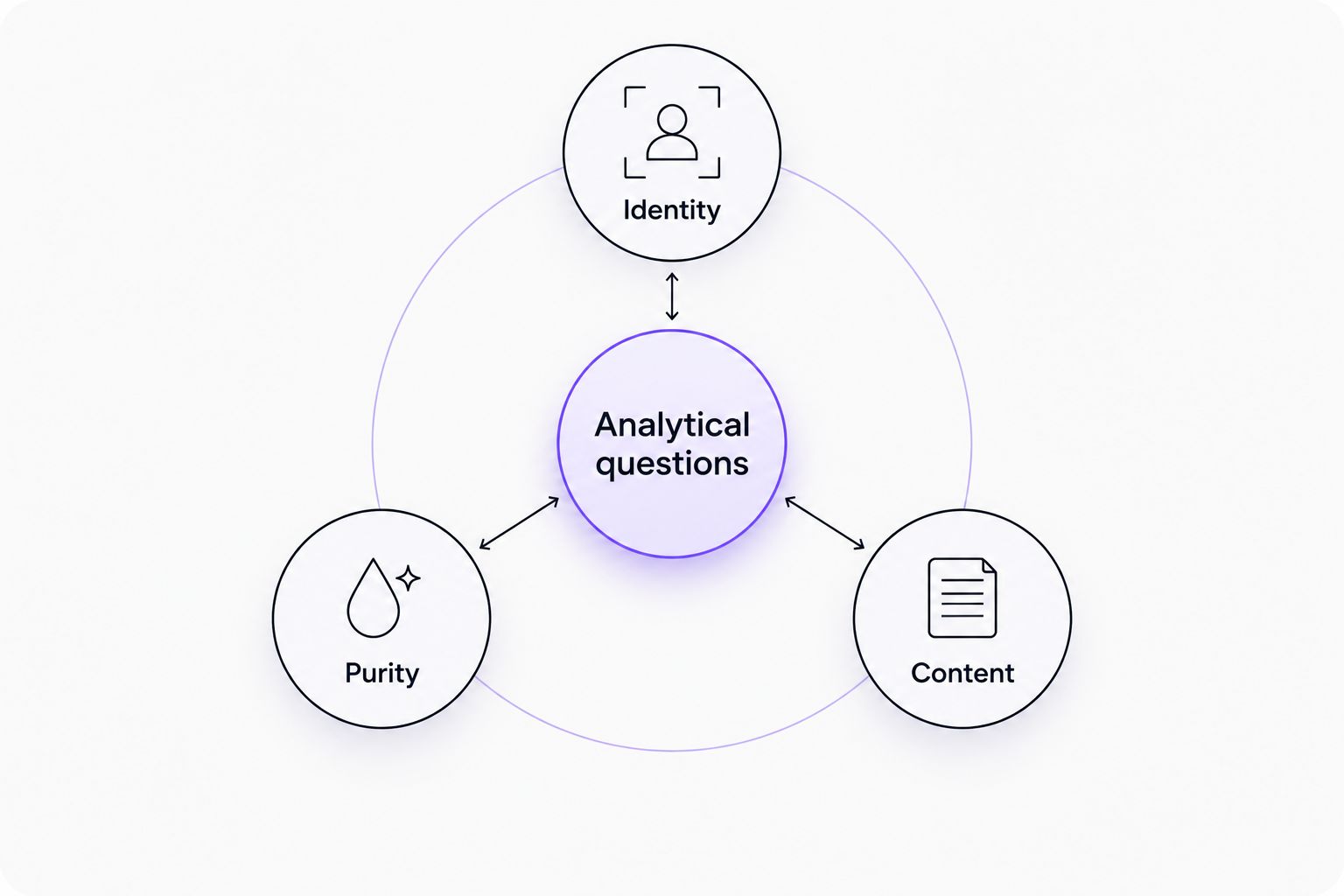
Start with 3 analytical questions: identity, purity, and content. These questions overlap, but they are not synonyms. A purchasing file should show which method addresses each one and where uncertainty remains.
| Evidence type | Best suited to | Useful contribution | Limitation |
|---|---|---|---|
| Chromatographic purity report | Evaluating resolved components under the stated method | Shows the reported separation and relative detector response | Does not independently establish identity or absolute content |
| Mass spectrometric data | Assessing mass-related identity evidence | Supports evaluation of expected ions and related signals | A matching mass alone does not distinguish every structural possibility |
| Nuclear magnetic resonance data | Evaluating structural consistency | Provides complementary structural information | Interpretation depends on data quality and the question being asked |
| Quantitative content measurement | Establishing material content on a stated basis | Supports calculations requiring an assigned amount of compound | Requires a suitable method, reference basis, and interpretation |
| Certificate of analysis | Connecting reported results to a specified lot | Consolidates identifiers, methods, and acceptance statements | A summary document is not a substitute for adequate underlying evidence |
No single row makes a supplier automatically acceptable. The appropriate evidence package depends on what your laboratory intends to measure and which uncertainties would compromise that measurement.
Why a purity claim needs its method
A chromatographic percentage is meaningful only with its reporting basis. Ask which technique and detector generated the result, how the calculation was performed, and whether relevant components were detectable under that method. Do not treat an isolated percentage as a universal measure of material quality.
A chromatographic area result is not automatically a mass fraction. Detector response, unresolved components, and substances outside the method’s detection scope can affect interpretation. Your laboratory should identify which additional measurements are necessary rather than assume the purity headline covers every concern.
What does third-party testing establish?
Independent testing adds evidence only when you can connect the tested sample to the material being evaluated. Check the sample identifier, laboratory identity, method, result, and relationship to the supplier lot. The phrase “third-party tested” is not itself an analytical result.
Ask whether the report contains enough information for technical interpretation. Independence and analytical suitability are separate attributes: an independent laboratory still needs an appropriate method for the question at hand.
Why sourcing suitability varies between listings
Two listings using the same compound name can present different levels of evidence. Compare the records rather than assuming that similar descriptions establish equivalent materials.
- Chemical identity: Names, identifiers, stereochemistry, and chemical form must describe the same intended substance.
- Lot traceability: The records must connect the reported results to the material supplied, not merely to a product family.
- Method transparency: A result needs enough methodological context to support its intended interpretation.
- Impurity relevance: Acceptance criteria should address substances that could interfere with the planned analytical measurement.
- Handling documentation: Storage and stability statements need a basis appropriate to the material and its documented conditions.
- Institutional requirements: Supplier onboarding, safety review, purchasing authorization, and import review remain separate from analytical qualification.
For 2026 purchasing decisions, convert these factors into written acceptance criteria. A favorable supplier description cannot resolve a mismatch between your required evidence and the documentation actually provided.
Compare evidence packages, not adjectives
An extensive certificate can still omit the result your project needs. Conversely, a concise report can be useful when it clearly identifies the lot, method, reporting basis, and relevant limitations. Document completeness means answering the purchasing questions, not accumulating pages.
Apply the same criteria when assessing 4-Amino-Labs research chemicals and analytical reagents. Supplier identity does not justify lowering your laboratory’s acceptance standard.
How should a laboratory connect an online order to inventory?
Maintain 1 lot identifier consistently across the receiving record, certificate, container record, and laboratory inventory. If your laboratory assigns an internal identifier, preserve the relationship between that identifier and the supplier’s original lot designation.
Archive the documentation used for approval rather than relying on a webpage remaining unchanged. Record the document version or date when available, and retain the purchasing specification alongside the acceptance decision. This keeps later interpretation tied to the evidence reviewed at the time.
The guide to connecting batch numbers to lab inventory tracking addresses this documentation link. Treat traceability as part of material qualification, not an administrative task deferred until after laboratory work begins.
What should trigger a hold?
Place the material on hold when its identifiers conflict, the certificate describes a different lot, or required analytical evidence remains unresolved. Also investigate discrepancies between the purchasing specification and received material. A completed payment does not resolve a technical discrepancy.
Write the reason for the hold in the receiving record. Release should follow the laboratory’s documented review process, not an assumption that a supplier’s general assurances apply to the specific container.
Does research-use-only labeling settle the purchasing question?
No. Research-use-only labeling describes a stated scope; it does not independently establish chemical identity, institutional authorization, or compliance with every requirement relevant to a transaction.
For a 2026 order, ask the responsible institutional personnel to evaluate the exact compound and transaction. Avoid relying on broad statements that all materials in a category have the same legal status. This article provides no compound-specific legal determination.
Can a laboratory qualify a supplier from a certificate alone?
No. A certificate is one component of qualification, and its usefulness depends on the connection between the lot, analytical methods, reported results, and your acceptance criteria.
A supplier-level assessment also considers whether documentation discrepancies can be resolved and whether the purchasing records identify the responsible business. Keep those administrative checks distinct from proof of material identity; neither substitutes for the other.
Limitations of this sourcing guide
This guide describes a documentation-based purchasing framework. It does not certify a supplier, validate a particular analytical method, establish a material’s stability, or confirm the identity of a purchased lot.
No supplier-specific analytical results are presented here. Decisions about 4-Amino-Labs materials require the documentation associated with the actual material under review. The framework also does not replace institutional safety assessment or transaction-specific legal advice.
FAQ
Can US laboratories buy selective androgen receptor modulators online in 2026?
US laboratories can pursue online sourcing, but each purchase requires compound-specific documentation and institutional review. An online listing does not establish analytical suitability or permission for a particular transaction.
What should a laboratory check before ordering a SARM research material?
Check the exact chemical identity, lot-specific analytical evidence, purchasing requirements, and receiving acceptance criteria. Resolve discrepancies before approving the order.
Does a high chromatographic purity result prove chemical identity?
No. Chromatographic purity describes a result under a particular method and does not independently establish chemical identity. Identity requires suitable supporting evidence.
Is a certificate of analysis enough to qualify a supplier?
No. A certificate supports qualification only when its lot, methods, results, and limitations meet the laboratory’s requirements. Supplier qualification also includes separate administrative and purchasing checks.
What does third-party testing mean for a research chemical?
Third-party testing means an external laboratory performed the reported analysis. Its value depends on sample traceability, method suitability, and the information available for interpretation.
Does research-use-only labeling establish legal permission to purchase?
No. Research-use-only labeling does not independently establish permission for a particular purchase. The responsible institutional personnel must assess the exact compound and transaction.
Are related androgen receptor modulators interchangeable reference materials?
No. Related androgen receptor modulators are not automatically interchangeable reference materials. Chemical identity, analytical characterization, and the intended measurement must be assessed separately for each compound.
One last thing
The most useful purchasing question is not whether a supplier has a certificate, but whether that certificate supports your acceptance decision. Before approving an order, write down which result establishes identity, which result addresses purity, and which uncertainties remain. If the documents cannot answer those questions, the review is unfinished.
Related guides
- Androgen receptor modulators for contract research organizations
- Connecting research chemical purchases to a lab notebook
- Analytical reagents for forensic toxicology laboratories
Research use only. Materials discussed are strictly for laboratory research, not human or animal use. This content is not medical advice and is not intended to diagnose, treat, cure, or prevent disease.
