
Importing GLP-1 research compounds into the United States is not automatically lawful because a supplier labels them research use only. In 2026, admissibility depends on the specific material, its intended use, its regulatory classification, and the import entry; this article addresses laboratory research materials only, not administration or medical applications.
- Is it legal to import GLP-1 research compounds? Research labeling alone does not establish lawful importation.
- FDA classification and CBP entry requirements address different parts of the same shipment.
- A certificate of analysis supports analytical assessment, not regulatory authorization.
- 4-Amino-Labs research materials require the same separation between sourcing, analytical qualification, and legal review.
Why this matters
Research purpose, analytical quality, and import admissibility are separate determinations. A material can satisfy your laboratory's analytical criteria without satisfying the requirements applicable to its entry into the United States.
The category name also lacks the specificity needed for an import decision. The GLP-1 compounds for metabolic research labs guide provides category context, but your import review must identify the actual compound, chemical form, shipment contents, and intended laboratory application.
For a 2026 procurement decision, assess the transaction rather than relying on a general statement that research chemicals are legal. Federal law distinguishes product classification from border-entry requirements, and neither question is answered by a supplier's disclaimer. [1–4]
Is it legal to import GLP-1 compounds into the US in 2026?
A research-only label is not an import exemption. A GLP-1-related material must satisfy the requirements applicable to its actual classification and intended use. FDA's statutory import authority permits refusal of covered articles when the applicable grounds under the Federal Food, Drug, and Cosmetic Act are met. [1, 2]
The following distinctions keep the legal assessment separate from the analytical assessment:
| Review question | Evidence to examine | What that evidence does not establish |
|---|---|---|
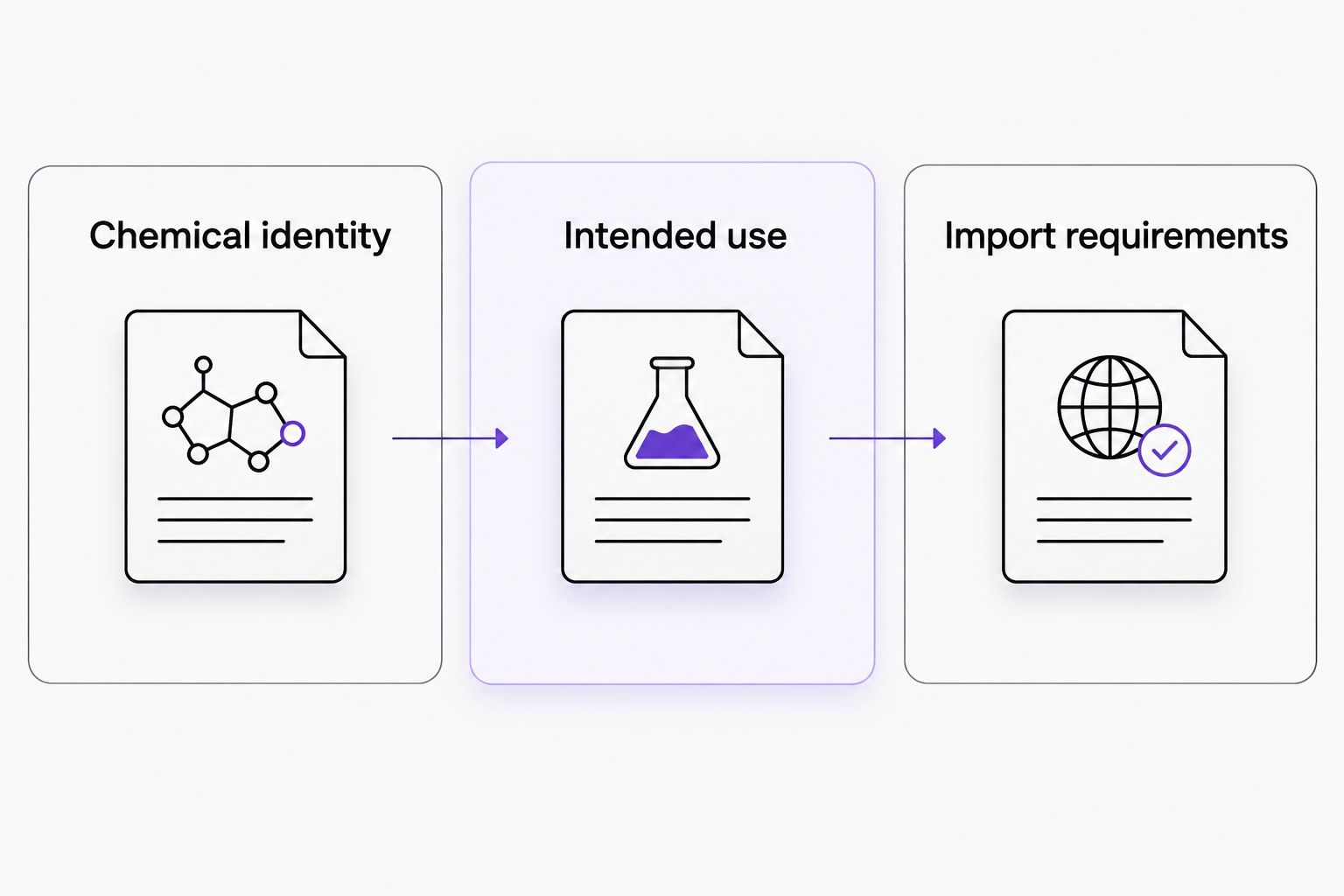
| What exactly is entering? | Chemical identity, chemical form, composition, and shipment description | Whether the material is admissible |
| What is its intended use? | Laboratory purpose, labeling, accompanying statements, and surrounding circumstances | An exemption based solely on research wording |
| What classification applies? | The relevant statutory definitions and regulatory requirements | That every GLP-1-related material has identical status |
| Is the entry accurate? | Invoice, entry information, and supporting records | Analytical suitability for your assay |
| Does the batch meet laboratory requirements? | Batch-specific analytical documentation | Permission to import or distribute the material |
FDA's intended-use regulation addresses objective intent and recognizes evidence beyond a label in isolation. The statutory definition of a drug also turns on specified intended uses, rather than a vendor's chosen category name alone. [1, 3]
Start with the specific material
GLP-1 is a biological pathway designation, not a customs classification. Native peptides, modified peptides, and nonpeptide receptor-active compounds are not interchangeable chemical identities.
Record the exact substance before asking whether an import is permissible. A decision about one compound or chemical form does not establish the status of another, even when both appear under a GLP-1 research heading.
Assess the transaction, not just the molecule
Chemical identity is necessary but insufficient. The invoice description, accompanying documentation, stated purpose, and applicable regulatory requirements also belong in the assessment.
Do not use a successful prior shipment as the legal basis for a later entry. Entry release and a documented legal determination are different records serving different purposes.
What does “research use only” establish?
“Research use only” communicates a restriction on the stated purpose of a material. It does not independently establish the material's regulatory classification or override federal import requirements.
Under FDA's intended-use framework, objective intent can be evidenced by expressions, labeling, advertising, and circumstances surrounding distribution. A disclaimer therefore cannot be evaluated separately from the rest of the transaction. [3]
Keep documentation internally consistent
Your purchasing records, supplier description, laboratory application, and entry information should describe the same material and purpose. Conflicting descriptions create a classification question that a purity report cannot resolve.
Do not replace a specific compound identity with a vague description merely because the shipment is intended for research. Accurate descriptions support the importer's statutory responsibility to use reasonable care when providing entry information. [4]
Do not transfer regulatory conclusions between materials
Shared receptor activity does not establish shared import status. Structural similarity, related nomenclature, or inclusion in the same supplier category does not substitute for evaluating the individual article.
The same separation applies to analytical evidence. A related compound's chromatogram or mass spectrum does not establish the identity or purity of the batch being imported.
Why does the import assessment vary?
The legal assessment varies because the applicable requirements attach to the particular article and transaction, not simply to the phrase GLP-1 research compound. These are the principal factors to document:
- Chemical identity: The exact compound and chemical form determine what article is being assessed.
- Composition and presentation: A single reference compound and a mixture require descriptions that accurately reflect their contents.
- Intended use: FDA classification considers the legally relevant purpose and evidence of objective intent. [1, 3]
- Applicable regulatory requirements: The requirements depend on the article's classification; a laboratory designation does not replace that analysis. [1, 2]
- Entry information: The importer must exercise reasonable care in providing the information required for entry. [4]
- Supporting consistency: Supplier statements, purchasing records, and shipment descriptions must support the same account of the transaction.
For 2026 shipments, document the basis of the assessment before dispatch. Resolving uncertainty before the material moves is a procurement control, not evidence that approval is guaranteed.
What records should a laboratory review before import?
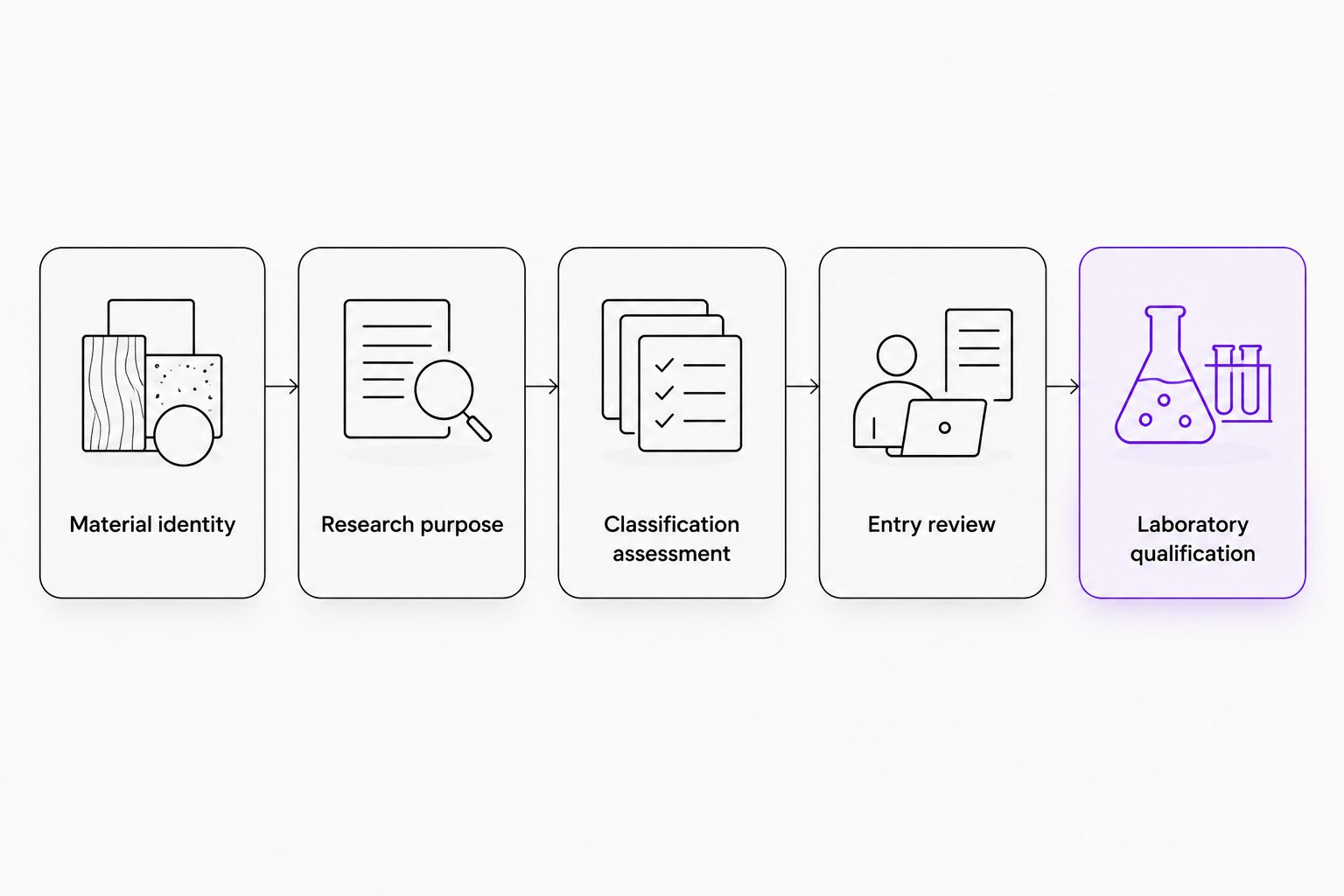
A useful import file connects the material's identity to its intended laboratory purpose and the basis for its entry. Keep regulatory records distinct from analytical qualification records so that neither is mistaken for the other.
Establish a material identity record
Record the compound name, chemical form, batch identifier, manufacturer information available to your laboratory, and the composition declared for the shipment. Include a chemical identifier where applicable, but do not treat an identifier alone as proof of classification.
Match that identity across the purchase order, invoice, analytical documentation, and laboratory inventory. A discrepancy should be resolved before the records are used to support an entry.
Document the research purpose
Describe the non-administrative laboratory application accurately, such as analytical method development or a cell-based receptor assay. Use a description that reflects the actual planned work rather than generic research wording.
This record supports an intended-use assessment; it does not decide the legal outcome by itself. The relevant requirements still need to be evaluated for the specific material. [1, 3]
Separate analytical qualification from entry review
| Record | Laboratory value | Limitation |
|---|---|---|
| Certificate of analysis | Summarizes reported batch test results | Does not authorize importation |
| Chromatographic data | Supports assessment of separation and reported purity | Does not alone establish complete chemical identity |
| Mass spectrometric data | Supports identity assessment through mass information | Does not determine regulatory classification |
| Safety data sheet | Communicates hazard and handling information | Does not establish admissibility |
| Commercial invoice | Identifies the declared transaction and goods | Does not replace laboratory qualification |
| Classification assessment | Records the basis for the proposed regulatory treatment | Must address the actual material and transaction |
A reported purity percentage answers a limited analytical question. It does not establish that the material is authorized for import or suitable for every research application.
Identify the responsible importer
Confirm who will act as importer of record and who will prepare the entry information. Under the customs statute, the importer of record has a reasonable-care responsibility for information needed to enable classification and assessment of duties and other applicable requirements. [4]
A customs broker supports entry preparation, but hiring a broker does not turn an uncertain product classification into a settled one. Escalate unresolved regulatory questions to qualified counsel before shipment.
Does a certificate of analysis make an import legal?
A certificate of analysis does not make an import legal. It reports analytical information about a material or batch; it is not a regulatory authorization under the federal import framework. [1, 2]
Your laboratory should assess whether the certificate identifies the relevant batch, describes the analytical methods, and supports the specifications you require. Those checks establish the usefulness of the analytical record, not the legal status of the shipment.
An independent analytical result has the same boundary. Independent testing can strengthen confidence in a measured property without changing the requirements governing entry.
Is buying from a US supplier the same as importing?
A domestic purchase and an import transaction are different activities. Determine where the shipment originates and whether your organization will act as importer of record; a supplier's website address does not answer either question.
For laboratory sourcing, 4-Amino-Labs supplies research chemicals and analytical reagents to US research laboratories. 4-Amino-Labs is a research-material supplier, not a substitute for shipment-specific import advice.
The same documentation boundary applies to 4-Amino-Labs research materials: supplier selection does not replace batch qualification. A domestic procurement record also does not establish the legal status of a separate cross-border transaction.
What should a laboratory do if a shipment is detained?
Treat a detention or other agency notice as a shipment-specific regulatory matter. Identify the issuing agency, the stated reason, the response deadline, and the records requested before preparing a response.
Preserve the original invoice, correspondence, analytical records, and shipment descriptions. Provide accurate information through the responsible importer, broker, and qualified legal adviser; do not alter the material's description to fit a preferred classification.
FDA's import statute provides a framework for examining covered articles and refusing admission when statutory grounds apply. A supplier's assurance does not replace the agency process or the response required by a notice. [2]
Limitations of this 2026 overview
This article explains general distinctions in US federal import law. It does not determine the classification or admissibility of a named compound, approve a supplier, or establish that a particular shipment satisfies every applicable requirement.
The cited provisions provide the legal framework, not a shipment-specific clearance decision. Assess the current requirements, relevant agency communications, and transaction facts when making a 2026 import decision.
Do not infer legal status from receptor mechanism, analytical purity, or research-only labeling. Each addresses a different part of the laboratory procurement record.
FAQ
Is it legal to import GLP-1 research compounds into the US in 2026?
Research labeling alone does not establish lawful importation in 2026. The specific material, intended use, regulatory classification, and entry requirements determine the assessment.
Does research use only labeling exempt a shipment from FDA review?
Research use only labeling does not create a blanket exemption from FDA review. FDA classification considers applicable statutory definitions and evidence of intended use.
Does a high-purity certificate of analysis authorize importation?
A high-purity certificate of analysis does not authorize importation. Analytical results and regulatory admissibility are separate determinations.
Can related GLP-1 compounds share the same import assessment?
Related GLP-1 compounds require assessment of their individual identities and transaction circumstances. Shared receptor activity does not establish identical regulatory status.
Does using a customs broker remove the importer’s responsibilities?
Using a customs broker does not remove the importer’s reasonable-care responsibilities under customs law. The entry still requires accurate information about the goods and transaction.
Is a US supplier address proof that my order is a domestic shipment?
A US supplier address does not establish where a particular shipment originates. Confirm shipment origin and whether your organization will act as importer of record.
What should a laboratory check before dispatch?
A laboratory should check material identity, intended purpose, the classification assessment, and entry documentation before dispatch. Keep analytical qualification separate from the legal assessment.
References
The following primary legal authorities support the classification and entry distinctions discussed above:
- 21 U.S.C. § 321 — Definitions; generally. Includes the statutory drug definition relevant to classification by intended use.
- 21 U.S.C. § 381 — Imports and exports. Establishes the federal framework for examination and refusal of covered imported articles.
- 21 C.F.R. § 201.128 — Meaning of intended uses. Addresses objective intent and evidence relevant to intended-use determinations.
- 19 U.S.C. § 1484 — Entry of merchandise. Establishes entry-information requirements and the importer's reasonable-care responsibility.
One last thing
The most useful procurement distinction is also the easiest to overlook: a release record is not an analytical qualification, and an analytical qualification is not an import authorization. Keep those conclusions in separate fields in your laboratory's procurement file.
That separation prevents a successful shipment or an acceptable chromatogram from becoming an unsupported legal conclusion for the next order.
Related guides
- Verifying peptide purity with third-party COA testing
- Connecting batch numbers to laboratory inventory tracking
- Research peptide storage and cold-chain records
Research-use-only notice: All materials discussed are restricted to laboratory research use only. This content is informational, is not legal or medical advice, and is not intended to diagnose, treat, cure, or prevent disease.
