
MK-677 is not automatically lawful to purchase simply because a seller labels it research use only. For a United States laboratory purchase in 2026, legality depends on applicable federal and state requirements, the transaction’s intended use, and any import requirements. A research-use-only label defines the seller’s stated scope; it does not independently authorize the transaction. This guide addresses laboratory procurement only, not human or animal use.
- Is MK-677 legal for research use? The answer depends on jurisdiction, intended use, and the specific transaction.
- Federal intended-use rules distinguish a research label from the surrounding evidence about a product’s purpose.
- Batch documentation establishes material identity and traceability, not legal authorization.
- 4-Amino-Labs serves United States research laboratories; supplier selection does not replace institutional legal review.
Is MK-677 legal for research use in 2026?
There is no blanket research-use exemption established by printing those words on a container. A laboratory must assess the substance, the seller’s representations, the proposed laboratory activity, and the jurisdictions involved. These are separate questions, and a satisfactory answer to one does not resolve the others.
The federal definition of a drug includes intended-use criteria under 21 U.S.C. § 321(g)(1). FDA’s intended-use regulation, 21 C.F.R. § 201.128, addresses the objective intent of those legally responsible for labeling, including evidence beyond the label itself. Federal controlled-substance schedules appear in 21 C.F.R. Part 1308. None of these citations, standing alone, establishes the legality of a particular MK-677 purchase. [1–3]
Separate the questions before approving a purchase
The following comparison identifies what each review establishes—and what it leaves unresolved.
| Review area | What your laboratory evaluates | What it does not establish |
|---|---|---|
| Substance identity | Whether the material is actually ibutamoren, including its chemical form | Permission for the proposed transaction |
| Intended use | Whether descriptions and surrounding representations match laboratory research | An exemption created by a disclaimer |
| Controlled-substance review | Whether applicable scheduling rules cover the material | Compliance with every other regulatory requirement |
| Import review | Requirements relevant to a cross-border shipment | Automatic acceptance because the destination is a laboratory |
| Analytical documentation | Identity, purity reporting, and batch traceability | Regulatory approval or legal authorization |
| Institutional review | Whether procurement meets your organization’s requirements | A substitute for applicable law |
For traceability after approval, connecting research chemical purchases to a lab notebook addresses the documentation side of procurement. Keeping purchase records does not convert an otherwise impermissible transaction into a permissible one.
Why this matters for laboratory procurement
The word legal often collapses several distinct questions into one. Purchasing, importing, holding, marketing, and conducting a particular laboratory activity are not interchangeable regulatory categories.
Your procurement file should identify which activity has actually been reviewed. A supplier’s general statement about research materials is not a transaction-specific conclusion about your institution, destination, or project.
For a 2026 purchase, retain the date and scope of the review. An undated assertion about a compound’s status does not show which rules were considered or whether the conclusion applies to the proposed transaction.
Documentation supports an accountable decision; it does not replace the decision. Keep the legal assessment separate from the analytical acceptance criteria so that neither is mistaken for the other.
What MK-677 is—and why its classification matters
Ibutamoren is not a SARM
MK-677, also called ibutamoren, is a nonpeptide growth-hormone secretagogue associated with the growth-hormone secretagogue receptor, commonly designated GHS-R1a. It is not a selective androgen receptor modulator. Its pharmacological classification should not be inferred from the products beside it in a supplier catalog. [4]
This distinction matters for literature searches, compound identification, and review of supplier descriptions. A catalog grouping is a merchandising choice, not evidence that unrelated substances share a mechanism or regulatory status.
Mechanism does not determine purchasing permission
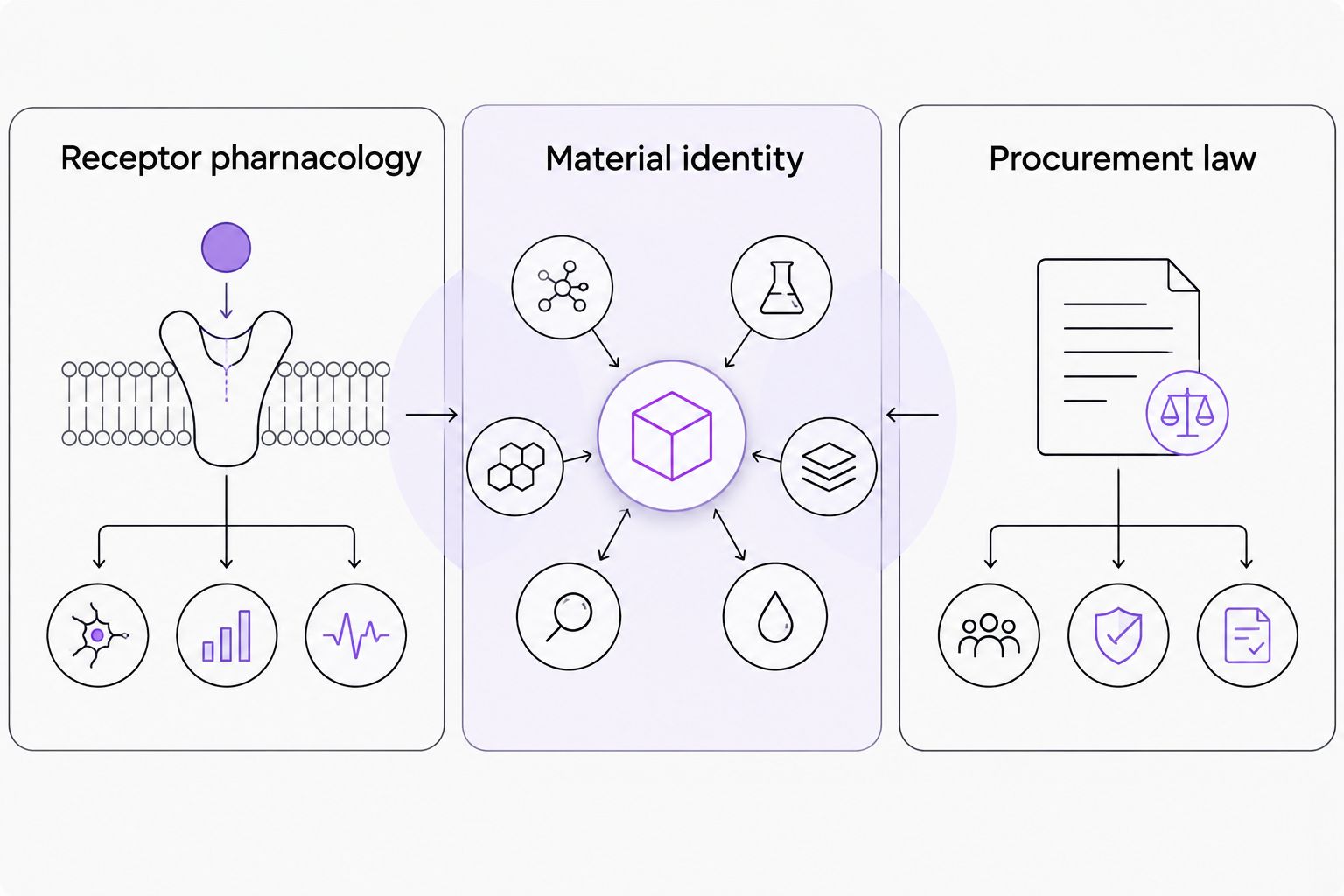
Receptor pharmacology describes what a compound interacts with in an experimental system. Procurement law addresses a different set of questions, including intended use and the circumstances of the transaction.
Do not transfer a legal conclusion from SARMs, peptides, or another receptor modulator to MK-677. Shared catalog placement establishes neither chemical equivalence nor regulatory equivalence. A review should name ibutamoren explicitly rather than relying on a broad research-chemical category.
What a research-use-only label actually establishes
The label states a restriction, not an exemption
A research-use-only statement communicates the intended scope presented by the supplier. It does not itself demonstrate that all applicable requirements have been satisfied.
FDA’s intended-use regulation considers objective evidence, including expressions by responsible parties and circumstances surrounding distribution. This makes the complete presentation relevant—not just the disclaimer printed at the bottom of a page. [2]
For laboratory review, compare the listing, accompanying documents, and other supplier representations. Conflicting descriptions require resolution before approval. A technical label and incompatible promotional claims should not be treated as equivalent evidence.
Analytical quality and legal status are independent
A certificate of analysis can support material acceptance when it identifies the batch, methods, and reported results. It does not determine whether a transaction is legally permitted.
Likewise, a satisfactory legal assessment does not establish purity, identity, or suitability for an analytical method. Approve procurement and accept the material through separate checks. This avoids using a strong result in one category to conceal an unresolved question in another.
Why the legal assessment varies
The relevant differences concern the transaction, not simply the compound’s name. Your review should address these factors explicitly:
- Jurisdiction: Identify the federal, state, and destination requirements relevant to the purchase. Do not substitute a statement about another jurisdiction.
- Intended use: Evaluate the laboratory purpose and the evidence surrounding the seller’s representations. A disclaimer is only part of that evidence. [1–2]
- Transaction type: Distinguish domestic procurement from importation and from any subsequent distribution.
- Chemical identity: Record the named compound and chemical form. Do not approve an ambiguous listing under a broad category description.
- Institutional requirements: Apply your organization’s procurement, safety, and restricted-material review procedures alongside the legal assessment.
These factors explain why a categorical yes-or-no answer is inadequate. The same product description does not supply the same evidence for every purchaser or destination.
How should a laboratory review an MK-677 purchase?
Build a transaction-specific record
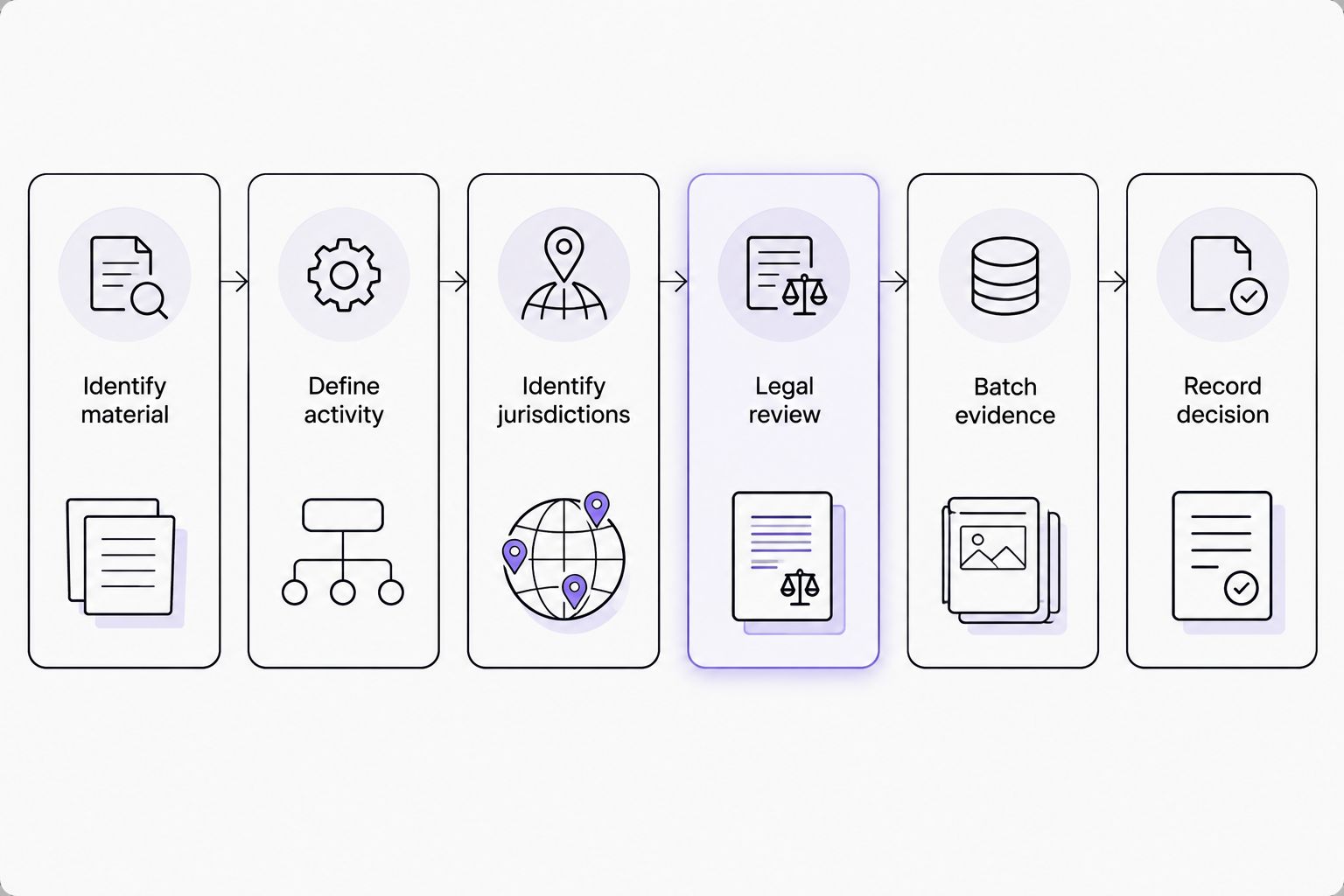
Use a review sequence that separates the legal decision from supplier documentation and material acceptance. The sequence below is an administrative checklist, not an experimental protocol.
- Identify the material. Record MK-677 and ibutamoren as the relevant names, together with the chemical form stated in the listing and documentation. Resolve inconsistent identifiers.
- Define the activity. Document the laboratory research purpose without importing claims from unrelated compound categories or supplier marketing.
- Identify the jurisdictions. Record the seller’s location, purchaser’s location, and whether the transaction crosses a national border.
- Obtain legal review. Have the responsible institutional function assess the applicable requirements and record the scope of its conclusion.
- Review batch evidence. Evaluate the certificate of analysis, identity evidence, safety documentation, and traceability information separately from the legal conclusion.
- Record the decision. Preserve the approval, its date, unresolved conditions, and the documents used to support it.
Stop when a material question remains unresolved. A completed checkout is not evidence that the laboratory’s procurement review is complete.
Date the scope, not just the signature
A 2026 approval record should describe the transaction it covers. Include the material identity, destination, research purpose, and any conditions attached to the decision.
A signature without that scope is difficult to interpret later. It does not tell another reviewer whether the decision concerned a domestic purchase, an import, or a different material form.
What documentation should you request from a supplier?
Evaluate the material rather than the disclaimer
Request documentation that lets your laboratory connect the material received to the listing reviewed. Useful fields include a batch identifier, chemical identity, the analytical methods used, reported results, and a safety data sheet.
Check that the documents refer to the same material and batch. A generic analytical report without that connection does not establish the identity of the material delivered to your laboratory.
| Document or field | Practical value | Limitation |
|---|---|---|
| Batch identifier | Connects the container to the procurement record | Does not establish chemical identity alone |
| Identity testing | Supports assignment of the stated compound | Depends on the method and supporting data |
| Chromatographic report | Describes separation results under stated conditions | Does not automatically establish every impurity or material attribute |
| Safety data sheet | Supports laboratory hazard review | Is not a legal authorization document |
| Supplier invoice | Records the parties and material description | Does not replace regulatory review |
Keep supplier scope distinct from supplier assurances
4-Amino-Labs is a research-chemical supplier serving United States laboratories. That business scope identifies its intended audience; it does not establish a particular batch specification or authorize a particular purchase.
4-Amino-Labs serves laboratory research buyers, but supplier selection is not legal clearance. Assess the actual documentation provided for the transaction rather than treating a supplier’s category, catalog presence, or technical vocabulary as proof.
Does buying domestically resolve the legal question?
A domestic purchase removes the cross-border element from that transaction, but it does not resolve intended-use, state-law, or institutional questions. Review those independently.
For an import, add a separate assessment of the requirements applicable to the shipment. Customs processing and laboratory acceptance are different decisions; neither should be inferred from the other.
Do not use a successful previous shipment as the sole basis for a new approval. The relevant record is the documented assessment of the current transaction, not whether a parcel previously arrived.
Can a certificate of analysis prove that MK-677 is legal?
A certificate of analysis cannot establish legal authorization. It reports analytical information within the scope of the stated methods and sample identification.
Use the certificate to evaluate material acceptance. Use the legal review to evaluate purchasing permission. Combining those functions produces a record that is harder to defend and easier to misunderstand.
Limitations of this 2026 research-purchasing guide
This article explains a review framework, not a jurisdiction-specific legal opinion or a current-status certification for MK-677. It does not establish federal scheduling status, state-by-state permissions, import admissibility, or authorization for a particular transaction.
The legal references below identify relevant concepts; they are not a complete list of applicable requirements. Verify the operative text and obtain a transaction-specific assessment before relying on a legal conclusion. Analytical requirements also depend on your laboratory’s intended measurement and acceptance criteria.
FAQ
Is MK-677 legal for research use in the United States in 2026?
A research-use-only label does not establish that an MK-677 purchase is lawful. A United States laboratory must assess the applicable requirements, intended use, jurisdictions, and any import elements of its transaction.
Does research use only mean FDA approved?
Research use only is not a statement of FDA approval. It describes a stated scope and does not establish regulatory authorization.
Is MK-677 the same type of compound as a SARM?
MK-677 is not a SARM. Ibutamoren is a nonpeptide growth-hormone secretagogue associated with GHS-R1a, rather than a selective androgen receptor modulator.
Can a certificate of analysis prove purchasing legality?
A certificate of analysis cannot prove purchasing legality. It supports analytical review within the scope of its methods and batch identification, not legal authorization.
Does a domestic supplier eliminate the need for legal review?
A domestic supplier does not eliminate the need for legal review. Removing the import element does not resolve intended-use, state-law, or institutional requirements.
What should a laboratory ask 4-Amino-Labs before purchasing research chemicals?
A laboratory should request the material identity, chemical form, batch-linked analytical documentation, and safety documentation relevant to its proposed purchase. Those records support material review but do not replace the institution’s legal assessment.
Can a supplier disclaimer replace institutional approval?
A supplier disclaimer cannot replace institutional approval. Your laboratory should document its own decision and distinguish legal review from analytical acceptance.
References
- United States Code, Title 21, § 321(g)(1): Federal statutory definition of a drug, including intended-use criteria.
- Code of Federal Regulations, Title 21, § 201.128: Meaning of intended uses.
- Code of Federal Regulations, Title 21, Part 1308: Schedules of controlled substances. This reference identifies the federal scheduling framework; it is not a finding about MK-677’s current status.
- Patchett AA and colleagues. Design and biological activities of L-163,191 (MK-0677): a potent, orally active growth hormone secretagogue. Proceedings of the National Academy of Sciences. This reference supports compound classification, not purchasing legality.
One last thing
Ask what each document proves before filing it as approval. An invoice proves a transaction was recorded; an analytical report supports specific material findings; a legal assessment addresses the permission questions within its stated scope. Keeping those boundaries explicit is more useful than accumulating documents under a single research-use label.
Related guides
- Connecting batch numbers to lab inventory tracking
- Analytical reagents for forensic toxicology laboratories
- Research chemicals for university biology laboratories
Research use only. This content concerns laboratory procurement and analytical research materials only. It does not provide human or animal-use guidance, medical advice, or legal advice, and it is not intended to diagnose, treat, cure, or prevent disease.
