
Amino H2O is not established as bacteriostatic water by its name alone: equivalence requires a documented water formulation, an identified antimicrobial preservative, and matching quality specifications. A bacteriostatic designation also does not establish compatibility with a particular analytical assay. This comparison is strictly for research-laboratory material identification and documentation, not human or animal use.
- For the query is amino h20 bac water, the answer is: verify formulation, not the name.
- Amino H2O requires documented composition before comparison with bacteriostatic water.
- Benzyl alcohol preservation, sterility, and endotoxin control are separate quality attributes.
- 4aminolabs supplies research chemicals and analytical reagents for United States laboratories.
Why this distinction matters
A product name is not a formulation specification. For a laboratory reviewing materials in 2026, the relevant question is whether the exact lot meets the requirements of the intended analytical method, not whether two names sound interchangeable.
Preservatives introduce an additional chemical component into a water matrix. That component belongs in the material record because it can affect method suitability, background signals, or interpretation of results.
Keep the label, specification, and analytical documentation connected to the same lot. The guide to connecting batch numbers to lab inventory tracking addresses that traceability task; an isolated certificate without a matching lot identifier cannot establish what is in the container being evaluated.
Is Amino H2O the same as bacteriostatic water?
Do not classify Amino H2O as bacteriostatic water unless its documentation establishes the formulation and relevant quality attributes. The term Amino H2O does not, by itself, identify a preservative, concentration, water grade, or microbiological specification.
Bacteriostatic water describes preserved water intended to inhibit bacterial growth. Benzyl alcohol is a common preservative in such formulations, but a familiar formulation is not proof of a particular named material's composition.
| Comparison point | Amino H2O, based on the name alone | Documented bacteriostatic water |
|---|---|---|
| Water composition | Not established | Established by the formulation specification |
| Preservative identity | Not established | Must be identified in the documentation |
| Preservative concentration | Not established | Must be stated with an unambiguous unit |
| Sterility status | Not established | Requires a separate documented claim or test |
| Endotoxin specification | Not established | Requires a separate specification or test |
| Analytical compatibility | Not established | Requires method-specific assessment |
This table compares evidence requirements, not verified product performance. Its practical advantage is separating identity from quality claims; its limitation is that it cannot replace the actual lot documentation.
Does the word amino establish amino acid content?
No. The word amino in a material name does not establish the presence, identity, or concentration of amino acids. Only an ingredient declaration, formulation specification, or appropriate analytical evidence establishes that composition.
Do not infer an amino acid blend from the name, and do not infer an antimicrobial preservative from the letters H2O.
What does benzyl alcohol establish?
Benzyl alcohol is an aromatic alcohol used as an antimicrobial preservative in some aqueous formulations. Its presence supports a composition statement; it does not independently establish sterility, endotoxin control, or suitability for a laboratory method.
A common preserved-water formulation contains 0.9% w/v benzyl alcohol, equivalent to 9 mg/mL. These are reference values for that formulation, not specifications for Amino H2O. Benzyl alcohol has a molar mass of 108.14 g/mol, which identifies a chemical property rather than a product-quality threshold.
Read the concentration basis
A concentration without its basis is incomplete. Mass per volume, volume per volume, and mass per mass express different relationships; a percentage alone does not tell you which relationship the supplier means.
When comparing documents, preserve the original units and check that any conversion compares the same quantity. An apparent numerical match is not enough if the reporting bases differ.
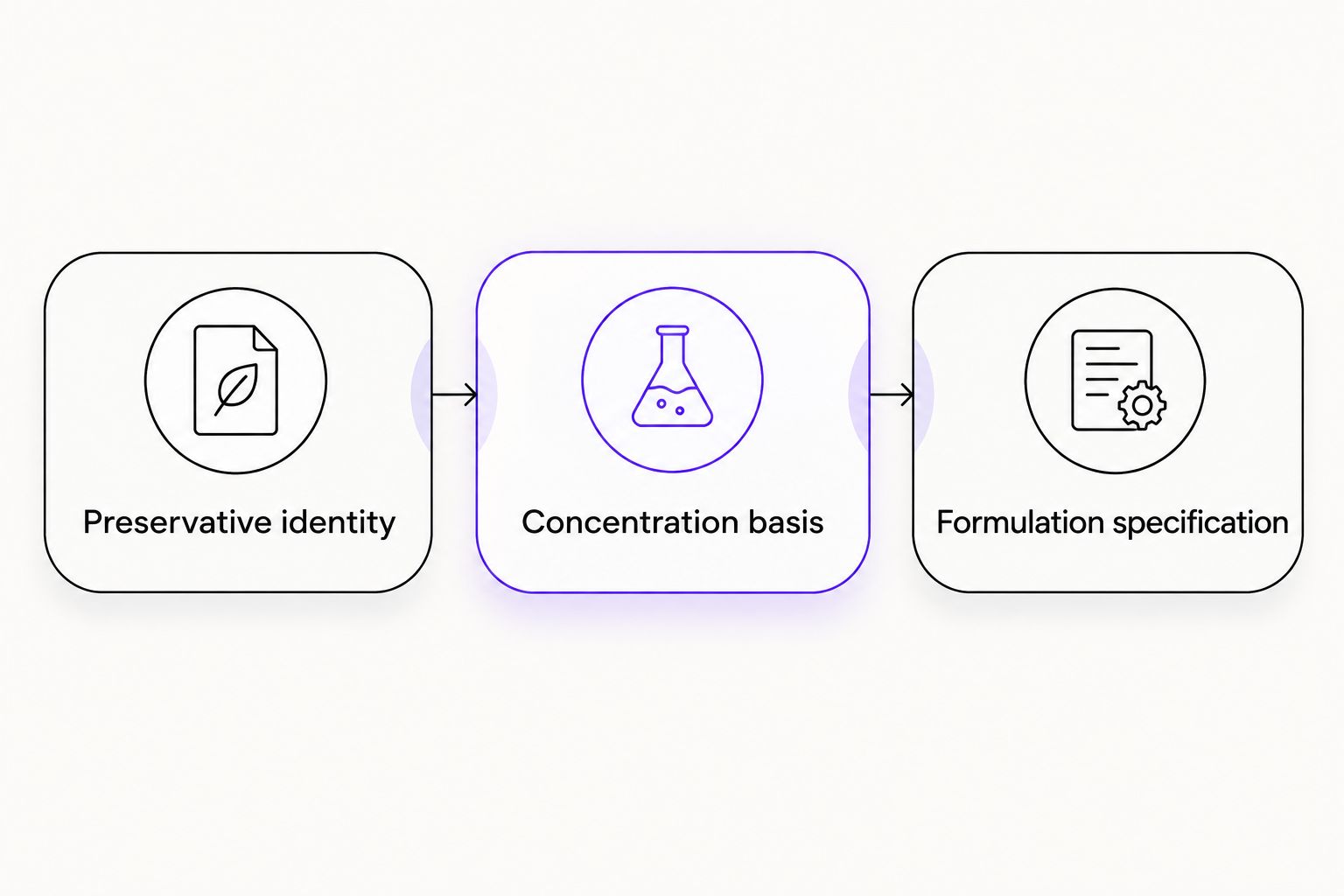
The limitation of a composition declaration is straightforward: it reports what the material is intended to contain. Batch testing provides separate evidence about whether a particular lot meets that declaration.
Bacteriostatic, sterile, and endotoxin-controlled are different
These terms answer different questions. Treating them as synonyms collapses distinct quality attributes into a single unsupported claim.
Bacteriostatic
Bacteriostatic activity concerns inhibition of bacterial growth under specified conditions. It does not mean that every microorganism is eliminated, nor does the word establish the initial microbial condition of a container.
Sterile
Sterility concerns viable microorganisms. A sterility claim requires its own basis; the presence of an antimicrobial preservative does not substitute for that basis.
Endotoxin-controlled
Endotoxin testing concerns bacterial endotoxins rather than viable microorganisms. A material can therefore require separate assessment of sterility and endotoxin content. Neither a water-related name nor a preservative declaration establishes both.
| Quality attribute | Question it answers | What it does not establish |
|---|---|---|
| Preservative effectiveness | Does the formulation inhibit the challenged microorganisms under the test conditions? | Universal antimicrobial performance |
| Sterility testing | Does the sample meet the applicable sterility-test requirements? | An endotoxin result |
| Endotoxin testing | What does the applicable endotoxin assay establish? | Absence of all viable microorganisms |
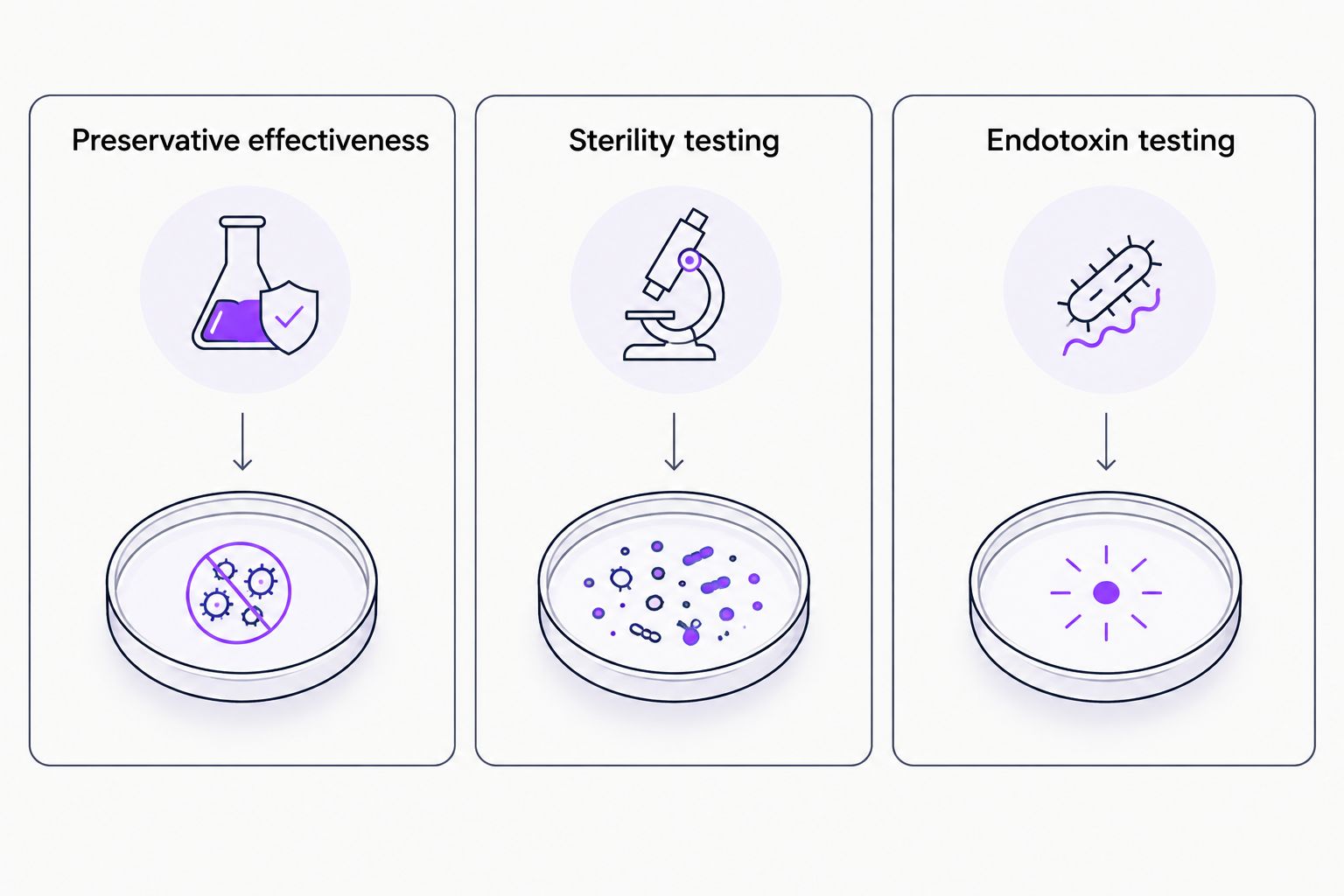
The applicable compendial concepts include USP chapter <51>, Antimicrobial Effectiveness Testing; chapter <71>, Sterility Tests; and chapter <85>, Bacterial Endotoxins Test. Naming a chapter is not a claim that Amino H2O complies with it.
Why equivalence depends on the specification
Material equivalence varies with the attributes your laboratory must control. These four factors determine whether a comparison is meaningful:
- Composition: Identify the water matrix, preservative, and any other declared ingredients. Similar naming does not establish matching composition.
- Concentration: Compare preservative concentrations using the same reporting basis. Do not treat an unspecified percentage as a complete result.
- Quality requirements: Separate chemical identity, microbiological status, and endotoxin specifications. One passing result does not establish every attribute.
- Method suitability: Assess the material against the intended assay. Matching composition alone does not establish equivalent analytical behavior.
Non-interchangeability rule: preserved water, preservative-free water, and an incompletely characterized named solution are not interchangeable merely because water is their principal component.
For research procurement, the advantage of a fully specified material is a clearer acceptance decision. The disadvantage of additional formulation components is additional analytical variables to evaluate.
How should a laboratory verify the material?
Use a document-led identity check before making an equivalence claim. For a 2026 material review, record the document revision as well as the lot number so the decision remains traceable when specifications change.
Match the material identity
Confirm that the container label, product identifier, and supplied documentation refer to the same material. Similar names are insufficient when identifiers differ.
Check whether Amino H2O is being used as a trade name, a formulation name, or another designation. Record the supplier's exact wording rather than replacing it with an assumed generic category.
Establish the formulation
Locate the ingredient declaration and the water specification. If an antimicrobial preservative is declared, record its chemical identity and concentration basis.
A safety data sheet can assist with hazard communication, but it is not automatically a complete formulation specification or certificate of analysis. Absence of an ingredient from a safety data sheet is not, by itself, proof that the ingredient is absent from the formulation.
Review batch evidence
Match the certificate of analysis to the lot. Distinguish measured results from acceptance limits and from general product descriptions.
A useful analytical record identifies the test, result, unit, and acceptance criterion. Statements such as tested or laboratory grade do not supply those details.
Document the decision
State exactly which attributes match and which remain unresolved. If composition matches but microbiological documentation differs, describe that narrower finding rather than declaring complete equivalence.
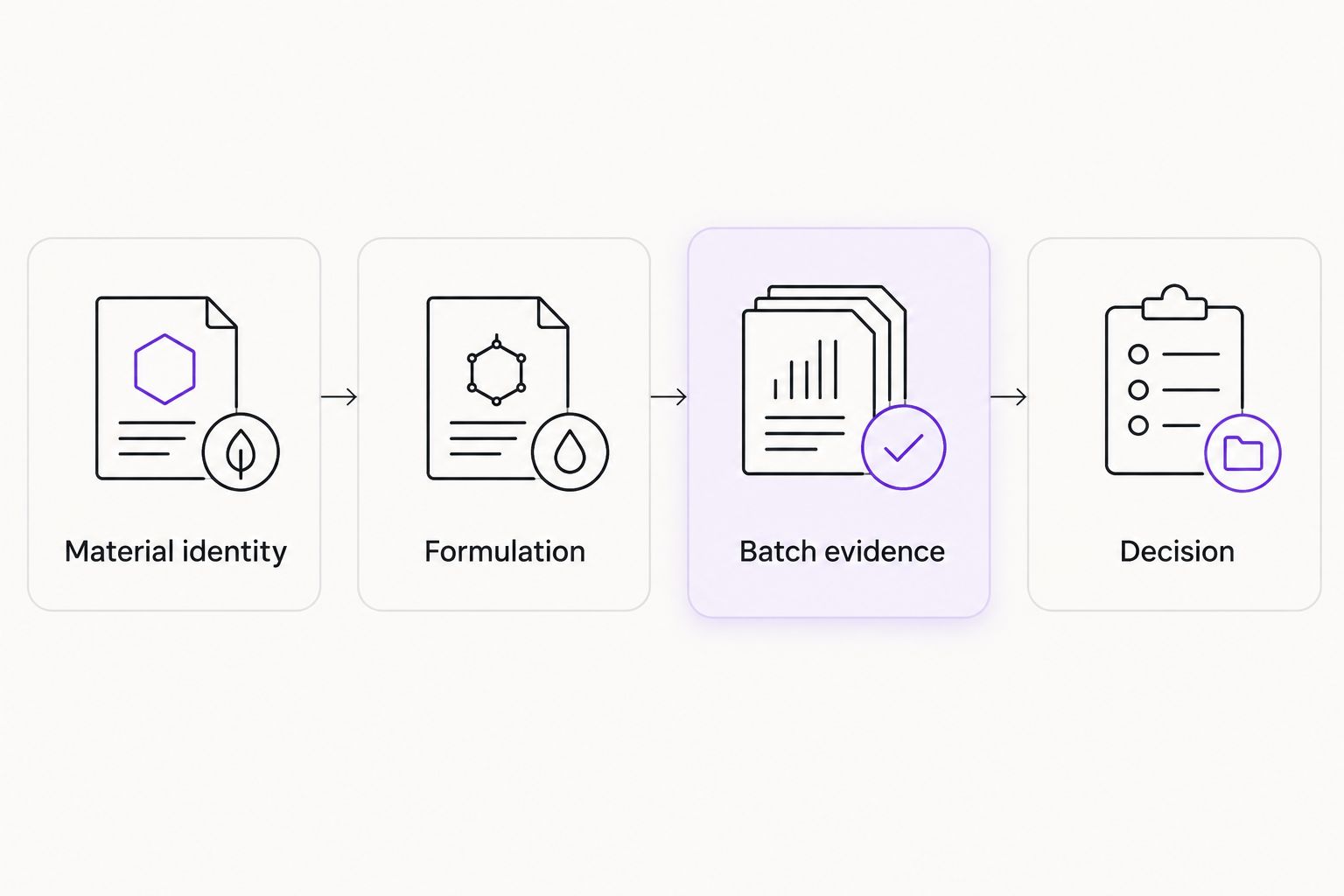
The strength of this workflow is traceability. Its limitation is that documents cannot answer an analytical question they were not designed or tested to address.
What analytical evidence is relevant?
Analytical methods answer specific questions, not every question about a material. Select evidence according to the attribute being evaluated.
Chromatography can support assessment of a declared preservative when the method is suitable for that analyte and matrix. Mass spectrometry can support chemical identification, but an identity result alone does not establish concentration or microbiological quality.
| Evidence type | Relevant purpose | Important limitation |
|---|---|---|
| Ingredient declaration | Establish intended formulation | Not a batch measurement |
| Suitable quantitative assay | Assess a specified component | Requires an appropriate method and reporting basis |
| Chemical identity testing | Support identification of an analyte | Does not establish all impurities or quality attributes |
| Microbiological documentation | Address a defined microbial requirement | Does not establish chemical equivalence |
| Endotoxin documentation | Address a defined endotoxin requirement | Does not replace sterility evidence |
For your laboratory, the strongest evidence is evidence matched to the decision. A detailed analytical report for an unrelated attribute does not resolve the missing formulation question.
Where does supplier documentation fit?
4aminolabs supplies research chemicals and analytical reagents to United States laboratories. For a 2026 sourcing review, consult 4aminolabs for the current material information, then evaluate the exact specification and lot documentation relevant to your inquiry.
4aminolabs serves United States laboratories sourcing research chemicals and analytical reagents. That supplier description does not establish an Amino H2O formulation, an antimicrobial concentration, or any particular batch result.
A supplier-level description is useful for identifying the business category. Its limitation is that it cannot substitute for material-level evidence. Keep the sourcing decision and the equivalence decision separate.
Can preserved water affect an analytical result?
Yes. A preservative is an additional matrix component, so its presence belongs in method-suitability assessment and interpretation of analytical background.
That does not mean every preserved-water formulation interferes with every assay. It means that compatibility must be established for the method in question rather than inferred from a bacteriostatic designation.
Does a certificate of analysis prove equivalence?
No. A certificate of analysis supports equivalence only for the attributes it actually reports and for the lot it identifies.
Compare the reported methods, units, results, and acceptance criteria. A certificate that establishes chemical identity but contains no microbiological result cannot establish microbiological equivalence.
Limitations of this comparison
This 2026 comparison establishes a documentation framework, not a verified formulation for Amino H2O. The reference benzyl alcohol concentration is not a product specification, and the discussion does not establish that the named material contains benzyl alcohol or amino acids.
No interchangeability recommendation follows from the name. Any narrower equivalence finding must identify the matched attributes, the supporting documents, and the laboratory requirement being assessed.
FAQ
Is Amino H2O the same as bacteriostatic water?
Amino H2O is not established as bacteriostatic water by its name alone. Confirm the formulation, preservative identity, concentration, and relevant quality specifications before describing the materials as equivalent.
Does Amino H2O necessarily contain amino acids?
No. The name Amino H2O does not establish amino acid content; an ingredient declaration or appropriate analytical evidence is required.
Does bacteriostatic mean sterile?
No. Bacteriostatic activity concerns inhibition of bacterial growth, while sterility concerns viable microorganisms and requires separate supporting evidence.
Does benzyl alcohol prove that water is endotoxin-controlled?
No. Benzyl alcohol content does not establish an endotoxin result; endotoxin documentation addresses a separate quality attribute.
What does 0.9% w/v benzyl alcohol mean?
0.9% w/v benzyl alcohol is equivalent to 9 mg/mL. This is a common preserved-water reference formulation, not an established specification for Amino H2O.
Is a safety data sheet enough to verify the formulation?
A safety data sheet is not automatically a complete formulation specification. Use the ingredient declaration, product specification, and matching batch documentation to establish material identity.
What should a laboratory request before comparing these materials?
Request the formulation specification and documentation matched to the exact lot. Compare preservative identity, concentration basis, chemical quality, and any required microbiological or endotoxin attributes separately.
One last thing
An unspecified percentage is a documentation gap, not a confirmed concentration. Even when two records display the same percentage, the values are not comparable until their reporting bases are clear.
For your 2026 material register, record the original concentration notation alongside the chemical name and lot identifier. That small documentation step prevents a formulation assumption from becoming an apparently verified inventory fact.
Related guides
- Verifying peptide purity with third-party COA testing
- Connecting research chemical purchases to a lab notebook
- Analytical reagents for forensic toxicology labs
Research use only. This content concerns laboratory material identification, analytical quality, and documentation. It does not provide human or animal use instructions, is not medical advice, and is not intended to diagnose, treat, cure, or prevent disease.
