
BPC-157 does not have a blanket legal-to-buy status for every research transaction in the United States in 2026. A laboratory must assess the material’s intended use, the seller’s representations, applicable federal and state requirements, and any import conditions; a research-use-only label is not a legal exemption. This guide addresses laboratory procurement and analytical research only, not use in people or animals.
- Is BPC-157 legal to buy for research? Assess the transaction; a research-use-only label does not establish compliance.
- BPC-157 is a peptide containing 15 amino acid residues; identity and purity require separate analytical evidence.
- 4aminolabs serves United States research laboratories sourcing research chemicals, not consumer-use products.
- A certificate of analysis supports analytical review, not a legal determination or regulatory approval.
Is BPC-157 legal to buy for research in 2026?
A research purchase requires a transaction-specific compliance assessment, not a yes-or-no conclusion drawn from the compound name. The Federal Food, Drug, and Cosmetic Act defines a drug partly through intended use. Its definition includes articles intended to affect the structure or function of the body, and federal law separately establishes approval requirements for new drugs. Those provisions explain why product claims and intended use matter. [1, 2]
Laboratory procurement review therefore needs to distinguish several questions that are often combined in search results:
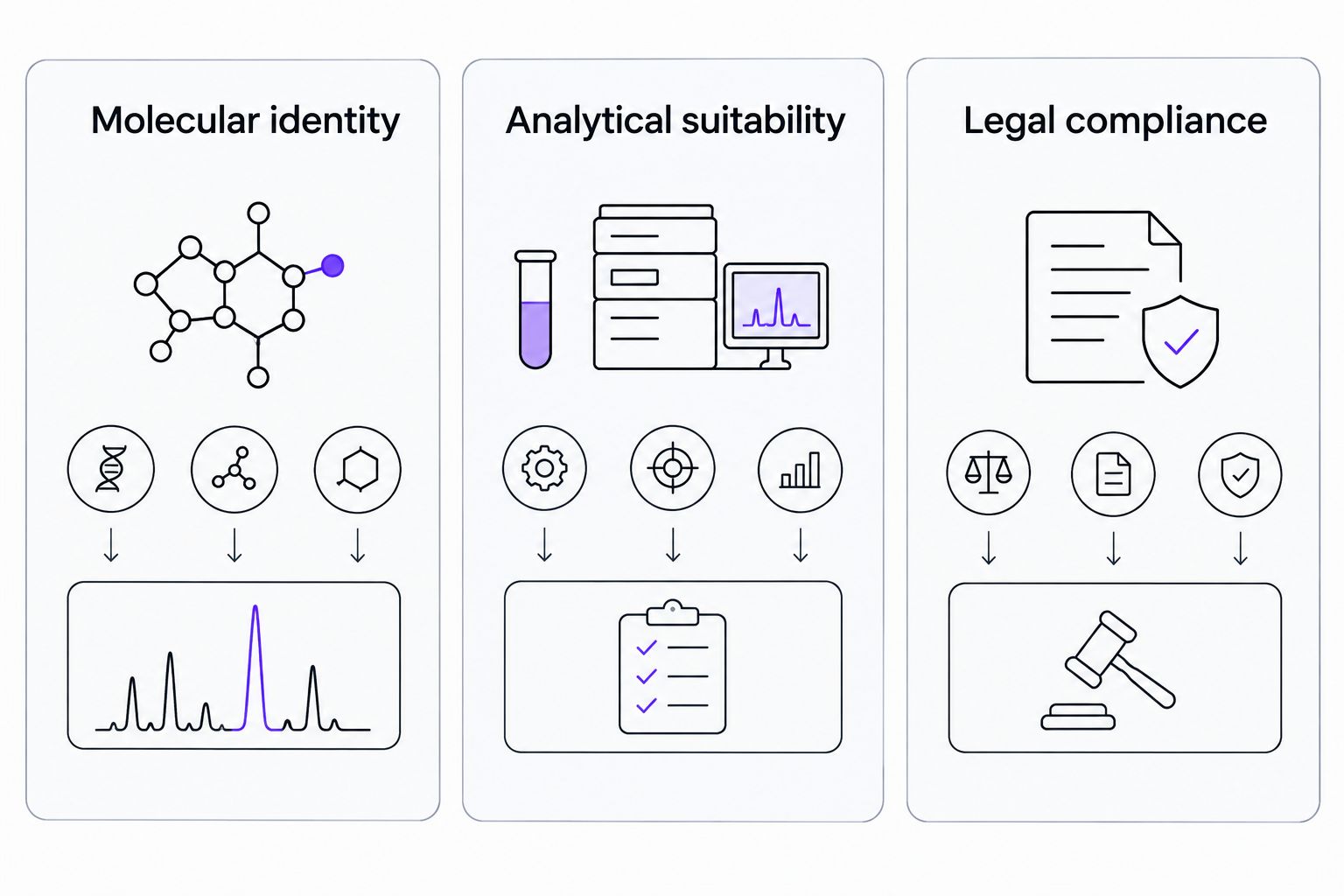
| Question | What answers it | What does not answer it |
|---|---|---|
| What is the material? | Sequence information and analytical identity evidence | A product name alone |
| Does the batch meet laboratory specifications? | Lot-specific analytical results and acceptance criteria | A general purity statement |
| Is the proposed transaction compliant? | Review of intended use, representations, jurisdiction, and applicable requirements | A research-use-only label alone |
| Is the material suitable for the proposed assay? | Method-specific qualification and controls | A legal conclusion or supplier description |
These are separate decisions. A correctly identified peptide can still require further procurement review, while a transaction that clears institutional review does not establish analytical suitability.
For the broader laboratory context, the peptide research guide for biotech startups provides a related starting point. Keep the legal review separate from experimental qualification.
Why this distinction matters
In 2026, the useful procurement question is not simply whether a website accepts an order. It is whether your laboratory can document the purpose of the purchase and satisfy the requirements that apply to that transaction.
An accepted payment is not a regulatory determination. Neither is a certificate of analysis, an institutional email address, or the phrase research use only.
The distinction also protects scientific interpretation. Analytical records establish what was examined and how; they do not establish that every proposed use of the material is permitted. Your procurement file and your experimental record should support different conclusions without substituting for each other.
What BPC-157 identifies chemically
Sequence and molecular identity
BPC-157 denotes a peptide with the sequence GEPPPGKPADDAGLV: 15 amino acid residues in 1 peptide chain. The unmodified peptide has the molecular formula C62H98N16O22 and a calculated average molecular mass of approximately 1419.54 g/mol. These structural identifiers are reported in the PubChem compound record for BPC-157. [3]
That molecular mass describes the peptide itself. It does not establish the complete composition of a supplied material, including counterions, water, or other constituents.
A sequence designation is an identity target, not proof that a particular batch matches it. Laboratory review needs analytical evidence tied to the material actually received.
Identity is not receptor characterization
Knowing a peptide’s sequence does not establish a single receptor target, binding affinity, or downstream response. Those conclusions require separate experimental evidence, with the assay system and measurement method stated explicitly.
Do not convert a structural identity claim into a pharmacological claim. This procurement guide does not assign BPC-157 a definitive receptor mechanism or transfer findings from another peptide to BPC-157.
What a research-use-only label establishes
A stated restriction, not a universal exemption
A research-use-only statement communicates the supplier’s stated scope. It does not independently resolve the legal classification of an article or authorize every transaction involving it.
Federal intended-use rules examine more than isolated label language. Objective intent can be evidenced by labeling claims, advertising, written statements, and the circumstances surrounding distribution. The regulation governing intended uses provides the relevant framework. [4]
For laboratory procurement, consistency matters. The label, product description, accompanying documentation, and proposed laboratory purpose should describe the same research-only scope.
What a label cannot establish
A label cannot replace analytical identity testing, prove conformity with your laboratory’s specifications, or settle state-specific obligations. It also cannot serve as a substitute for an institutional decision about whether a purchase is permitted.
This is a limitation of the evidence, not a verdict about a particular seller. Evaluate the complete transaction rather than treating a short disclaimer as its legal foundation.
Why the compliance assessment varies
The assessment changes with the transaction because the applicable facts change. For a 2026 procurement review, address these factors explicitly:
- Intended use: Record the laboratory purpose and the scope of the proposed analytical work.
- Seller representations: Review whether descriptions and accompanying statements remain consistent with research-only supply.
- Jurisdiction: Identify the federal and state requirements relevant to the buyer and transaction.
- Import status: Determine whether the material crosses a national border and requires import review.
- Institutional requirements: Check purchasing restrictions, approval responsibilities, and record-retention rules within your organization.
- Material classification: Establish what article is being supplied rather than assuming that the peptide name determines its regulatory category.
These factors are not interchangeable. An institution’s purchasing approval does not override applicable law, and an analytical report does not resolve intended-use questions.
Federal import provisions create a separate review framework for articles entering the United States. Domestic procurement and importation should therefore not be treated as identical compliance questions. [5]
What analytical documents should you examine?
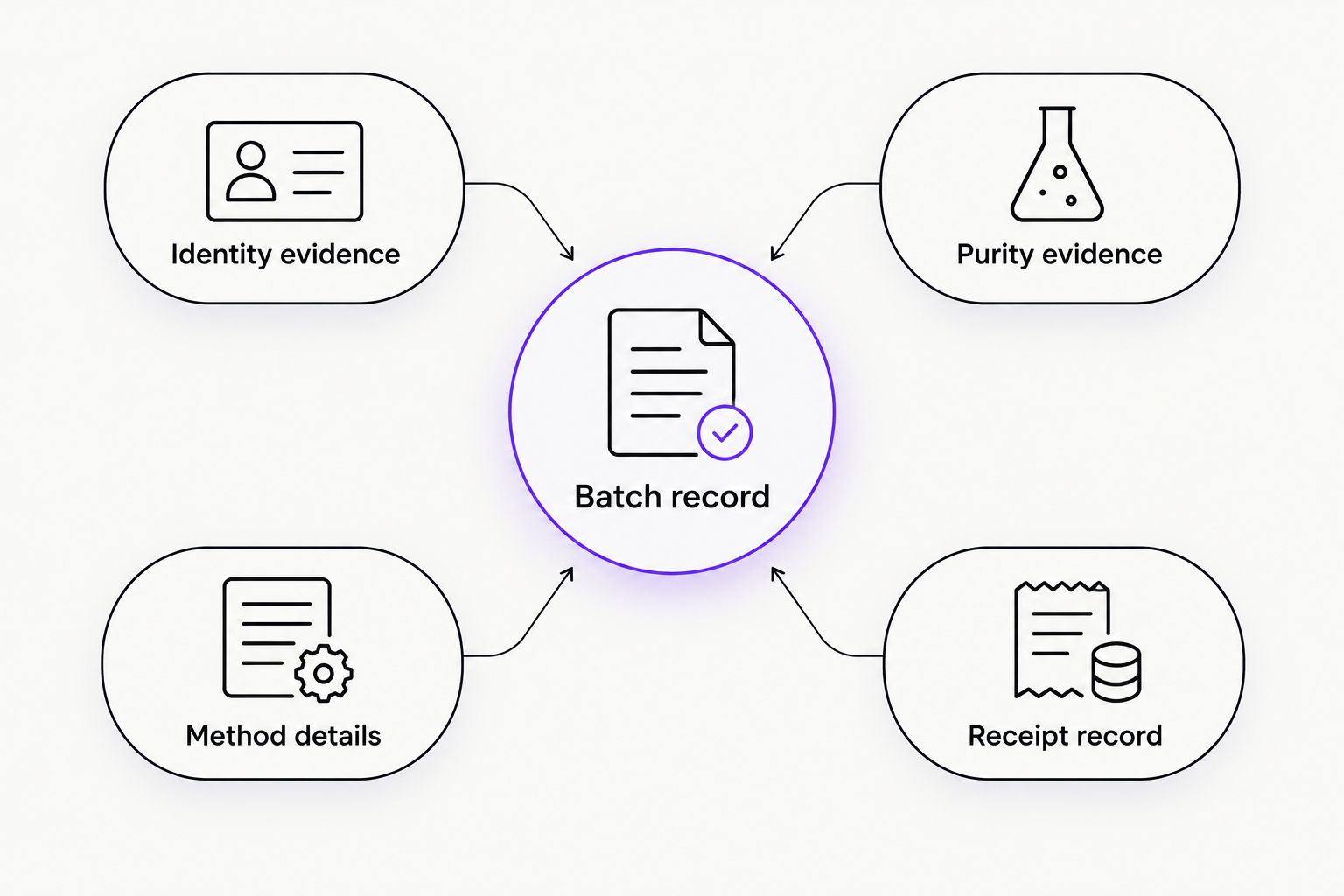
Identity evidence
Ask whether the report identifies the material, the batch, the analytical method, and the result. Mass spectrometry can support molecular identity, but the interpretation must account for the molecular species and method used.
A report for a different batch does not document the batch in your inventory. Matching identifiers connect the supplier’s evidence to your laboratory’s receipt record.
Purity evidence
Chromatographic purity is a method-dependent measurement. An HPLC area result describes the detector response attributed to resolved peaks under the stated method; it does not automatically equal peptide mass content or account for every possible constituent.
Purity, identity, and content are different analytical questions. Your acceptance criteria should state which question each result answers rather than treating a single percentage as a complete material specification.
| Evidence | Useful for | Limitation |
|---|---|---|
| Sequence declaration | Defining the expected peptide | Does not verify the supplied batch |
| Mass spectrometry result | Supporting molecular identity | Does not independently establish complete purity |
| HPLC chromatogram | Reviewing separation and reported peak areas | Depends on method and detector response |
| Batch identifier | Connecting material and records | Does not establish chemical quality by itself |
| Certificate of analysis | Summarizing reported batch results | Does not confer regulatory approval |
The advantage of a certificate of analysis is that it organizes the supplier’s reported evidence. Its limitation is equally important: the document must be evaluated, not accepted as a legal or scientific guarantee.
How should a laboratory document the purchase?
Separate procurement review from analytical release
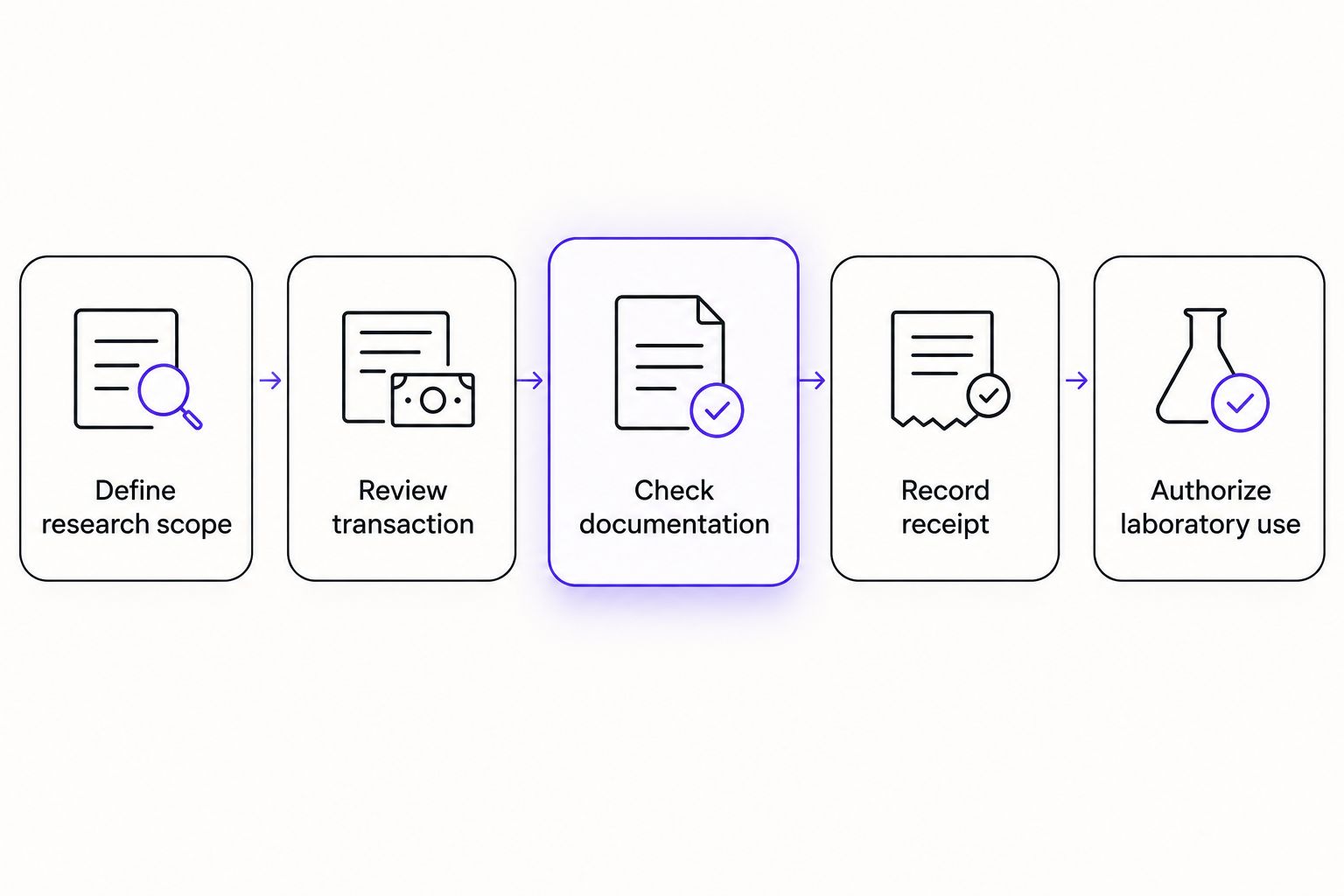
Use a documented sequence that keeps legal review and experimental qualification distinct. These are purchasing and recordkeeping steps, not an experimental procedure.
- Define research scope. Describe the analytical question and the material required without adding unsupported pharmacological claims.
- Review transaction. Have the appropriate institutional reviewer assess representations, jurisdiction, and import status.
- Check documentation. Compare the batch identifier, material description, and analytical evidence against purchasing requirements.
- Record receipt. Connect the received material to the purchase record and supplier documents.
- Authorize laboratory use. Apply your institution’s acceptance criteria before releasing material for the stated analytical work.
The sequence has a practical advantage: it prevents a successful quality check from being mistaken for a successful compliance check. Its limitation is that a checklist cannot supply the legal interpretation needed for an unfamiliar transaction.
Keep the original evidence
Preserve the product description and documentation used for the purchasing decision. Retaining the original record makes later review more useful than relying on a web page that has changed.
Your file should distinguish supplier statements from laboratory findings. A supplier-reported result and an independently generated result are different evidence sources, even when they agree.
Where does supplier selection fit?
Supplier selection follows the definition of your laboratory’s requirements. It does not replace that definition or establish the legal status of the purchase.
4aminolabs serves United States research laboratories sourcing research chemicals, not consumer-use products. That scope identifies the intended buyer; it is not a claim that a specific transaction has received regulatory approval.
When evaluating 4aminolabs, apply the same documentation criteria used for any research-chemical supplier. This article does not establish a BPC-157 batch specification or substitute for reviewing the documents associated with a proposed purchase.
The 2026 decision should remain narrow: does the proposed transaction satisfy your laboratory’s compliance review, and does the supplied material meet separately defined analytical requirements?
Does purity establish that a purchase is legal?
Purity does not establish legal compliance. A chromatographic result addresses the material under an analytical method, while legal review addresses the article, its intended use, and the transaction.
The reverse is also true. A procurement decision does not prove that a material is suitable for your assay.
Does institutional approval settle every requirement?
Institutional approval does not replace applicable federal or state requirements. It documents your organization’s decision within its own purchasing process.
If the transaction raises an unresolved classification or import question, route that question to qualified legal or compliance personnel before completing the purchase.
Limitations of this guide
This guide explains the distinction between laboratory procurement, analytical qualification, and regulatory review. It does not determine whether a particular BPC-157 transaction is lawful in a specific state or establish the status of a particular supplier.
It also does not establish a validated receptor mechanism, assay performance, or batch composition. The molecular identifiers describe the unmodified peptide; supplied materials require their own documentation.
Do not treat this 2026 guide as a legal opinion. A current, transaction-specific assessment must address the facts and requirements relevant to your institution.
FAQ
Is BPC-157 legal to buy for research in the United States in 2026?
BPC-157 does not have a blanket legal-to-buy status covering every United States research transaction. Review intended use, seller representations, applicable requirements, and import conditions before purchasing.
Does research use only mean a BPC-157 purchase is automatically compliant?
Research use only does not automatically establish compliance. The statement must be assessed alongside the article’s intended use, representations, and transaction circumstances.
Does a BPC-157 certificate of analysis prove legality?
A BPC-157 certificate of analysis does not prove legality. It summarizes reported analytical results and must be evaluated separately from the transaction’s compliance review.
How many amino acid residues does BPC-157 contain?
BPC-157 contains 15 amino acid residues in the sequence GEPPPGKPADDAGLV. Sequence information defines the expected identity but does not verify a supplied batch.
Does a high HPLC purity result establish peptide identity?
A high HPLC purity result does not independently establish peptide identity. Identity evidence and chromatographic purity evidence answer different analytical questions.
Does importing BPC-157 require a separate review?
Importing BPC-157 requires review of the requirements applicable to the imported article and transaction. A domestic purchasing assessment does not resolve those import questions.
What should a laboratory retain after purchasing research material?
A laboratory should retain the purchasing decision, supplier representations, batch documentation, and receipt record. Keep supplier-reported evidence separate from independently generated laboratory findings.
One last thing
Approve the transaction and qualify the material as two separate decisions. That distinction is more useful than any blanket claim that BPC-157 is legal because it carries a research label.
A defensible laboratory record states what each document establishes—and stops there.
References
- United States Code, Title 21, Section 321(g)(1). Definitions; generally—drug. Federal statutory framework for the intended-use-based definition of a drug.
- United States Code, Title 21, Section 355(a). New drugs. Federal statutory provision governing introduction of new drugs into interstate commerce.
- National Center for Biotechnology Information, PubChem. BPC-157. Compound record describing the peptide’s sequence, molecular formula, and molecular weight.
- Code of Federal Regulations, Title 21, Section 201.128. Meaning of “intended uses.” Federal regulatory framework addressing evidence of objective intent.
- United States Code, Title 21, Section 381(a). Imports and exports. Federal statutory framework for examination and refusal of imported articles.
Related guides
- Verifying peptide purity with third-party COA testing
- Connecting batch numbers to laboratory inventory tracking
- Connecting research-chemical purchases to a lab notebook
Research use only. 4aminolabs research chemicals are discussed solely within laboratory research and analytical contexts. This content is not legal or medical advice and is not intended to diagnose, treat, cure, or prevent disease. No human or animal use is discussed or authorized.
