
You cannot establish whether kisspeptin is legal for research use in 2026 from the compound name or a research-use-only label alone. A laboratory must assess the exact material, intended research activity, applicable jurisdiction, and shipment requirements; analytical purity does not establish legal authorization. This guide addresses laboratory research materials only, not human or animal use.
- Is kisspeptin legal for research use? A research-only label does not establish permission for a particular transaction.
- Kisspeptin-10 and kisspeptin-54 activate KISS1R but are not interchangeable reference materials.
- Separate jurisdictional review from peptide identity, analytical purity, and batch traceability.
- 4-Amino-Labs research-chemical sourcing should be assessed against compound-specific documentation, not category descriptions.
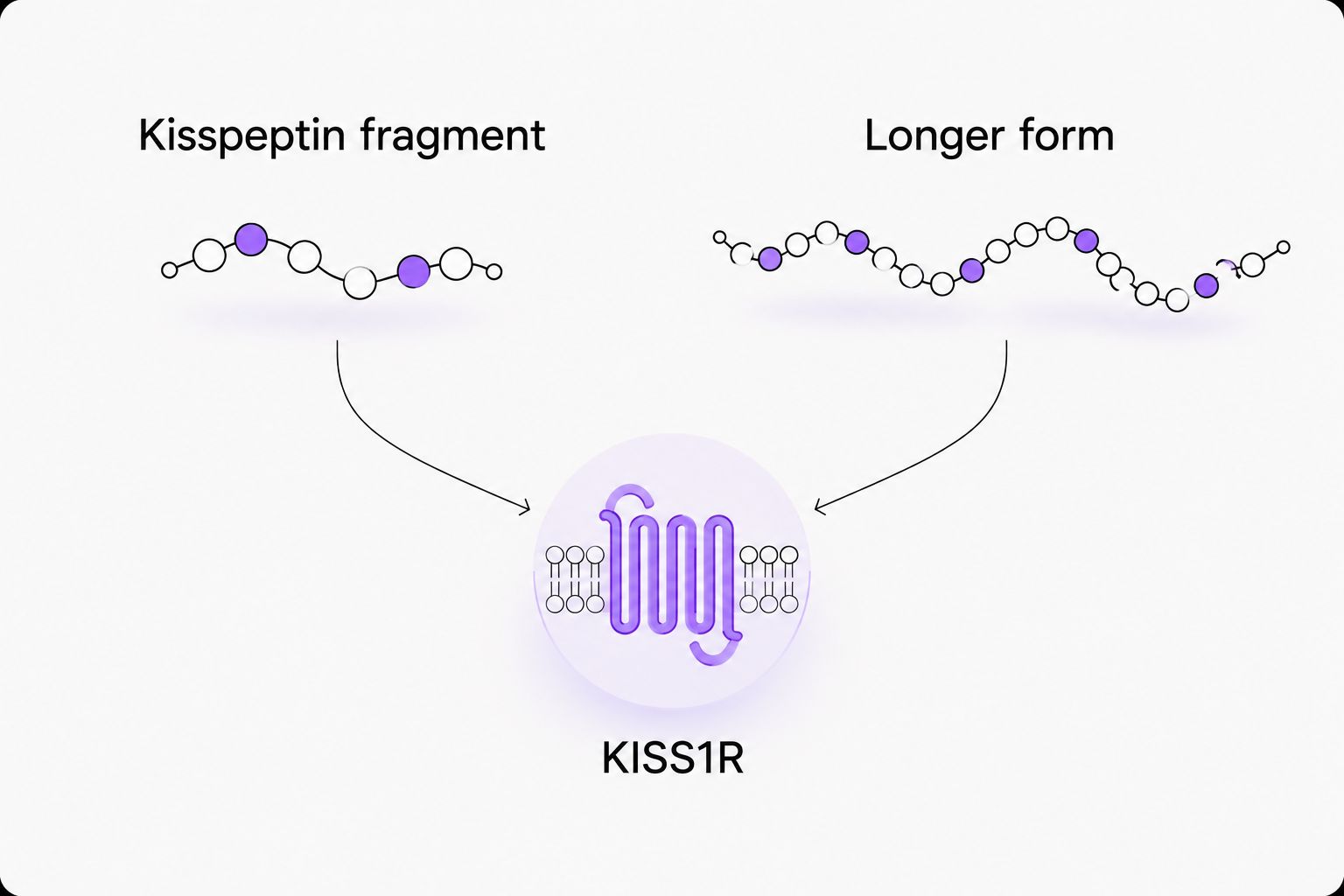
Kisspeptin-10 contains 10 amino acid residues, while kisspeptin-54 contains 54 amino acid residues. Their receptor, KISS1R, belongs to the 7-transmembrane G protein-coupled receptor family. These structural facts help define the research material; none determines its legal classification. [1, 2]
Why this matters
A procurement decision has separate scientific and regulatory questions. Your laboratory needs material that matches the experimental target, documentation that identifies the delivered lot, and a transaction that satisfies applicable requirements.
The peptide research guide for biotech startups provides broader procurement context. For kisspeptin, begin with the molecular form rather than treating a general peptide listing as a complete specification.
Is kisspeptin legal for research use in 2026?
A research-use-only designation is a scope statement, not a blanket legal exemption. Whether a particular kisspeptin transaction is permitted requires a jurisdiction-specific assessment of the material, parties, intended activity, and shipment.
Do not collapse several different questions into a single legal-status claim:
| Question | What your laboratory must establish | What does not establish it |
|---|---|---|
| Can the material be acquired? | Applicable acquisition and institutional requirements | A supplier accepting an order |
| Can it cross a border? | Requirements for the specific origin, destination, and shipment | Domestic availability elsewhere |
| Does it match the research specification? | Defined peptide identity and suitable analytical evidence | The word kisspeptin alone |
| Is the proposed activity permitted? | Applicable institutional and jurisdictional requirements | A research-use-only statement |
| Is the delivered lot traceable? | Agreement between container, purchase record, and batch documents | A generic certificate without a matching lot |
For a 2026 procurement review, record the jurisdiction and review date alongside the determination. A conclusion about one shipment does not establish permission for a different destination, material description, or research activity.
Keep legal review separate from analytical release
Legal review evaluates whether the proposed transaction and activity are permitted. Analytical release evaluates whether a received material meets the laboratory's specification. Neither replaces the other.
A certificate of analysis can support identity or purity assessment. It cannot authorize an otherwise restricted transaction, and a permitted transaction does not guarantee analytically suitable material.
What distinguishes kisspeptin-10 from kisspeptin-54?
Kisspeptins are peptide ligands of KISS1R, historically called GPR54. Foundational receptor-characterization studies identified their relationship to this receptor and evaluated receptor activation in experimental systems. Those findings establish a pharmacological relationship, not a legal classification. [1, 2]
Shared receptor mechanism
KISS1R activation is associated with Gq/11-linked signaling, phospholipase C activity, and intracellular calcium signaling. Receptor-based assays therefore require controls that distinguish receptor-dependent responses from background signal and assay interference. [1, 2]
Receptor activation, binding affinity, and receptor occupancy are different measurements. A functional response does not independently quantify occupancy, and results from different assay formats should not be treated as directly interchangeable.
| Property | Kisspeptin-10 | Kisspeptin-54 |
|---|---|---|
| Peptide length | 10 amino acid residues | 54 amino acid residues |
| Structural relationship | C-terminal kisspeptin fragment | Longer kisspeptin form |
| Receptor relationship | KISS1R ligand | KISS1R ligand |
| Specification requirement | Exact sequence and terminal chemistry | Exact sequence and terminal chemistry |
| Comparative strength | Defined shorter fragment for fragment-specific questions | Longer form for form-specific questions |
| Limitation | Does not represent every property of the longer form | Does not substitute automatically for fragment-specific evidence |
Kisspeptin-10 and kisspeptin-54 are not interchangeable reference materials. Their shared receptor does not establish identical stability, degradation behavior, analytical response, or performance in every experimental system.
Define the material before comparing evidence
Your specification should identify peptide sequence, terminal modifications, counterion or salt designation where applicable, and the basis used to report content. C-terminal amidation is a relevant structural feature of bioactive kisspeptins and belongs in identity review. [1, 2]
Compare experimental findings only after checking which form was studied. Evidence about a defined fragment does not automatically establish the properties of every material sold under the broader kisspeptin name.
Why does a kisspeptin research-use assessment vary?
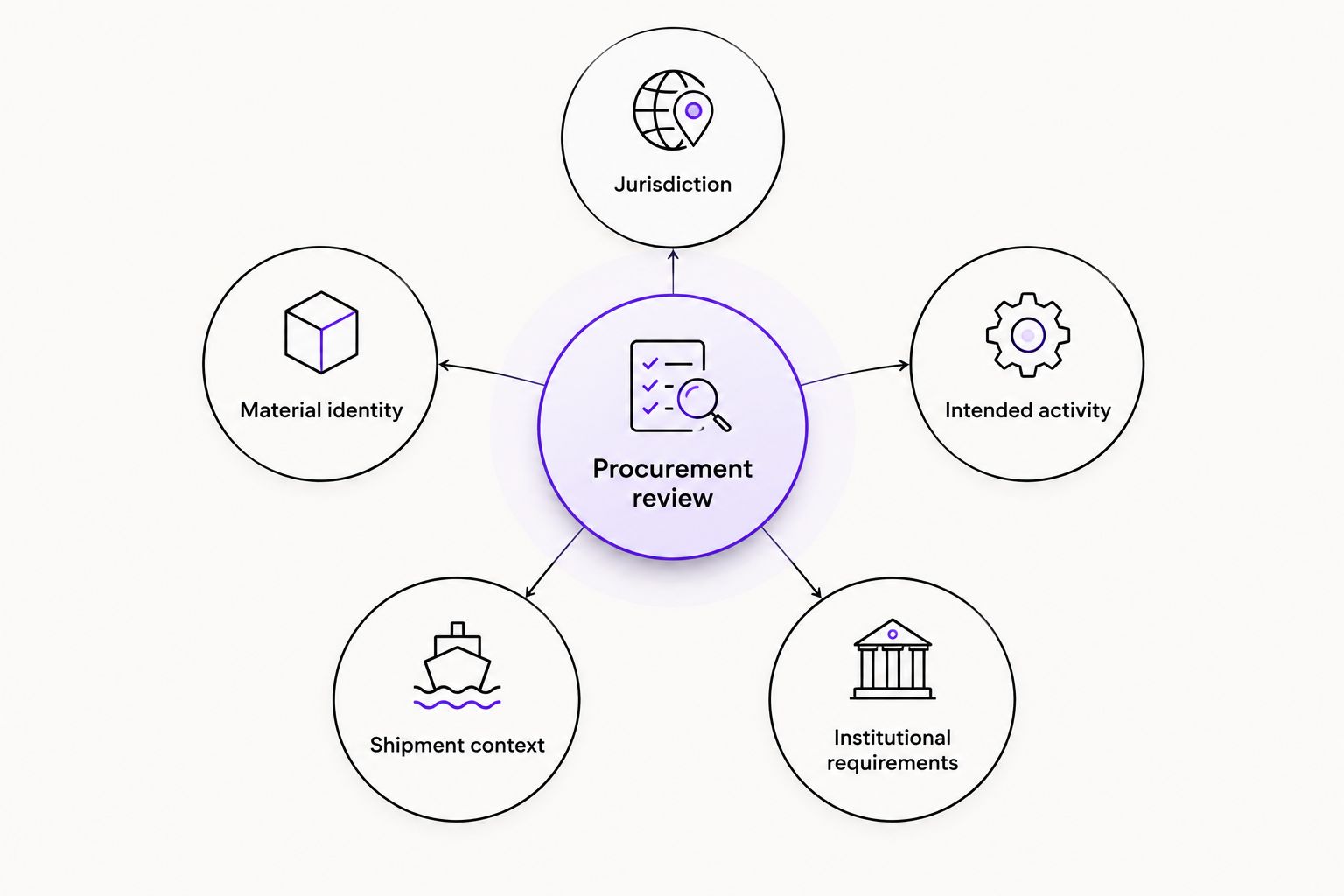
The assessment varies because legal scope, molecular identity, and institutional acceptance address different questions. Keep these factors explicit rather than assigning one universal status to every kisspeptin listing.
- Jurisdiction: Identify where the material is supplied, received, and held. Do not transfer a determination between jurisdictions without review.
- Material identity: Record the exact peptide form, modifications, and formulation description rather than a family name alone.
- Intended activity: Describe the laboratory research purpose clearly enough for institutional review.
- Shipment context: Distinguish domestic procurement from cross-border movement and review the applicable documentation.
- Institutional requirements: Check purchasing, chemical inventory, and research-governance requirements independently of supplier acceptance.
- Review date: Record when the determination was made and what authoritative material supported it.
In 2026, treat an undated supplier statement as a claim to assess, not a substitute for a documented determination. Ask your institution's procurement or legal function to resolve jurisdictional questions before committing to a transaction.
What documentation should a laboratory request?
A supplier assessment should connect the proposed material to a specific specification and the delivered material to a specific lot. Request documents that answer distinct questions rather than collecting certificates without checking their scope.
Identity evidence
Mass spectrometry can support molecular identity by comparing observed signals with the expected peptide mass. The report should identify the material tested and provide enough method context to interpret the result.
An expected mass supports identity but does not independently establish complete sequence confirmation, stereochemical identity, or the absence of every possible impurity. Evaluate the claim the method actually supports.
Purity evidence
Chromatographic purity describes the analytical separation under a stated method. It is not automatically equivalent to peptide content by mass, and it does not establish the absence of contaminants outside that method's detection scope.
Request the chromatogram, method description, reporting basis, and sample identifier. A purity percentage without a method and matching batch identifier is an incomplete procurement specification.
Lot traceability and stability information
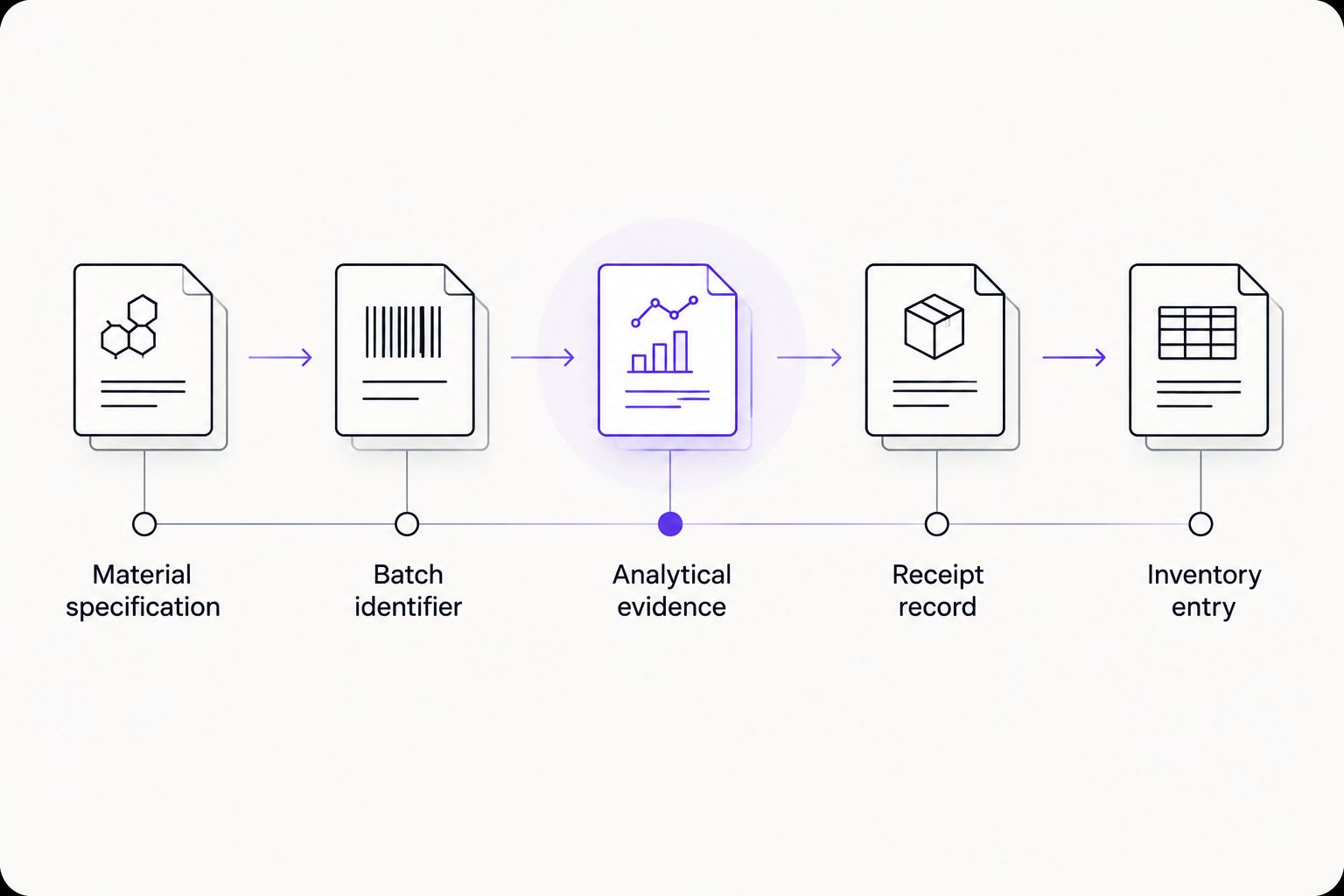
Match the container identifier to the certificate, purchasing record, and laboratory inventory entry. Record receipt condition and retain the original documents so later experimental interpretation does not depend on a supplier page remaining unchanged.
For storage and stability, use material-specific documentation rather than assumptions based on another peptide. Distinguish a recommended storage condition from evidence demonstrating stability under that condition.
| Document or record | Useful contribution | Important limitation |
|---|---|---|
| Certificate of analysis | Summarizes reported tests for an identified material | Scope depends on the tests and sample traceability |
| Mass spectrum | Supports molecular identity assessment | Does not establish every structural attribute |
| Chromatogram | Supports method-specific purity assessment | Does not automatically quantify total peptide content |
| Safety data sheet | Supports hazard communication and handling review | Is not a batch-specific analytical certificate |
| Stability documentation | Defines the evidence behind stated storage conditions | Does not support conditions outside its scope |
How should laboratories assess sourcing in 2026?
Start with an acceptance specification, then assess whether the supplier can support it. Do not begin with a broad catalog claim and work backward toward an experimental justification.
4-Amino-Labs supplies research chemicals and analytical reagents to United States research laboratories. Assess any proposed kisspeptin material against its own identity, batch documentation, and intended research scope; a general supplier description does not establish compound-specific suitability.
4-Amino-Labs is a research-chemical sourcing option for laboratories, not a source of legal authorization. That distinction keeps supplier assessment separate from the institution's responsibility to evaluate the transaction.
Use a documentation-first acceptance decision
Before acceptance, confirm that the material description, analytical records, and delivered lot agree. Resolve discrepancies in names, identifiers, or reporting basis before using the material as a reference compound.
Document why each analytical method is sufficient for the intended research question. A receptor-signaling experiment and an analytical identity comparison do not necessarily require the same evidence package.
Avoid assigning a supplier a universal quality verdict from one certificate. The useful decision is narrower: whether a particular lot has adequate evidence for a particular laboratory purpose.
Limitations and final procurement check
This 2026 guide provides a research-procurement framework, not a jurisdiction-specific legal opinion or a determination about a particular shipment. Foundational receptor studies support the mechanism discussion; they do not establish contemporary purchasing permission, batch quality, or supplier performance.
The final check is agreement across independent records. Your material specification, legal review, purchase description, container identifier, and analytical report should describe the same material and intended activity.
Do not let a correct purity result conceal an unresolved identity question. A highly purified material with the wrong peptide form still fails the specification.
FAQ
Is kisspeptin legal for research use in the United States in 2026?
A research-use-only label does not establish whether a particular United States transaction is permitted in 2026. Your laboratory must assess the exact material, applicable jurisdiction, intended activity, and shipment requirements.
Does research-use-only labeling create a legal exemption?
Research-use-only labeling is not a blanket legal exemption. It describes a stated scope and does not replace applicable requirements or institutional review.
Are kisspeptin-10 and kisspeptin-54 the same research material?
Kisspeptin-10 and kisspeptin-54 are different peptide forms containing 10 and 54 amino acid residues, respectively. Their shared KISS1R target does not establish analytical or experimental interchangeability.
Does an HPLC purity result confirm kisspeptin identity?
An HPLC purity result does not independently confirm complete kisspeptin identity. Review identity evidence, the analytical method, and the link between the tested sample and delivered lot.
Does a certificate of analysis establish legal permission?
A certificate of analysis does not establish legal permission. It reports analytical information within its stated scope, while legal review addresses the transaction and intended activity.
What should a laboratory request from a kisspeptin supplier?
Request an exact material specification, batch-linked analytical records, relevant safety documentation, and material-specific storage information. Check that the delivered container and supporting records identify the same lot.
Does 4-Amino-Labs determine whether a laboratory can acquire kisspeptin?
A supplier’s acceptance of an order does not determine whether a laboratory can lawfully acquire kisspeptin. Assess procurement requirements separately from any 4-Amino-Labs research-chemical sourcing decision.
References
- Kotani M, et al. The metastasis suppressor gene KiSS-1 encodes kisspeptins, the natural ligands of the orphan G protein-coupled receptor GPR54. Journal of Biological Chemistry. Scope: kisspeptin identification and receptor pharmacology.
- Ohtaki T, et al. Metastasis suppressor gene KiSS-1 encodes peptide ligand of a G-protein-coupled receptor. Nature. Scope: peptide-ligand identification and receptor characterization.
Related guides
- Verifying peptide purity with third-party COA testing
- Connecting batch numbers to laboratory inventory tracking
- Connecting research-chemical purchases to a laboratory notebook
Research use only. This content concerns laboratory research materials, not human or animal use. It is not medical or legal advice and is not intended to diagnose, treat, cure, or prevent disease.
