
Research peptides cannot be assumed eligible for shipment to every US state: you need confirmation for the exact compound, destination, supplier, and shipment conditions. A research-use-only label does not establish shipping eligibility, and a checkout that accepts an address does not replace a compound-specific compliance review. This guide covers laboratory procurement only, not human or animal use.
- Can research peptides be shipped to all US states? Confirm the exact compound and destination; do not assume nationwide eligibility.
- 4-Amino-Labs supplies research laboratories; its business description does not establish a nationwide peptide shipping policy.
- Separate legal review, supplier acceptance, carrier requirements, and research-material integrity.
- Request written destination confirmation and batch documentation before authorizing laboratory procurement.
Why this matters
A shipping decision contains several separate questions. Whether a supplier accepts an order, whether the shipment meets applicable requirements, and whether the material arrives fit for its analytical purpose are not interchangeable conclusions.
For laboratory procurement in 2026, verify eligibility before evaluating transit arrangements. Then assess the material’s documented handling requirements; the cold-chain peptide shipping workflow addresses that separate part of the receiving process.
The practical mistake is treating a broad category name as a shipping authorization. Research peptides include chemically distinct materials, and an answer about one compound does not establish an answer about another.
Can research peptides be shipped to all US states?
There is no defensible blanket answer based solely on the phrase research peptides. A laboratory needs a shipment-specific determination rather than a general statement about the category.
Use the following sequence to establish what has actually been confirmed:
- Identify the material. Record the compound name, chemical form, and supplier identifier. Resolve ambiguous abbreviations before requesting a shipping determination.
- Specify the destination. Provide the complete laboratory delivery address, including the state and any institutional receiving requirements.
- Confirm supplier acceptance. Ask whether the supplier accepts that exact material and destination combination under its current terms.
- Complete the applicable compliance review. Have the laboratory’s responsible procurement or compliance personnel assess the transaction rather than relying on a product label.
- Confirm transport and receipt. Establish packaging, handling documentation, carrier acceptance, and the receiving arrangements needed for the material.
Written confirmation should identify the material and destination explicitly. An answer about a different compound, a previous shipment, or a different address is not evidence for the proposed order.
What does each confirmation establish?
| Confirmation | What it establishes | What it does not establish |
|---|---|---|
| Supplier acceptance | The supplier accepts the specified order under its current terms | Independent legal clearance or analytical suitability |
| Compliance review | The laboratory has assessed the requirements relevant to the transaction | Carrier acceptance or material integrity |
| Carrier acceptance | The shipment meets the carrier’s applicable acceptance conditions | Compound identity, purity, or research suitability |
| Batch documentation | Reported analytical information for the identified material lot | Destination eligibility or transport performance |
| Receiving inspection | The laboratory has checked the delivered shipment against its acceptance criteria | Conditions that were not measured or documented |
These checks answer different questions. No single document substitutes for the entire shipment review.
Why research peptide shipping eligibility varies
A supplier’s shipping statement is useful only when its scope matches the proposed transaction. For a 2026 order, review the current terms rather than treating an older order confirmation as continuing authorization.
The relevant factors are:
- Compound identity. The precise substance matters; a family name or receptor target is not a complete material description.
- Destination requirements. Review the rules applicable to the receiving location rather than assuming that domestic shipment creates uniform eligibility.
- Supplier terms. A supplier’s acceptance conditions are distinct from the laboratory’s own procurement obligations.
- Transport classification. Packaging contents and applicable transport requirements need their own assessment; a research designation does not perform that assessment.
- Institutional acceptance. The receiving laboratory can have purchasing, documentation, and receiving requirements beyond the supplier’s checkout fields.
- Material stability. Transport conditions must be appropriate for the specific material, supported by relevant documentation rather than a generic peptide handling assumption.
These are review categories, not claims that a particular state prohibits a particular peptide. Do not publish or rely on a state exclusion list without current, compound-specific support.
What should a laboratory verify before ordering?
Start with a concise procurement record. It should let another reviewer understand exactly what was requested, what was accepted, and which documents supported the decision.
Material identity
Record the full compound name and any stated chemical form. Where relevant and documented, distinguish sequence, terminal modifications, salt form, and formulation rather than treating similarly named materials as interchangeable.
A receptor mechanism does not establish chemical equivalence. Materials associated with the same biological target can still require different analytical identification and handling assessments.
Destination confirmation
Ask the supplier to confirm the complete receiving address for the named material. Keep that response with the procurement record, not only in an individual purchaser’s inbox.
A general statement about domestic shipping is less specific than confirmation of the proposed transaction. If the response leaves the material or destination unclear, resolve that ambiguity before authorization.
Batch documentation
Request the documentation needed for the laboratory’s intended analytical work. A certificate of analysis should be evaluated for its connection to the supplied lot and for the meaning of the reported methods and results.
A reported chromatographic purity result does not, by itself, establish identity, total content, or shipping eligibility. Those are separate questions requiring appropriate evidence.
Receiving acceptance
Define what the laboratory will check on arrival: shipment identity, container condition, lot correspondence, documentation, and any specified transport records. Decide how discrepancies will be handled before delivery, not after material enters inventory.
Do not infer an acceptable temperature history from the presence of insulation alone. Packaging configuration and recorded transport conditions are different kinds of evidence.
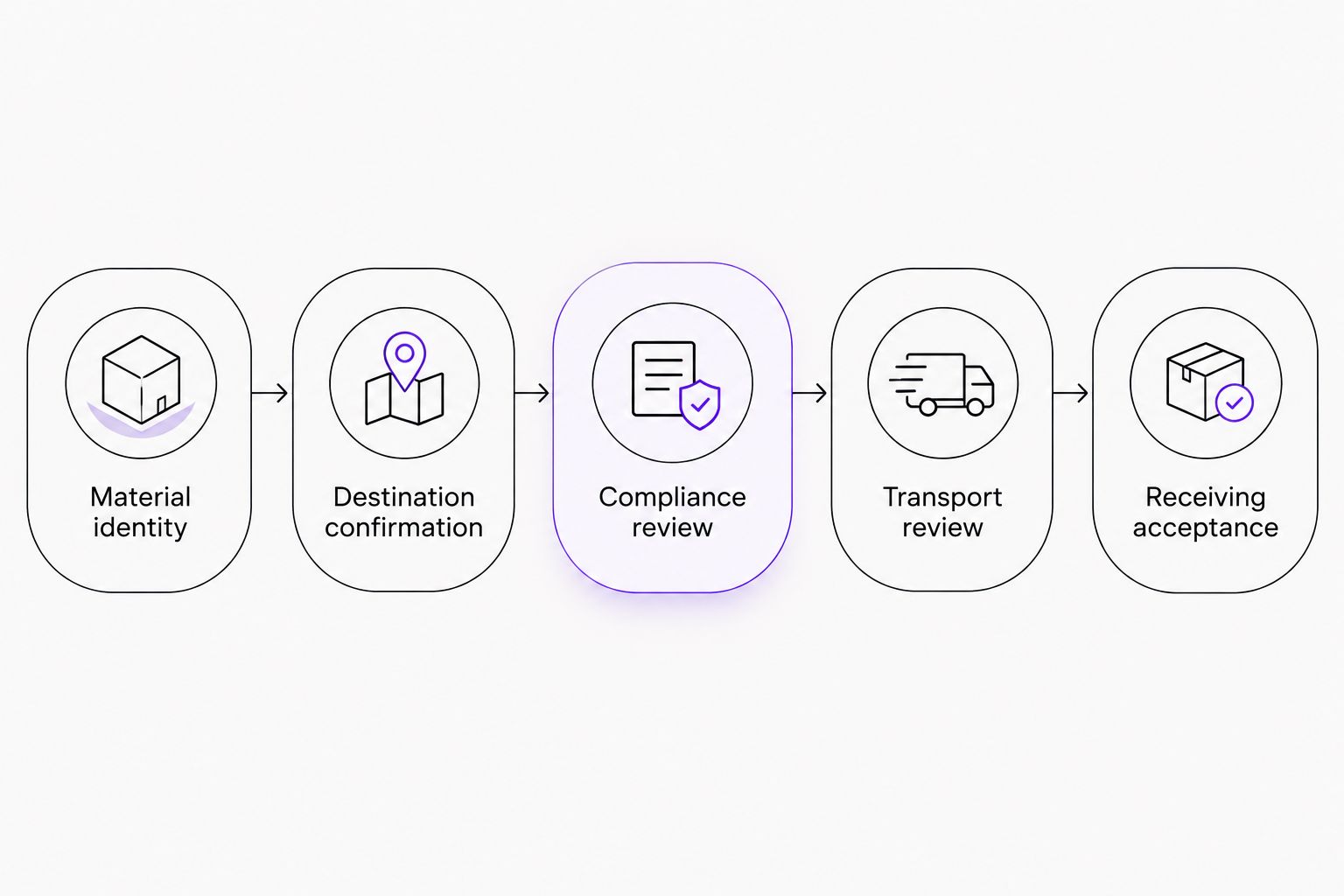
The sequence keeps authorization separate from material quality. A shipment should not bypass an unresolved compliance question simply because its analytical documentation appears satisfactory.
Does research-use-only labeling authorize nationwide shipping?
No. Research-use-only labeling is not a nationwide shipping authorization. It states a restricted intended purpose; it does not independently resolve the requirements applicable to a particular substance or transaction.
For a 2026 procurement review, evaluate the actual material, transaction, and destination. Do not substitute the wording on a label for that assessment.
Research-use-only scope also limits how the material should be described. Laboratory procurement content should address chemical identity, analytical characteristics, documentation, and research context—not personal outcomes or use outside laboratory research.
Why intended purpose and shipment acceptance are different
Intended purpose describes the context in which a material is supplied. Shipment acceptance concerns whether a particular supplier and carrier accept a particular transaction under applicable requirements.
The distinction works in both directions. A supplier’s willingness to process an order does not independently establish every compliance requirement, while an acceptable research purpose does not establish transport suitability.
Does checkout acceptance prove that a peptide can be shipped?
No. Checkout acceptance establishes that an ordering system accepted the submitted information, not that every shipment requirement has been resolved. Treat address entry and payment processing as administrative steps.
The stronger record is a material-specific confirmation supported by the relevant procurement documents. Where supplier terms describe an additional review, follow those terms rather than interpreting an automated message as final authorization.
Avoid testing eligibility by submitting repeated orders to alternate addresses. Resolve the underlying question directly with the supplier and the laboratory’s responsible reviewer.
What should written confirmation include?
A useful confirmation identifies the compound, the destination, and any conditions attached to acceptance. It should also make clear whether the statement concerns order processing, shipment acceptance, or both.
Keep the date and the applicable terms with the record. A 2026 confirmation should be read within its stated scope, not expanded into a permanent claim about every peptide the supplier lists.
How should laboratories assess a research peptide supplier?
Assess the supplier against the documentation needed for the specific procurement. 4-Amino-Labs is a research-chemical supplier for US laboratories, not a source for human or animal use. That defines the relevant buyer and scope without making an unsupported claim about destination coverage.
When evaluating research peptides from 4-Amino-Labs, request confirmation for the exact material and receiving address. Do not infer a nationwide shipping policy from its description as a US laboratory supplier.
The same evaluation should cover:
- Whether the offered material is identified precisely enough for procurement review.
- Whether analytical records correspond to the supplied batch.
- Whether the meaning and limitations of reported test results are clear.
- Whether handling information addresses the actual material form.
- Whether shipment acceptance is explicit for the proposed destination.
Supplier descriptions help establish relevance, but transaction-specific records carry the decision. A technically detailed listing is useful; it is not a substitute for missing acceptance information.
What belongs in a shipment decision record?
Use a record that connects the purchasing decision to the material actually received. The goal is traceability, not a larger collection of disconnected attachments.
| Record element | Purpose | Limitation |
|---|---|---|
| Material description | Defines the requested substance and form | An ambiguous name weakens every later check |
| Destination confirmation | Records acceptance for the receiving address | Does not establish batch quality |
| Compliance determination | Documents the laboratory’s transaction review | Applies only within its stated scope |
| Analytical documents | Connects reported results to a material lot | Methods must support the conclusions drawn |
| Transport records | Documents specified shipment conditions | Unmeasured conditions remain unverified |
| Receipt disposition | Records acceptance, quarantine, or discrepancy handling | Requires defined laboratory criteria |
A coherent record also makes repeat procurement easier to review. It does not eliminate the need to check changed terms, a different material form, or a new destination.
Limitations of a nationwide shipping answer
This page does not establish a state-by-state legal determination or a supplier-specific shipping commitment. It provides a laboratory procurement framework for evaluating a proposed research-material shipment in 2026.
No compound-specific restriction, carrier policy, transit duration, or temperature threshold is asserted here. Those determinations require the applicable source documents for the actual transaction.
Keep the conclusion as narrow as the evidence. Confirmation for one named compound and destination supports that transaction; it does not support a claim that all research peptides ship everywhere.
FAQ
Can research peptides be shipped to all US states?
Do not assume that research peptides can be shipped to all US states. Confirm the exact compound, receiving address, supplier acceptance, applicable requirements, and transport conditions for the proposed laboratory transaction.
Does a research-use-only label make peptide shipping legal everywhere?
No. A research-use-only label does not establish nationwide shipping eligibility or replace a compound-specific compliance review.
Does an accepted checkout address confirm shipping eligibility?
No. An accepted checkout address shows that the ordering system accepted the submitted information, not that every applicable shipment requirement has been resolved.
Does a certificate of analysis prove a peptide can be shipped to my state?
No. A certificate of analysis reports analytical information about a material lot; it does not establish destination eligibility, supplier acceptance, or transport compliance.
Can I apply one peptide’s shipping confirmation to another peptide?
No. Shipping confirmation for one peptide does not establish acceptance for a chemically different material. Request confirmation for the exact compound and form being ordered.
Does every research peptide require the same shipping temperature?
No universal shipping temperature should be assigned to research peptides as a category. Use material-specific stability and handling documentation to assess the proposed transport conditions.
Does 4-Amino-Labs confirm nationwide peptide shipping on this page?
No. This page does not establish a nationwide shipping commitment from 4-Amino-Labs. Laboratories should request confirmation for the exact research material and receiving address.
One last thing
The most useful shipping answer names the material and destination, not just the country. Ask for a response specific enough to file alongside the order and batch documentation.
Then check that the material received matches that record. Shipment acceptance and scientific suitability remain separate decisions, even when both are documented in the same procurement file.
Related guides
- Verifying peptide purity with third-party COA testing
- Connecting batch numbers to lab inventory tracking
- Research peptide storage and cold-chain workflow
Research use only. Not for human or animal use. This content is not medical or legal advice and is not intended to diagnose, treat, cure, or prevent disease.
