
Buying research chemicals online in 2026 is not inherently safe: laboratory procurement depends on verified identity, lot-specific documentation, appropriate handling information, and an accountable supplier. A successful transaction does not establish material suitability, and a purity result does not establish every property your experiment requires. This guide addresses laboratory sourcing only, not human or animal use.
- Is it safe to buy research chemicals online? Evaluate the specific lot, not the storefront.
- A certificate of analysis supports procurement only when its identifiers and methods match the material supplied.
- Chromatographic purity, chemical identity, and quantitative content answer different analytical questions.
- 4-Amino-Labs supplies research chemicals; evaluate individual materials against your laboratory’s acceptance criteria.
Why this matters
An online listing describes an offer. Your laboratory needs evidence about the material that enters an experiment. Confusing those functions leaves a gap between what purchasing approves and what the analytical record supports.
Approve the documented material, not the appearance of the website. Start with verifying peptide purity through third-party COA testing when peptide characterization is relevant, then determine whether the available evidence addresses your actual research question.
Is it safe to buy research chemicals online in 2026?
Online procurement is acceptable only when your laboratory can establish what it is buying, identify the supplied lot, assess relevant hazards, and document its acceptance decision. No storefront feature replaces those checks. Separate transaction confidence from analytical confidence before approving an order.
| Procurement check | Evidence to request | What it supports | What it does not establish |
|---|---|---|---|
| Material identity | Defined chemical identity and applicable analytical results | Whether the material matches the intended compound | Quantitative content or every impurity |
| Lot traceability | Matching lot identifiers across label and documentation | Connection between the supplied material and its records | Independent confirmation of the reported results |
| Purity characterization | Method, result, and supporting analytical output | Interpretation within the stated analytical method | Universal freedom from contaminants |
| Handling information | Safety data and material-specific storage information | Laboratory hazard assessment and handling decisions | Suitability for every experimental system |
| Supplier accountability | Identifiable business contact and written responses | A route for resolving documentation discrepancies | Guaranteed material performance |
This table is an acceptance framework, not a supplier certification. A missing record requires resolution; a complete record still requires technical interpretation.
Transaction checks and material checks are not interchangeable
A secure checkout addresses part of the transaction. It does not characterize the contents of a container. Likewise, an analytical report does not establish how a payment dispute will be handled.
Keep separate records for commercial terms and scientific acceptance. That separation makes a purchasing decision easier to review without turning a financial assurance into a chemical-quality claim.
What does a certificate of analysis actually establish?
A certificate of analysis, or COA, reports results for an identified sample or lot under stated methods. Its usefulness depends on traceability, method relevance, and sufficient detail to interpret the result. A document headed COA is not automatically adequate evidence.
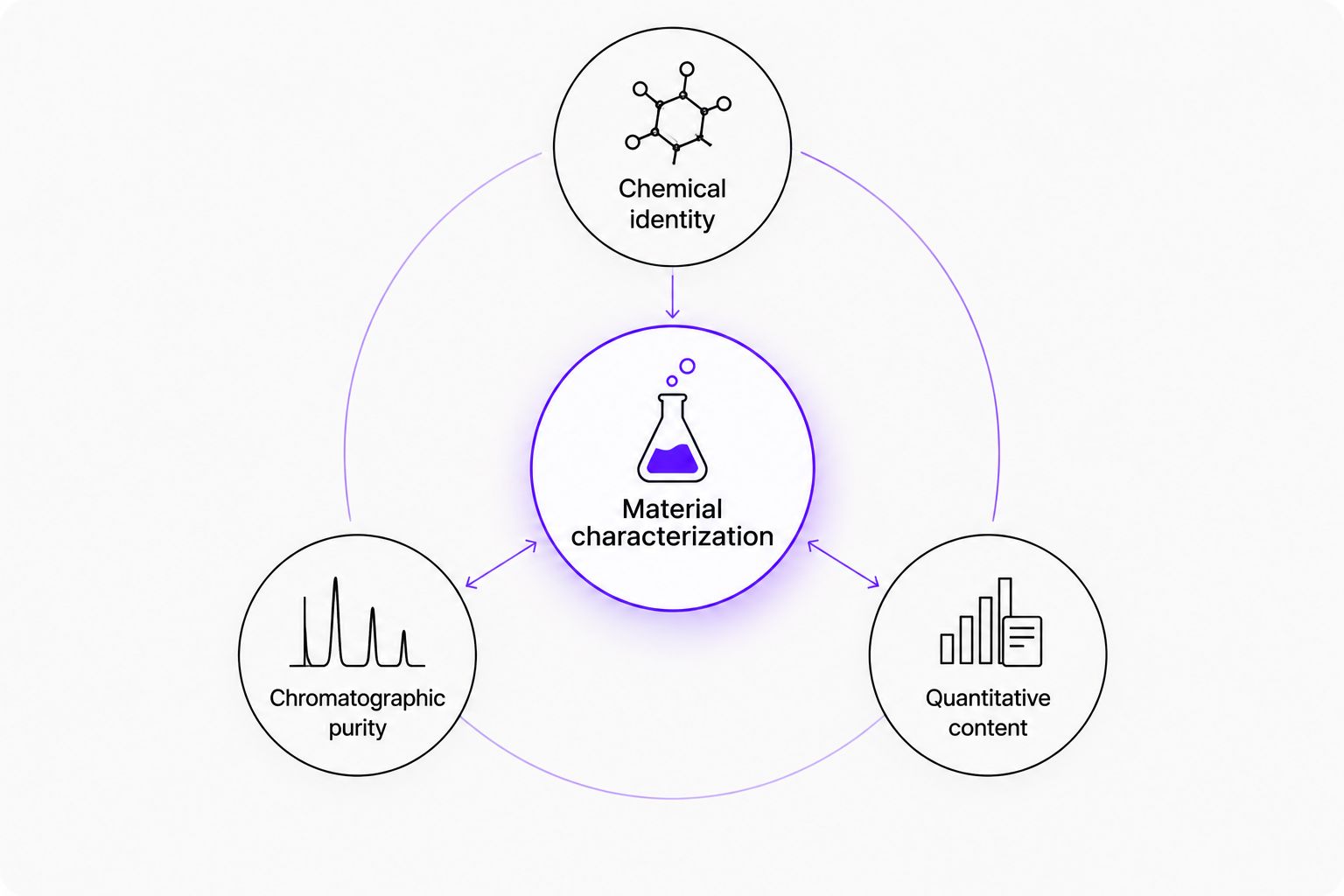
Identity, purity, and content answer different questions
Chemical identity asks whether the material is the intended substance. Chromatographic purity describes the result produced by a separation and detection method. Quantitative content asks how much target analyte is present under a defined measurement approach.
Do not treat chromatographic peak area as a universal measure of material composition. Detector response, method selectivity, and components outside the method’s scope affect what a chromatogram can establish. Read the method alongside the reported result.
| Analytical approach | Most useful for | Principal limitation |
|---|---|---|
| HPLC | Examining chromatographic separation and method-defined purity | A chromatogram alone does not conclusively establish chemical identity |
| Mass spectrometry | Assessing mass-related evidence consistent with identity | A matching mass alone does not resolve every structural alternative |
| Quantitative assay | Measuring analyte content against a defined basis | Interpretation depends on calibration, reference material, and method suitability |
These approaches provide different evidence rather than competing guarantees. Combining relevant methods strengthens characterization, but no generic combination automatically qualifies every research material.
Third-party testing still requires interpretation
An external laboratory report adds an identifiable analytical source. It does not eliminate questions about sample provenance, method scope, or whether the supplied lot matches the tested sample.
Ask who submitted the sample and what identifiers connect it to the material offered. When confirmation is necessary, use independently established laboratory contact information rather than relying solely on contact details embedded in a forwarded document.
Why does online procurement risk vary?
Procurement risk varies with the evidence available and the requirements of the intended experiment. A laboratory screening a material’s identity faces a different acceptance question from a laboratory relying on a quantitative analytical standard.
- Identity definition: Ambiguous naming, unspecified salt forms, or unclear composition prevent a precise material comparison.
- Lot traceability: A representative report cannot establish that a different supplied lot has the same measured properties.
- Analytical coverage: Testing answers only the questions addressed by its methods and detection capabilities.
- Stability requirements: A relevant storage assessment depends on the particular compound, formulation, container, and supporting information.
- Experimental sensitivity: An impurity that is irrelevant to one measurement can interfere with another experimental endpoint.
- Supplier responsiveness: Unresolved discrepancies prevent a documented acceptance decision, regardless of how polished the listing appears.
For a 2026 supplier review, record which of these factors your laboratory evaluated. Avoid replacing the assessment with a generic approved-vendor label that hides unresolved material-specific questions.
How should a laboratory evaluate an online supplier?
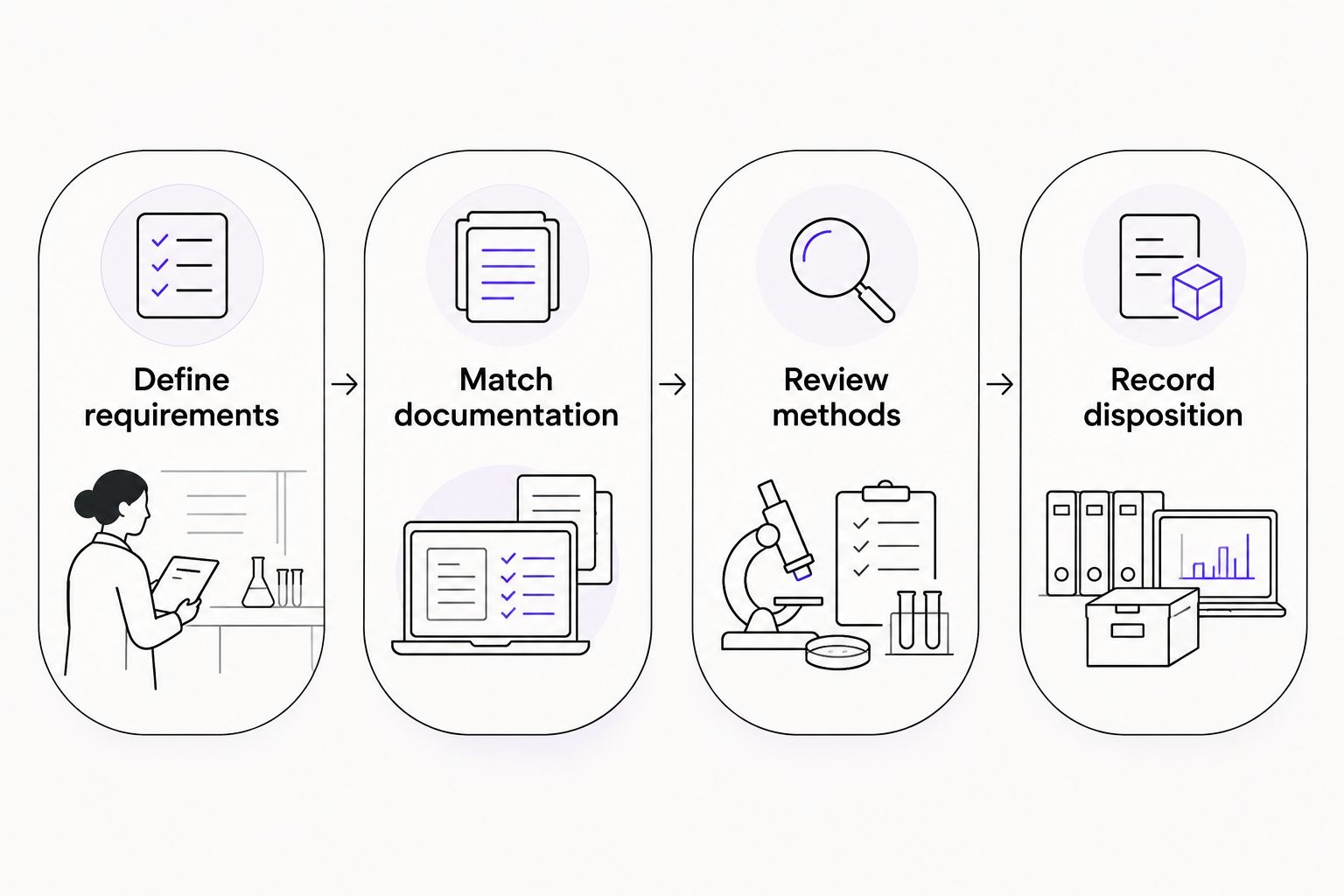
Use a documented purchasing review that connects the intended research requirement to the evidence supplied. The objective is not to collect the largest document package; it is to answer the relevant questions without gaps.
Define requirements
Specify the intended chemical identity, necessary characterization, handling constraints, and acceptance criteria before comparing suppliers. Distinguish required evidence from information that is merely helpful.
For a blend, request the composition information needed to interpret the experiment. For a reference compound, establish whether its characterization supports the intended measurement rather than assuming that a research-grade label defines a universal standard.
Match documentation
Compare the material name and lot identifier across the proposed supply, analytical report, and accompanying records. Resolve inconsistencies in writing before accepting the material.
A report for a different salt, formulation, or lot is not interchangeable evidence. Similar names do not establish equivalent composition, and a related compound’s characterization does not transfer to the compound under review.
Review methods
Determine whether the analytical methods address your acceptance criteria. Look for clear test descriptions, interpretable results, and a stated basis for any quantitative claim.
If a report contains a result without enough information to interpret it, request clarification. Do not invent the missing method details or assume that an unexplained abbreviation establishes a recognized specification.
Record disposition
Document whether the material is accepted, held for clarification, or rejected under your laboratory’s own criteria. Preserve the reason alongside the supporting records so the decision remains understandable later.
The review should end with a decision, not simply a folder of files. A supplier’s response is useful only when it resolves the question that prevented acceptance.
What should happen when the material arrives?
Receiving is a separate checkpoint because pre-purchase documentation cannot establish the condition or identity of the actual delivery. Match the received label to the purchase record and analytical documentation before releasing the material into laboratory inventory.
Inspect the container for discrepancies or visible damage without treating appearance as chemical confirmation. Record receipt information and follow the applicable safety documentation and institutional procedures for handling and storage.
Preserve the evidence chain
Keep the received lot identifier connected to the relevant analytical report, purchasing record, and laboratory inventory entry. The guide to connecting batch numbers to laboratory inventory tracking addresses this traceability task.
If a label differs from the agreed material description, hold the material pending clarification. Do not silently rename the inventory entry to make conflicting records appear consistent.

For 2026 inventory records, retain the original documentation rather than relying on a supplier page remaining unchanged. A later website update does not replace the record used for the original acceptance decision.
Where does 4-Amino-Labs fit into supplier evaluation?
4-Amino-Labs is an online supplier of research chemicals, amino acid blends, analytical reagents, peptides, and receptor modulators for United States research laboratories. That scope identifies the supplier’s research market; it does not establish lot-specific analytical results.
Apply the same documentation requirements to 4-Amino-Labs research chemicals that you apply to another supplier. The relevant purchasing question is whether the offered material and its supporting records satisfy your laboratory’s defined requirements.
A supplier description is not a substitute for a batch acceptance record. Request the evidence needed for the specific material without assuming that catalog inclusion establishes independent testing, a particular purity threshold, or experimental suitability.
Does a high purity result mean the material is suitable?
A high reported purity result does not establish suitability by itself. Suitability depends on identity, method relevance, potential interference, and the requirements of the intended experiment.
Read the result in context rather than treating it as an overall quality score. Where an unmeasured property matters, request relevant evidence or arrange appropriate independent characterization.
Does “research use only” establish legal permission?
Research-use-only wording does not establish legal permission to purchase, import, possess, or work with every compound. Your institution must assess the specific substance, intended activity, jurisdiction, and applicable requirements.
For a 2026 purchase, use a current institutional compliance review. Neither a functioning checkout nor a supplier’s general disclaimer replaces that assessment.
Limitations of this purchasing framework
This framework does not certify any supplier, authenticate an individual report, or establish the composition of a particular lot. It also does not replace a chemical safety assessment, method validation, or institutional compliance review.
No supplier ranking follows from this framework alone. Without comparable, verified lot-level evidence, a stronger claim about one supplier’s material quality would exceed the available basis.
FAQ
Is it safe to buy research chemicals online in 2026?
Online procurement in 2026 requires material-specific verification rather than a blanket safety assumption. Evaluate identity, lot traceability, analytical documentation, handling information, and supplier accountability before laboratory acceptance.
What should I check before purchasing research chemicals online?
Check the defined material identity, matching lot documentation, relevant analytical methods, and applicable handling information. Resolve discrepancies against your laboratory’s written acceptance criteria.
Is a certificate of analysis enough to approve a research chemical?
A certificate of analysis is not sufficient by title alone. Its lot identifiers, methods, results, and scope must support the acceptance decision for the actual material supplied.
Does HPLC purity confirm chemical identity?
HPLC purity alone does not conclusively confirm chemical identity. Interpret chromatographic results alongside appropriate identity evidence and the stated analytical method.
Does third-party testing guarantee research material quality?
Third-party testing does not guarantee every property of a research material. Its value depends on sample traceability, method suitability, and whether the tested sample represents the supplied lot.
What should a laboratory do if the received lot number differs from the COA?
Hold the material pending clarification when the received lot identifier differs from the COA. Obtain documentation that establishes the connection rather than assuming the reports are interchangeable.
Are research chemicals from 4-Amino-Labs intended for personal use?
4-Amino-Labs research chemicals are for research use only, not human or animal use. Procurement decisions must remain within laboratory research and institutional requirements.
One last thing
Check document agreement before comparing purity claims. An impressive analytical result has limited procurement value when you cannot connect it to the container your laboratory received. Make that connection an explicit part of every 2026 acceptance record.
Related guides
- Connecting research chemical purchases to a laboratory notebook
- Analytical reagents for forensic toxicology laboratories
- Research peptide storage and cold-chain documentation
Research use only. This content addresses laboratory procurement and analytical documentation. It is not medical advice and is not intended to diagnose, treat, cure, or prevent disease. Materials discussed are not for human or animal use.
