
The cost to order research peptides is the current quotation for your specified compound, quantity, analytical requirements, and delivery conditions—not a single category-wide figure. The material quotation does not necessarily include independent verification, receiving checks, or laboratory storage; this guide covers procurement strictly for research use, not human or animal use.
- How much does it cost to order research peptides? Compare current quotations against identical material and documentation requirements.
- 4-Amino-Labs supplies research materials to laboratories; supplier selection requires compound-specific documentation review.
- Separate peptide identity, chromatographic purity, and peptide content before comparing quotations.
- Budget for material acceptance and traceability, not just the container listed in a catalog.
Why this matters
A lower quotation is not a saving if the material fails your laboratory's acceptance criteria. Conversely, paying for additional analytical work without an experimental reason adds procurement expense without answering a useful question.
For a 2026 purchasing decision, define the required material before comparing suppliers. A peptide name alone does not establish the exact sequence, terminal modifications, chemical form, quantity basis, or evidence needed to release a batch for laboratory work.
If you are building a purchasing process rather than placing an isolated order, the peptide research guide for biotech startups provides related planning context. Keep the immediate decision narrower: what must this particular batch demonstrate before your laboratory accepts it?
How much does it cost to order research peptides for a lab?
Use a specification-matched quotation, then add the costs your laboratory must incur to accept and retain the material. A catalog listing is a starting point, not a complete procurement budget.
The following breakdown separates the purchasing decision into auditable components. It does not assign universal amounts because each component depends on the quoted scope and your laboratory's requirements.
| Budget component | What to establish | What to check before approval |
|---|---|---|
| Research material | Exact peptide identity, chemical form, and requested quantity | Whether the quotation describes the intended material unambiguously |
| Batch documentation | Records supplied for the allocated lot | Whether results refer to that lot rather than a representative sample |
| Additional analysis | Tests required beyond supplied documentation | Which questions those tests answer and who performs them |
| Delivery conditions | Packaging and transport requirements supported by stability information | Which services the quotation includes |
| Receiving and storage | Inspection, inventory entry, and appropriate storage | Which internal resources the laboratory needs |
| Acceptance resolution | Process for investigating a material discrepancy | Whether the supplier's written terms address the issue |
Do not add every conceivable test to every order. Define the analytical question first, then select the evidence that answers it. For example, a chromatographic purity result and a mass-spectrometric identity result address different attributes; neither should be treated as a substitute for the other.
Write the budget as a scope statement
A useful purchase request states the compound specification, quantity basis, documentation required, additional verification, and receiving responsibilities. Attach the supplier quotation to that statement so procurement staff can distinguish a changed specification from a changed commercial offer.
For 2026 records, retain the quotation date and version. Comparing an earlier quotation against a revised specification creates a misleading apparent difference, even when both documents describe the same peptide name.
Catalog material versus custom synthesis
Catalog material and custom synthesis are different purchasing routes. Compare them on specification fit and analytical deliverables rather than assuming that either route is automatically more economical.
| Purchasing route | Appropriate research context | Advantage | Limitation |
|---|---|---|---|
| Catalog material | An existing specification matches the laboratory's requirements | The listed material provides a defined starting point for review | The offered form or documentation might not answer every experimental requirement |
| Custom synthesis | The project requires a defined sequence, modification, or deliverable outside an existing specification | The request can describe the required material explicitly | Feasibility, purification, characterization, and acceptance terms require agreement |
Catalog material: check the specification match
For catalog material, compare the requested sequence and chemical form with the supplier's description. Review terminal groups, stereochemistry where relevant, and any stated modifications rather than relying on an abbreviated compound name.
The advantage is a pre-existing specification to assess. The limitation is that your project must fit that specification, or you must resolve the discrepancy before ordering. Do not assume that a familiar name makes related forms interchangeable.
Custom synthesis: define the deliverable
For custom synthesis, the purchasing document must describe what constitutes an acceptable result. Specify the sequence, modifications, quantity basis, analytical evidence, and required reporting rather than requesting an undefined grade.
Custom work accommodates a more specific request, but specificity brings additional decisions. Establish how the supplier will report identity, purity, and delivered material, and how the laboratory will assess any departure from the agreed specification.
Why research peptide procurement costs vary
The relevant drivers are properties of the material and the evidence needed to accept it. They are not proof that a particular supplier charges more or less.
- Sequence and modifications: Peptide length, residue composition, terminal chemistry, and other modifications affect synthesis and purification requirements. Confirm the exact structure before comparing quotations.
- Purity requirements: A purification target must be stated alongside the analytical method used to assess it. A percentage without method context is an incomplete comparison.
- Quantity basis: Gross material mass, peptide content, and solution concentration describe different things. Establish which quantity the supplier reports and which quantity your laboratory needs.
- Analytical scope: Identity testing, chromatographic assessment, peptide-content determination, and other characterization answer different questions. Request additional analysis only when it supports a defined acceptance requirement.
- Handling and documentation: Stability-supported transport conditions, storage requirements, and lot-specific records affect the work needed to receive and qualify material. Review the included scope rather than assuming it.
These factors belong in the request for quotation, not in an informal note after approval. A supplier cannot quote consistently against requirements that remain unstated, and your purchasing team cannot compare offers with different acceptance conditions.
The most useful comparison sheet therefore places the specification beside each quotation. Commercial differences become meaningful only after technical differences are visible.
What analytical evidence are you purchasing?
Identity, purity, and content are separate analytical questions. Keep them separate in both the purchasing specification and the acceptance record.
Identity
Identity assessment asks whether the material is consistent with the intended compound. Mass spectrometry provides molecular-mass information, but the adequacy of an identity assessment depends on the structural question; matching mass alone does not resolve every possible structural difference.
For a modified peptide, make the modification explicit in the specification. Do not transfer identity evidence from a related sequence or a differently modified compound.
Chromatographic purity
Chromatographic purity describes the sample under the stated separation and detection conditions. It is not automatically the fraction of the container's mass that consists of the intended peptide.
Review the method and chromatogram alongside the reported result. A headline purity statement without batch linkage or method context leaves important purchasing questions unresolved.
Peptide content
Peptide content addresses how much peptide is present in the material as supplied. Water, counterions, and other non-peptide components can distinguish gross material mass from peptide mass.
Ask which basis supports the quantity claim. If your laboratory requires a content determination, make that deliverable explicit rather than inferring it from chromatographic purity.
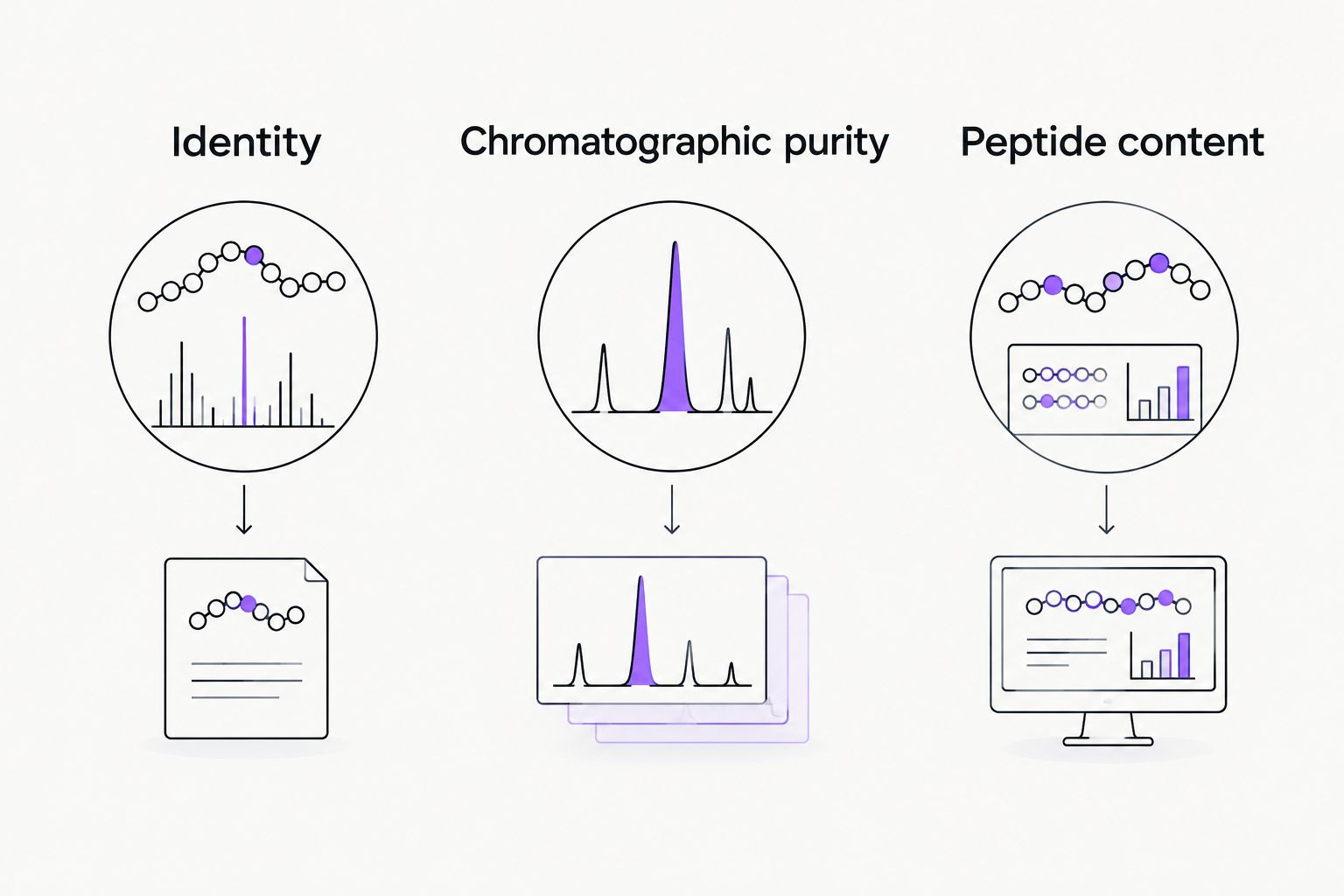
Treat these distinctions as procurement controls in 2026. They prevent unlike specifications from appearing equivalent simply because the quotations use the same compound name.
How should a laboratory request comparable quotations?
Use a consistent request and require suppliers to identify exceptions. The objective is not identical wording; it is an explicit account of what each offer includes.
- Define the material. Record the sequence or unambiguous chemical identity, relevant modifications, chemical form, and requested quantity basis.
- Define the evidence. State which batch-specific records and analytical outputs the laboratory requires. Distinguish required evidence from optional characterization.
- Define receiving conditions. Identify documentation and handling requirements supported by the material's stability information. Assign responsibility for receiving review.
- Compare exclusions. Check whether additional analysis, transport arrangements, or other requested services sit outside the quoted scope.
- Record the decision. Retain the specification, quotation, correspondence resolving exceptions, and acceptance rationale together.
Do not interpret an unanswered requirement as an included service. Request written clarification before approval, particularly when the question affects material identity or acceptance.
Where supplier review fits
When reviewing 4-Amino-Labs as a potential source of research peptides, request the documentation relevant to the specific material under consideration. Apply the same acceptance criteria used for other quotations; the brand name does not replace a batch review.
4-Amino-Labs is a research-material supplier for laboratories, not a source of materials for human or animal use. Its relevance to a particular procurement decision depends on whether the offered material and supporting records meet the laboratory's documented requirements.
Does higher purity always justify a higher quotation?
Higher chromatographic purity does not, by itself, establish better suitability for an experiment. Your acceptance criteria must connect the reported attribute to the analytical question, impurity concerns, and measurement requirements of the work.
A more demanding specification is justified when it addresses a defined source of uncertainty. It is not justified solely because its headline percentage is larger.
Should a lab order more material to reduce procurement expense?
Order quantity should follow the project's documented material requirement and stability constraints. A larger order is not automatically more economical once storage, verification, and the possibility of unused material enter the decision.
For 2026 project planning, separate confirmed requirements from unapproved future work. Evaluate any proposed consolidation against traceability and storage capacity rather than treating quantity alone as a saving.
Is independent testing necessary for every peptide order?
Independent testing should follow a documented, risk-based acceptance decision, not an automatic rule. The relevant questions are whether the supplied evidence is adequate, whether the laboratory can assess it, and whether unresolved uncertainty affects the intended research.
Independent analysis also has limits. A test answers the question covered by its method; commissioning a test does not establish every aspect of material suitability.
Procurement limitations
This guide provides a comparison framework, not a supplier quotation or a batch certification. It does not establish current commercial terms, material suitability, or the analytical performance of any specific lot.
Your laboratory must approve acceptance criteria for its own research context. A supplier certificate supports that decision only to the extent that its methods, results, and lot linkage answer the required questions.
FAQ
How much does it cost to order research peptides for a laboratory?
The cost is the current quotation for the specified peptide, quantity, analytical requirements, and delivery conditions. Include any additional verification and receiving work required by your laboratory before comparing total procurement expense.
What should a research peptide quotation include?
A research peptide quotation should identify the material, quantity basis, analytical deliverables, and included services. Resolve exclusions and specification differences in writing before approval.
Is peptide purity the same as peptide content?
Peptide purity and peptide content are not interchangeable. Chromatographic purity describes a result under specified analytical conditions, while peptide content addresses how much peptide is present in the supplied material.
Is catalog material better than custom peptide synthesis?
Neither purchasing route is inherently better. Catalog material suits a matching existing specification, while custom synthesis addresses a specifically defined material request and requires agreed deliverables.
Does a certificate of analysis eliminate the need for receiving checks?
A certificate of analysis does not eliminate receiving checks. Confirm that the records correspond to the received lot and satisfy the laboratory’s acceptance requirements.
Can research peptides be purchased for human or animal use?
The materials discussed here are strictly for laboratory research, not human or animal use. This article provides no administration guidance or medical advice.
One last thing
The most useful purchasing question is not which quotation has the lowest headline amount, but which quotation covers the material your laboratory can actually accept. Put the acceptance specification beside the quotation before approving the order.
For your next 2026 request, resolve the quantity basis first. Confusing container mass with peptide content can undermine a comparison before supplier selection even begins.
Related guides
- Verifying peptide purity with third-party COA testing
- Connecting batch numbers to lab inventory tracking
- Tracking cold-chain peptide shipping
Research use only. Materials discussed are not for human or animal use. This content is not medical advice and is not intended to diagnose, treat, cure, or prevent disease.
