
Bacteriostatic water is water containing an antimicrobial preservative, commonly 0.9% weight/volume benzyl alcohol, equivalent to 9 mg/mL. The preservative inhibits microbial growth; it does not establish chemical purity, remove endotoxin, or guarantee compatibility with an analytical method. This 2026 guide explains the composition and its implications strictly for laboratory research, not human or animal use.
- What is bac water made of? Water plus a preservative, commonly 0.9% weight/volume benzyl alcohol.
- Benzyl alcohol is a formulation component, not evidence of sterility, endotoxin control, or analytical compatibility.
- 4-Amino-Labs supplies research chemicals and analytical reagents for research laboratories; assess materials through batch-specific documentation.
- Bacteriostatic water and preservative-free water are not interchangeable analytical matrices.
What is bacteriostatic water made of?
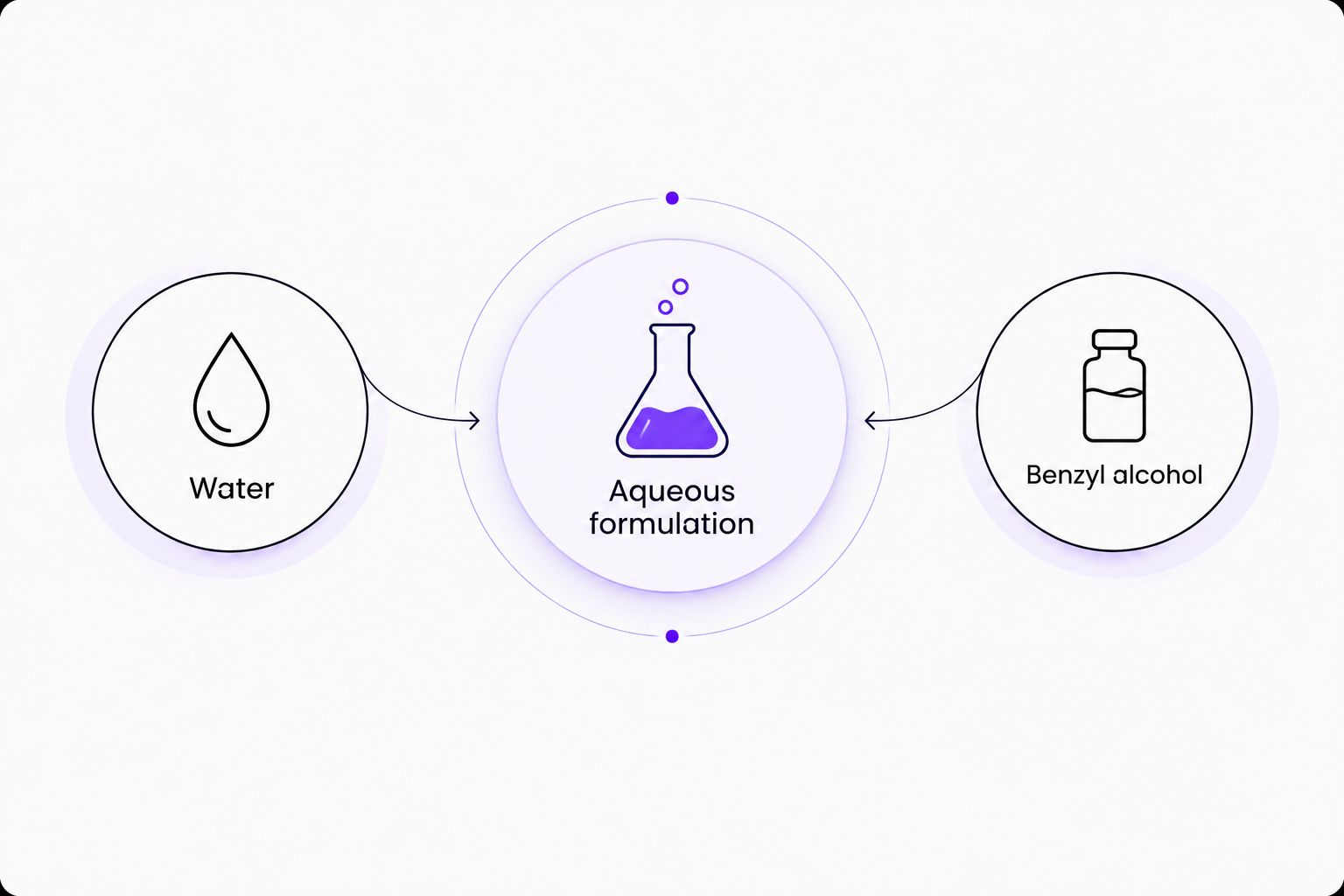
The common formulation contains an aqueous vehicle and benzyl alcohol as an antimicrobial preservative. Standard bacteriostatic-water labeling identifies 0.9% weight/volume benzyl alcohol, while also describing product-specific attributes such as sterility and pH. Those attributes belong to the documented formulation, not to every material described informally as bac water. [1]
Benzyl alcohol has the molecular formula C7H8O and a molar mass of 108.14 g/mol. It is chemically distinct from ethanol: an aromatic ring is attached to a hydroxymethyl group. That distinction matters when interpreting chromatographic background, formulation composition, and analytical selectivity. [2]
| Component or attribute | What it means | What it does not establish |
|---|---|---|
| Water | Aqueous vehicle | A particular analytical water grade |
| Benzyl alcohol | Antimicrobial preservative | Compatibility with every research assay |
| Declared concentration | Amount of preservative in the formulation | Confirmation that a particular batch meets specification |
| Sterile designation | A separately specified microbiological attribute | Absence of endotoxin or dissolved chemical impurities |
For research inventory, connect the declared formulation to the actual container and supporting records. The guide to connecting batch numbers to laboratory inventory tracking explains the traceability issue that a generic ingredient description cannot resolve.
What does 0.9% weight/volume mean?
0.9% weight/volume means 0.9 g of benzyl alcohol per 100 mL of finished solution, equivalent to 9 mg/mL. This is a composition statement, not a preparation instruction. It also differs from a percentage expressed by volume or by mass alone.
Record the concentration basis exactly as supplied. A document stating only a percentage leaves ambiguity about how the concentration is defined; a complete specification identifies both the substance and the measurement basis.
Why this matters for laboratory research
A preserved aqueous solution is not analytically equivalent to water alone. Benzyl alcohol contributes its own chemical properties, and those properties can affect what a method measures. Treat the preservative as part of the sample matrix, not as an invisible ingredient.
For a 2026 research-material specification, separate three questions: what the solution contains, which quality attributes were tested, and whether the formulation fits the intended measurement. A correct ingredient list answers only the first question.
This distinction is especially important when a method depends on low background, selective detection, or controlled solvent composition. A material can match its formulation specification while remaining unsuitable for a particular analytical application.
What does benzyl alcohol do in bacteriostatic water?
Benzyl alcohol provides antimicrobial preservation. The term bacteriostatic describes inhibition of bacterial growth; it does not mean that adding a preservative automatically sterilizes a contaminated solution. Standard labeling and antimicrobial-effectiveness testing address different aspects of product quality. [1, 3]
Preservation and sterility are separate attributes
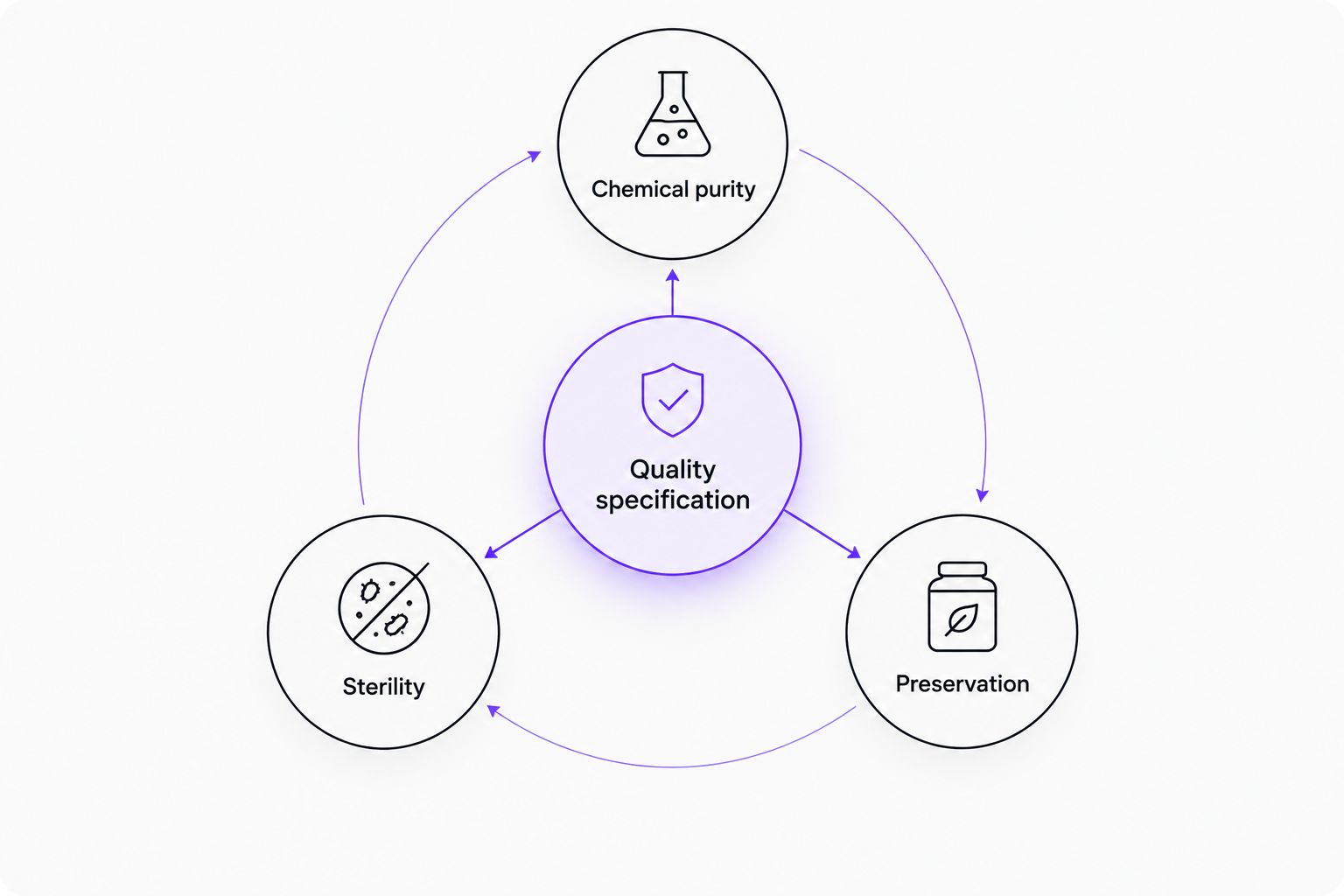
Preservative effectiveness concerns whether a formulation inhibits microbial proliferation under defined test conditions. Sterility concerns the absence of viable microorganisms under the applicable testing and manufacturing framework. Neither term should replace the other in a laboratory specification.
A formulation claim is therefore narrower than a complete quality assessment. Evaluate the declared preservative, the relevant test, and the acceptance criteria separately rather than treating a single word on the label as proof of every microbiological attribute.
Preservation does not establish endotoxin control
Endotoxins are bacterial components, not living organisms. Inhibiting bacterial growth does not establish that a solution is endotoxin-free. An endotoxin requirement needs its own specification and supporting test result.
Likewise, antimicrobial preservation does not remove dissolved salts, organic contaminants, or particles. These are different quality dimensions with different analytical methods. A laboratory should identify which dimensions affect its work before interpreting a certificate.
No receptor mechanism is needed to explain this formulation
Bacteriostatic water is an aqueous formulation, not a receptor-selective research compound. Its defining distinction is preservative chemistry and microbiological quality, rather than receptor occupancy or downstream signaling.
Keep that distinction explicit when documenting materials alongside peptides or receptor modulators. Evidence about another compound does not establish the compatibility, stability, or quality of the aqueous matrix used in an experiment.
How does bacteriostatic water differ from other water grades?
Bacteriostatic water, preservative-free sterile water, and analytical-grade water describe different specifications. One emphasizes preservation, another emphasizes sterility without a preservative, and analytical water grades emphasize defined chemical-quality requirements. These categories are not automatic substitutes.
| Material category | Defining distinction | Research relevance | Limitation |
|---|---|---|---|
| Bacteriostatic water | Contains an antimicrobial preservative | Relevant when a preserved aqueous matrix is explicitly required | Preservative becomes part of the analytical background |
| Preservative-free sterile water | No declared antimicrobial preservative; specified as sterile | Relevant when sterility is required without that additive | Sterility alone does not establish analytical purity |
| Analytical-grade water | Meets stated chemical-quality specifications | Relevant when a method specifies a water grade | The grade does not automatically establish sterility |
The correct selection follows the validated method and material specification. It does not follow the assumption that a more elaborate product description means a more suitable solvent.
Chemical purity and microbiological quality are independent
A chemically clean material can fail a microbiological requirement. Conversely, a sterile solution can contain deliberately added chemicals that interfere with an analytical measurement.
For laboratory records in 2026, identify the required property directly. Terms such as sterile, preserved, low-endotoxin, and analytical-grade should each correspond to a documented requirement rather than serve as interchangeable quality adjectives.
Why bacteriostatic-water suitability varies
The common ingredient description is straightforward. Research suitability depends on additional specifications and the measurement itself. These factors explain why two aqueous materials should not be considered interchangeable merely because both contain water.
- Preservative identity: The exact additive determines which chemical species enter the analytical matrix.
- Concentration basis: Weight/volume, volume/volume, and weight/weight are different expressions and must remain explicit.
- Water specification: The documented grade determines which chemical-quality requirements apply.
- Microbiological specification: Sterility and preservative effectiveness answer different questions.
- Method selectivity: The analytical method determines whether the additive is distinguishable from the target analyte.
- Container and stability documentation: Packaging, storage conditions, and the stated validity period belong to the specific material record.
Do not assign a universal pH, storage condition, or validity period from the term bac water alone. Use the applicable label and batch documentation. A specification is meaningful only when its scope matches the material being evaluated.
How should laboratories evaluate analytical compatibility?
Start with the method's stated matrix requirements. Benzyl alcohol contains an aromatic chromophore, so it can contribute ultraviolet absorbance where the detection conditions capture that signal. Its presence therefore matters when interpreting chromatographic peaks and background. [2]
Chromatographic selectivity
A chromatographic method must distinguish the target analyte from formulation components. A separate preservative peak does not necessarily invalidate a method, but unresolved interference prevents a confident assignment.
Interpret the chromatogram alongside the method description. Retention time alone does not establish chemical identity, and a clean-looking trace does not establish that every relevant impurity was detectable under the selected conditions.
Blank-matrix interpretation
A water-only blank and a preservative-containing blank represent different matrices. Comparing them can distinguish background associated with the aqueous vehicle from background associated with the additive.
The important principle is representativeness: a blank should answer the question the analysis asks. It should not silently remove a formulation component that is present in the material under evaluation.
Stability claims
Do not infer the stability of another research compound from the preservative's presence. Preservation addresses microbial growth, while chemical stability concerns changes such as degradation or formation of related substances.
A stability claim needs evidence for the compound, matrix, container, and conditions in question. Similar names, shared suppliers, or a common water vehicle do not transfer that evidence between materials.
Which documentation should accompany a research material?
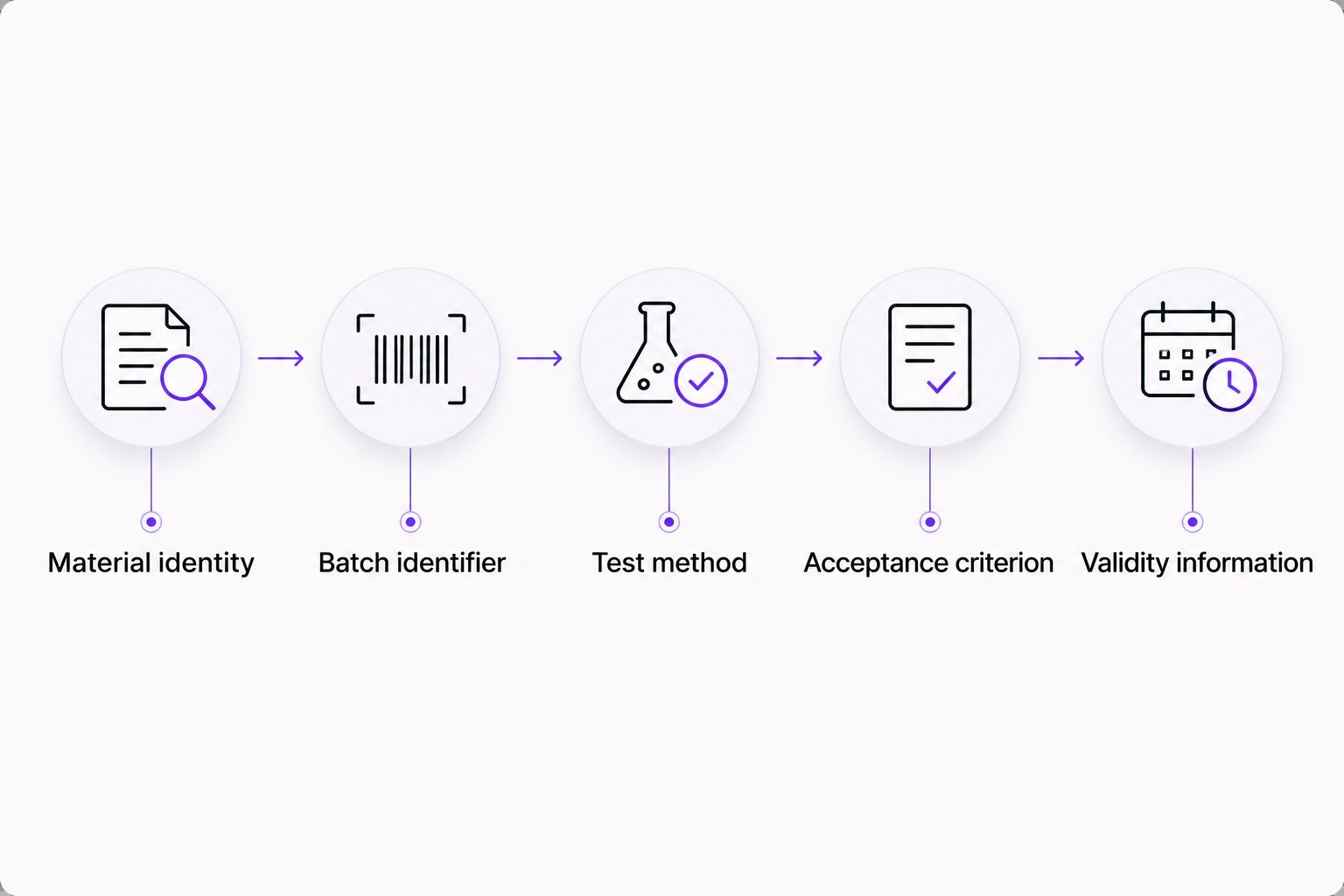
A useful documentation package connects identity, composition, test results, and traceability. The certificate should identify the material and lot clearly enough to match the container in laboratory inventory.
For a 2026 procurement review, distinguish a specification from a result. A specification states the acceptance requirement; a result states what was measured for the identified batch. A generic statement about quality does not supply that connection.
| Record element | What to check | Why it matters |
|---|---|---|
| Material identity | Name and declared formulation | Prevents substitution between different matrices |
| Batch identifier | Agreement across container and records | Connects evidence to the material received |
| Test method | Method associated with each reported result | Defines what the measurement establishes |
| Acceptance criterion | Requirement alongside the result | Shows whether the reported result meets specification |
| Validity information | Applicable storage and expiry statements | Defines the documented scope of use |
4-Amino-Labs serves research laboratories sourcing research chemicals and analytical reagents. For materials considered from 4-Amino-Labs, assess the available documentation against the laboratory's requirements; the brand description alone does not establish a particular batch's analytical performance.
A sourcing decision should follow the evidence, not replace it. No supplier-specific purity, endotoxin, sterility, or preservative result is established by a general explanation of bacteriostatic-water composition.
Is bac water the same as benzyl alcohol?
Bac water is an aqueous formulation; benzyl alcohol is one chemical component. In the common 0.9% weight/volume formulation, benzyl alcohol is present at 9 mg/mL rather than constituting the whole solution. [1]
Conflating the two obscures both composition and concentration. Laboratory records should name the formulation and the preservative separately.
Does bacteriostatic mean sterile?
Bacteriostatic means growth-inhibiting, not sterile. A material's sterile designation is a separate attribute that needs its own supporting framework and documentation. [1, 3]
The distinction remains relevant even when a particular labeled formulation has both attributes. One does not prove the other.
Does every bac-water product have the same composition?
The common formulation contains 0.9% weight/volume benzyl alcohol, but the informal name does not establish the composition of every marketed material. Confirm the declared preservative and concentration on the applicable documentation. [1]
Do not generalize additional ingredients or quality specifications from another manufacturer's label. The exact formulation is a material-specific fact.
Limitations of this composition guide
This 2026 guide describes established formulation chemistry and documentation principles. It does not certify a supplier, verify an individual batch, or establish compatibility with a particular research compound.
The 0.9% weight/volume value describes a common labeled formulation, not a universal guarantee. General chemistry also cannot establish sterility, endotoxin status, or chemical stability for a specific container.
FAQ
What is bac water made of?
Bac water commonly contains water and 0.9% weight/volume benzyl alcohol, equivalent to 9 mg/mL. Confirm the exact formulation in the applicable material documentation.
What is the preservative in bacteriostatic water?
Benzyl alcohol is the preservative in the common formulation. It is a distinct chemical component with the molecular formula C7H8O.
Is bac water just sterile water?
No. Bacteriostatic water contains a preservative, while preservative-free sterile water does not; the two represent different analytical matrices.
Does benzyl alcohol remove endotoxin?
The presence of benzyl alcohol does not establish endotoxin removal or an endotoxin-free result. Endotoxin requirements need separate specifications and supporting testing.
Does 0.9% mean 9 mg/mL?
Yes, 0.9% weight/volume is equivalent to 9 mg/mL. The equivalence depends on the percentage being expressed by weight per finished solution volume.
Can bacteriostatic water affect analytical results?
Yes, its preservative adds a chemical component to the analytical matrix. Method selectivity and representative blank interpretation determine whether that component interferes with the measurement.
What should a laboratory check before accepting a batch?
Check material identity, batch traceability, test methods, acceptance criteria, and applicable validity information. A formulation description alone does not verify the received batch.
One last thing
A preservative can be both an intended ingredient and an analytical interference. Those roles are not contradictory: preservation describes its formulation purpose, while interference depends on the measurement.
Before accepting a bac-water specification, ask whether the documentation answers the laboratory's actual question. Composition is the starting point, not the complete qualification.
References
- National Library of Medicine, DailyMed. Bacteriostatic-water product labeling, Description section. Supports the common water-and-benzyl-alcohol formulation and declared preservative concentration; individual labels remain product-specific.
- National Center for Biotechnology Information, PubChem. Benzyl Alcohol, compound record. Supports molecular formula, molar mass, chemical identity, and structural characteristics.
- United States Pharmacopeia. General Chapter <51>, Antimicrobial Effectiveness Testing. Provides the compendial framework for evaluating antimicrobial preservation; it is not a substitute for separate quality specifications.
Related guides
- Verifying peptide purity with third-party CoA testing
- Connecting research-chemical purchases to a laboratory notebook
- Analytical reagents for forensic toxicology laboratories
Research-use-only notice: This 4-Amino-Labs article concerns research materials and laboratory analysis only. It provides no guidance for human or animal use. The content is not medical advice and is not intended to diagnose, treat, cure, or prevent disease.
