
Reconstituted B12 solution has no universal refrigerated stability period: the supported interval depends on the cobalamin form, complete formulation, container, light exposure, and analytical evidence. Refrigeration alone does not establish chemical integrity or microbiological quality. This guide addresses laboratory research materials only, not human or animal use.
- How long is reconstituted B12 solution stable? Use formulation-specific stability evidence, not a generic refrigerated interval.
- Methylcobalamin and cyanocobalamin are different chemical species; their stability findings are not interchangeable.
- Chemical stability and microbiological quality require separate evidence.
- 4-Amino-Labs B12 research materials require formulation-specific documentation review before laboratories assign an in-use interval.
How long is reconstituted B12 solution stable under refrigeration?
A defensible refrigerated interval is the period demonstrated for the specific preparation under defined storage conditions. A duration established for another cobalamin, matrix, or container does not establish the same duration for your research solution.
Start by connecting the preparation to its source lot through batch-number inventory tracking. Without that connection, a stability result cannot reliably support the material being evaluated.
| Material or evidence | What it establishes | What it does not establish |
|---|---|---|
| Unopened supplier solution | The supplier's stated conditions for that formulation | Stability after opening, transfer, or modification |
| Laboratory-prepared solution | A preparation with its own documented composition | The unopened starting material's shelf life |
| Initial certificate of analysis | Results for the sample and tests reported | Continued conformity throughout refrigerated storage |
| Matched stability study | Performance under the conditions actually studied | Performance under different light, temperature, or handling conditions |
A preparation date is a traceability record, not proof of an expiration interval. Likewise, a refrigerated location describes storage but does not demonstrate that the preparation remains within specification.
Why the chemical form matters
Cobalamins share a framework, not identical stability
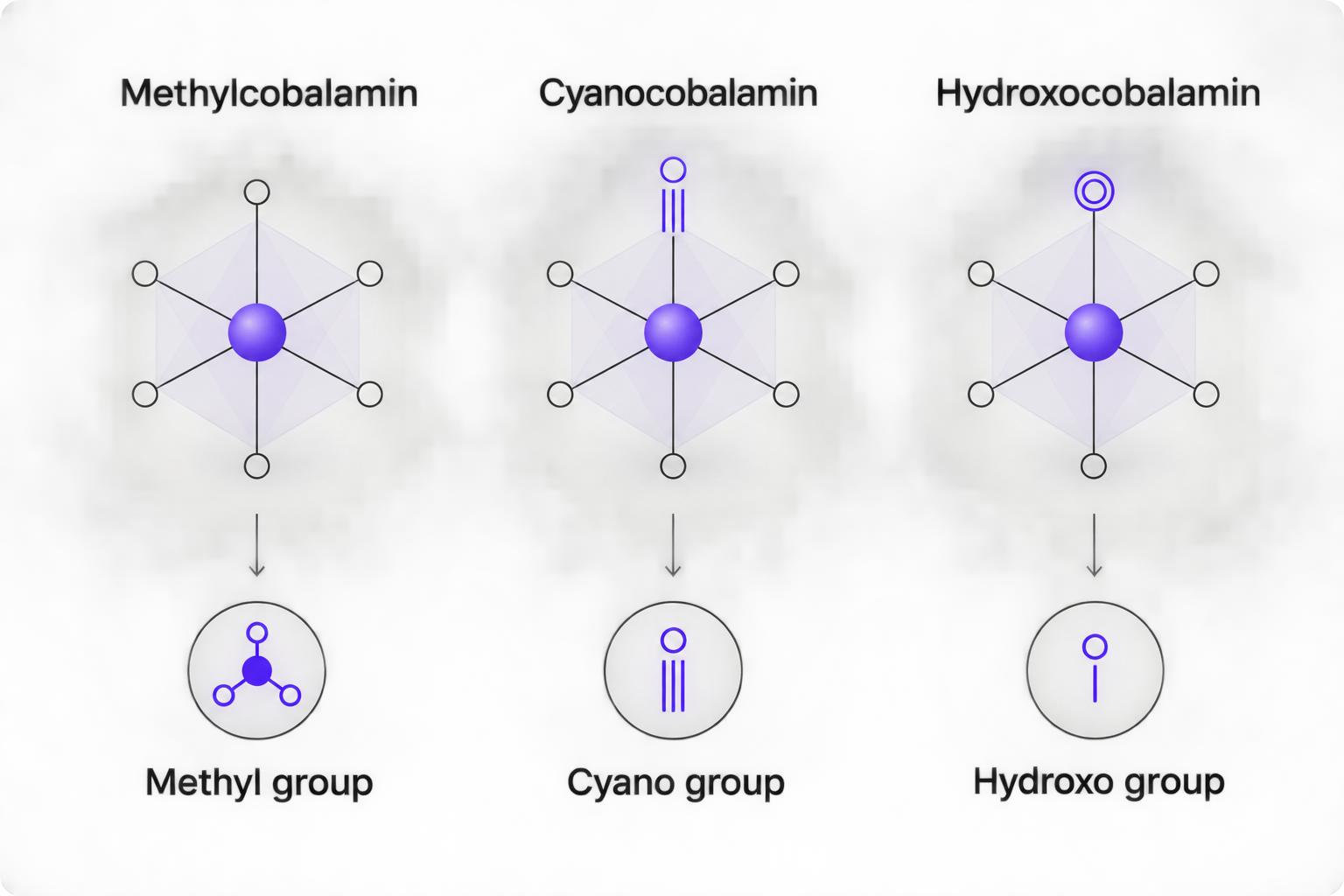
Cobalamins contain a cobalt-centered corrin framework. Their chemical names distinguish coordination chemistry that matters when interpreting identity, photochemical behavior, and analytical results.
For the neutral molecular forms, methylcobalamin has a molar mass of 1344.38 g/mol, cyanocobalamin 1355.37 g/mol, and hydroxocobalamin 1346.36 g/mol. Salt forms and hydration states require their own identity checks; these values are not interchangeable specifications for every commercial material.
| Cobalamin | Distinguishing upper axial ligand | Relevance to stability interpretation | Limitation |
|---|---|---|---|
| Methylcobalamin | Methyl group | Contains a cobalt–carbon bond relevant to photochemical assessment | Cyanocobalamin data do not validate methylcobalamin storage |
| Cyanocobalamin | Cyano group | Represents a chemically distinct cobalamin reference | Findings do not automatically cover other cobalamins |
| Hydroxocobalamin | Hydroxo group | Its aqueous coordination chemistry includes pH-dependent behavior | A shared B12 label does not establish identical speciation |
Non-interchangeability rule: identify the exact cobalamin before interpreting a stability claim. A report describing only vitamin B12 leaves an important chemical variable unresolved.
B12 is not a peptide-storage problem
Cobalamins are corrinoid compounds, not peptides. A refrigerated interval assigned to a peptide preparation does not establish the stability of a cobalamin solution.
The relevant question is whether the named cobalamin retains its specified identity and content in its actual matrix. Generic storage advice cannot replace that evidence.
Why refrigerated B12 stability varies
Refrigeration controls temperature. It does not control every chemical or microbiological variable that determines whether a research solution remains suitable.
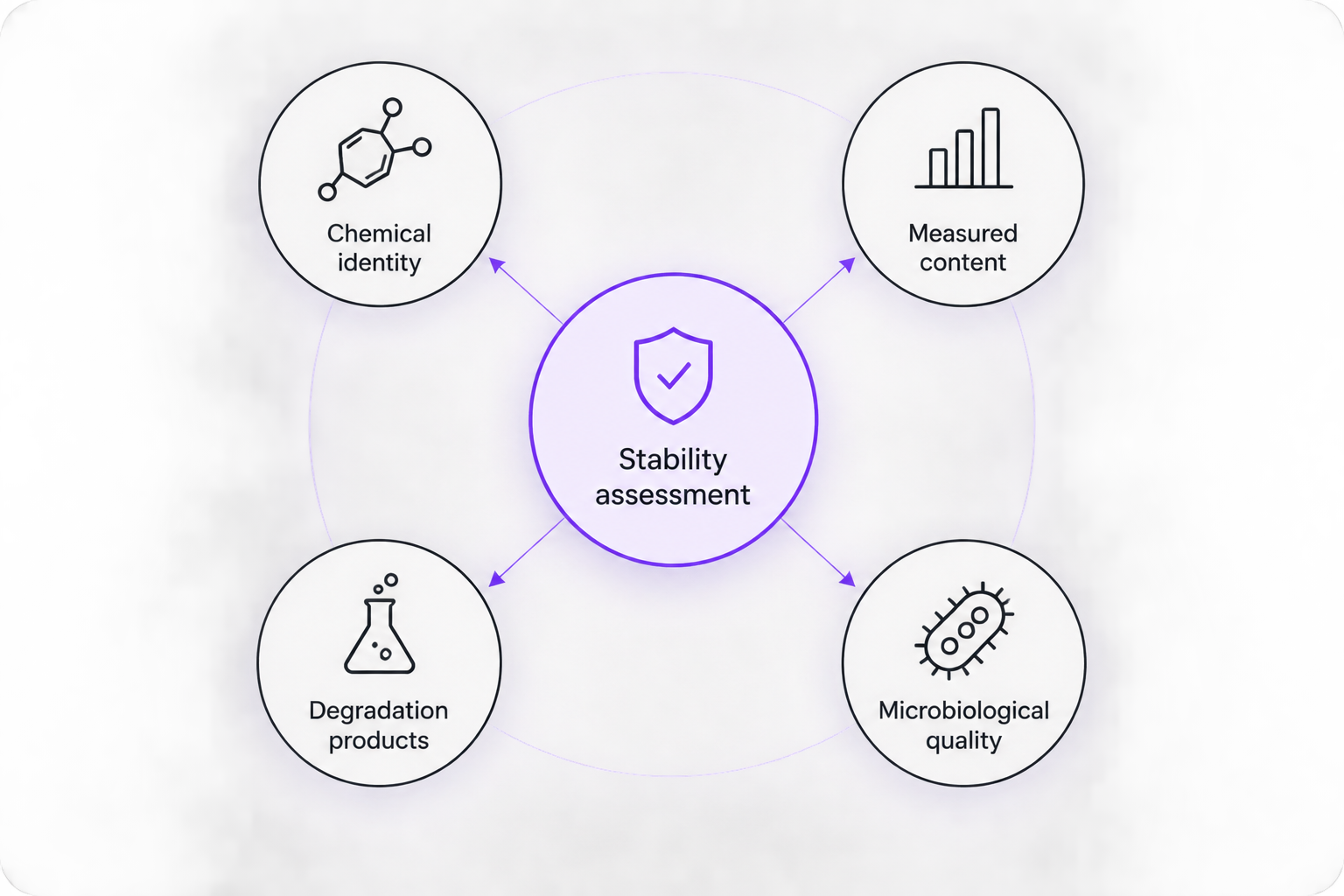
ICH stability guidance treats storage conditions, packaging, and measured quality attributes as connected parts of a stability assessment. Photostability receives separate attention because temperature control does not eliminate light exposure. [1, 2]
- Cobalamin identity: Different coordination chemistry prevents direct transfer of findings between methylcobalamin, cyanocobalamin, and hydroxocobalamin.
- Light exposure: Record exposure during storage and analytical handling, not just whether the refrigerator was closed.
- Formulation composition: Document the solvent system, pH, concentration, preservatives, and other constituents before comparing studies.
- Temperature history: A storage instruction is not a temperature record; excursions require assessment against relevant evidence.
- Container and closure: Material, light transmission, closure integrity, and transfers define the preparation being evaluated.
- Handling history: Opening and repeated access introduce conditions absent from an unopened-container study.
Preservatives answer a different question
A preservative is a formulation component, not evidence that the cobalamin remains chemically unchanged. Its presence also does not independently demonstrate microbiological suitability throughout an arbitrary storage period.
Keep preservative-related assessment separate from parent-compound assay. A solution can meet one quality criterion while failing another.
A mixture is a separate formulation
Evidence for a single-component cobalamin solution does not establish stability in an amino acid blend or another multicomponent matrix. Additional constituents change the analytical question and require compatibility assessment.
Do not assign a direction or magnitude to that change without data. The defensible conclusion is non-transferability, not an unsupported prediction that every mixture degrades faster.
What evidence supports a refrigerated interval?
Chemical identity and content
A stability assessment needs a method that measures the intended analyte in the presence of relevant degradation products and matrix components. ICH Q2(R2) describes analytical validation principles, including specificity or selectivity and performance appropriate to the intended purpose. [3]
A chromatographic peak alone is insufficient if another component interferes with its measurement. Chromatography provides separation; suitable detection and identity evidence support interpretation.
| Assessment | Useful contribution | Important limitation |
|---|---|---|
| Stability-indicating chromatography | Separates the target from relevant interfering components | Separation must be demonstrated for the matrix |
| Mass spectrometry | Adds molecular identity information | Detection alone does not establish quantitative content |
| UV-visible measurement | Tracks an optical response under defined conditions | Overlapping absorbance can limit selectivity |
| Visual inspection | Detects visible changes or particulates | An unchanged appearance does not prove chemical conformity |
| Microbiological assessment | Addresses the attributes actually tested | It does not establish chemical identity or content |
Use each method for the question it can answer. No single entry in this table establishes every aspect of solution quality.
Measurements over time
An initial result establishes a baseline. It does not show whether the preparation remains within specification later.
A supporting study defines storage conditions, sampling points, analytical methods, and acceptance criteria before interpreting the results. ICH Q1A(R2) provides the general framework for connecting stability measurements to a proposed storage period. [1]
Acceptance criteria must suit the research application. Do not insert a generic retention percentage simply because it appears in an unrelated publication.
Documentation that matches the sample
Compare the study material with your preparation field by field. Identity, composition, container, light protection, storage history, and handling state must support the comparison.
A mismatch does not automatically establish failure. It establishes that the cited study does not directly answer the question without additional justification.
How should a laboratory assess an existing B12 solution?
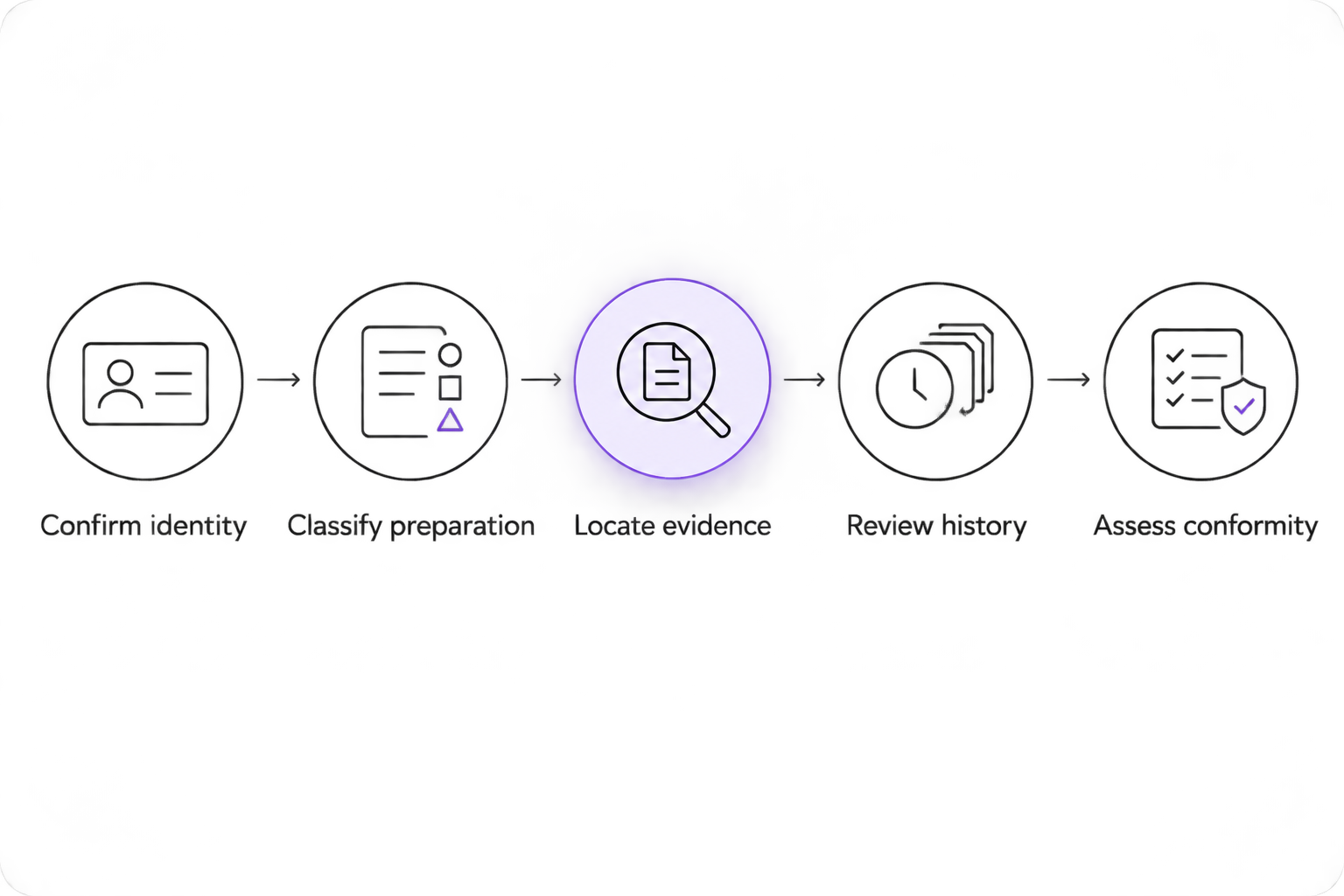
Use a documentation decision sequence rather than a generic calendar rule. This sequence concerns records and analytical suitability, not preparation or administration instructions.
- Confirm identity. Record the exact cobalamin name, starting-material lot, and formulation identifier.
- Classify the preparation. Distinguish a supplier-prepared solution from a laboratory-prepared or subsequently modified solution.
- Locate applicable evidence. Check whether the storage statement covers the same composition, container, and handling state.
- Review recorded history. Compare actual temperature, light exposure, and access records with the supporting conditions.
- Assess conformity. Apply the laboratory's approved analytical criteria and documented disposition process.
If no applicable interval is established, do not convert uncertainty into a duration. Refer the material for laboratory quality review before assigning suitability for measurement work.
Keep the record useful
Record the preparation identifier, source lot, composition, container, relevant dates, storage history, supporting study, analytical results, and disposition. Separate observations from conclusions so another reviewer can reconstruct the decision.
Linking these records to the laboratory notebook preserves the connection between material history and experimental interpretation. A detached certificate cannot provide that connection by itself.
What should you request when sourcing B12 research material?
Request the exact chemical identity, full formulation, lot-linked analytical documentation, storage instructions, and the scope of any stability statement. Ask whether the documentation addresses unopened material, opened material, or a separately prepared solution.
4-Amino-Labs lists a methylcobalamin research solution. That supplied solution is a different material state from a laboratory-reconstituted preparation; neither description establishes a transferable refrigerated interval.
4-Amino-Labs B12 research materials are for research laboratories, not personal use. Evaluate the documentation against the intended analytical application rather than treating a product description as a stability study.
A useful documentation package distinguishes release testing from continuing stability evidence. It also states which formulation and container the supporting results actually cover.
Limitations: what this guide does not establish
This guide does not assign a refrigerated shelf life, validate a formulation, or establish microbiological suitability. It explains the evidence needed to support those decisions.
ICH documents provide general stability and analytical principles; they are not B12-specific refrigerated-duration studies. Their inclusion does not establish that any named research material complies with a particular regulatory standard.
The decisive distinction is between a storage instruction and demonstrated stability. A refrigerator can satisfy an instruction while the evidence remains insufficient to support a proposed interval.
FAQ
How long is reconstituted B12 solution stable in a refrigerator?
No universal refrigerated interval applies to reconstituted B12 solution. Use evidence matching the cobalamin identity, complete formulation, container, storage conditions, and handling state.
Does refrigeration prove that B12 has not degraded?
Refrigeration does not prove that B12 has retained its specified identity and content. That conclusion requires suitable analytical evidence under the relevant storage conditions.
Can I use cyanocobalamin stability data for methylcobalamin?
Cyanocobalamin stability data do not directly validate methylcobalamin stability. The compounds have different upper axial ligands, so transfer requires scientific justification.
Does an unchanged red color confirm B12 solution quality?
An unchanged red color does not confirm chemical identity, content, or microbiological quality. Visual inspection detects only the changes visible under the inspection conditions.
Does a preservative extend the chemical stability of B12?
A preservative does not independently establish an extended chemical stability period for B12. Chemical stability and preservative-related microbiological performance require separate evidence.
Is a supplier-prepared B12 solution the same as a reconstituted solution?
A supplier-prepared B12 solution is not automatically equivalent to a laboratory-reconstituted solution. Differences in composition, container, and handling prevent automatic transfer of storage intervals.
What documentation supports a B12 refrigerated stability claim?
A B12 refrigerated stability claim needs formulation-specific results linked to defined storage conditions, suitable methods, and acceptance criteria. An initial certificate of analysis alone does not establish continued conformity.
References
- International Council for Harmonisation. ICH Q1A(R2): Stability Testing of New Drug Substances and Products. General framework for stability studies, storage conditions, packaging, and evaluation.
- International Council for Harmonisation. ICH Q1B: Photostability Testing of New Drug Substances and Products. Framework for assessing light-related changes.
- International Council for Harmonisation. ICH Q2(R2): Validation of Analytical Procedures. Principles for analytical procedures appropriate to their intended purpose.
Related guides
- Research chemical suppliers ranked by documentation
- Connecting analytical documentation to a quality management system
Research use only. 4-Amino-Labs research materials are not for human or animal use. This content is not medical advice and is not intended to diagnose, treat, cure, or prevent disease.