
No. RU58841 antagonizes the androgen receptor; finasteride inhibits steroid 5-alpha reductase, principally the type 2 isoenzyme. These mechanisms act at different points in androgen signaling, so a reduced androgen-responsive signal does not establish that RU58841 inhibits testosterone-to-dihydrotestosterone conversion. This 2026 comparison addresses molecular pharmacology, analytical interpretation, and research materials strictly for laboratory use.
- Does RU58841 inhibit 5-alpha reductase like finasteride? No: RU58841 targets the androgen receptor, not the same enzyme mechanism.
- Finasteride inhibits androgen conversion; RU58841 antagonizes receptor activation. These are not interchangeable research functions.
- Measure steroid conversion separately from androgen-receptor signaling before assigning a mechanism.
- 4-Amino-Labs RU58841 research material belongs in receptor-antagonism research, not as an assumed finasteride equivalent.
For chemical identity checks, RU58841 has a molecular mass of 369.34 g/mol, finasteride 372.55 g/mol, and dihydrotestosterone, abbreviated DHT, 290.44 g/mol. These reference values distinguish molecular identities; they do not establish receptor affinity, enzyme inhibition, or material purity. [4]
Does RU58841 inhibit 5-alpha reductase like finasteride?
RU58841 and finasteride are not mechanistically interchangeable. RU58841 is a nonsteroidal androgen-receptor antagonist, whereas finasteride is a steroidal inhibitor of 5-alpha reductase. The distinction is between interfering with receptor activation and interfering with androgen synthesis. [1–3]
| Property | RU58841 | Finasteride |
|---|---|---|
| Principal pharmacological target | Androgen receptor | Steroid 5-alpha reductase, principally type 2 |
| Mechanistic position | Receptor-level antagonism | Testosterone-to-DHT conversion |
| Chemical class | Nonsteroidal antiandrogen | 4-azasteroid enzyme inhibitor |
| Direct research question | Is androgen-receptor signaling antagonized? | Is enzymatic DHT formation inhibited? |
| Informative evidence | Receptor binding and functional receptor assays | Substrate/product measurements in an enzyme-defined system |
| Interpretive strength | Interrogates receptor-level activity | Interrogates androgen conversion |
| Main limitation | A reporter change alone does not prove receptor-specific antagonism | Reduced conversion does not establish direct receptor antagonism |
The table describes established target pharmacology, not universal selectivity across every experimental system. Neither classification substitutes for characterization of the particular material, assay, or biological preparation under examination.
Why this distinction matters
Both mechanisms can reduce an androgen-responsive endpoint, but the same endpoint can arise through different causal routes. If you measure only downstream transcription, you cannot determine whether the initiating change involved ligand production, receptor engagement, or unrelated interference with the measurement system.
The broader distinction between receptor engagement and functional activity also applies to androgen receptor modulators for contract research organizations. For this comparison, keep the narrower question explicit: is the experiment assessing androgen conversion or androgen-receptor function?
In a 2026 literature review, classify each result by what investigators actually measured. A binding result, a steroid concentration, and a reporter signal are different evidence types, even when authors discuss the same signaling pathway.
Where do the mechanisms separate?
Androgen conversion
Steroid 5-alpha reductase catalyzes the NADPH-dependent conversion of testosterone to DHT. Finasteride inhibits this enzyme system, with its established pharmacology centered on the type 2 isoenzyme. Enzyme identity matters because findings from one isoenzyme preparation do not automatically describe another. [2]
Receptor activation
Testosterone and DHT are androgen-receptor ligands. Ligand binding influences receptor conformation and downstream transcriptional regulation; the resulting response depends on receptor status and cellular context. RU58841 is characterized as an androgen-receptor antagonist rather than a testosterone-conversion inhibitor. [1,3]
Measured response
The shared pathway is androgen availability, receptor activation, and androgen-responsive transcription. Finasteride acts upstream at conversion; RU58841 acts at the receptor. A downstream readout compresses those separate events into a single measured response.
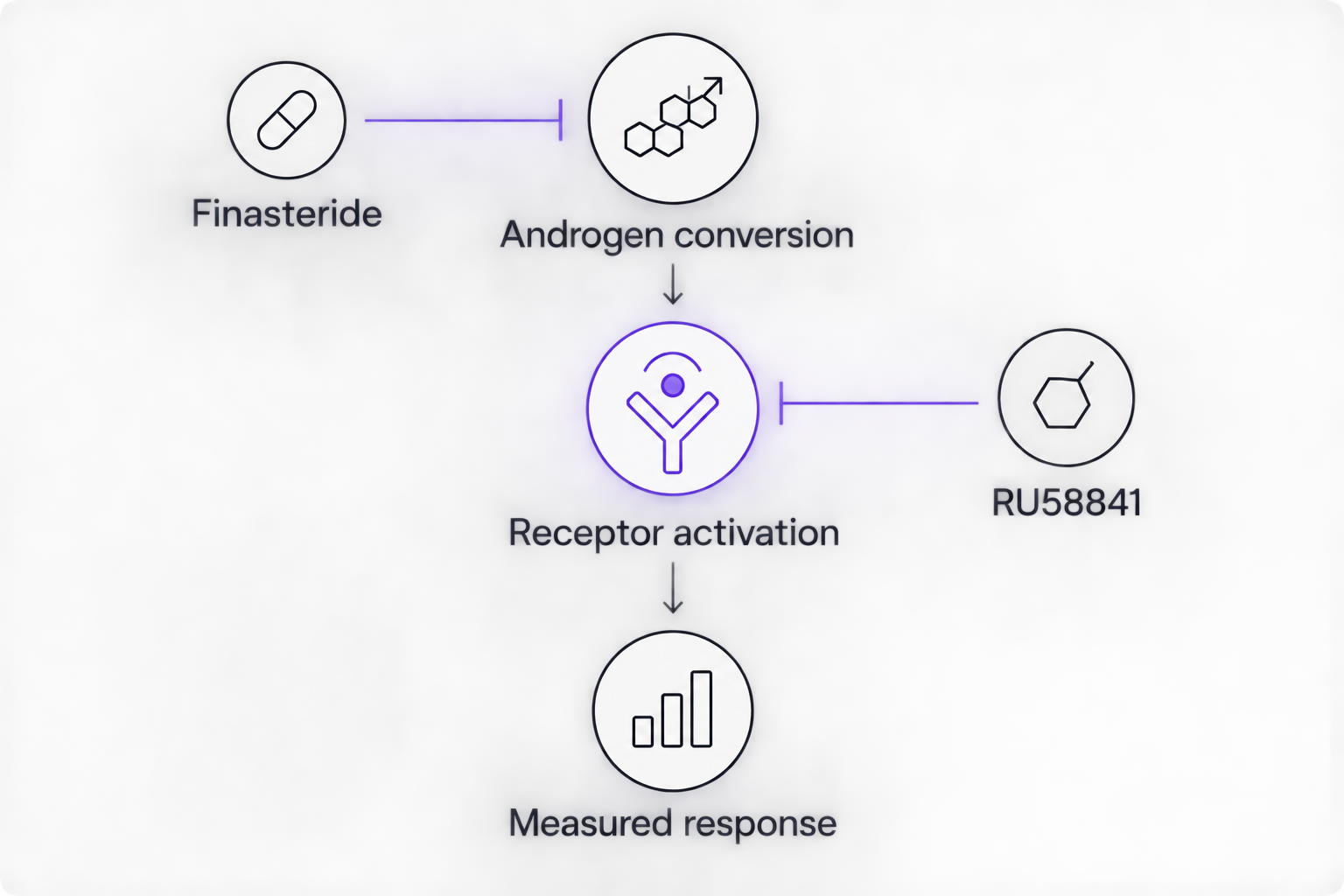
A shared downstream response is not evidence of a shared molecular target. This is the central interpretation rule for the comparison.
What does RU58841 establish in receptor research?
Binding and antagonism answer different questions
A receptor-binding assay evaluates interaction with the receptor under defined conditions. A functional assay evaluates the consequences of that interaction, such as changes in androgen-responsive transcription. Binding supports target engagement; functional antagonism requires evidence about the receptor-mediated response. [1,3]
Neither measurement directly establishes inhibition of steroid 5-alpha reductase. Assigning that additional mechanism requires separate enzyme-directed evidence rather than an inference from the compound's antiandrogen classification.
Receptor context changes interpretation
Androgen-receptor abundance, receptor sequence, and transcriptional cofactors influence the observed signal. Results from one receptor system therefore need their own context before comparison with another. A compound's name alone does not establish identical behavior across preparations. [3]
RU58841's methodological advantage is its relevance to receptor antagonism. Its interpretive limitation is that reduced signaling, considered alone, cannot exclude nonspecific interference or demonstrate an upstream enzyme effect.
What does finasteride establish in enzyme research?
Conversion is the relevant biochemical endpoint
For finasteride, the mechanistically relevant measurement is the conversion of testosterone to DHT in an enzyme-defined system. Measuring substrate and product addresses the conversion step more directly than measuring a downstream transcriptional response. [2]
The enzyme source and isoenzyme assignment belong beside the result. A statement that a compound inhibits “5-alpha reductase” without identifying the system leaves an important part of the evidence undefined.
Enzyme inhibition is not receptor blockade
Finasteride's established enzyme mechanism does not make it an androgen-receptor antagonist. A reduction in DHT formation can change downstream receptor signaling without direct receptor antagonism by the test compound. [2,3]
That upstream specificity is useful when the question concerns androgen conversion. It is a limitation when an experiment requires a receptor-level comparator: an enzyme inhibitor cannot automatically fill that role.
Why do RU58841 and finasteride results vary between assays?
The principal drivers concern the experimental system, not an assumed equivalence between the compounds:
- Enzyme identity: The expressed 5-alpha-reductase isoenzyme determines which conversion system is being examined.
- Ligand identity: Testosterone-dependent and DHT-dependent receptor responses interrogate different relationships to the conversion step.
- Receptor context: Receptor abundance, sequence, and cofactors influence functional signaling.
- Endpoint selection: Binding, steroid conversion, and transcription describe different biological events.
- Material composition: A single compound and a mixture do not support the same causal attribution.
- Analytical interference: Matrix effects, reporter interference, and compromised cellular integrity can obscure target-specific interpretation.
For a 2026 evidence comparison, record these factors alongside each result. Do not compare isolated potency figures as though assay conditions were interchangeable.
Which measurements distinguish the mechanisms?
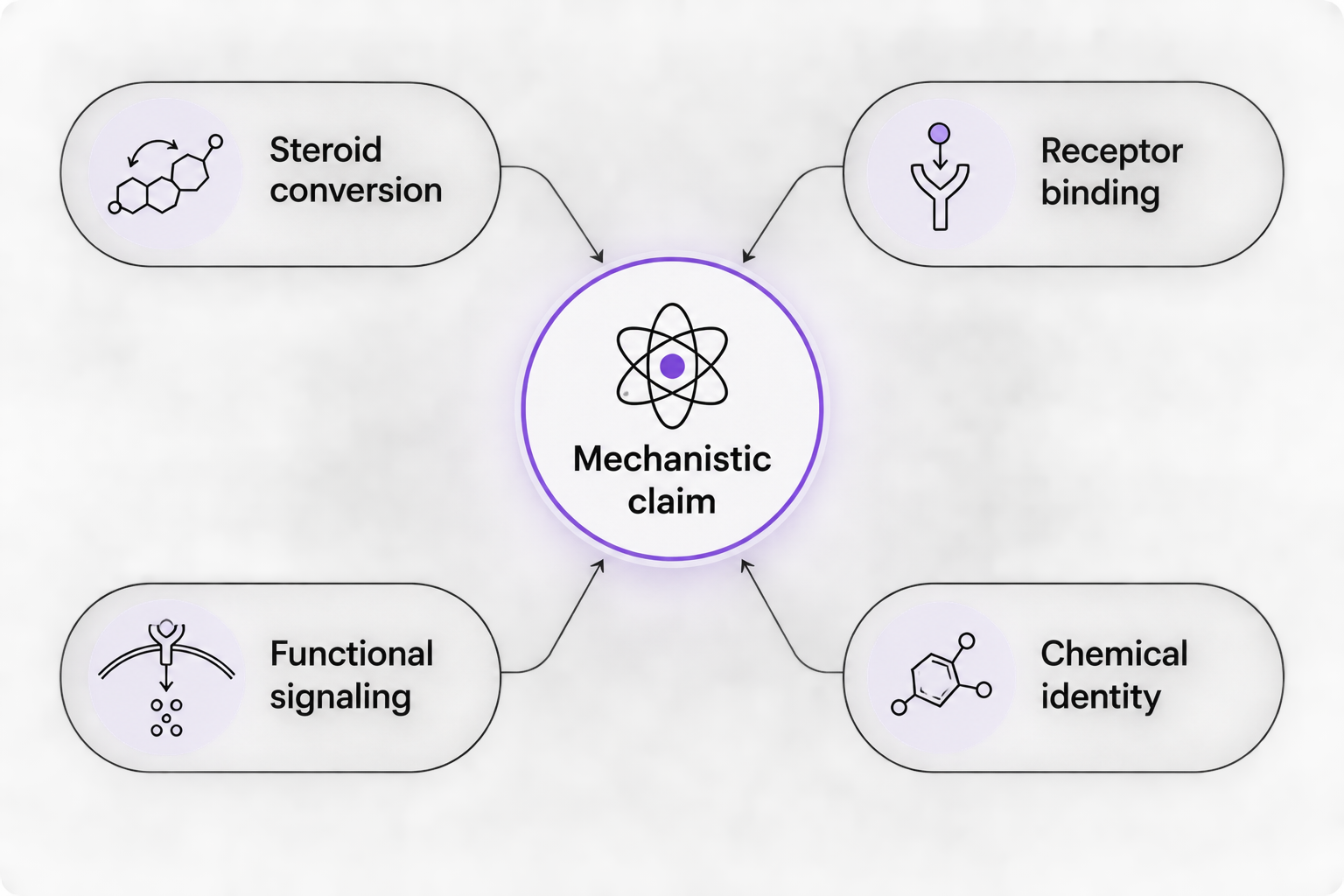
Steroid conversion
A steroid-conversion measurement examines testosterone and DHT as chemically distinct analytes. Appropriate analytical selectivity matters: a signal assigned to DHT must be distinguishable from related steroids and matrix components.
Receptor binding
A receptor-binding measurement addresses compound interaction with the androgen receptor. It does not independently establish transcriptional antagonism, cellular selectivity, or inhibition of an androgen-synthesis enzyme.
Functional signaling
A functional receptor assay measures a downstream response. Its interpretation requires controls that distinguish receptor-dependent activity from nonspecific signal suppression. Functional activity and chemical identity should remain separate claims.
| Measurement | What it supports | What it does not establish alone |
|---|---|---|
| Steroid conversion | Changes in testosterone-to-DHT conversion | Direct androgen-receptor antagonism |
| Receptor binding | Interaction with the androgen receptor | Functional antagonism or enzyme inhibition |
| Functional signaling | Changes in an androgen-responsive endpoint | The initiating molecular target |
| Chemical identity | Consistency with the expected compound | Biological activity or selectivity |
These are evidence categories, not laboratory operating instructions. The useful conclusion is narrower than a protocol: match the mechanistic claim to a measurement that directly addresses it.
Why does research-material composition matter?
A mixture containing RU58841 and finasteride cannot establish that RU58841 itself inhibits 5-alpha reductase. The enzyme inhibitor is already present as a separate constituent. Any mechanistic attribution must distinguish the contributions of the components.
The supplied 4-Amino-Labs catalog lists RU58841 separately and also lists ONYX, a formulation containing RU58841, finasteride, and dutasteride. These materials are relevant to the composition question, but they are not interchangeable mechanistic references. A mixed formulation does not isolate RU58841 pharmacology.
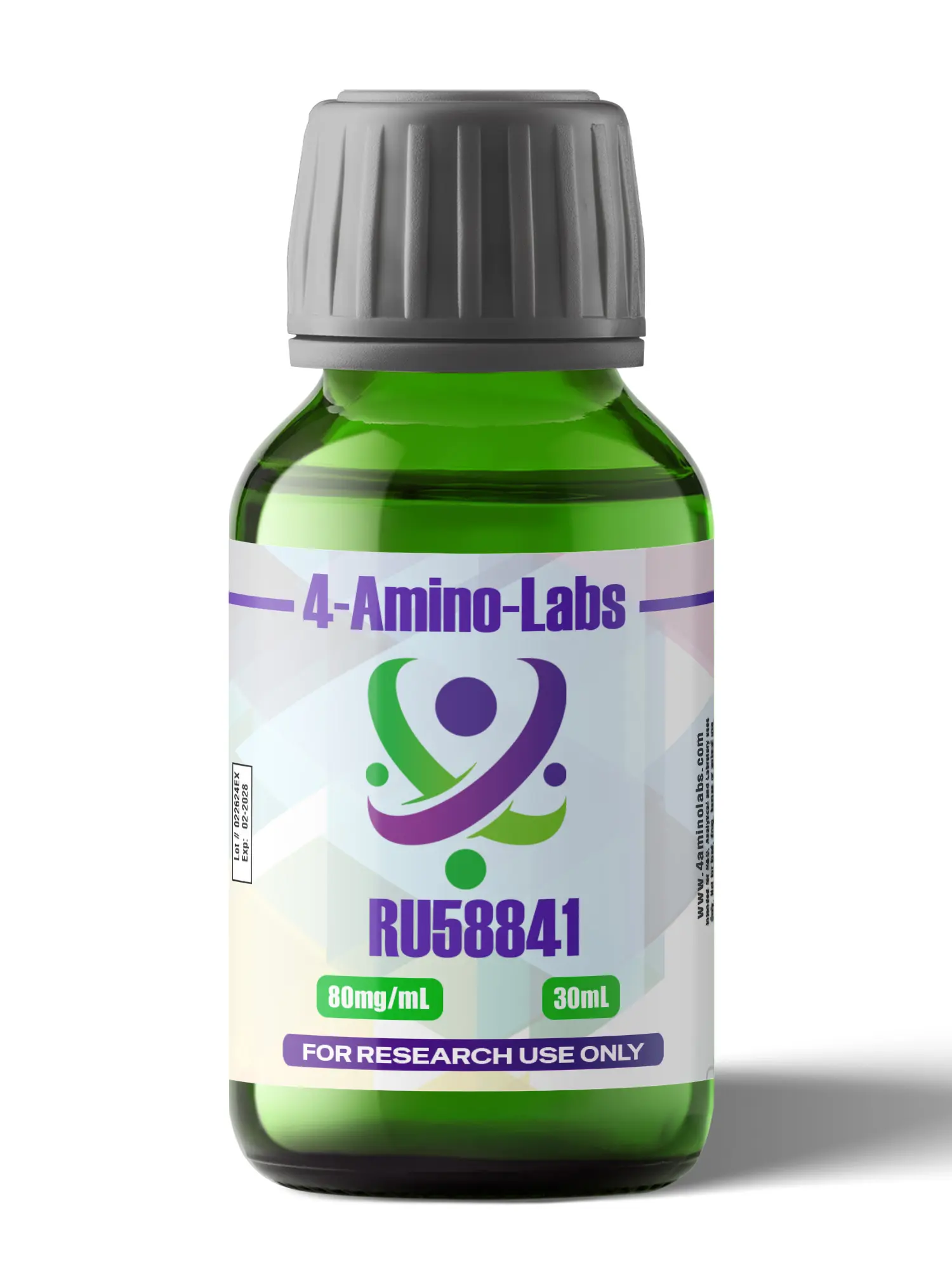
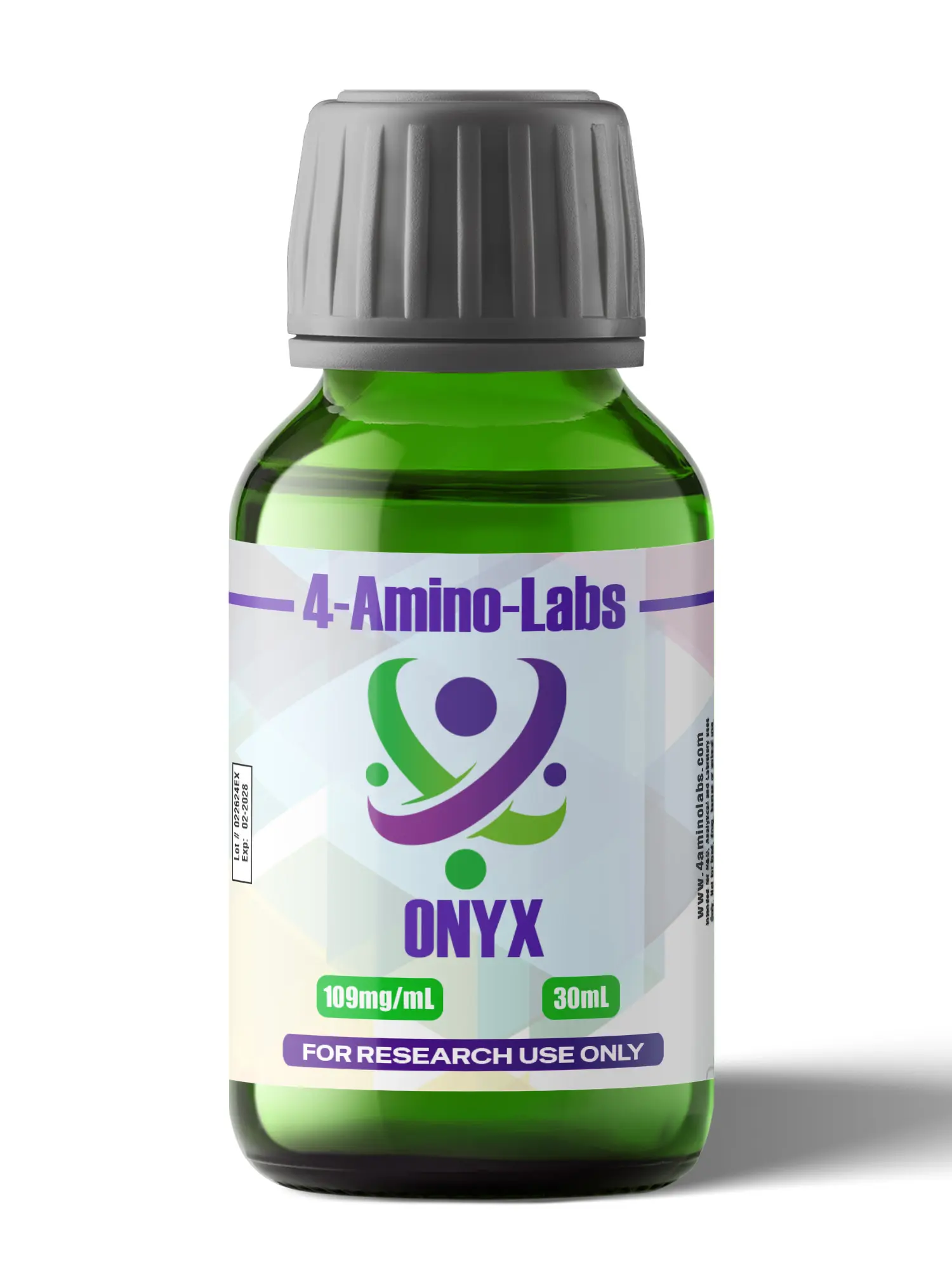
For 2026 material review, request documentation that connects the received material to its identity, composition, and analytical results. A catalog description is not a substitute for batch-specific evidence.
Identity evidence
Identity evidence addresses whether the material is consistent with the named compound. Molecular mass is useful here, but a mass match alone does not fully establish structure or exclude every related impurity.
Composition evidence
Composition evidence addresses what else is present. This distinction is especially important when comparing a nominally single-compound material with a formulation containing several pharmacologically active constituents.
Batch traceability
Batch traceability connects the analytical record to the material examined. For 4-Amino-Labs research materials, evaluate the documentation supplied for the actual batch rather than transferring specifications between unrelated catalog entries.

What are the limits of this comparison?
This 2026 review distinguishes established target classes; it does not establish that either compound has absolute selectivity under every conceivable condition. Demonstrating an additional target requires direct evidence with appropriate analytical and biological controls.
The comparison also does not establish batch purity, stability, receptor occupancy, or an experimental potency value for any catalog material. Those are separate questions requiring compound-specific evidence. Findings about finasteride must not be transferred to RU58841, and findings about a mixture must not be assigned to a single constituent.
No human or animal application is addressed. All material references concern laboratory research and analytical characterization only.
FAQ
Does RU58841 inhibit 5-alpha reductase like finasteride?
No. RU58841 is characterized as an androgen-receptor antagonist, whereas finasteride inhibits steroid 5-alpha reductase, principally type 2. A shared downstream response does not establish a shared target.
Is RU58841 the same type of research compound as finasteride?
No. RU58841 is a nonsteroidal androgen-receptor antagonist, while finasteride is a steroidal enzyme inhibitor. Their established mechanisms interrogate different steps in androgen signaling.
Does a reduced androgen-receptor reporter signal prove enzyme inhibition?
No. A reduced reporter signal establishes a change in that functional readout, not its initiating cause. Enzyme inhibition requires evidence directed at the conversion reaction.
Can finasteride serve as a direct androgen-receptor antagonist reference?
Finasteride cannot be assumed to serve as a direct androgen-receptor antagonist reference. Its established research role concerns inhibition of testosterone-to-DHT conversion.
Can a mixture containing RU58841 and finasteride establish RU58841’s enzyme activity?
No. A mixture containing finasteride does not isolate RU58841’s contribution to an enzyme-related result. Component-specific evidence is necessary for mechanistic attribution.
What documentation matters when evaluating RU58841 research material?
Identity, composition, and batch traceability are central documentation categories. Chemical characterization supports material assessment but does not independently prove receptor antagonism or enzyme inhibition.
One last thing
Name the measured event before naming the mechanism. “Reduced DHT formation” and “reduced androgen-responsive transcription” are not equivalent statements. Keeping those descriptions separate prevents the original classification error: calling every antiandrogen a 5-alpha-reductase inhibitor.
References
- Battmann T, et al. RU 58841, a new specific topical antiandrogen: a candidate of choice for the treatment of androgenetic alopecia. Journal of Steroid Biochemistry and Molecular Biology. Primary pharmacological characterization of RU58841.
- Russell DW, Wilson JD. Steroid 5 alpha-reductase: two genes/two enzymes. Annual Review of Biochemistry. Review of steroid 5-alpha-reductase biochemistry and isoenzymes.
- Davey RA, Grossmann M. Androgen Receptor Structure, Function and Biology: From Bench to Bedside. Clinical Biochemist Reviews. Review of androgen-receptor structure and signaling.
- PubChem compound records: RU58841, Finasteride, and Dihydrotestosterone. Chemical identity and molecular-mass reference entries.
Related guides
- Connecting batch numbers to lab inventory tracking
- Connecting research chemical purchases to a lab notebook
- Analytical reagents for pharma QC labs
Research use only. 4-Amino-Labs materials discussed here are for laboratory research and analytical work only, not human or animal use. This content is not medical advice and is not intended to diagnose, treat, cure, or prevent disease.