
IGF-1 LR3 has no universally applicable stability period after reconstitution: a defensible storage interval must come from stability data for the specific formulation, container, and storage conditions. Chemical identity, soluble recovery, and receptor-related activity are different endpoints, so a clear solution or an initial purity result cannot establish all three. This guide addresses research-material characterization only, not human or animal use.
- IGF-1 LR3 stability after reconstitution requires formulation-specific evidence, not a generic expiration estimate.
- IGF-1 LR3 contains 83 amino acids; its structural modifications do not establish solution stability.
- Chromatographic purity, soluble recovery, and biological activity answer different stability questions.
- For 4-Amino-Labs research materials, match any storage claim to the applicable batch documentation.
How long does IGF-1 LR3 stay stable once reconstituted?
Use the interval supported by the applicable stability study—not a duration borrowed from another peptide, formulation, or supplier. A stability claim needs a defined starting material, documented storage conditions, suitable analytical methods, and acceptance criteria. ICH Q5C provides the relevant framework for evaluating biological-product stability; it does not assign a storage period to IGF-1 LR3. [1]
For your 2026 laboratory records, distinguish the original material's expiration date from any supported interval after solution preparation. These describe different material states and require different evidence. The research peptide storage guide provides related context for organizing storage records.
| Evidence available | What it supports | What it does not establish |
|---|---|---|
| Initial identity and purity results | Characterization at the tested time point | Stability throughout later storage |
| Written storage instructions | Conditions specified for that material | Performance outside those conditions |
| Time-point testing under defined conditions | Change over the tested interval | An unrestricted extension beyond the study |
| Qualified functional testing | Activity in the specified assay | Chemical identity or contamination control by itself |
The practical distinction is between an instruction and its supporting evidence. Keep both together when a research result depends on stored material retaining defined properties.
Why this matters for research interpretation
An apparent change in a receptor-based experiment can originate in the material rather than the biological system. Changes in soluble recovery, chemical composition, or aggregation complicate comparisons between experiments performed with differently handled samples. Protein stability assessment therefore requires more than visual inspection. [1, 2]
Treat storage history as part of sample identity in your 2026 study records. The relevant question is not simply whether a vial remains presentable; it is whether the material still meets the attributes required for the intended measurement.
A narrow analytical claim is more useful than a broad unsupported assurance. For example, unchanged chromatographic results support a statement about the measured chromatographic attributes, not an automatic statement about receptor activation.
What makes IGF-1 LR3 different from native IGF-I?
Sequence length and modifications
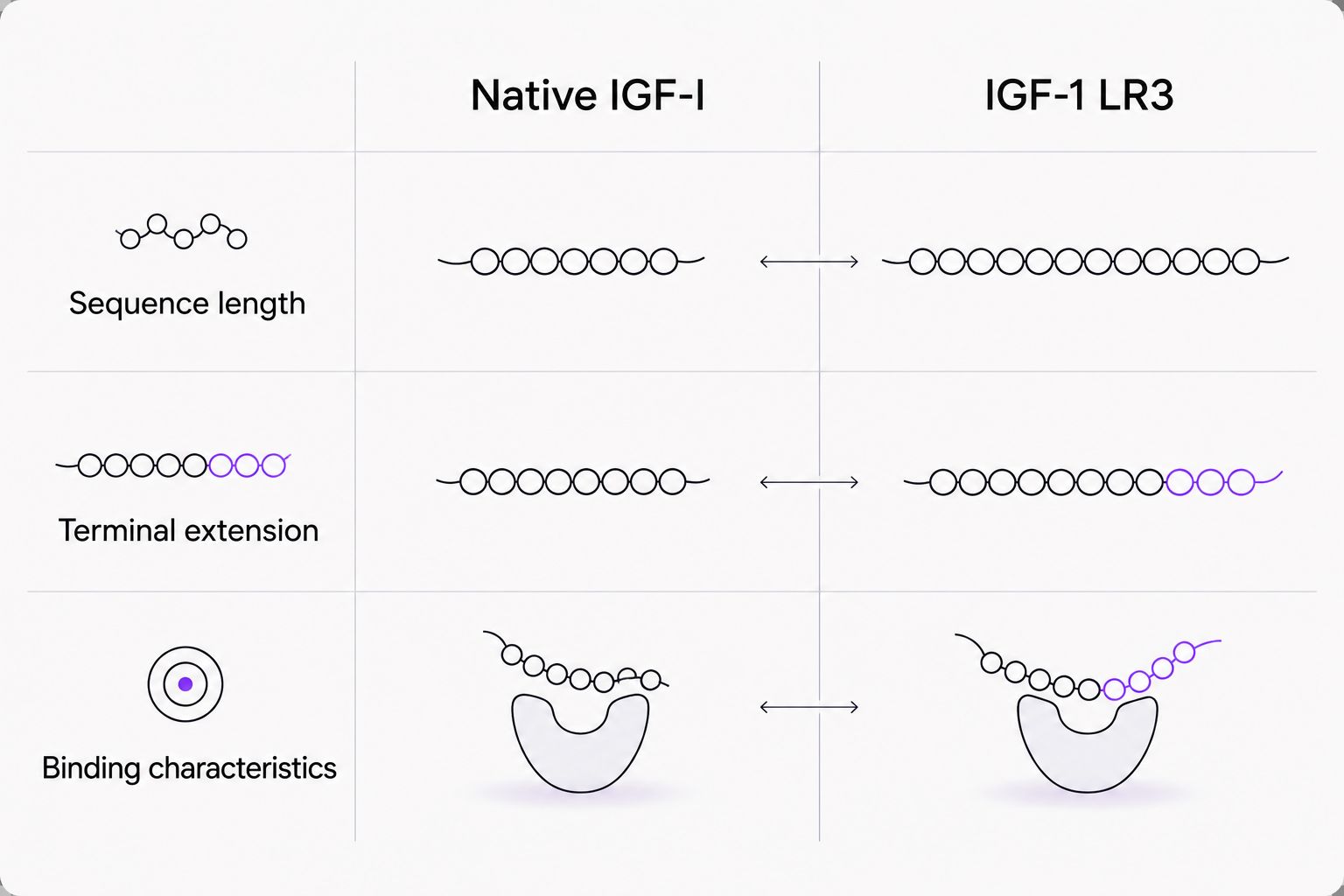
Native IGF-I contains 70 amino acids. IGF-1 LR3 contains 83 amino acids, including a 13-amino-acid N-terminal extension, and has an arginine substitution at position three of the native IGF-I sequence. These are defining structural differences, not storage specifications. [3]
The extension accounts for the difference in sequence length. The substitution changes residue identity without adding another residue.
| Structural feature | Native IGF-I | IGF-1 LR3 |
|---|---|---|
| Sequence length | 70 amino acids | 83 amino acids |
| N-terminal extension | No LR3 extension | 13 amino acids |
| Native-sequence position three | Glutamate | Arginine |
| Research interpretation | Native reference sequence | Modified analogue with distinct binding characteristics |
Receptor and binding-protein context
IGF-I receptor activation initiates intracellular signaling that includes PI3K–AKT and RAS–MAPK pathways. IGF-binding proteins influence ligand availability, making binding-protein interactions relevant when comparing IGF-I analogues. Research on modified IGF-I analogues distinguishes receptor binding from binding-protein interactions. [3, 4]
Altered binding-protein affinity does not establish greater stability in a laboratory solution. Binding behavior and storage degradation address different mechanisms and need separate measurements.
What does stability actually mean?
Chemical integrity
Chemical stability concerns whether the material retains its intended molecular composition. Protein degradation can involve oxidation, deamidation, cleavage, or other chemical changes, depending on sequence and environment. These are general protein-stability mechanisms, not proof that a particular IGF-1 LR3 batch has undergone them. [2]
A suitable chromatographic method can track resolved changes. Mass spectrometry adds molecular-mass information, but the interpretation still depends on the method's coverage and ability to distinguish relevant species.
Physical integrity
Physical stability concerns properties such as aggregation, precipitation, and loss through surface interactions. A solution can lose recoverable material without producing an obvious visible change. Conversely, visible particles do not identify their own composition. [2]
For research interpretation, distinguish the proportion of a measured component from the amount recovered. A chromatogram expressed as relative peak areas does not automatically measure the total quantity remaining in solution.
Functional activity
Functional stability concerns retention of a defined activity in a qualified assay. Receptor-related measurements address a different question from molecular mass or chromatographic peak distribution. ICH Q5C recognizes that biological-product stability assessment requires methods appropriate to the relevant quality attributes. [1]
A functional result is also assay-specific. Document the measured endpoint rather than relabeling it as proof that every property of the material remains unchanged.
| Analytical approach | Primary question | Main limitation |
|---|---|---|
| Chromatography | Has the resolved component profile changed? | Unresolved species and detector response limit interpretation |
| Mass spectrometry | Does measured mass support the expected identity? | Mass alone does not establish folding or activity |
| Soluble-content measurement | How much material remains recoverable? | Recovery does not prove molecular integrity |
| Functional assay | Is the defined activity retained? | Activity does not replace identity or contamination testing |
Why IGF-1 LR3 stability varies
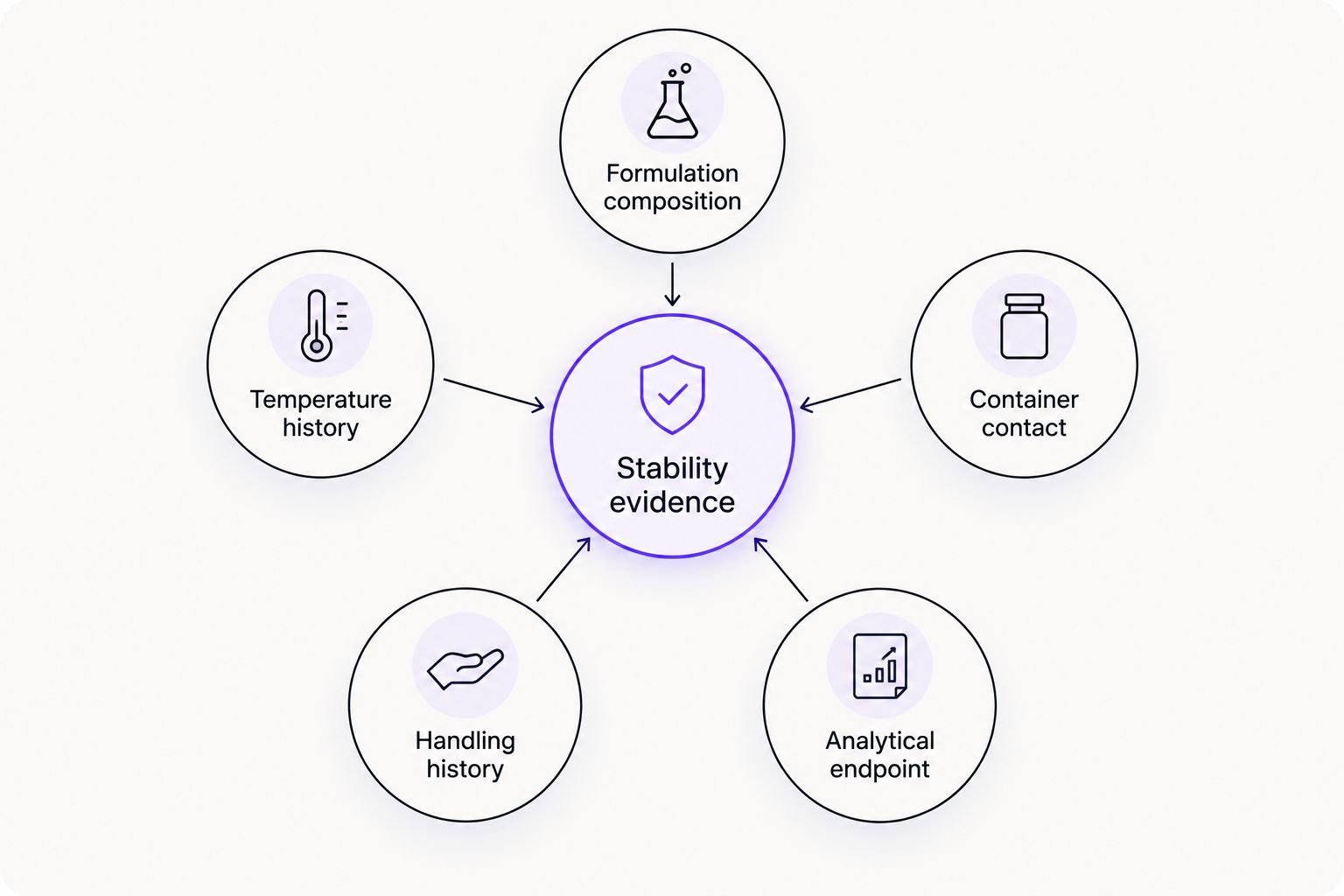
Protein stability depends on the formulation and its handling environment. The following factors belong in the interpretation of a stability claim; none supplies a universal duration on its own. [1, 2]
- Formulation composition: Solution chemistry affects molecular interactions and degradation pathways. Evidence from one formulation does not automatically transfer to another.
- Temperature history: A stated storage condition does not describe undocumented excursions or repeated transitions between conditions.
- Container contact: Surface interactions can influence recoverable protein, making the container part of the tested system.
- Handling history: Repeated processing and transfers introduce variables that an untouched retained sample does not represent.
- Analytical endpoint: A claim based on appearance is narrower than one supported by chemical, physical, and functional measurements.
- Study coverage: The tested duration and sampling design determine the interval that the results actually support.
For a 2026 assessment, record what happened to the sample rather than relying only on where it was nominally stored. An equipment setting and a documented sample history are not equivalent records.
What documentation supports a storage interval?
Match the evidence to the material
Start with the material identifier, batch identifier, formulation description, container, and specified storage conditions. A document for a related analogue is not a substitute. Neither is a general peptide-storage statement detached from the actual material.
When assessing 4-Amino-Labs research materials, keep the applicable product documentation separate from general educational guidance. The guide to verifying peptide purity with third-party COA testing explains a related documentation topic; an initial certificate remains distinct from a stability study.
Read the claim at its actual scope
A useful stability statement identifies what was measured and when. Look for the analytical method, tested conditions, time points, and acceptance criteria rather than an isolated conclusion such as unchanged or acceptable. ICH Q6B explains the role of tests and acceptance criteria in characterizing biological materials. [5]
Ask whether the document describes the original supplied state or the prepared solution. Also distinguish real-time storage evidence from stress testing intended to reveal degradation pathways.
Preserve the chain of records
For your 2026 review, connect the batch record, preparation record, storage history, and analytical report. This makes it possible to distinguish a material problem from a documentation gap without assigning an unsupported expiration date.
A supplier name is not a stability endpoint. For 4-Amino-Labs research chemicals, as for any other research source, the decision should rest on material-specific documentation and measurements.
Does a clear solution prove IGF-1 LR3 is stable?
No. A clear solution establishes only the absence of visible changes under the observation conditions. It does not establish intact molecular structure, unchanged concentration, retained receptor-related activity, or absence of contamination. [1, 2]
Visual inspection remains useful as a screen for obvious change. Its limitation is scope: an appearance check cannot replace the analytical methods required to answer a molecular or functional question.
If appearance changes, document the observation without assigning a mechanism from appearance alone. Cloudiness is an observation, not a chemical identification.
Does higher initial purity mean a longer storage interval?
No. Initial purity and subsequent stability describe different properties. A high initial chromatographic purity result characterizes the tested sample at that time; it does not establish its future degradation rate. [1, 5]
The analytical method also matters. Relative peak area, absolute content, identity, and functional activity are not interchangeable measures, even when they appear together in one report.
Do not convert an initial purity percentage into a storage duration. That conversion requires time-dependent evidence, not a stronger adjective on the certificate.
What should a laboratory do with an unsupported duration claim?
Treat the duration as unsubstantiated until its conditions and supporting measurements are identified. Do not turn a supplier statement, forum estimate, or result for another peptide into a validated interval for the material under review.
A documentation review should separate three questions:
- Material identity: Does the evidence refer to the same compound and formulation?
- Study conditions: Does the evidence cover the relevant container and handling history?
- Measured endpoint: Does the evidence address the attribute required for your research?
These questions organize the evidence; they do not constitute a product-preparation procedure. Keep decisions about research-material suitability within your laboratory's established quality system.

This distinction prevents a common documentation error: accepting a precise duration while leaving the underlying definition of stable unspecified.
Limitations of this assessment
This 2026 guide explains how to evaluate stability evidence; it does not establish a storage interval for an individual batch. The cited literature supports structural distinctions, receptor context, and general biological-material stability principles—not a universal expiration date for prepared IGF-1 LR3 solutions.
Native IGF-I and IGF-1 LR3 are not interchangeable reference materials. Evidence about binding behavior, chemical stability, or functional performance must remain attached to the compound and experimental conditions actually studied.
FAQ
How long does IGF-1 LR3 stay stable after reconstitution?
IGF-1 LR3 has no universally applicable post-reconstitution stability period. Use an interval supported by evidence for the specific formulation, container, storage conditions, and measured endpoints.
Does IGF-1 LR3 have the same stability as native IGF-I?
Stability evidence for native IGF-I does not automatically apply to IGF-1 LR3. IGF-1 LR3 has structural modifications, so the materials require separately scoped evidence.
Can I judge IGF-1 LR3 stability by looking at the solution?
Visual appearance alone cannot establish IGF-1 LR3 stability. A clear solution does not prove unchanged identity, soluble recovery, or functional activity.
Does an initial certificate of analysis prove continued stability?
An initial certificate of analysis does not by itself prove continued stability. It characterizes the tested sample at a particular time unless it explicitly includes relevant stability results.
Does mass spectrometry prove that IGF-1 LR3 remains active?
Mass spectrometry alone does not prove retained IGF-1 LR3 activity. Molecular-mass evidence and functional measurements address different attributes.
Which records matter when reviewing a stability claim?
Material identity, formulation, container, storage history, analytical methods, time points, and acceptance criteria matter when reviewing a stability claim. Keep these records linked to the applicable batch.
One last thing
A precise duration is not useful unless stable has a defined analytical meaning. Before accepting any interval, identify the attribute that remained within its acceptance criteria. That question is more informative than comparing unsupported expiration estimates.
References
- International Council for Harmonisation. Q5C: Quality of Biotechnological Products: Stability Testing of Biotechnological/Biological Products. Framework for stability-indicating evaluation of biological materials.
- Wang W. Instability, stabilization, and formulation of liquid protein pharmaceuticals. International Journal of Pharmaceutics. Review of protein chemical and physical instability mechanisms.
- Francis GL and colleagues. Novel recombinant fusion protein analogues of insulin-like growth factor (IGF)-I indicate the relative importance of IGF-binding protein and receptor binding for enhanced biological potency. Journal of Molecular Endocrinology. Structural and binding context for modified IGF-I analogues.
- LeRoith D, Werner H, Beitner-Johnson D, Roberts CT Jr. Molecular and cellular aspects of the insulin-like growth factor I receptor. Endocrine Reviews. IGF-I receptor and downstream signaling context.
- International Council for Harmonisation. Q6B: Specifications: Test Procedures and Acceptance Criteria for Biotechnological/Biological Products. Framework for characterization, testing, and acceptance criteria.
Related guides
- Connecting batch numbers to laboratory inventory tracking
- Tracking cold-chain peptide shipping
- Connecting research chemical purchases to a lab notebook
Research use only. 4-Amino-Labs research materials are discussed solely in a laboratory research context. This content is not medical advice and is not intended to diagnose, treat, cure, or prevent disease.