
Yes—lidocaine hydrochloride can be used for non-clinical research involving voltage-gated sodium channels, analytical method development, and chemical characterization, provided the material is qualified for the intended experiment. This 2026 guide addresses in vitro and analytical research only; a research-use-only label does not establish identity, purity, reference-standard status, or suitability for a particular assay.
- Lidocaine HCl for non-clinical research use requires confirmed chemical identity, salt form, and batch-specific analytical documentation.
- Lidocaine blocks voltage-gated sodium channels; experimental conditions influence the measured response.
- Anhydrous lidocaine hydrochloride and its monohydrate have different formula masses and are not interchangeable by mass.
- 4-Amino-Labs research-chemical sourcing should be evaluated through material documentation, not category labels alone.
Can lidocaine HCl be used for non-clinical research?
Lidocaine hydrochloride is a research material for sodium-channel pharmacology and analytical chemistry, but the intended measurement determines the required material specifications. A compound suitable for exploratory characterization is not automatically a qualified calibration standard or an adequately characterized material for a functional assay.
The relevant distinction is between chemical identity and experimental fitness. Confirming the name on a container answers neither the question of assay interference nor the question of quantitative traceability.
| Research application | What lidocaine contributes | Main limitation | Required qualification |
|---|---|---|---|
| In vitro sodium-channel characterization | A compound with established sodium-channel-blocking activity | Response depends on channel state and assay conditions | Identity, content, matrix compatibility, and functional controls |
| Chromatographic method development | A defined small-molecule analyte | A resolved peak does not prove quantitative accuracy | Identity confirmation and an appropriate reference material |
| Mass-spectrometric characterization | An analyte for evaluating molecular identity | Detection alone does not establish purity or content | Orthogonal identity evidence and impurity assessment |
| Stability investigation | A material whose composition can be followed over time | Results apply only to the investigated conditions | Initial characterization and a stability-indicating method |
For broader analytical context, the guide to analytical reagents for forensic toxicology labs addresses a related laboratory category. Its scope does not replace compound-specific qualification.
Why this matters
A chemically correct material can still produce an uninterpretable experiment. An undocumented hydrate state affects mass-based calculations; an interfering impurity affects analytical selectivity; an uncontrolled assay condition affects the functional endpoint.
Keep those questions separate. Material qualification establishes what enters the experiment; assay validation establishes what the measurement means.
How does lidocaine interact with sodium channels?
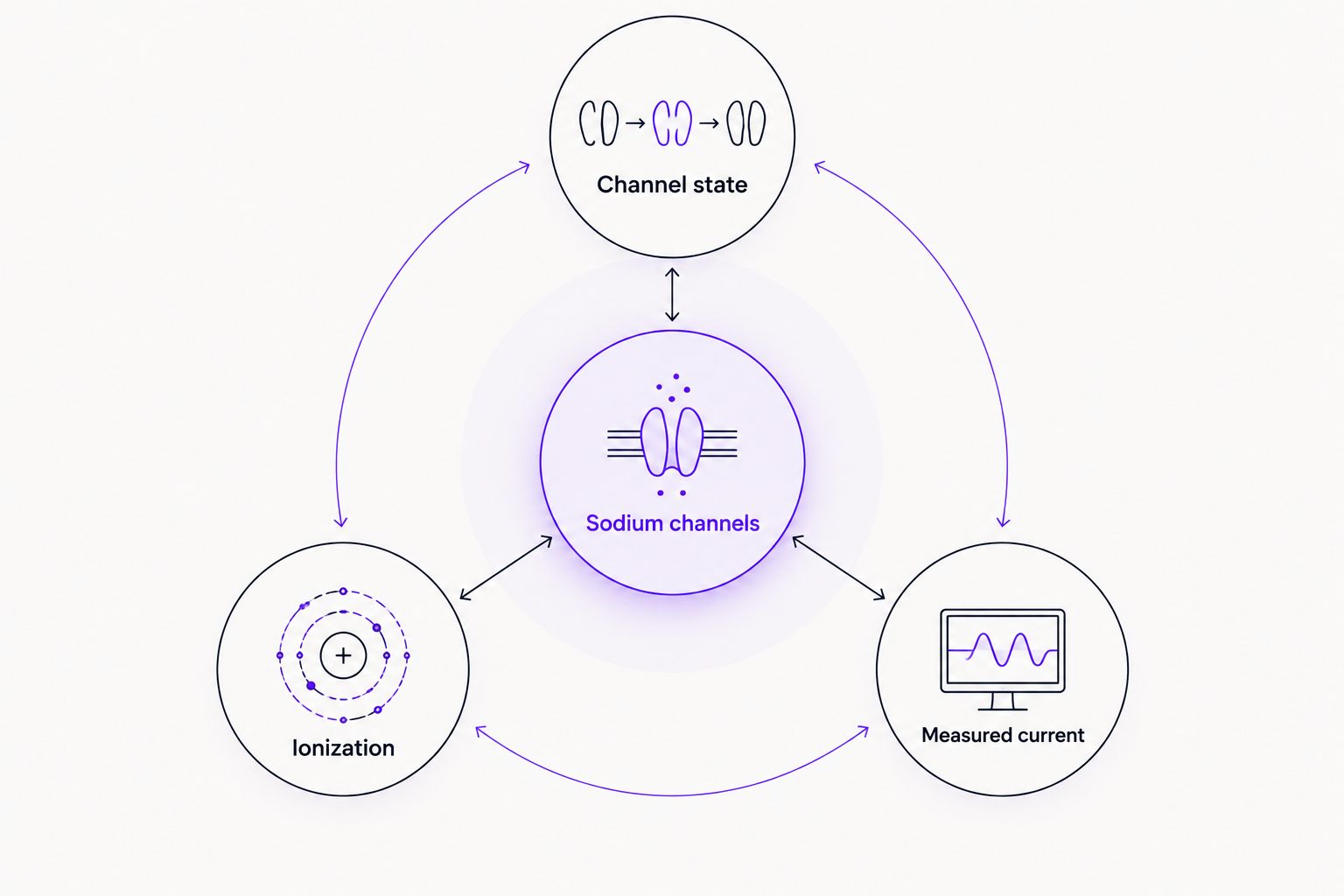
Lidocaine interacts with voltage-gated sodium channels and reduces sodium current under appropriate experimental conditions. Channel conformation and access to the binding region influence the interaction, so a single response value does not describe every experimental system. [1, 2]
Channel state matters
Voltage-gated sodium channels occupy resting, open, and inactivated states. Lidocaine block is state-dependent: the observed interaction changes with the channel-state distribution established by the measurement conditions. Repeated activation can also change the extent of observed block. [1, 2]
This distinction matters when comparing published results. Different channel constructs, expression systems, and electrical recording conditions do not automatically yield directly comparable measurements.
Ionization matters
Lidocaine contains a basic amine, so protonated and unprotonated species coexist according to solution conditions. The hydrochloride designation describes the supplied salt; it does not mean the molecule remains in a single fixed ionization state throughout an experiment. [1]
The classic mechanistic distinction involves hydrophilic and hydrophobic access pathways. That framework explains why solution conditions and channel state belong in the interpretation, rather than treating block as a property independent of the experimental system. [1]
What the mechanism does not establish
A known mechanism does not demonstrate that every observed cellular change is caused exclusively by sodium-channel block. Nor does it establish that an unidentified research batch has the expected composition.
Use channel-specific measurements and suitable controls to distinguish the intended endpoint from broader assay effects. Do not transfer a conclusion from one channel subtype or experimental system to another without supporting evidence.
Which chemical form is being evaluated?
Lidocaine free base has a formula mass of 234.34 g/mol. Anhydrous lidocaine hydrochloride has a formula mass of 270.80 g/mol, while lidocaine hydrochloride monohydrate has a formula mass of 288.81 g/mol. These values describe different chemical forms, not different purity grades. [3]
Free base versus hydrochloride
The free base and hydrochloride share the lidocaine molecular component, but their complete compositions differ. The hydrochloride includes the counterion; the monohydrate additionally includes water of crystallization.
Consequently, equal weighed masses do not represent equal amounts of the lidocaine molecular component. A comparison that ignores the documented chemical form introduces an avoidable calculation error before analytical or functional testing begins.
| Chemical form | Molecular formula | Formula mass | Principal documentation question |
|---|---|---|---|
| Lidocaine free base | C14H22N2O | 234.34 g/mol | Does the identity record specify the free base? |
| Anhydrous lidocaine hydrochloride | C14H23ClN2O | 270.80 g/mol | Is the reported content expressed on an anhydrous basis? |
| Lidocaine hydrochloride monohydrate | C14H25ClN2O2 | 288.81 g/mol | Is the hydrate state documented and accounted for? |
Non-interchangeability warning: do not substitute free base, anhydrous hydrochloride, and hydrochloride monohydrate on a mass-for-mass basis. Verify the chemical form before interpreting a reported concentration or comparing material records.
Hydrate identity is not a stability result
A monohydrate designation identifies a chemical form. It does not, by itself, establish how the material behaves after storage or under analytical conditions.
Likewise, a supplier's storage statement does not demonstrate stability in every experimental matrix. Stability conclusions require measurements under the conditions to which the conclusion applies.
Why does research suitability vary?
Suitability varies because material specifications and experimental requirements answer different questions. For a 2026 laboratory assessment, evaluate the following factors separately rather than collapsing them into a single purity claim:
- Chemical form: free base, anhydrous hydrochloride, and monohydrate require distinct identity records and calculation bases.
- Identity evidence: chromatographic behavior alone provides less structural discrimination than complementary analytical evidence.
- Content basis: chromatographic area percentage is not automatically equivalent to mass-based assay content.
- Impurity profile: a minor component can interfere with detection or with a functional endpoint.
- Experimental matrix: solution conditions influence ionization, analytical behavior, and assay compatibility.
- Measurement conditions: channel subtype, channel state, and recording conditions influence pharmacological interpretation.
A strong qualification record makes these distinctions visible. An isolated purity percentage leaves too many of them unresolved.
What analytical evidence should a laboratory review?
Use complementary methods to answer different analytical questions. Chromatography, mass spectrometry, and structural characterization are not interchangeable certificates of quality; each contributes a different kind of evidence.
Identity evidence
Mass spectrometry supports molecular identity through observed ions and fragmentation information. Nuclear magnetic resonance provides structural information. Chromatographic retention can support a comparison with an authenticated material, but retention alone is not definitive identification.
Review the method, the actual result, and the acceptance criterion. A document that merely lists an instrument name does not show how the identity conclusion was reached.
Purity and content
Chromatographic area purity describes detector response under the reported method. It does not automatically account for water, inorganic material, residual solvents, or compounds that respond differently to that detector.
Quantitative content therefore needs its own stated basis. If a certificate reports an assay result, determine what was measured, how the result was calculated, and whether the stated chemical form matches the material being assessed.
Traceability evidence
The container identifier, certificate identifier, and laboratory inventory entry should refer to the same batch. Otherwise, even a detailed certificate cannot establish the characteristics of the material actually under evaluation.
The guide to connecting batch numbers to lab inventory tracking covers the recordkeeping side of that distinction.

A certificate of analysis is evidence to evaluate, not a substitute for evaluation. Its usefulness depends on whether the reported methods and results address the laboratory's intended measurement.
How should sourcing fit into the research decision?
For 4-Amino-Labs research-chemical sourcing, apply the same documentation criteria used for any supplier. The brand name does not replace confirmation of the compound, chemical form, batch identity, and analytical basis.
A useful 2026 sourcing decision starts with the experiment's required characteristics and then checks the documentation against them. It does not begin with a general category label and assume the necessary qualification follows.
Separate supplier evaluation from material acceptance
Supplier evaluation concerns the quality and traceability of the information provided. Material acceptance concerns whether the particular batch meets your laboratory's predefined requirements.
Keep those decisions distinct in the laboratory record. Documentation can be clear yet insufficient for a demanding quantitative application; a material can have useful exploratory applications without qualifying as a certified reference material.
For 4-Amino-Labs research materials, request compound-specific evidence rather than inferring specifications from the broader catalog description. Claims about certification, independent testing, or analytical performance require their own supporting records.
Does research-grade mean reference-standard quality?
No. A research-grade description does not establish certified reference material status, metrological traceability, or suitability for calibration.
A reference material must be assessed against its intended role. Where a quantitative method requires assigned content, uncertainty information, or specified traceability, confirm those characteristics explicitly rather than treating a purity statement as an equivalent.
Can results from different lidocaine forms be compared?
Yes, but only after accounting for chemical form, content basis, and experimental conditions. Equal weighed masses of free base and hydrochloride forms are not equivalent amounts of the lidocaine component.
Even after that distinction is resolved, functional results still require comparable assay conditions. Correct material accounting does not remove differences in channel subtype, matrix, or measurement design.
Limitations of this research overview
This 2026 overview explains established chemical distinctions and sodium-channel research context. It does not characterize a particular 4-Amino-Labs batch, validate an analytical method, establish a legal determination, or demonstrate stability under unspecified conditions.
The mechanistic literature cited below supports channel-interaction concepts. It does not establish the specifications of a commercial research material or justify transferring results between experimental systems.
FAQ
Can lidocaine HCl be used for non-clinical research?
Yes. Lidocaine HCl can be evaluated in in vitro sodium-channel research and analytical chemistry when its identity, chemical form, and batch characteristics meet the experiment’s requirements.
What does lidocaine HCl do in a sodium-channel assay?
Lidocaine can reduce voltage-gated sodium current through state-dependent channel block. The measured response depends on channel subtype and experimental conditions.
Is lidocaine hydrochloride the same as lidocaine free base?
No. Lidocaine hydrochloride includes a counterion and has a different formula mass from lidocaine free base, so the forms are not interchangeable by weighed mass.
Does a high HPLC purity result prove research suitability?
No. HPLC area purity does not automatically establish identity, mass-based content, water content, or compatibility with a functional assay.
Does research-use-only labeling mean a material is a certified reference standard?
No. Research-use-only labeling does not establish certified reference material status, assigned content, or metrological traceability.
What documentation should a laboratory review in 2026?
Review batch-linked identity evidence, the documented chemical form, purity and content methods, and relevant handling information. Match those records to the intended analytical or functional application.
One last thing
The most useful question is not whether lidocaine HCl is a research chemical, but whether the documented material answers the specific research question. Record the chemical form alongside the batch identifier; that small distinction prevents a correct chemical name from concealing an incorrect material comparison.
Related guides
- Connecting research chemical purchases to a lab notebook
- Research chemicals for university biology labs
References
- Hille B. Local anesthetics: hydrophilic and hydrophobic pathways for the drug-receptor reaction. Journal of General Physiology. Mechanistic source for ionization, access pathways, and sodium-channel interaction.
- Ragsdale DS, McPhee JC, Scheuer T, Catterall WA. Molecular determinants of state-dependent block of Na+ channels by local anesthetics. Science. Mechanistic source for state-dependent sodium-channel block.
- PubChem compound records: Lidocaine, Lidocaine Hydrochloride, and Lidocaine Hydrochloride Monohydrate. Chemical-identity sources for molecular formulas and formula masses.
Research use only. This 4-Amino-Labs article addresses analytical and in vitro research only. It provides no guidance for human or animal use, is not medical advice, and is not intended to diagnose, treat, cure, or prevent disease.