
Lidocaine HCl solution has no universal shelf life after opening: the applicable interval must come from documentation for the exact formulation and container, or from a justified laboratory stability assessment. An unopened expiry date does not establish an open-container limit; this guide addresses research-material quality only, not human or animal use.
- Lidocaine HCl solution shelf life after opening is formulation-specific; an unopened expiry does not establish an open-container limit.
- Chemical stability, microbial quality, and container integrity require different evidence.
- A clear solution and an acceptable chromatographic result do not establish sterility.
- For 4-Amino-Labs research-material evaluations, assess the exact batch documentation rather than assuming a storage interval.
Why this matters
Opening a container changes the conditions under which the material is stored. A solution that met its release specification does not automatically remain suitable after repeated access, transfer, or an undocumented storage excursion.
For a 2026 laboratory inventory review, the useful question is not simply how many days have elapsed. It is whether the available evidence still supports the material's intended analytical purpose. Start by connecting batch numbers to laboratory inventory records so the container, documentation, and opening history remain traceable.
An expiry date is evidence for specified conditions, not permission to disregard changed conditions. Stability guidance evaluates material against defined attributes over time; it does not supply a universal interval for every opened laboratory solution.[1]
How long does lidocaine HCl solution last once opened?
Use the documented open-container interval for the exact solution, where one exists. If no applicable interval is documented, the unopened expiry alone cannot establish how long the opened solution remains suitable.
Separate these records before assigning a laboratory disposition:
| Record or date | What it establishes | What it does not establish |
|---|---|---|
| Unopened expiry | The stated endpoint under specified storage and packaging conditions | Suitability after opening under different conditions |
| Opening date | When the container first entered its opened state | Chemical or microbial acceptability |
| Retest date | When reassessment is required under the applicable quality system | Automatic extension without reassessment |
| Laboratory-assigned limit | An internal endpoint supported by the laboratory's documented rationale | A transferable limit for other formulations |
These dates answer different questions. Treating them as interchangeable removes the evidence needed to defend an analytical result.
Establish the applicable limit
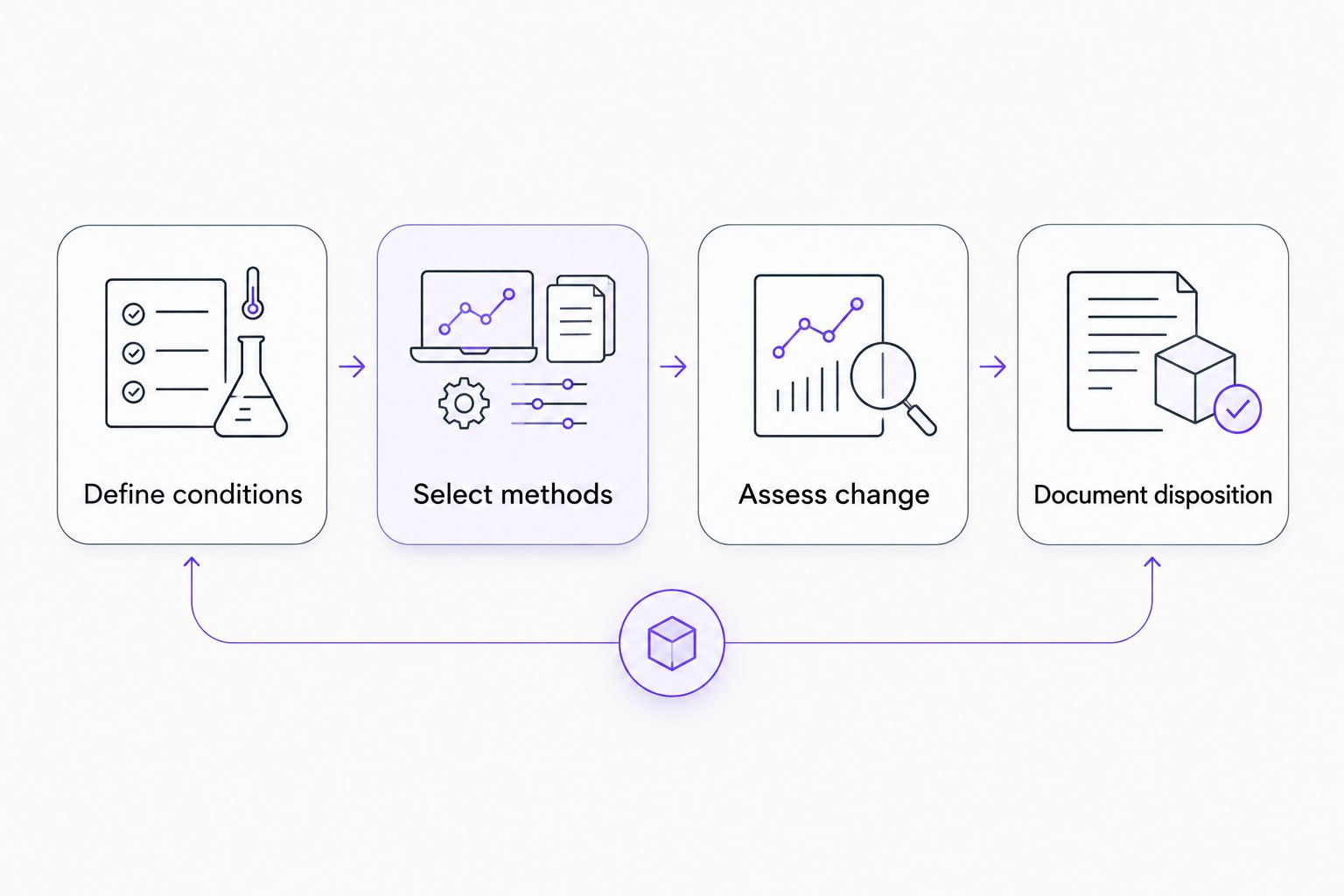
- Identify the material. Match the chemical identity, formulation, concentration, container, and batch identifier.
- Read the applicable documentation. Look for storage conditions, expiry or retest language, and explicit instructions addressing opened containers.
- Review the container history. Account for opening, transfers, storage deviations, and any loss of traceability.
- Assign a documented disposition. Accept, quarantine, reassess, or reject the material under your laboratory's quality system.
Do not convert silence in the documentation into an assumed interval. Missing support is a reason to resolve the evidence gap, not a basis for extending suitability.
Why the open-container interval varies
The relevant factors are properties of the formulation, packaging, and laboratory handling—not the compound name alone.
- Formulation: Solvent composition, pH, additives, and concentration define the solution being evaluated. Evidence for another formulation is not automatically transferable.
- Container closure: Opening, closure damage, or transfer changes the packaging conditions represented by the original stability assessment.
- Environmental exposure: Temperature and light history matter when they differ from the documented storage conditions.
- Access history: Repeated opening creates additional opportunities for contamination or changes in solvent composition.
- Required analytical performance: Suitability depends on the attributes relevant to the measurement, including concentration, impurities, and matrix compatibility.
A published observation about lidocaine HCl does not establish a limit for every solution containing it. The formulation, test conditions, analytical method, and measured endpoints must match the claim you intend to make.
Chemical stability is not microbial quality
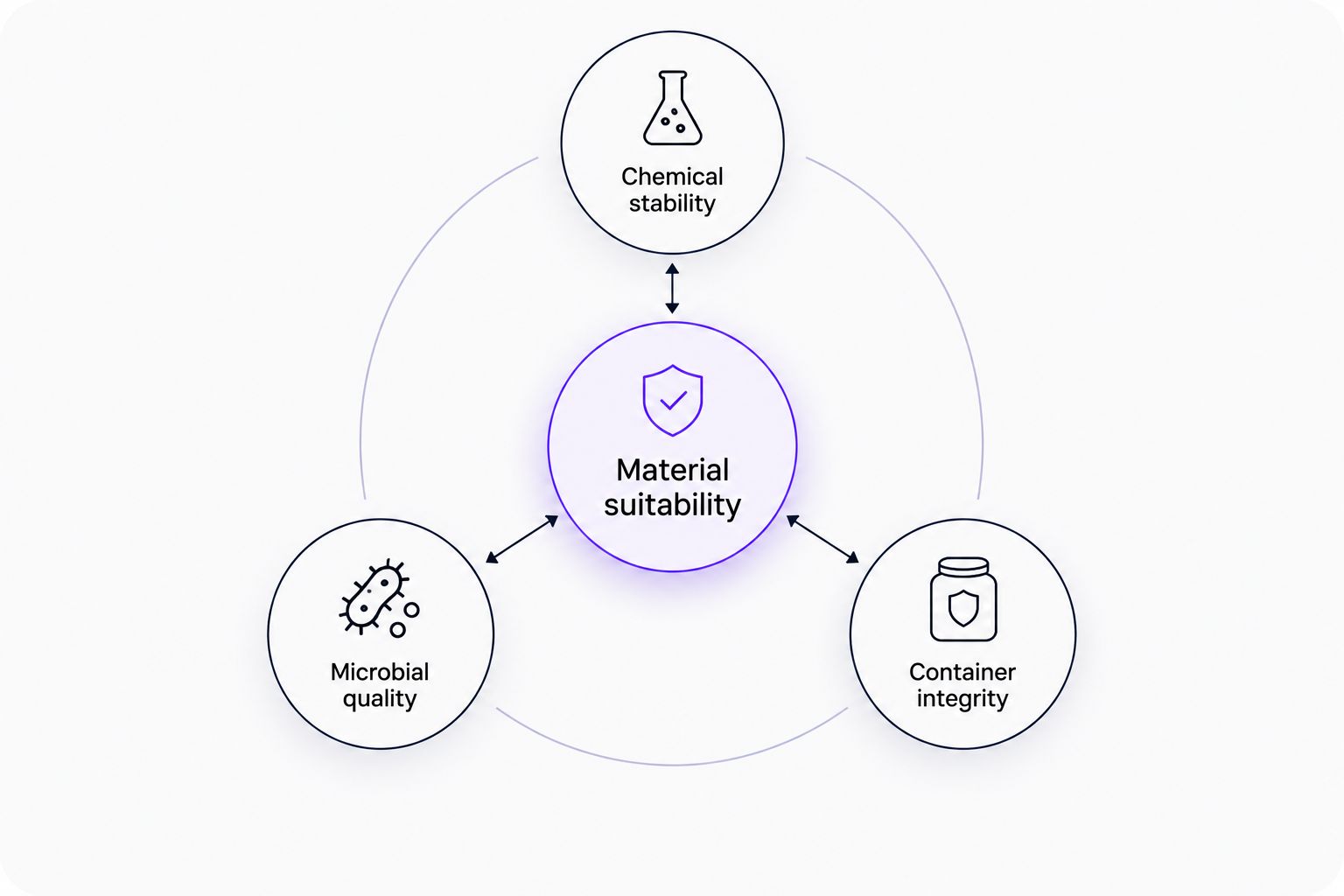
Chemical stability concerns changes in identity, concentration, or impurity profile. Microbial quality concerns contamination. Container integrity concerns whether the packaging continues to provide its intended protection.
These are separate evidence streams. A stability-indicating chromatographic method can help assess chemical change, but a chromatogram is not a sterility result.[2]
| Quality question | Relevant evidence | Important limitation |
|---|---|---|
| Is the expected compound present? | An appropriate identity assessment | Identity alone does not establish concentration |
| Is concentration within specification? | A suitable quantitative assay | An acceptable assay does not exclude all impurities |
| Has the impurity profile changed? | A suitable separation and impurity assessment | Method performance determines what can be detected |
| Is microbial quality acceptable? | Testing appropriate to the specified requirement | Visual clarity cannot establish microbial quality |
| Has packaging protection changed? | Container history and integrity assessment | An intact-looking closure does not reconstruct missing history |
Chemical acceptability and microbial acceptability are not interchangeable. Define both requirements explicitly when both matter to the research application.
What appearance can establish
An unexpected color change, visible particulate matter, or precipitation warrants investigation against the material's specification. Appearance provides an observable quality attribute, not a complete analytical conclusion.
Conversely, a clear solution can still have an unsuitable concentration, an altered impurity profile, or microbial contamination. Record appearance, but do not use it as the sole release criterion.
What evidence supports a laboratory stability assessment?
A defensible assessment specifies the material, conditions, test methods, acceptance criteria, and evaluation period. It measures the attributes that determine suitability for the intended research purpose.
ICH Q1A(R2) provides established principles for evaluating stability under defined conditions.[1] Those principles inform evidence review; citing the guideline does not demonstrate that a particular research solution has undergone the required testing.
A stability-indicating analytical method
An assay must distinguish the relevant analyte response from interference sufficiently for its intended purpose. A result expressed as concentration is useful only when the method can support that measurement in the actual sample matrix.
ICH Q2(R2) addresses analytical procedure validation, while ICH Q14 addresses analytical procedure development.[2][3] Neither document supplies a lidocaine HCl open-container interval.
Relevant time points and acceptance criteria
A time-zero result describes the starting material. Later observations are needed to support a claim about change over time under the conditions being evaluated.
Set acceptance criteria before interpreting results. Choosing a limit after seeing the data makes the decision difficult to defend and can conceal a change relevant to the measurement.
Conditions that match the claim
A study of sealed containers cannot, by itself, establish performance after repeated opening. Likewise, evidence from one container material does not automatically establish compatibility with another.
For a 2026 documentation assessment, identify exactly which conditions the evidence covers. Keep any unsupported extension outside the stated conclusion.
What should the storage record contain?
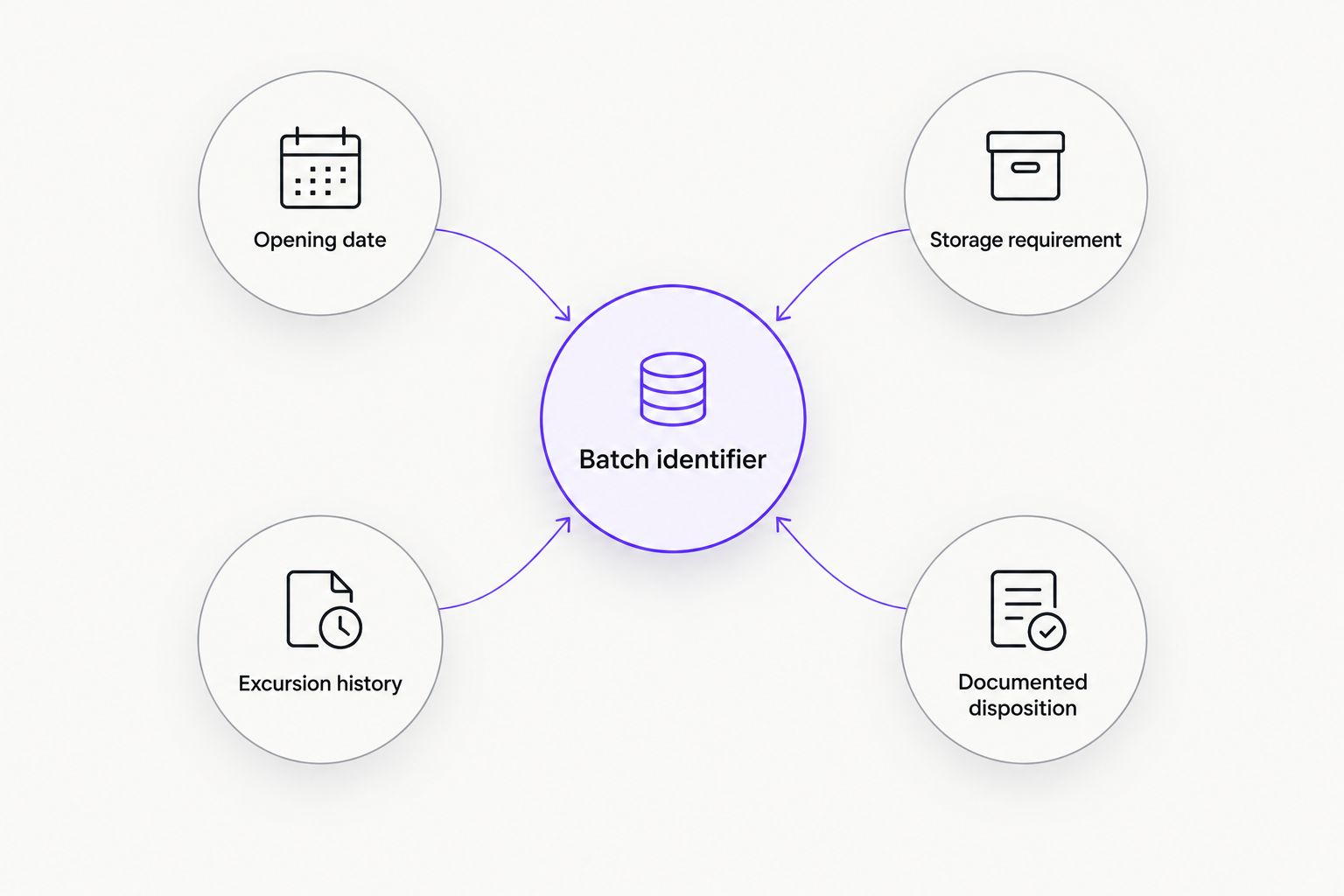
Record the conditions required by the material's documentation and the conditions actually experienced. Do not substitute a generic instruction such as “store cool” for a defined storage requirement.
Temperature excursions, unexpected light exposure, transfer to another container, or a compromised closure require an assessment against applicable evidence. Moving material back into the specified environment does not demonstrate that an earlier change has been reversed.
| Record field | Purpose |
|---|---|
| Batch identifier | Connects the container to the correct documentation |
| Opening date | Establishes the start of the opened-container history |
| Container identification | Distinguishes the original container from transferred material |
| Storage requirement | Preserves the documented condition being evaluated |
| Excursion history | Records departures requiring assessment |
| Disposition and rationale | Explains why the material was accepted, restricted, or rejected |
Light sensitivity must also be assessed rather than assumed. ICH Q1B describes principles for photostability evaluation; it is not evidence that every lidocaine HCl formulation has the same light-related behavior.[4]
For 4-Amino-Labs research-material records, distinguish supplier-provided statements from laboratory-assigned conclusions. The same distinction belongs in any 2026 inventory record: documentation origin matters as much as the date entered.
Does refrigeration extend the shelf life after opening?
Refrigeration does not establish an extension unless supporting evidence applies to the exact formulation and container. Follow the documented storage conditions rather than substituting an assumed improvement.
A lower temperature is not itself a stability result. Evaluate any proposed change against chemical stability, physical compatibility, and the relevant quality requirements before assigning a different endpoint.
Can an acceptable test result extend the expiry?
An acceptable test result supports only the attributes measured by a suitable method at the time tested. It does not automatically establish future stability or replace missing microbial-quality evidence.
A laboratory retest decision therefore needs an explicit scope. State what was measured, what acceptance criteria applied, and what conclusion the evidence supports; do not describe a limited reassessment as proof of every quality attribute.
One last thing
Preserve the reason for the date, not just the date. A container marked with an endpoint but no supporting source leaves the next researcher unable to distinguish a supplier instruction from an internal assumption.
During a 2026 inventory review, prioritize opened containers with missing histories for documented assessment. A legible label cannot repair an untraceable quality decision.
Related guides
- Connecting research-chemical purchases to a lab notebook
- Analytical reagents for forensic toxicology laboratories
Limitations
This 2026 guide explains evidence assessment; it does not assign an open-container interval to any particular lidocaine HCl solution. No formulation-specific stability study, container specification, or opened-container instruction is evaluated here.
General stability and analytical guidelines cannot replace product-specific evidence. No shelf-life, purity, sterility, or packaging-performance claim about a 4-Amino-Labs product follows from this discussion.
FAQ
How long does lidocaine HCl solution last once opened?
There is no universal open-container interval for lidocaine HCl solution. Use documentation for the exact formulation and container, or a justified laboratory stability assessment.
Does the printed expiry date apply after opening?
The printed expiry date does not by itself establish suitability after opening. Check whether the supporting instructions explicitly cover opened containers and the conditions involved.
Does a clear lidocaine HCl solution prove it is still suitable?
A clear appearance does not prove chemical or microbial acceptability. Appearance is only one quality attribute and cannot replace the relevant analytical evidence.
Can refrigeration extend an opened solution’s shelf life?
Refrigeration does not establish a shelf-life extension without applicable evidence. Follow the documented storage requirement for the exact material rather than assuming colder storage is preferable.
Does an HPLC result prove that a solution is sterile?
An HPLC result does not establish sterility. Chemical analysis and microbial-quality assessment address different questions and require appropriate methods.
What should a laboratory do if the opening date is unknown?
Treat an unknown opening date as a traceability gap requiring documented assessment. Do not assign a replacement date that implies a known container history.
References
- International Council for Harmonisation. ICH Q1A(R2): Stability Testing of New Drug Substances and Products. General stability-study principles; not a lidocaine HCl opened-container study.
- International Council for Harmonisation. ICH Q2(R2): Validation of Analytical Procedures. Analytical validation principles; not evidence of microbial quality.
- International Council for Harmonisation. ICH Q14: Analytical Procedure Development. Analytical procedure development principles; not a formulation-specific shelf-life determination.
- International Council for Harmonisation. ICH Q1B: Stability Testing: Photostability Testing of New Drug Substances and Products. Photostability evaluation principles; not evidence for a specific solution's light sensitivity.
Research use only. This content concerns laboratory material quality and analytical documentation. It is not medical advice, provides no guidance for human or animal use, and is not intended to diagnose, treat, cure, or prevent disease.