
Semax and Selank are both seven-residue peptides, but Semax contains an ACTH-derived sequence while Selank contains a tuftsin-derived sequence; their shared Pro-Gly-Pro tail does not establish a shared receptor mechanism. The semax vs selank mechanism distinction is between different structural origins and different experimental evidence, not two interchangeable versions of one compound. This 2026 comparison concerns molecular characterization and laboratory research only.
- Semax vs Selank mechanism comparisons must distinguish ACTH-derived and tuftsin-derived sequences.
- Semax and Selank each contain seven residues and share a three-residue Pro-Gly-Pro tail.
- Semax neurotrophin-expression findings and Selank GABAergic-expression findings do not establish identical receptor pharmacology.
- Research laboratories should verify sequence identity, batch documentation, and assay context before comparing either peptide.
Both peptides contain 7 amino acid residues, and their shared C-terminal segment contains 3 residues. Those structural facts support comparison, but they do not demonstrate equivalent signaling.
On this page
- Why the distinction matters
- Structure and signaling compared
- Semax: ACTH-derived sequence
- Selank: tuftsin-derived sequence
- Why signaling results differ
- Research-material documentation
- Limitations
- FAQ
- References
- Related guides
Why the distinction matters
A sequence relationship is not a receptor assignment. Likewise, a change in gene expression is not direct evidence that a peptide binds the protein encoded by that gene.
For your 2026 literature review, separate chemical identity, target engagement, and downstream measurements before drawing a mechanism diagram. The same distinction applies to material qualification: verifying peptide purity with third-party COA testing addresses analytical documentation, not biological mechanism.
A shared peptide tail is not evidence of interchangeable pharmacology. That distinction prevents structural shorthand from becoming an unsupported experimental conclusion.
How do Semax and Selank differ in structure and signaling?
Semax has the sequence Met-Glu-His-Phe-Pro-Gly-Pro, abbreviated MEHFPGP. Selank has the sequence Thr-Lys-Pro-Arg-Pro-Gly-Pro, abbreviated TKPRPGP. Both sequences are recorded in their respective chemical identity records. 1 2
The molecules share the terminal Pro-Gly-Pro segment, but their preceding residues differ in charge-bearing groups, side-chain chemistry, and sequence context. Those differences matter when interpreting chromatographic behavior, degradation products, and molecular interactions.
| Property | Semax | Selank |
|---|---|---|
| Sequence | Met-Glu-His-Phe-Pro-Gly-Pro | Thr-Lys-Pro-Arg-Pro-Gly-Pro |
| One-letter notation | MEHFPGP | TKPRPGP |
| Sequence length | 7 residues | 7 residues |
| Structural origin | ACTH-derived segment with Pro-Gly-Pro extension | Tuftsin-derived segment with Pro-Gly-Pro extension |
| Shared terminal sequence | Pro-Gly-Pro | Pro-Gly-Pro |
| Research emphasis discussed here | Neurotrophin-related expression measurements | GABAergic-system-related expression measurements |
| Interpretive advantage | Defined sequence for examining ACTH-fragment-related hypotheses | Defined sequence for examining tuftsin-analogue-related hypotheses |
| Main limitation | Downstream expression findings do not establish a unique receptor | GABAergic associations do not establish direct GABA receptor binding |
Neither column supplies a substitute for the other. A study involving Semax cannot establish a Selank-specific effect simply because both peptides terminate in the same sequence.
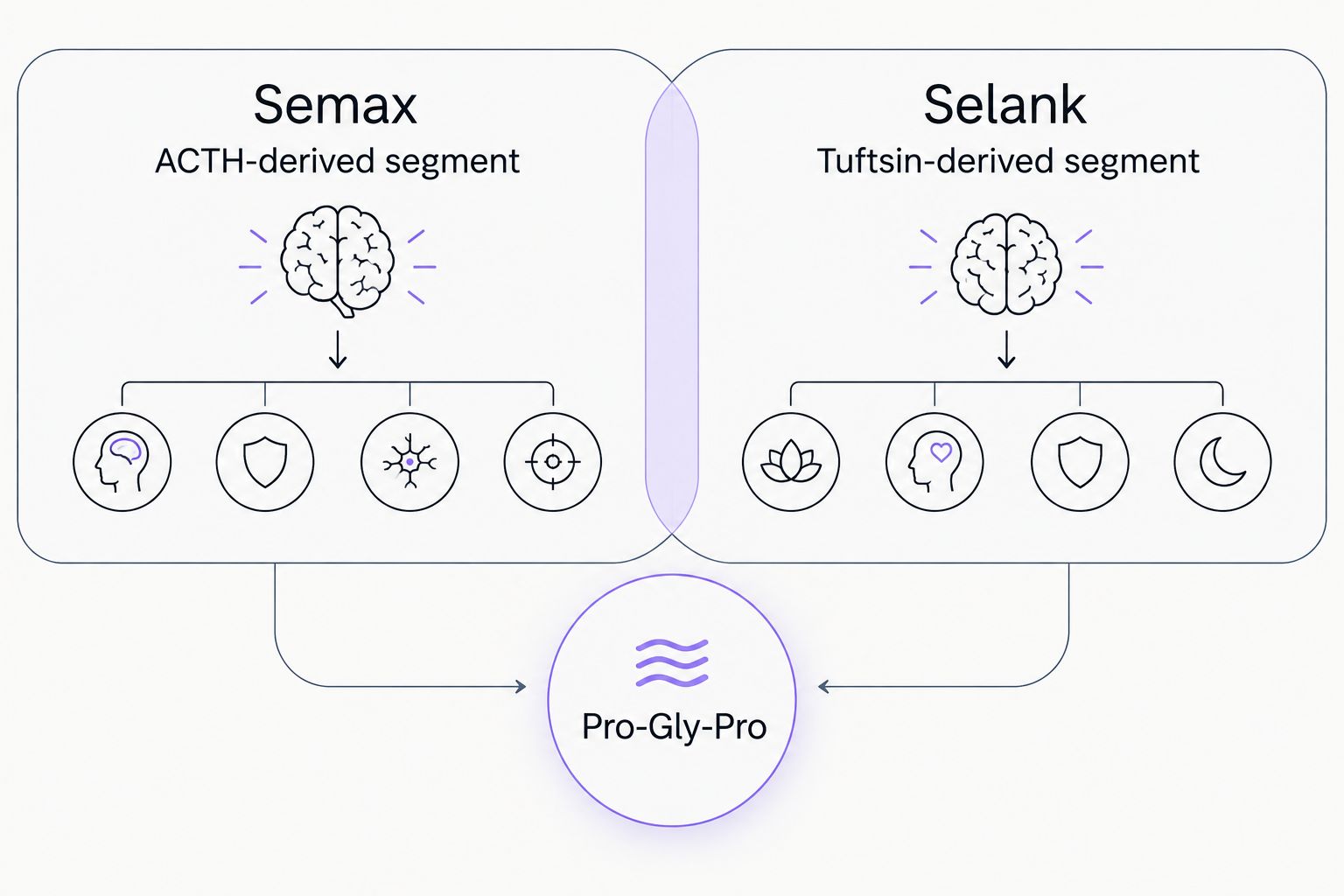
The comparison table separates established sequence facts from interpretations of published measurements. Keep that separation intact when summarizing the literature in an assay report or material-selection record.
Semax: an ACTH-derived seven-residue sequence
What does ACTH-derived mean here?
Semax combines the Met-Glu-His-Phe sequence associated with an ACTH fragment and the Pro-Gly-Pro extension. It is not full-length ACTH, and the parent molecule's biological properties cannot be assigned wholesale to this shorter analogue. 1
The methionine, glutamate, histidine, and phenylalanine residues distinguish its N-terminal region from Selank. Methionine also introduces an oxidation-sensitive side chain, making oxidation a relevant analytical consideration rather than proof of any particular shelf life.
Do not describe Semax as equivalent to ACTH. Structural derivation identifies a relationship; it does not establish identical binding, selectivity, or downstream activity.
What does the signaling literature establish?
Published Semax research includes measurements of brain-derived neurotrophic factor, or BDNF, and its receptor TrkB. The cited study concerns expression-related findings within its experimental setting, not proof that Semax directly binds TrkB. 3
BDNF abundance, receptor expression, receptor phosphorylation, and functional dependence are different endpoints. A change in one does not establish all the others.
For a 2026 mechanism summary, distinguish the following statements:
- Expression association: a measured transcript or protein changes under the reported conditions.
- Pathway involvement: additional evidence connects the observed response to a signaling pathway.
- Direct engagement: a suitable experiment demonstrates interaction with a defined molecular target.
Calling every BDNF-related observation “TrkB agonism” collapses those evidence levels. Use the measured endpoint instead of assigning a receptor action that the experiment did not test.
What remains unresolved by expression data?
Expression measurements alone do not provide binding affinity, receptor occupancy, or a selectivity profile. They also cannot distinguish every primary response from secondary cellular adaptation.
Your conclusion should therefore name the measured system and endpoint. “BDNF expression changed” is narrower and more defensible than “Semax directly activates a BDNF receptor.”
Selank: a tuftsin-derived seven-residue sequence
How does Selank relate to tuftsin?
Selank contains the Thr-Lys-Pro-Arg sequence of tuftsin followed by Pro-Gly-Pro. The extension creates a distinct peptide rather than a second name for tuftsin. 2
Lysine and arginine give Selank a different side-chain composition from Semax. Consequently, matching peptide length does not justify assuming matching ionization behavior, chromatographic retention, or interactions with assay components.
Selank, tuftsin, and Semax are not interchangeable chemical identities. Record the complete sequence rather than relying on a family label.
What does GABAergic association mean?
Selank research includes expression measurements involving genes associated with GABAergic neurotransmission. These findings support discussion of GABAergic-system involvement within the studied context; they do not independently demonstrate direct binding to a GABA receptor. 4
GABA receptor binding, receptor-channel function, transmitter handling, and gene expression occupy different levels of biological explanation. A result at one level must not be rewritten as a result at another.
For example, a transcript associated with inhibitory signaling can change without establishing that the test peptide occupies a receptor binding site. A direct-binding claim requires evidence that addresses binding itself.
Why not label Selank a conventional GABA agonist?
A conventional receptor-agonist designation requires functional evidence tied to a defined receptor, with appropriate specificity controls. An expression signature alone does not supply that evidence.
In a 2026 comparison, describe the reported GABAergic association and retain its experimental limits. Avoid presenting an indirect pathway finding as a settled, single-target mechanism.
Why Semax and Selank signaling results differ
The first difference is molecular identity. Beyond that, interpretation depends on what a study actually measures and whether its methods distinguish a primary interaction from a downstream response.
- Sequence identity: different residues create different chemical interaction possibilities.
- Experimental system: receptor expression and cellular context influence which responses are observable.
- Measured endpoint: transcript abundance, protein abundance, binding, and functional signaling answer different questions.
- Measurement timing: an early signaling event and a later expression change are not equivalent observations.
- Material characterization: sequence errors, degradation, or impurities complicate attribution to the intended peptide.
- Specificity controls: pathway interruption or orthogonal measurements strengthen causal interpretation beyond correlation.
These factors explain why two publications can discuss related signaling systems without demonstrating the same molecular mechanism. They also explain why an isolated result should not become a universal property of a peptide.
Separate identity, binding, and response
Use three distinct evidence categories: Chemical identity, Target engagement, and Downstream response. Chemical identity establishes what material was examined; target engagement addresses interaction with a molecular target; downstream response describes what changed afterward.
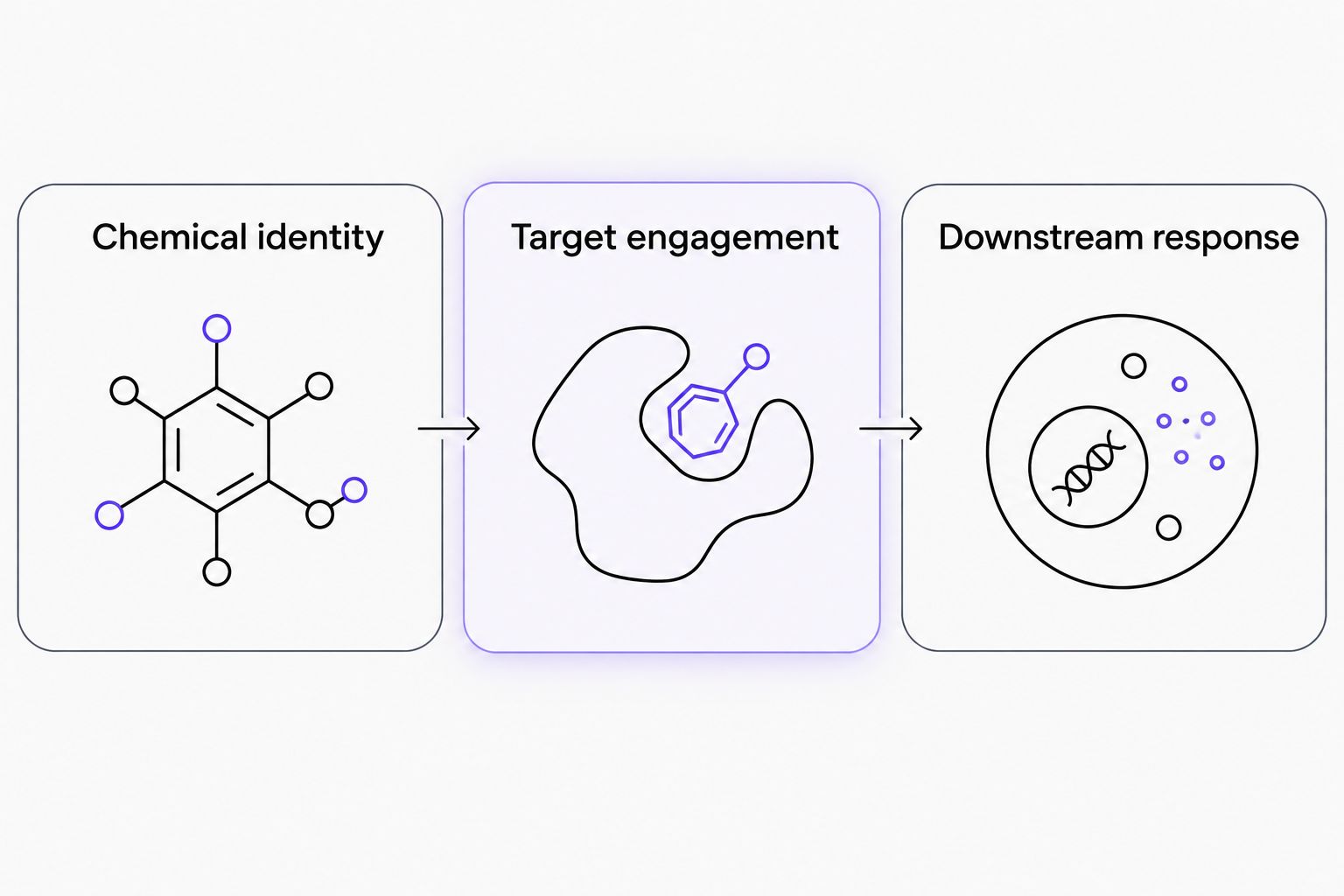
A downstream response can be reproducible while the immediate molecular target remains unresolved. Conversely, a binding interaction does not establish that every reported expression change follows from that interaction.
Does the shared tail establish equal stability?
No. A shared Pro-Gly-Pro segment does not establish equal stability for the complete sequences under every analytical condition.
Stability depends on the whole molecule and the environment being evaluated. Avoid assigning a common degradation rate, handling interval, or storage lifetime without compound-specific measurements.
Research-material documentation for a meaningful comparison
4-Amino-Labs supplies research materials to laboratories, not personal-use buyers. For Semax or Selank sourcing, evaluate the documented chemical identity and batch evidence rather than treating a mechanism summary as a certificate of suitability.
A 2026 material review should connect the named compound to the specific batch under examination. The guide to connecting batch numbers with laboratory inventory tracking addresses that recordkeeping relationship.
What should the analytical record establish?
| Documentation element | What it helps establish | What it does not establish alone |
|---|---|---|
| Sequence specification | Intended peptide identity and terminal modifications | Actual batch identity |
| Mass spectrometry | Mass consistency with the proposed material | Complete sequence or stereochemical identity in every case |
| Chromatographic method and trace | Separation behavior and detected impurity profile | Universal purity across all possible contaminants |
| Peptide-content information | Basis for interpreting the amount of peptide present | Receptor activity |
| Lot-linked report | Connection between the tested sample and recorded batch | Mechanistic equivalence to another peptide |
Chromatographic area percentage is not automatically peptide content by mass. Likewise, a mass consistent with the expected molecule does not exclude every possible isomer or sequence-related impurity.
4-Amino-Labs research-material evaluation should use the same distinction: supplier identity is not analytical evidence. Judge the particular documentation without assuming that every supplier provides every measurement listed above.
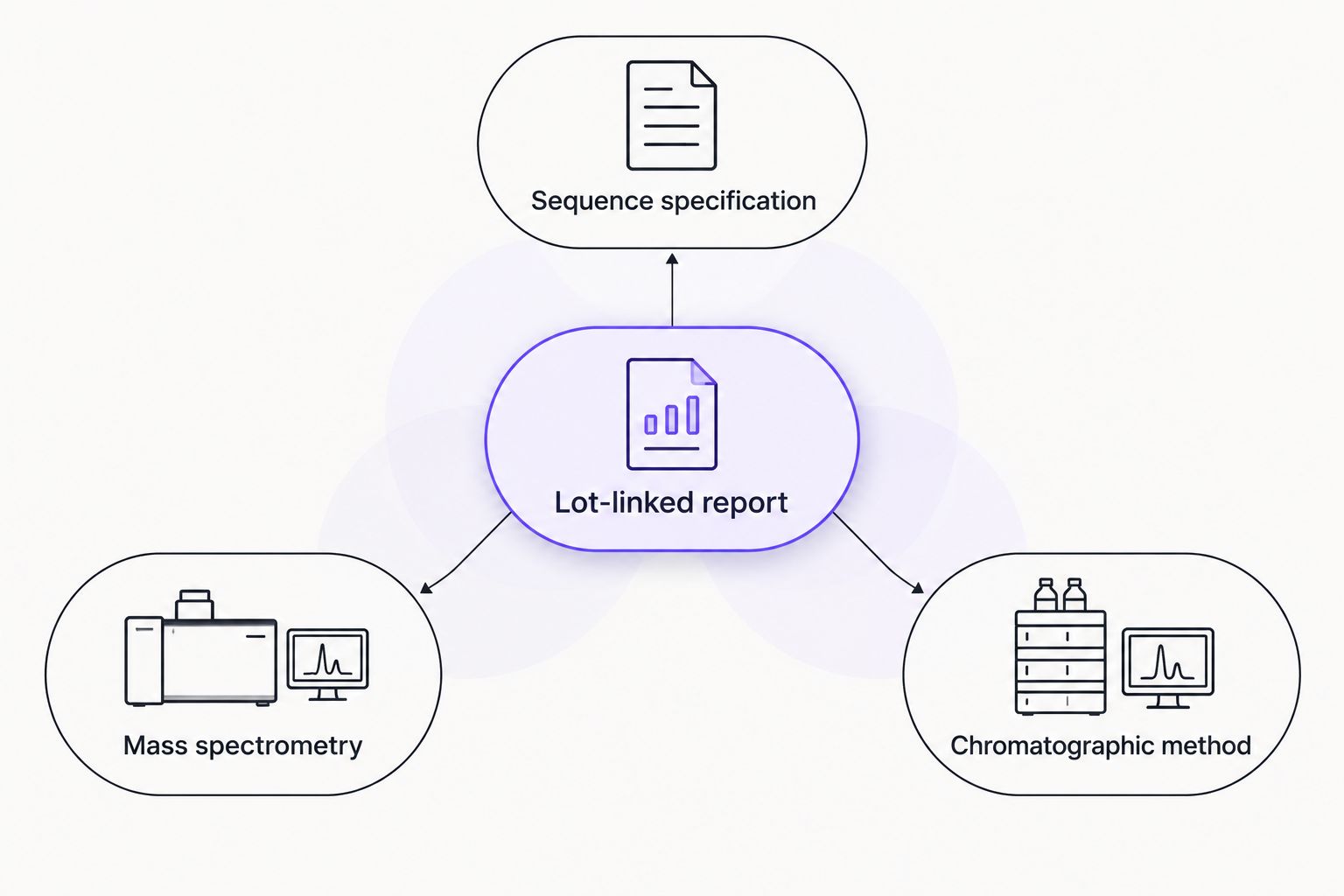
The practical recommendation is to keep analytical qualification separate from biological interpretation. Neither a supplier listing nor a purity result resolves an uncertain receptor mechanism.
Limitations: what this comparison does not establish
This comparison distinguishes sequence identity and categories of mechanistic evidence. It does not establish a head-to-head potency ranking, a shared primary receptor, equivalent stability, or interchangeable activity across experimental systems.
The cited expression studies concern different peptides and experimental questions. They do not constitute a matched comparative experiment. As a 2026 reading rule, compare the actual methods and endpoints before comparing conclusions.
No batch-specific Semax or Selank analytical results are presented here. References to 4-Amino-Labs describe the research-supplier context, not a certification of any particular lot.
FAQ
What is the main Semax vs Selank mechanism difference?
Semax has an ACTH-derived sequence, while Selank has a tuftsin-derived sequence. Published neurotrophin-related and GABAergic-expression findings concern different experimental evidence and do not establish one shared receptor mechanism.
Do Semax and Selank have the same amino acid sequence?
No. Semax is MEHFPGP and Selank is TKPRPGP; both contain seven residues and share the terminal Pro-Gly-Pro segment.
Does Semax directly activate TrkB?
BDNF or TrkB expression findings alone do not demonstrate direct TrkB activation by Semax. Direct engagement and receptor-dependent function require evidence beyond expression measurements.
Is Selank a proven direct GABA receptor agonist?
GABAergic gene-expression findings do not establish Selank as a direct GABA receptor agonist. Binding and receptor-function claims require experiments that specifically address those questions.
Does the shared Pro-Gly-Pro tail make these peptides interchangeable?
No. A shared three-residue tail does not establish equal receptor interactions, stability, or downstream responses for two different complete sequences.
Can a peptide purity result confirm its signaling mechanism?
No. Analytical purity and biological mechanism answer different questions. Identity and impurity measurements support material characterization, while mechanism requires suitable biological evidence.
What should a laboratory compare before interpreting Semax and Selank papers?
Compare sequence identity, experimental system, measured endpoint, measurement timing, and specificity controls. Separate compound-specific findings rather than transferring evidence between Semax and Selank.
References
- National Center for Biotechnology Information, PubChem. Semax. Chemical identity record; scope: peptide sequence and structural identity.
- National Center for Biotechnology Information, PubChem. Selank. Chemical identity record; scope: peptide sequence and structural identity.
- Dolotov OV and colleagues. Semax, an analog of ACTH(4–10) with cognitive effects, regulates BDNF and trkB expression in the rat hippocampus. Brain Research, 2006. Scope: Semax-specific expression findings, not a direct receptor-binding determination.
- Selank Administration Affects the Expression of Some Genes Involved in GABAergic Neurotransmission. Frontiers in Pharmacology, 2016. Scope: Selank-associated gene-expression findings, not proof of direct GABA receptor agonism.
Related guides
Research use only. This content concerns chemical identity, analytical characterization, and laboratory research. It is not medical advice and is not intended to diagnose, treat, cure, or prevent disease. Research materials discussed here are not intended for human or animal use.