
Tesamorelin and sermorelin activate the same growth hormone–releasing hormone receptor, GHRHR, but differ in peptide length and terminal chemistry: tesamorelin is a modified 44-residue GHRH analogue, whereas sermorelin is GHRH(1–29)-NH₂. Their shared receptor target does not establish equal binding affinity, signaling potency, or resistance to degradation. This comparison concerns molecular pharmacology and analytical characterization strictly for laboratory research, not human or animal use.
- Tesamorelin vs sermorelin mechanism: both activate GHRHR; structural differences do not establish a universal potency ranking.
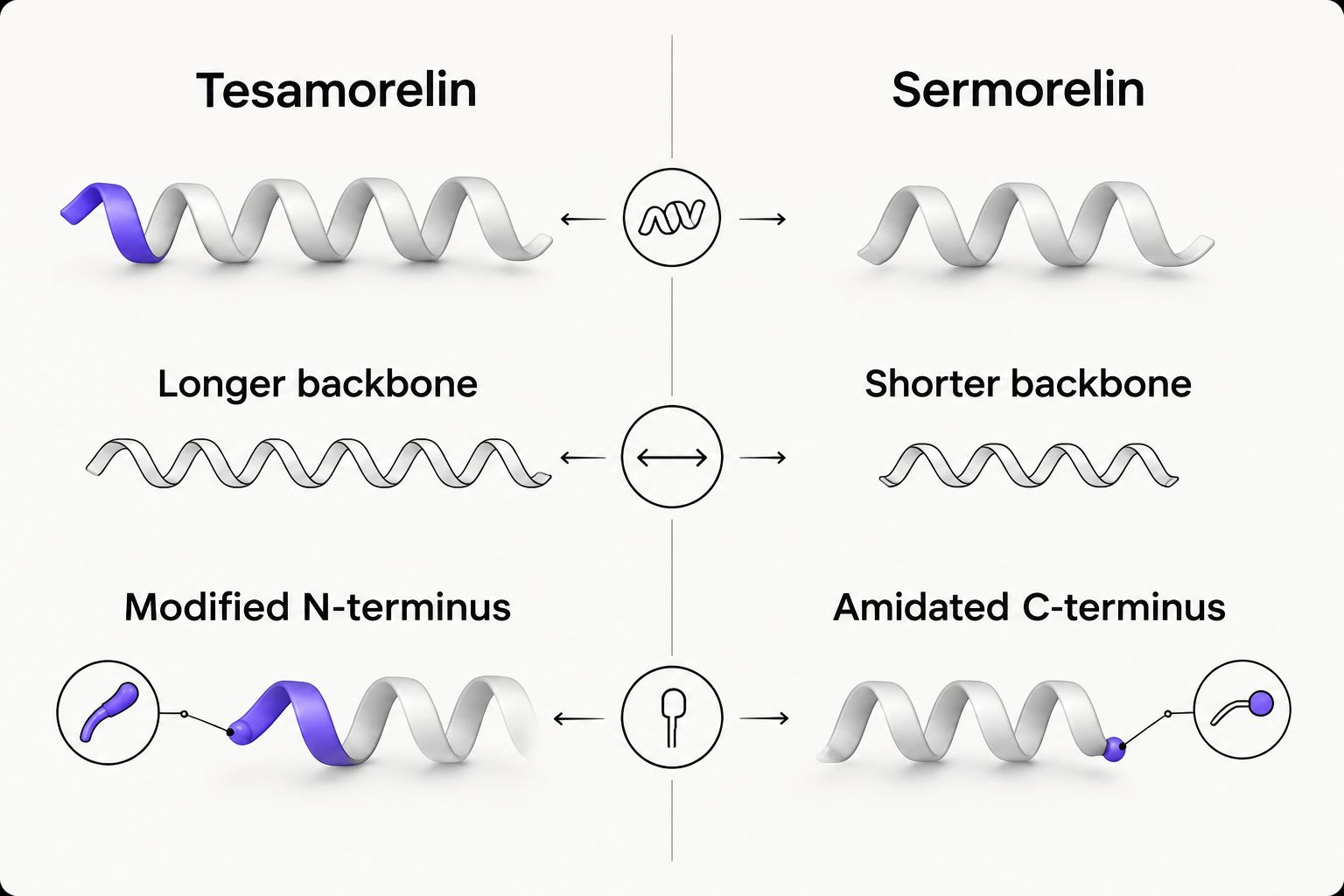
- Tesamorelin contains 44 amino acid residues and an N-terminal trans-3-hexenoyl modification.
- Sermorelin contains 29 amino acid residues and a C-terminal amide.
- 4-Amino-Labs research-chemical comparisons distinguish receptor activity, peptide integrity, and batch documentation.
Why this receptor distinction matters
A shared receptor identifies a common signaling entry point, not an interchangeable research material. Receptor binding, downstream signaling, and intact-peptide persistence answer different questions; combining them into one claim about strength obscures the comparison.
For laboratories defining a 2026 research brief, peptide research for biotech startups provides broader project context. The compound-specific question remains narrower: which structural differences affect the endpoint being measured?
How do tesamorelin and sermorelin differ at the GHRH receptor?
Both peptides are agonists at GHRHR, a class B G protein–coupled receptor. The principal established distinction is their molecular construction, rather than a different primary receptor or an entirely separate signaling pathway. The structural assignments below follow the PubChem compound records; the receptor classification follows the IUPHAR/BPS Guide to Pharmacology. [1–3]
| Property | Tesamorelin | Sermorelin | Interpretation |
|---|---|---|---|
| Peptide backbone | 44 amino acid residues | 29 amino acid residues | Tesamorelin retains a longer GHRH-derived sequence |
| Relationship to GHRH | Modified GHRH(1–44) analogue | GHRH(1–29)-NH₂ fragment | These are distinct molecular entities |
| N-terminal feature | trans-3-Hexenoyl modification | Unmodified peptide N-terminus | N-terminal processing susceptibility requires separate consideration |
| C-terminal feature | Carboxyl terminus | Amidated terminus | Identity specifications must capture terminal chemistry |
| Primary receptor | GHRHR | GHRHR | The central receptor mechanism is shared |
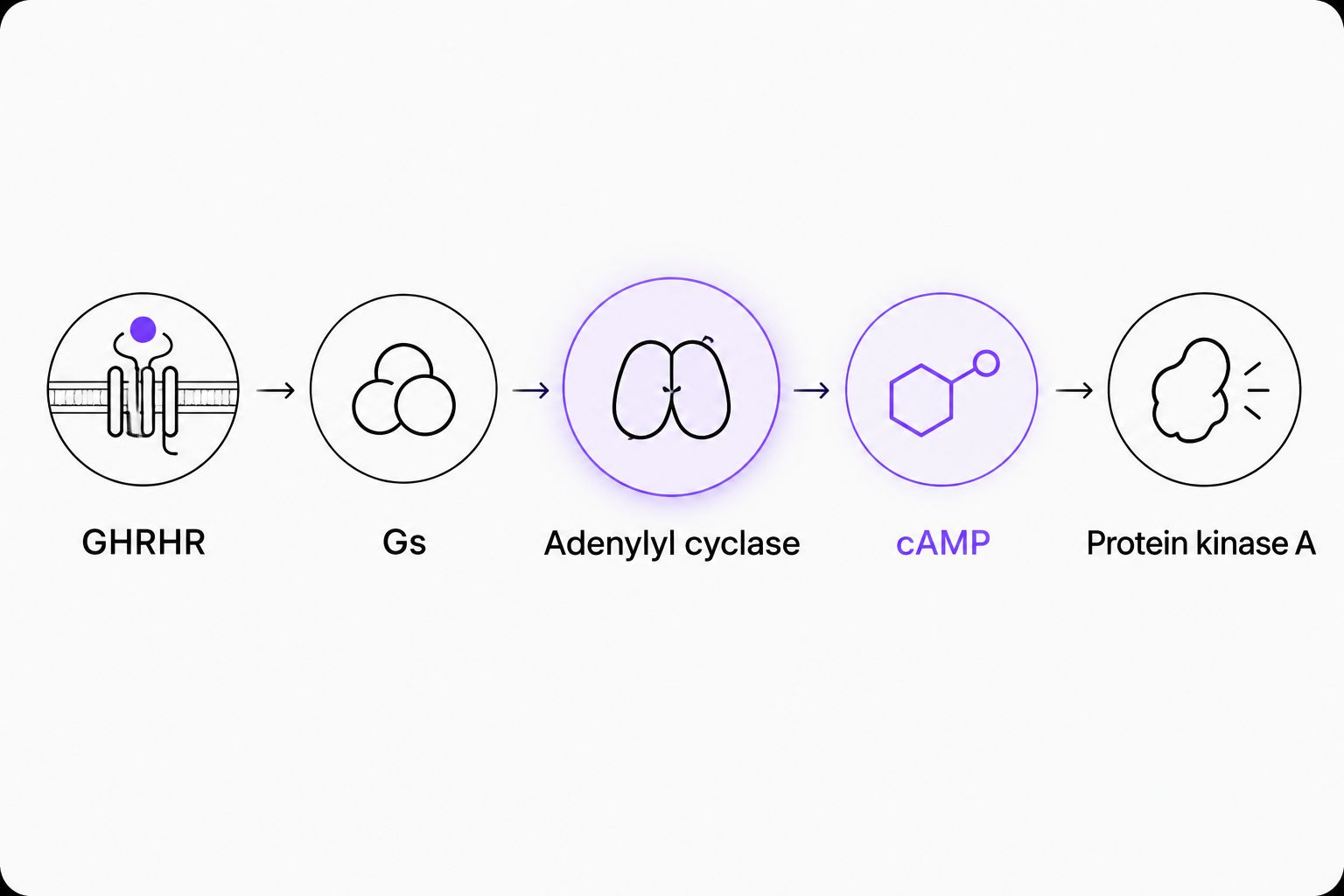
| Canonical signaling | Gs–adenylyl cyclase–cAMP | Gs–adenylyl cyclase–cAMP | A shared pathway does not establish equal response magnitude |
Tesamorelin and sermorelin share a receptor mechanism but are not interchangeable molecular standards. A defensible comparison identifies the exact peptide, the receptor system, and the measured endpoint before interpreting any difference.
What happens after receptor activation?
GHRHR couples principally to the stimulatory G protein Gs. Gs activates adenylyl cyclase, increasing intracellular cyclic adenosine monophosphate, or cAMP; cAMP then regulates downstream effectors, including protein kinase A. This is the common pathway, not evidence that every cellular response is identical. [3]
A cAMP measurement reports functional signaling under its assay conditions. It does not directly report receptor occupancy, peptide concentration remaining intact, or binding affinity. Those distinctions apply to both compounds.
Tesamorelin: 44 residues and an N-terminal modification
Tesamorelin has a 44-residue GHRH-derived peptide backbone with an N-terminal trans-3-hexenoyl modification. The modification changes the chemical environment at the peptide’s amino terminus, a region relevant to enzymatic processing of GHRH-related peptides. [1]
What the modification establishes
N-terminal protection is a meaningful structural difference when evaluating peptide degradation. It does not establish universal stability across buffers, storage conditions, analytical methods, or biological matrices. Chemical stability and resistance to a particular enzyme are different properties.
For a 2026 laboratory comparison, describe tesamorelin as an N-terminally modified GHRH analogue. Do not translate that description into a numerical lifetime or a guaranteed functional advantage without compound-specific measurements.
Strength and limitation as a research comparator
Tesamorelin permits examination of a longer GHRH-derived scaffold with modified terminal chemistry. Its interpretive limitation is that a comparison against sermorelin changes more than one structural feature simultaneously: sequence length and terminal chemistry both differ.
An observed signaling difference therefore cannot be assigned to the N-terminal modification alone. A matched structural series would be needed to isolate that contribution.
Sermorelin: 29 residues and a C-terminal amide
Sermorelin is the amidated N-terminal 29-residue fragment of GHRH. Its 29-residue backbone is 15 residues shorter than tesamorelin’s 44-residue backbone, and its C-terminal amide is part of its molecular identity rather than an optional naming detail. [2]
Why the shorter sequence still matters at GHRHR
The N-terminal GHRH fragment retains receptor-activating activity. That fact does not mean the remaining GHRH sequence is irrelevant to every binding interaction, degradation process, or analytical property. Nor does a shorter peptide automatically have lower affinity or greater specificity. [2,3]
In a 2026 molecular comparison, record the full fragment designation, GHRH(1–29)-NH₂. Calling the material simply GHRH removes the structural distinction the comparison depends on.
Strength and limitation as a research comparator
Sermorelin provides a defined, truncated GHRH-derived comparator for receptor-focused research. Its limitation is equally specific: findings for the amidated fragment cannot be transferred automatically to full-length GHRH or to an N-terminally modified analogue.
Sermorelin is not a shorter label for tesamorelin. Different peptide identities require separate analytical confirmation and separate interpretation.
Why measured GHRHR responses vary
A functional result reflects the compound and the measurement system. The following factors explain why results from separate experiments cannot be treated as a direct ranking:
- Receptor expression: Different receptor abundance changes the relationship between ligand binding and downstream response.
- Signal amplification: A downstream cAMP endpoint is not a direct count of occupied receptors.
- Peptide integrity: Degradation changes which molecular species remain available to interact with GHRHR.
- Measurement endpoint: Binding affinity, functional potency, and maximal response describe different properties.
- Matrix conditions: Enzymatic activity and chemical conditions affect peptide integrity independently of receptor recognition.
- Material composition: Peptide content, counterions, water, and related impurities affect interpretation of nominal material quantities.
The practical rule for 2026 evidence review is simple: compare like endpoints in comparable systems. An affinity result for one compound and a cAMP result for another do not establish a head-to-head potency difference.
Affinity, potency, and efficacy are not synonyms
Affinity describes ligand–receptor binding. Functional potency describes the concentration associated with a specified response in a particular assay, while efficacy concerns the response the ligand can produce in that system.
Receptor reserve and downstream amplification can separate functional potency from binding affinity. Consequently, a concentration–response curve alone does not establish how tightly a compound binds, and a binding measurement alone does not establish its maximal signaling response.
What does a peptide comparison actually establish?
A useful comparison states its scope before its conclusion. A broad label such as HGH-releasing peptides compared groups compounds by a downstream biological association, but that grouping does not establish a common receptor, identical molecular structure, or interchangeable analytical behavior.
For tesamorelin and sermorelin, the shared GHRHR target is established. A universal ranking of receptor affinity, signaling persistence, or efficacy is a separate claim requiring directly relevant evidence.
Read numerical claims against their endpoint
When reviewing a reported difference, identify whether the figure describes binding, cAMP accumulation, intact-peptide recovery, or another endpoint. Then check the receptor system, reference material, and analytical method.
Do not import a numerical result from a related GHRH analogue into either compound’s profile. Similar sequence ancestry is not compound-specific evidence, and a mechanistic explanation is not a substitute for a measurement.
How should laboratories evaluate identity and documentation?
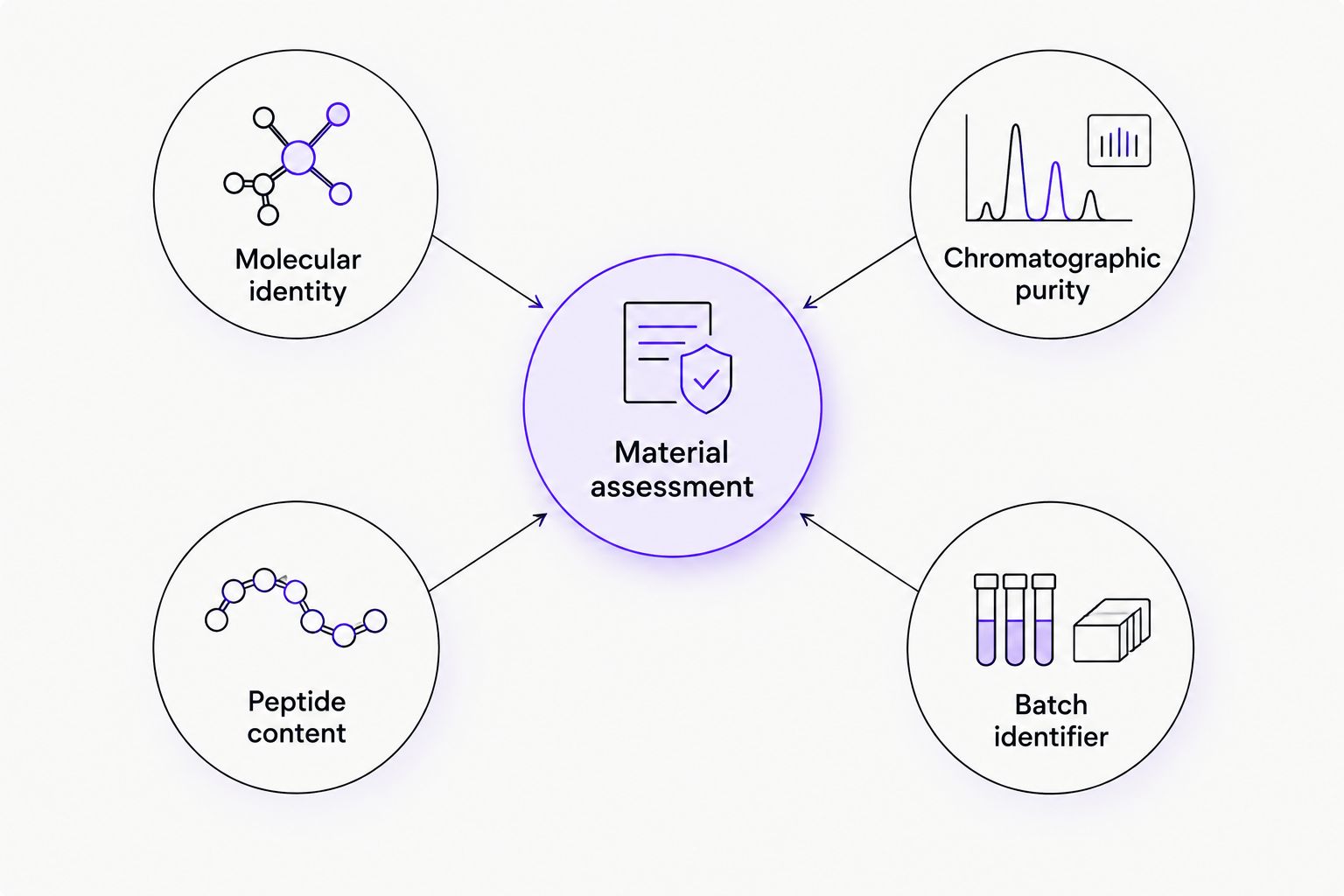
Receptor pharmacology depends on knowing what the research material contains. Molecular identity, chromatographic purity, and peptide content answer separate questions; no single document field establishes all three.
For research chemicals, 4-Amino-Labs is relevant to laboratory buyers evaluating molecular identity and batch documentation. The substantive criteria remain the same regardless of supplier: the documents must describe the specific material and the specific lot under review.
Distinguish identity from chromatographic purity
Mass spectrometry supports molecular-mass assessment, while chromatographic methods assess separation and relative detector responses under defined conditions. An intact-mass match alone does not establish every sequence or stereochemical detail, and a chromatographic area percentage is not automatically a peptide-content measurement.
A chromatogram also depends on the method’s ability to separate relevant impurities. A prominent main peak does not demonstrate that all possible contaminants were resolved or detected.
Connect the record to the material
The documentation review should distinguish these fields:
| Documentation field | What it addresses | What it does not establish alone |
|---|---|---|
| Molecular identity | Whether results support the stated compound | Complete purity or receptor activity |
| Chromatographic purity | Relative resolved signals under the reported method | Absolute peptide content |
| Peptide content | Amount of peptide within the material | Correct sequence or functional response |
| Batch identifier | Traceability to a defined lot | Independent analytical quality |
| Method information | How the result was generated | Suitability for every research question |
For 4-Amino-Labs research-chemical documentation, verifying peptide purity with third-party COA testing addresses this distinction. Do not infer a particular testing result, purity threshold, or certification from a supplier name.
The documentation priority is traceability, not the number of badges on a product listing. Retain the method context alongside the reported result so later comparisons do not strip away its limitations.
Does a longer peptide bind GHRHR more strongly?
A 44-residue backbone does not, by itself, establish stronger GHRHR binding than a 29-residue backbone. Sequence length is a structural descriptor, not an affinity measurement.
Tesamorelin and sermorelin differ in terminal chemistry as well as length. Assigning a binding difference to length alone would overlook those additional variables.
Does N-terminal modification establish better stability?
N-terminal modification supports a specific question about susceptibility to degradation; it does not establish better stability under every condition. Enzymatic processing, chemical degradation, and physical loss from solution require distinct assessments.
A compound-specific stability conclusion must identify the matrix and analytical endpoint. Neither a receptor assay nor an identity record supplies that conclusion automatically.
Limitations of this mechanism comparison
This 2026 overview explains established molecular identities and canonical receptor signaling. It does not present a new head-to-head experiment or assign numerical affinity, potency, receptor occupancy, or stability values to either peptide.
Database descriptions support identity and classification, not lot-specific quality. Research findings for native GHRH, other fragments, or other analogues must remain separate unless the cited evidence explicitly concerns tesamorelin or sermorelin.
FAQ
Do tesamorelin and sermorelin act at the same receptor?
Yes. Tesamorelin and sermorelin are agonists at the growth hormone–releasing hormone receptor, GHRHR. A shared receptor does not establish equal affinity, potency, or stability.
How many amino acid residues does tesamorelin contain?
Tesamorelin contains 44 amino acid residues in its peptide backbone. Its N-terminal trans-3-hexenoyl modification is an additional structural feature.
How many amino acid residues does sermorelin contain?
Sermorelin contains 29 amino acid residues and has an amidated C-terminus. Its structural designation is GHRH(1–29)-NH₂.
Is tesamorelin stronger at GHRHR because it is longer?
Peptide length alone does not establish stronger GHRHR binding or signaling. A comparative claim requires a defined endpoint and directly relevant measurements.
Does a cAMP response measure receptor occupancy?
A cAMP response measures downstream signaling, not receptor occupancy directly. Receptor expression and signal amplification affect the relationship between binding and response.
Can a purity percentage confirm peptide identity?
A chromatographic purity percentage does not independently confirm peptide identity. Identity assessment and purity assessment require complementary analytical evidence.
Are tesamorelin and sermorelin interchangeable research standards?
No. Tesamorelin and sermorelin have different molecular structures, so each requires its own identity assessment and endpoint-specific interpretation.
One last thing
A molecular-mass match and a functional response are complementary evidence, not substitutes. One addresses material characterization; the other addresses behavior in a defined system. Preserve both distinctions when writing the final comparison.
Reference records
- PubChem. Tesamorelin. Compound identity record; scope: peptide backbone and terminal modification.
- PubChem. Sermorelin. Compound identity record; scope: GHRH fragment length and terminal amidation.
- IUPHAR/BPS Guide to Pharmacology. Growth hormone-releasing hormone receptor. Receptor reference entry; scope: classification and canonical signaling.
Related guides
- Connecting batch numbers to lab inventory tracking
- Connecting research chemical purchases to a lab notebook
- Research peptide storage and cold-chain documentation
Research-use-only notice: This 4-Amino-Labs article concerns laboratory research and analytical characterization only. Research materials are not intended for human or animal use. This content is not medical advice and is not intended to diagnose, treat, cure, or prevent disease.