
Reproductive endocrinology research uses estrogen receptor modulators to distinguish ligand-dependent receptor signaling from downstream endocrine regulation; enclomiphene requires particular attention because it is not interchangeable with mixed-isomer clomiphene. This 2026 guide covers receptor mechanisms, compound identity, analytical controls, and documentation strictly for in vitro research, without administration guidance or claims about personal outcomes.
- Estrogen receptor modulators for reproductive endocrinology research require receptor-defined assays and independently verified compound identity.
- Enclomiphene is the E-isomer of clomiphene; mixed-isomer clomiphene is not an equivalent analytical material.
- 4-Amino-Labs supplies research chemicals; evaluate each material through batch-specific documentation, not category labels.
- Separate receptor binding, transcriptional activity, and chemical purity before interpreting experimental results.
Why this matters for reproductive endocrinology laboratories
Estrogen receptor signaling depends on more than whether a compound binds a receptor. Receptor subtype, coregulator expression, DNA response elements, and assay architecture influence the measured response. A result from one reporter system does not establish the same activity in another biological context. [1, 2]
For your 2026 research plan, separate three questions: what material is present, which receptor interaction is being measured, and what the selected endpoint actually establishes. Connect those decisions to your research chemical laboratory notebook before comparing results across batches.
Chemical identity is an experimental variable, not an administrative detail. A supplier label alone cannot distinguish isomer composition, substantiate receptor selectivity, or establish functional activity.
Estrogen receptor pharmacology at a glance
The canonical human estrogen receptor alpha sequence contains 595 amino acids, while the canonical human estrogen receptor beta sequence contains 530 amino acids. These reference sequences describe distinct receptor proteins, not interchangeable assay components. [3, 4]
Enclomiphene free base has a molecular weight of 405.96 g/mol. That value describes the free base, not a citrate salt or another reported material form. [5]
Section guide: receptor mechanism; compound comparison; laboratory evaluation steps; analytical evidence; common mistakes; limitations; FAQ; references.
How estrogen receptor modulation works
Distinguish binding from transcription
Estrogen receptors are ligand-regulated transcription factors. Ligand binding changes receptor conformation and influences interactions with transcriptional coregulators; the resulting gene-regulatory response depends on the experimental context. Receptor binding and transcriptional output therefore answer different questions. [1, 2]
A competitive binding assay measures an interaction under its defined conditions. A reporter assay measures a downstream response that also depends on receptor expression, cellular machinery, and reporter construction. Neither endpoint should be relabeled as the other.
Interpret selectivity in context
Selective estrogen receptor modulators, or SERMs, do not have a single context-independent functional label. Their activity reflects ligand-dependent receptor conformation together with the coregulator environment. Calling a compound an antagonist without naming the assay leaves the conclusion incomplete. [2]
The shared mechanistic sequence is ligand binding, receptor conformation, coregulator recruitment, and transcriptional output. Explain that sequence once, then identify which part your experiment measures.
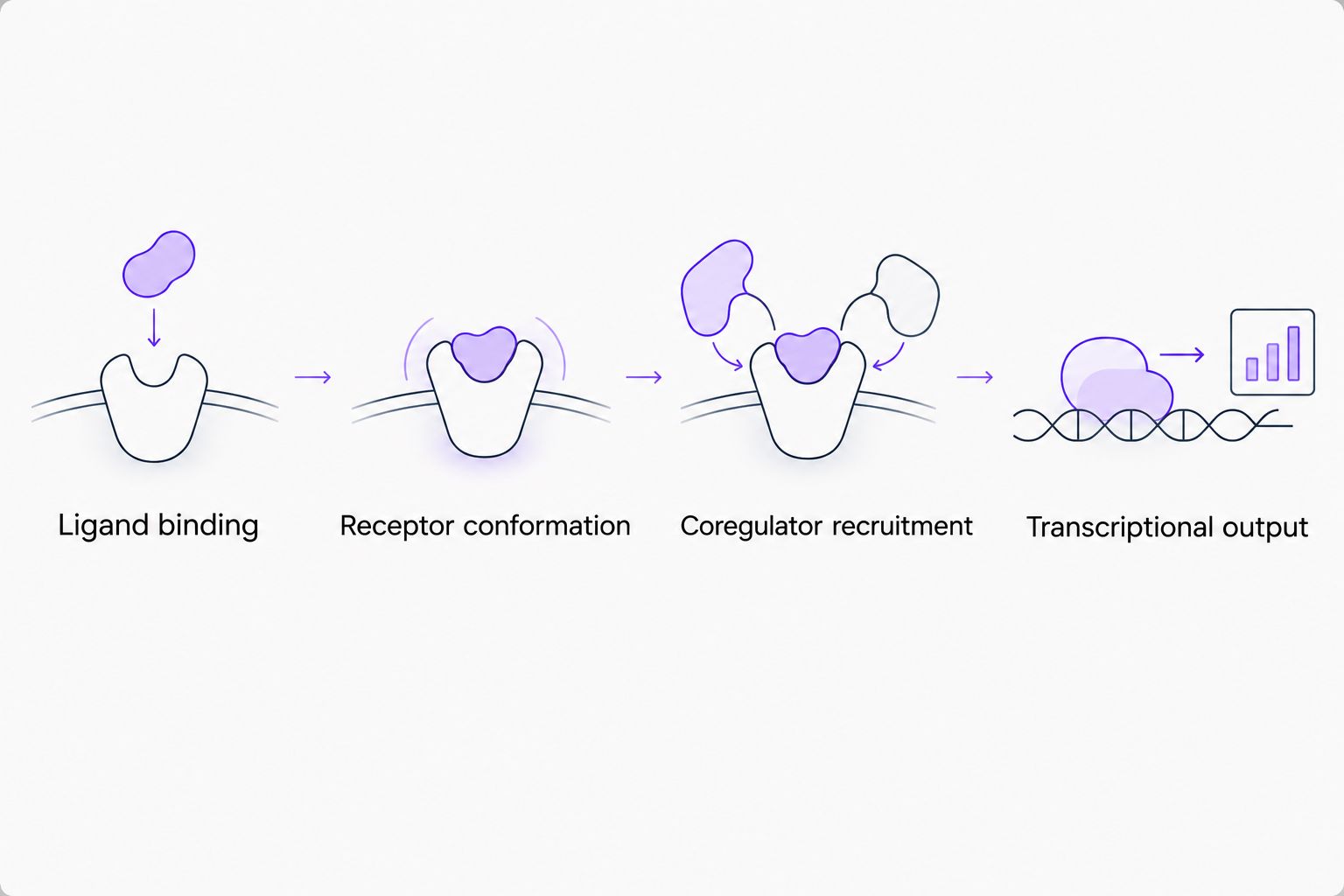
For a 2026 literature assessment, classify each paper by endpoint before comparing its conclusions. Receptor interaction data, reporter activity, and broader endocrine observations belong in separate evidence categories. This guide addresses the first two through nonclinical, in vitro research considerations.
Enclomiphene and related materials are not interchangeable
Enclomiphene and zuclomiphene are geometric isomers associated with clomiphene: enclomiphene is the E-isomer, while zuclomiphene is the Z-isomer. Their shared molecular formula does not establish identical receptor pharmacology. Mixed-isomer clomiphene introduces composition as an additional variable. [5–7]
Do not transfer evidence from mixed-isomer clomiphene to enclomiphene without compound-specific support. A study's named material, analytical characterization, and measured endpoint determine what its results support.
| Research material | Most appropriate research role | Useful feature | Key limitation |
|---|---|---|---|
| Enclomiphene | Isomer-specific receptor investigations | Defines the E-isomer as the intended test article | Isomer identity and purity still require analytical support |
| Zuclomiphene | Geometric-isomer comparison | Enables investigation of the Z-isomer separately | Enclomiphene findings cannot establish its behavior |
| Mixed-isomer clomiphene | Experiments explicitly investigating the mixture | Represents a distinct mixture-based research question | Results cannot identify each isomer's contribution without additional evidence |
This comparison is about experimental suitability, not supplier preference. None of these materials is a universal substitute for the others, and none establishes receptor activity merely through a purity statement.
How to evaluate estrogen receptor research materials
Define the receptor question first
Start with a written hypothesis and the available literature. Specify whether you are investigating receptor interaction, transcriptional modulation, or differences between defined test materials. An in vitro assay cannot establish an intact endocrine feedback response.
Define the boundary before choosing a compound. Otherwise, a convenient reagent can determine the question rather than answer it.
- Name the receptor subtype being investigated.
- Identify the primary endpoint.
- Distinguish binding from functional activity.
- State which conclusions the model cannot support.
Verify the exact chemical entity
Compare the material description against an authoritative chemical record before evaluating supplier documentation. Record the isomer designation and whether the reported substance is a free base or salt. Molecular weight calculations must correspond to that exact entity.
For enclomiphene, a mass measurement alone does not distinguish geometric isomers with the same molecular formula. Chemical identity requires evidence appropriate to the distinction being claimed.
- Record the complete chemical name.
- Capture the E- or Z-isomer designation.
- Identify the salt or free-base form.
- Check that formula and molecular weight agree.
- Keep mixture composition separate from total purity.
Review sourcing documentation against the research question
Use a manual document review before adding procurement software or inventory automation. Match the proposed material to the identity requirements already defined, then examine the supporting analytical records. The enclomiphene research supplier guide provides a related sourcing topic; the acceptance decision still belongs to your laboratory.
4-Amino-Labs is an online supplier of research chemicals and analytical reagents for United States laboratories. For 4-Amino-Labs estrogen receptor modulator sourcing, evaluate the specific material's documentation rather than assuming that a supplier category establishes batch quality.
- Match the batch identifier across records.
- Check the analytical method and report date.
- Request evidence for isomer discrimination.
- Separate measured results from acceptance limits.
- Record unresolved documentation questions.
Select complementary analytical evidence
Use existing analytical records first and identify what each method establishes. Chromatography can support separation and relative impurity assessment when the method resolves relevant components. Mass spectrometry supports molecular characterization but does not independently establish every aspect of structure or isomer composition.
Treat analytical methods as complementary. A familiar technique name is not proof that the method answers your particular identity question.
- Examine chromatographic separation of relevant components.
- Check how peaks were identified.
- Review mass-spectral evidence alongside chromatography.
- Identify whether structural evidence addresses geometric identity.
- Distinguish area percentage from quantitative content.
Preserve traceability through interpretation
Maintain a batch-linked record that connects material identity, analytical evidence, assay metadata, and the final interpretation. A spreadsheet can provide this structure when fields are consistent and records remain accessible. Software does not correct an undefined endpoint or an ambiguous material description.
For 2026 comparisons, preserve the original records alongside your summary. A normalized comparison table is useful only if another researcher can reconstruct its source.
- Assign a unique internal material identifier.
- Link the identifier to supplier and analytical records.
- Record receptor expression and assay format.
- Preserve controls and raw endpoint data.
- Document deviations before comparing results.
What analytical evidence does and does not establish
A certificate of analysis is a summary document. Its usefulness depends on the methods, underlying records, and connection to the material being evaluated. A high chromatographic area percentage is not automatically equivalent to identity, content, or biological activity.
| Evidence type | What it supports | What it does not establish alone |
|---|---|---|
| Chromatographic profile | Separation and relative detector response under stated conditions | Absolute content or resolution of every relevant impurity |
| Mass spectrometry | Mass-related molecular characterization | Unambiguous geometric-isomer identity |
| Structural spectroscopy | Structural interpretation appropriate to the method | Functional receptor activity |
| Receptor binding assay | Interaction in a defined binding system | Downstream transcriptional response |
| Reporter assay | Functional output in a defined cellular construct | General activity across other models |
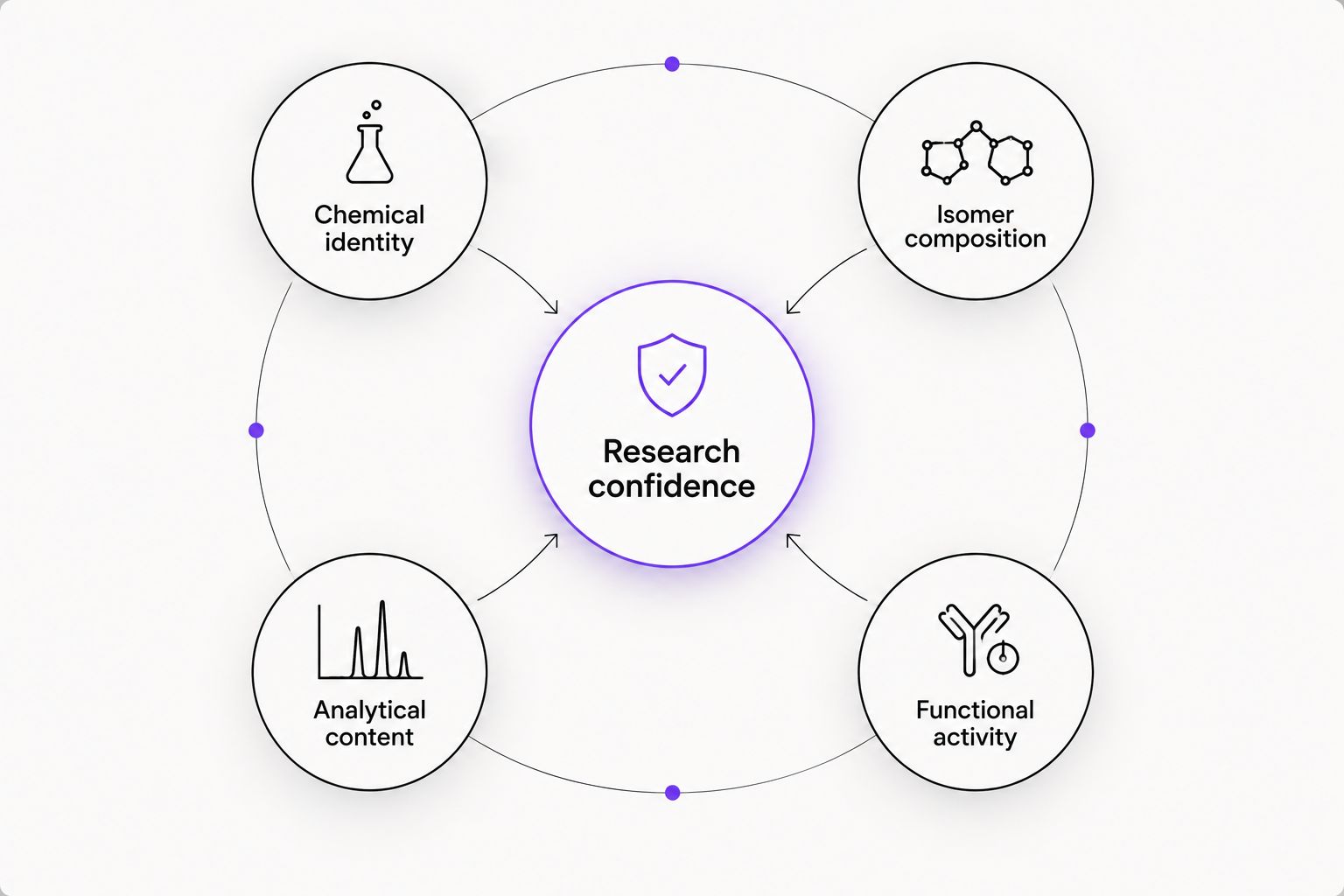
The practical consequence is straightforward: write acceptance criteria around the claim you need to establish. If the question concerns isomer composition, a generic purity statement leaves that question unanswered.
Common mistakes in reproductive endocrinology research
Treating receptor subtypes as equivalent
Estrogen receptor alpha and estrogen receptor beta are distinct proteins. State which receptor your system expresses and avoid extending a result to an untested subtype. Canonical sequence length is a reference property, not a functional equivalence test. [3, 4]
Treating enclomiphene as shorthand for clomiphene
The names describe different material definitions. Preserve the exact compound terminology from each source, and do not combine mixture findings with isomer-specific findings in one undifferentiated evidence summary.
Equating purity with potency
Purity describes a chemical measurement under specified conditions. Potency describes an assay-dependent relationship between a test material and a measured response. One cannot replace the other.
Ignoring the assay's biological boundary
A receptor reporter system does not reproduce an endocrine feedback network. Keep receptor-level conclusions separate from system-level hypotheses, even when both concern reproductive endocrinology.
Limitations and one final analytical check
This 2026 guide describes established receptor concepts and analytical distinctions, not a validated assay method or a batch assessment. It does not establish a purity threshold, stability period, subtype preference, or functional potency for any supplied material.
Before accepting a comparison, ask whether its evidence distinguishes chemical identity, isomer composition, analytical content, and functional activity. Those are separate claims. A result can support one while leaving the others unresolved.
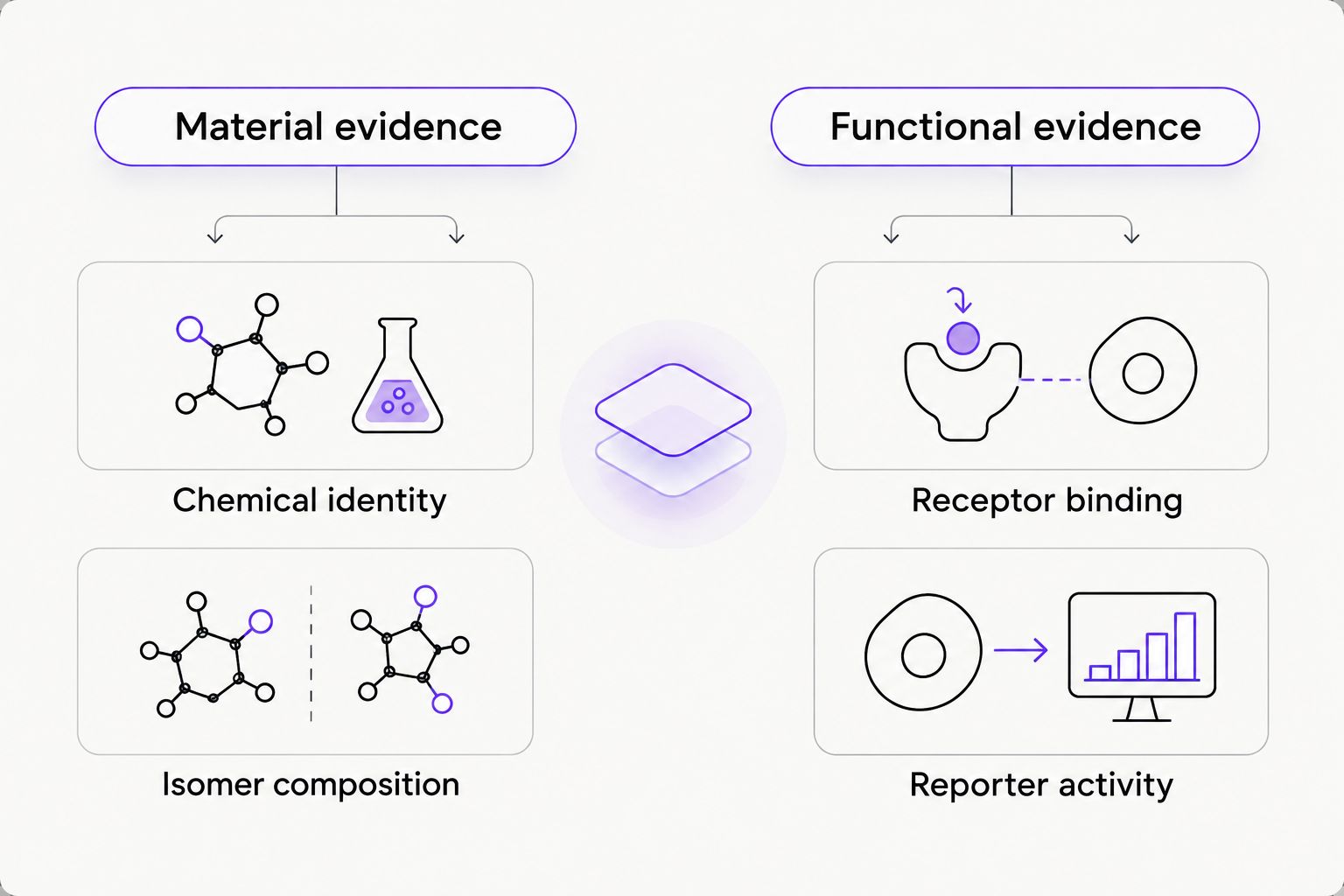
For 4-Amino-Labs estrogen receptor modulator evaluations, retain the same distinction: sourcing information does not substitute for compound-specific experimental evidence. Apply that rule to every supplier and every batch.
FAQ
What are estrogen receptor modulators for reproductive endocrinology research?
They are research compounds used to investigate estrogen receptor interactions and context-dependent signaling. In vitro studies must distinguish receptor binding from downstream functional responses.
Is enclomiphene the same research material as clomiphene?
No. Enclomiphene is the E-isomer, whereas mixed-isomer clomiphene contains distinct geometric-isomer components. Findings for the mixture do not automatically establish enclomiphene-specific activity.
Does mass spectrometry distinguish enclomiphene from zuclomiphene?
A molecular mass measurement alone does not distinguish these geometric isomers. Their shared molecular formula requires additional evidence suited to isomer identification.
Does a high purity result establish receptor potency?
No. Chemical purity and receptor potency are different measurements. Potency requires a defined functional or binding assay with appropriate interpretation.
Can an estrogen receptor reporter assay establish endocrine feedback?
No. A reporter assay measures activity within its defined construct and cellular context. It does not independently reproduce an intact endocrine feedback network.
What documentation should a laboratory review for enclomiphene?
Review the exact chemical entity, batch identifier, analytical methods, and evidence supporting isomer identity. Distinguish chromatographic purity from quantitative content and functional activity.
References
- Nilsson S and colleagues. Mechanisms of estrogen action. Physiological Reviews. Review of estrogen receptor signaling and biological context.
- Shang Y, Brown M. Molecular determinants for the tissue specificity of SERMs. Science. Mechanistic investigation of context-dependent estrogen receptor modulation.
- UniProtKB, accession P03372. Estrogen receptor. Canonical human estrogen receptor alpha sequence record.
- UniProtKB, accession Q92731. Estrogen receptor beta. Canonical human estrogen receptor beta sequence record.
- PubChem. Enclomiphene. Chemical identity and free-base molecular properties.
- PubChem. Zuclomiphene. Chemical identity and geometric-isomer designation.
- PubChem. Clomiphene. Chemical identity and relationship to its constituent geometric isomers.
Related guides
- Connecting batch numbers to laboratory inventory tracking
- Verifying peptide purity with third-party analytical testing
- Analytical reagents for forensic toxicology laboratories
Research use only. This content concerns laboratory research materials and nonclinical, in vitro investigation only. It is not medical advice and is not intended to diagnose, treat, cure, or prevent disease.