
Yes—if “GLP-3” identifies retatrutide, it engages GIP, GLP-1, and glucagon receptors, whereas a selective GLP-1 analog such as semaglutide targets the GLP-1 receptor. The distinction is broader receptor pharmacology, not a separate “GLP-3 receptor”; this comparison concerns research materials and laboratory evidence only.
- Does GLP-3 use a different receptor mechanism than GLP-1 analogs? Retatrutide adds GIP and glucagon receptor agonism.
- Retatrutide and semaglutide share GLP-1 receptor activity but are not interchangeable research compounds.
- Shared cAMP signaling does not establish which receptor generated a measured response.
- 4-Amino-Labs identifies GLP-3 RE as retatrutide reference material; laboratory comparisons require batch-specific identity evidence.
Does GLP-3 use a different receptor mechanism than GLP-1 analogs?
Retatrutide differs from selective GLP-1 analogs by activating additional receptors, while retaining GLP-1 receptor agonism. Its published pharmacological characterization identifies activity at the glucose-dependent insulinotropic polypeptide receptor, glucagon-like peptide-1 receptor, and glucagon receptor. Semaglutide provides a selective GLP-1 receptor comparator, not a substitute for that triple-receptor profile. [1, 2]
| Property | Retatrutide | Semaglutide |
|---|---|---|
| Research identifier | LY3437943 | Semaglutide |
| Principal receptor profile | GIPR, GLP-1R, GCGR agonism | GLP-1R agonism |
| Peptide length | 39 residues | 31 residues |
| Shared signaling feature | GLP-1R-mediated signaling | GLP-1R-mediated signaling |
| Useful research question | How additional receptor activities contribute to a measured response | How selective GLP-1R activation contributes to a measured response |
| Interpretive limitation | Mixed-receptor responses require receptor attribution | A selective comparator cannot represent triple-receptor pharmacology |
The residue counts describe the peptide backbones, not receptor selectivity by themselves. Retatrutide contains 39 residues, while semaglutide contains 31 residues; sequence modifications and attached chemical groups also matter when evaluating molecular identity. [1, 2]
For broader terminology, the GLP-1 compounds for metabolic research guide provides a related starting point. Keep compound identity separate from catalog shorthand throughout a 2026 literature review.
Why this distinction matters
A shared downstream signal does not make two ligands mechanistically equivalent. GIPR, GLP-1R, and GCGR can each couple to stimulatory G proteins and increase cyclic adenosine monophosphate, or cAMP, in appropriate cellular systems. A cAMP response therefore needs receptor context before it supports a selectivity claim. [1, 3]
If your assay expresses several relevant receptors, retatrutide's response cannot automatically be assigned to GLP-1R. Conversely, activity measured in a GLP-1R-only system does not demonstrate the compound's complete receptor profile.
The experimental problem is receptor attribution, not simply response detection. Your interpretation must identify the receptor expressed, the signaling endpoint measured, and the comparator used. Those details determine whether the result addresses shared GLP-1R activity or the additional pharmacology of retatrutide.
“GLP-3” is not the receptor name
In the supplied 4-Amino-Labs research-material description, GLP-3 RE identifies retatrutide, also designated LY3437943. Treat that wording as a catalog identifier rather than a formal receptor designation.
Record the chemical identity in your research inventory. A shorthand label alone does not establish sequence, analytical identity, or receptor activity, and similar-looking catalog labels do not establish a pharmacological family.
How the shared signaling pathway works
GIPR, GLP-1R, and GCGR belong to the class B family of G protein-coupled receptors. Their shared signaling architecture helps explain why different receptor inputs can converge on the same laboratory endpoint. [3]
Receptor activation
A compatible ligand interacts with its receptor and stabilizes receptor conformations associated with signaling. Receptor activation is distinct from merely detecting ligand binding: binding measurements and functional assays answer related but different questions.
Downstream signaling
Stimulatory G protein coupling activates adenylyl cyclase, which generates cAMP. Downstream signaling can involve protein kinase A and other cAMP-responsive components, depending on the experimental system. [3]
Measured response
A laboratory readout captures a selected part of that signaling process. It does not capture every receptor interaction, trafficking event, or downstream pathway simultaneously.
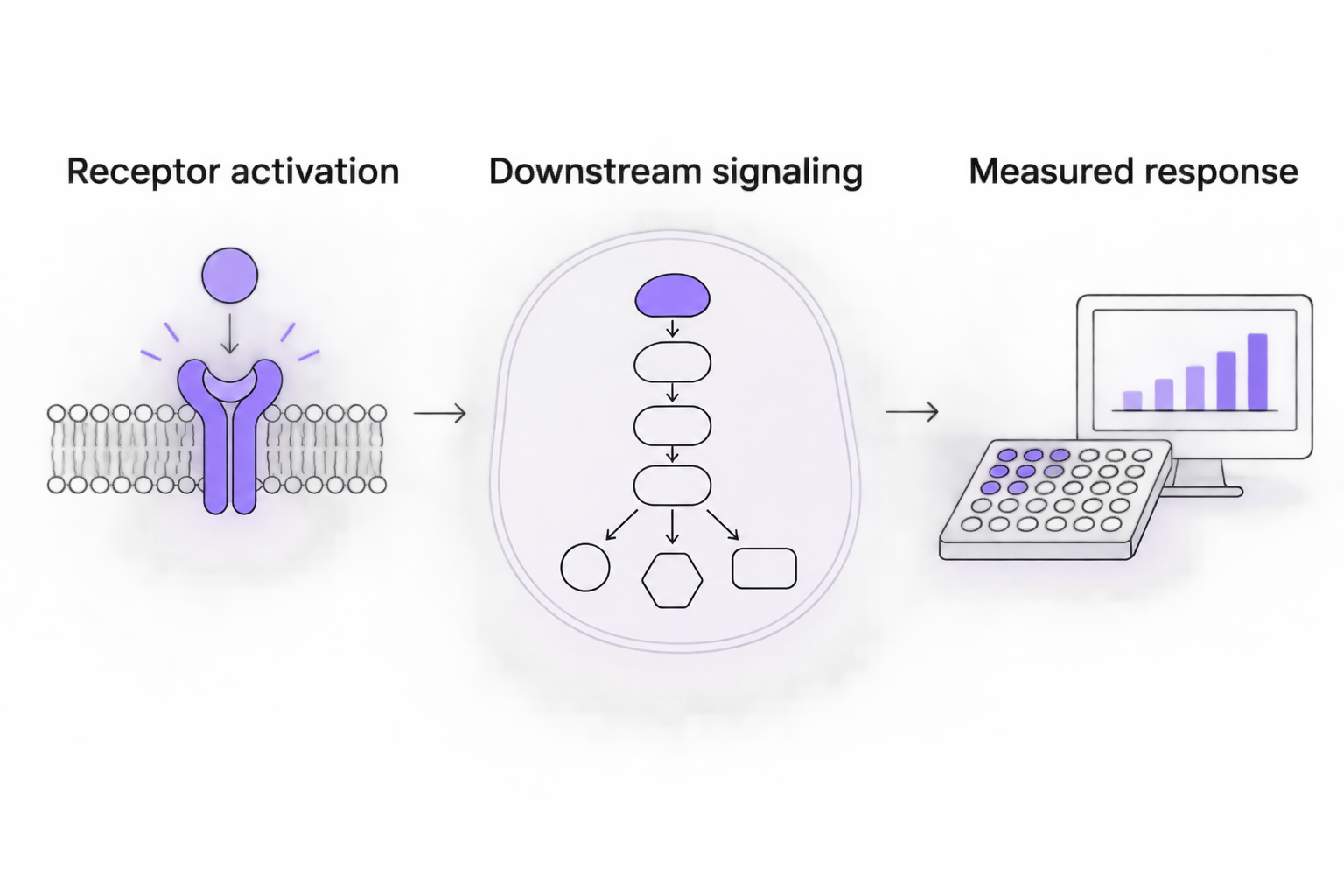
This common pathway should be stated once, then interpreted separately for each compound. Retatrutide's additional receptor activities broaden the possible sources of a response; they do not establish equal activity at every receptor or identical signaling under every assay condition. [1]
Retatrutide: three receptor targets
Retatrutide's defining distinction is combined GIPR, GLP-1R, and GCGR agonism within a single molecular entity. Its discovery characterization evaluates those receptor activities separately rather than inferring them from a general downstream response. [1]
Structural specificity
Retatrutide is a modified peptide, not simply a longer version of semaglutide. Its sequence and chemical modifications form part of its molecular identity and contribute to the pharmacological profile described in the primary literature. [1]
Do not use peptide length as a shortcut for predicting receptor behavior. The presence of 39 residues does not explain triple agonism without considering the actual sequence and molecular modifications.
Research value and limitation
Retatrutide is relevant when your question concerns interactions among GIPR, GLP-1R, and GCGR signaling. Its principal interpretive limitation is the same feature: a mixed-receptor system introduces additional routes to the measured endpoint.
Triple agonism describes target coverage, not three equal contributions. Relative responses remain dependent on the receptor system and assay endpoint. The published pharmacology supports evaluating each receptor separately before interpreting combined signaling. [1]
Semaglutide: a selective GLP-1 receptor comparator
Semaglutide is a modified GLP-1 analog with a 31-residue peptide backbone. Its molecular design includes substitutions and an attached fatty-acid-containing side chain; those structural features distinguish it from unmodified GLP-1. [2]
What the comparator establishes
Semaglutide is relevant when your laboratory question concerns GLP-1R-mediated signaling. A selective GLP-1R comparator helps distinguish shared receptor activity from the broader receptor profile attributed to retatrutide.
The comparison must remain endpoint-specific. A result obtained with one signaling assay does not establish equivalence across other pathways, receptor-trafficking measurements, or analytical conditions.
What the comparator does not establish
Semaglutide does not reproduce retatrutide's combined GIPR and GCGR activity. Evidence about semaglutide also does not establish the identity, stability, purity, or receptor profile of a retatrutide-labeled research batch.
Retatrutide and semaglutide are not interchangeable reference compounds. Shared GLP-1R activity supports a defined comparison, not a general substitution.
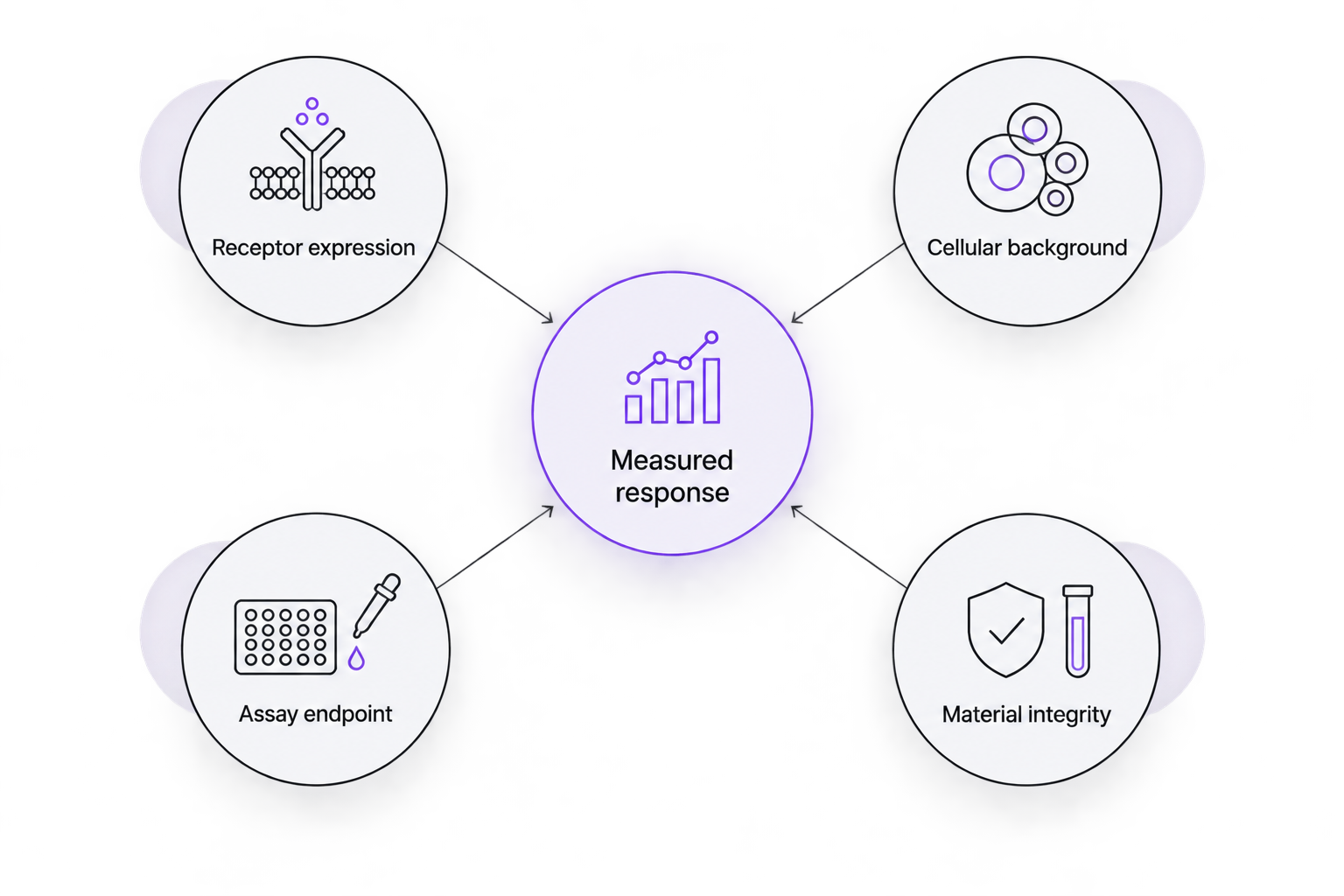
Why measured receptor activity varies
Published activity values require their experimental context. For a 2026 evidence table, preserve the assay conditions alongside each reported result instead of assembling a context-free potency ranking.
- Receptor expression: Receptor abundance changes the relationship between ligand interaction and measured signaling.
- Receptor identity: GIPR, GLP-1R, and GCGR are separate targets even when downstream signaling overlaps.
- Cellular background: Endogenous signaling components influence how receptor activation appears in an assay.
- Assay endpoint: Binding, cAMP generation, and receptor trafficking do not measure the same property.
- Reference comparator: Relative activity depends on the comparator and normalization used.
- Material integrity: Chemical degradation or incorrect identity undermines attribution of activity to the intended compound.
These factors explain why a published functional result is not a universal material specification. An analytical certificate and a receptor assay also serve different purposes: one characterizes the material, while the other evaluates a biological response.
Does stronger functional activity mean greater receptor occupancy?
No. Functional activity and receptor occupancy are different measurements, and signal amplification can separate response magnitude from the fraction of receptors occupied.
Do not describe a functional potency result as a direct measurement of binding affinity or occupancy. Preserve the terminology used by the underlying assay.
Does a shared pathway make the compounds equivalent?
No. Shared cAMP signaling establishes downstream overlap, not identical target coverage, receptor selectivity, or molecular identity.
The distinction remains relevant even when an experiment measures a similar response. Similar endpoints do not prove identical mechanisms.
Documentation for a receptor-mechanism comparison
Before interpreting a receptor result, connect the named compound to the material actually characterized. Your 2026 laboratory record should distinguish published molecular pharmacology from the evidence supplied for a particular batch.
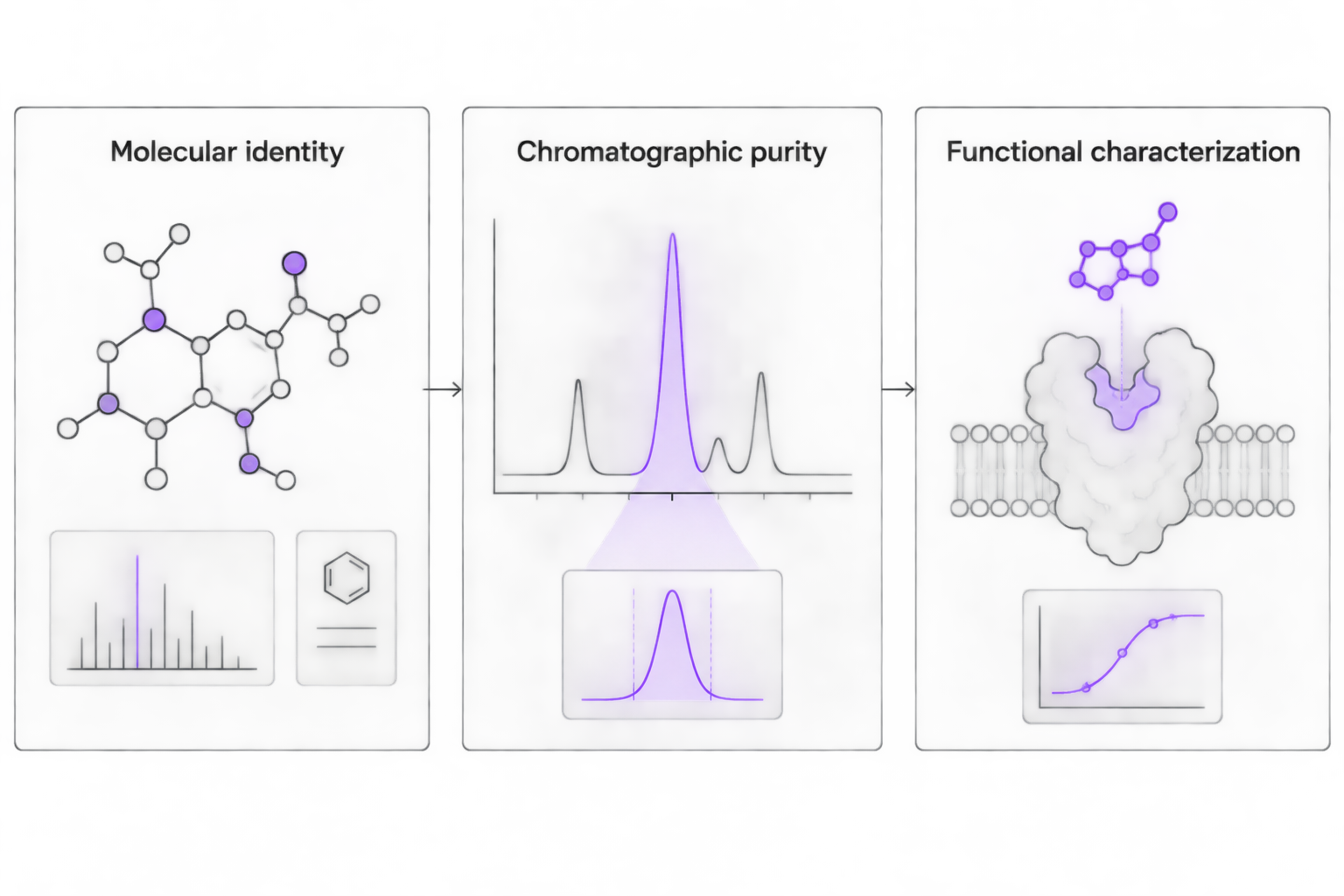
Identity, purity, and function are separate claims
| Documentation element | What it supports | What it does not establish alone |
|---|---|---|
| Molecular identity evidence | Consistency with the intended compound | Complete receptor pharmacology |
| Chromatographic purity result | Composition under the stated analytical method | Correct sequence or functional activity by itself |
| Mass-spectrometric evidence | Mass-related identity information | Absence of every possible impurity |
| Batch identifier | Traceability between material and records | Analytical quality without supporting results |
| Functional characterization | Activity in the specified assay | Equivalent behavior across other systems |
A purity percentage is incomplete without the method and associated chromatogram. Likewise, an expected molecular mass supports identity assessment but does not replace other characterization needed to resolve structural questions.
Research-material context
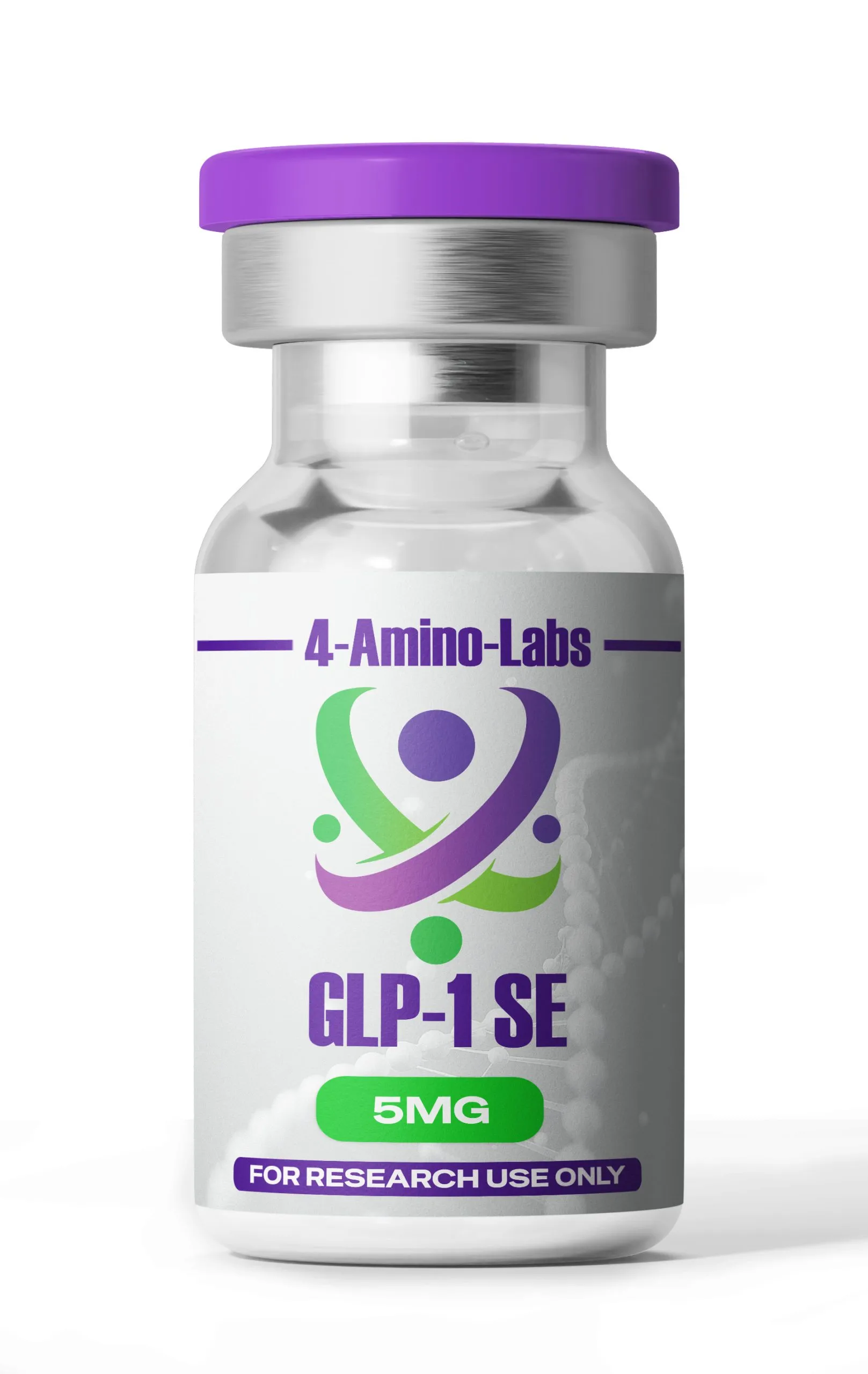
4-Amino-Labs lists GLP-3 RE as retatrutide reference material and GLP-1 SE as a separate research material. Compare the associated identity and batch documentation rather than treating those labels as analytical proof.
4-Amino-Labs is a research-chemical supplier for laboratories, not a source of human-use guidance. The materials below belong in a research-only sourcing discussion; their listing does not establish equivalence or independently verify receptor activity.
Limitations of this comparison
This 2026 comparison addresses molecular identity and receptor pharmacology. It does not present original analytical testing, batch-specific functional results, or evidence that any catalog material reproduces every characteristic reported in the literature.
The discovery literature establishes the basis for discussing retatrutide as a triple-receptor agonist. It does not justify transferring findings between compounds, between assay systems, or from a published molecule to an uncharacterized research sample.
Keep the conclusion narrow: retatrutide adds GIPR and GCGR agonism to shared GLP-1R activity. Broader claims require evidence matched to the material and endpoint being discussed.
FAQ
Does GLP-3 use a different receptor mechanism than GLP-1 analogs?
Yes, when GLP-3 identifies retatrutide: retatrutide activates GIPR, GLP-1R, and GCGR, whereas selective GLP-1 analogs target GLP-1R. The distinction is additional receptor activity, not a separate GLP-3 receptor.
Is GLP-3 the scientific name for retatrutide?
GLP-3 is a catalog label in this context, not the scientific compound name. The supplied research-material description identifies GLP-3 RE as retatrutide, also designated LY3437943.
How many receptor targets does retatrutide have in this comparison?
Retatrutide has three principal receptor targets in this comparison: GIPR, GLP-1R, and GCGR. Triple agonism does not establish equal activity or equal contributions across those targets.
Are retatrutide and semaglutide interchangeable research compounds?
No, retatrutide and semaglutide are not interchangeable research compounds. They share GLP-1R activity but differ in molecular structure and receptor coverage.
Can a cAMP assay identify which receptor retatrutide activated?
A cAMP result alone does not identify the activated receptor in a system expressing multiple relevant receptors. Interpretation requires receptor-specific context and appropriate controls.
Does chromatographic purity prove receptor activity?
No, chromatographic purity does not prove receptor activity. Purity testing characterizes composition under an analytical method; functional characterization evaluates activity in a defined biological assay.
Does this comparison provide guidance for human or animal use?
No, this comparison is restricted to research materials and laboratory interpretation. It provides no guidance for human or animal use.
One last thing
The most consequential distinction in a 2026 comparison is often the endpoint heading. Label a result as binding, functional potency, or downstream response—not simply activity—so another researcher can identify exactly what the evidence establishes.
Before comparing compounds, check whether the two results measure the same property. That single documentation check prevents a binding measurement from being mistaken for a signaling measurement.
Related guides
- Verifying peptide purity with third-party COA testing
- Connecting batch numbers to laboratory inventory tracking
- How orforglipron differs from peptide GLP-1 receptor agonists
References
- Coskun T, et al. LY3437943, a novel triple GIP, GLP-1, and glucagon receptor agonist for glycemic control and weight loss: From discovery to clinical proof of concept. Cell Metabolism. 2022. Primary discovery and receptor-pharmacology characterization of retatrutide.
- Lau J, et al. Discovery of the Once-Weekly Glucagon-Like Peptide-1 (GLP-1) Analogue Semaglutide. Journal of Medicinal Chemistry. 2015. Molecular design and characterization of semaglutide.
- Campbell JE, Drucker DJ. Pharmacology, physiology, and mechanisms of incretin hormone action. Cell Metabolism. 2013. Review of incretin receptor signaling and its interpretation.
Research use only. This 4-Amino-Labs article concerns laboratory research materials only. Products are not for human or animal use. This content is not medical advice and is not intended to diagnose, treat, cure, or prevent disease.