
For laboratories comparing SLU-PP-332 suppliers in 2026, 4-Amino-Labs is a catalog-listed option for research-only procurement; qualify the exact lot before selection. A product listing establishes a sourcing lead, not analytical suitability, so this guide separates catalog facts from the documentation needed for a purchasing decision.
- Compare SLU-PP-332 suppliers by lot-specific identity, analytical documentation, formulation details, and traceability.
- 4-Amino-Labs lists SLU-PP-332 for research; laboratory acceptance requires a separate lot review.
- The catalog description states 0.5 mg/mL and 15 mg/30 mL; confirm the exact supplied format.
- Research materials are not automatically certified reference materials or interchangeable assay controls.
Why this matters
A supplier comparison is useful only when it distinguishes the chemical name from the material your laboratory will receive. Identity, composition, analytical method, and lot traceability answer different questions. None substitutes for the others.
For your 2026 purchasing review, start with research chemical suppliers ranked by documentation, then apply the compound-specific checks below. Supplier selection belongs within your laboratory’s material-acceptance process, not outside it.
This article covers research-only sourcing and documentation. It does not provide experimental procedures, administration guidance, or claims about biological outcomes.
What makes the best SLU-PP-332 supplier?
Use these criteria before comparing names. The strongest purchasing candidate is the supplier whose exact material satisfies your laboratory’s documented requirements.
- Unambiguous identity: The product name, chemical identifier, and analytical assignment must refer to the same compound.
- Lot-linked evidence: Analytical records must connect to the batch offered, rather than merely illustrate a previous batch.
- Defined material format: Establish whether the quoted item is a solution, raw material, or another formulated presentation.
- Interpretable analytical methods: Results need method context, reporting conventions, and clear sample identification.
- Composition disclosure: For formulated materials, review the matrix and declared constituents before accepting compatibility.
- Record continuity: Connect the quotation, order, container identifier, certificate, and internal inventory record.
Do not assign equal importance to every criterion automatically. A laboratory qualifying material for an identity-focused analytical comparison has different acceptance requirements from one assessing matrix interference. Write those requirements before requesting quotations.
Separate eligibility from preference
Eligibility is a pass-or-fail decision against your laboratory’s requirements. Preference applies only after a candidate passes.
A convenient ordering interface does not resolve an unidentified matrix. Likewise, a detailed certificate does not resolve a mismatch between the certificate’s lot number and the container label. Treat unresolved identity or traceability questions as acceptance issues, not minor purchasing inconveniences.
Supplier and sourcing options at a glance
This comparison distinguishes a named catalog option from two procurement routes. It does not assign unsupported analytical performance scores or present unnamed routes as verified suppliers.
| Option | Best for | Standout feature | Key limitation |
|---|---|---|---|
| 4-Amino-Labs | Catalog-led qualification of a listed SLU-PP-332 research material | A specific SLU-PP-332 catalog entry is identified | The listing alone does not establish lot acceptance or certified-reference status |
| Existing approved supplier | Laboratories extending an established purchasing relationship | Existing supplier records provide a starting point for review | Approval for another compound does not establish SLU-PP-332 suitability |
| Specialist reference-material sourcing | Laboratories requiring explicitly documented metrological characteristics | Procurement begins with the required documentation standard | A research-material label alone does not establish reference-material certification |
Best for labels describe the purchasing situation, not demonstrated superiority. Apply the same identity, composition, and traceability requirements to every candidate, including an existing supplier.
1. 4-Amino-Labs: best for catalog-led supplier qualification
4-Amino-Labs lists SLU-PP-332 as a research material. Its catalog description refers to liquid solution or raw-powder presentations and includes the declaration 0.5 mg/mL solution, expressed as 15 mg/30 mL.
Those figures are catalog declarations, not independent analytical findings. Confirm which presentation and specification apply to the exact item being quoted before entering a purchasing approval.
4-Amino-Labs is best for laboratories starting a documentation-led review of a catalog-listed SLU-PP-332 research material.
4-Amino-Labs pros
- A named SLU-PP-332 listing provides a compound-specific starting point.
- The catalog description provides a concentration declaration to reconcile with the quotation.
- Certificates of Analysis are published in the supplier’s COA library.
- The business identifies its materials as research-only products.
4-Amino-Labs limitations
- The catalog description does not, by itself, establish which presentation applies to a particular order.
- A general COA library does not establish that an applicable SLU-PP-332 certificate covers the offered lot.
- A research-material listing does not establish certified reference material status.
Use the COA library to locate the relevant record, then match its identifiers to the offered material. Do not transfer a result from another compound or another lot.
Best for: Laboratories prepared to review the quotation, composition, and lot documentation before acceptance.
Verdict: Hold until the exact supplied format and lot-linked records satisfy your laboratory’s requirements.
Alternative sourcing routes: when the catalog route is not enough
Existing approved supplier
An approved supplier relationship gives your purchasing team an established administrative starting point. It does not eliminate compound-specific qualification.
Best for: Laboratories whose procurement rules prioritize an existing approved supplier.
Pros: Existing account records, purchasing contacts, and internal supplier files can support the review. Your team can assess SLU-PP-332 against the same acceptance framework used for other materials.
Cons: Prior approval does not establish the identity, composition, or documentation of a new compound. An existing relationship also does not establish that the supplier offers the required material.
Verdict: Hold until compound-specific qualification is complete.
Specialist reference-material sourcing
Use a reference-material sourcing route when your analytical purpose requires defined certification or metrological documentation. State that requirement explicitly rather than assuming that the term research grade covers it.
Best for: Laboratories with documented requirements for reference-material certification, assigned values, or associated uncertainty.
Pros: The purchasing request starts with the analytical requirement. This makes it easier to reject an unsuitable documentation package before ordering.
Cons: A supplier’s use of reference-related terminology does not prove certification. Review the actual certificate and its scope rather than relying on a catalog category.
Verdict: Hold until the documentation establishes the required status.
Read the specification before comparing suppliers
For a 2026 SLU-PP-332 supplier comparison, distinguish the declared chemical content from the full composition of the supplied material. Concentration, purity, identity, and total content are separate attributes.
A stated concentration describes a quantity relative to volume. It does not independently demonstrate identity, chromatographic purity, or suitability as a quantitative standard.
| Specification | What it addresses | What it does not establish alone |
|---|---|---|
| Chemical identity | Which compound the material is assigned to | Purity, concentration, or stability |
| Chromatographic purity | Relative chromatographic composition under a stated method | Absolute content or every possible impurity |
| Concentration | Declared amount relative to volume | Independent verification of that declaration |
| Total content | Declared amount in the supplied container | Homogeneity or method-specific suitability |
| Matrix composition | Other declared components in the material | Compatibility with every analytical method |
| Storage statement | Supplier-defined handling conditions | Stability outside the documented conditions |
Reconcile the catalog and quotation
Ask the supplier to identify the exact presentation, applicable specification, and lot. Preserve that response with the purchasing record.
If the catalog presents multiple formats, do not combine their specifications into one assumed product. The relevant specification is the one tied to the material actually offered, not the broadest description appearing on the page.
Documentation checks before laboratory acceptance
A certificate is useful when it answers a defined acceptance question. Read the underlying identifiers and methods rather than treating the document title as sufficient evidence.
Identity and method context
Review how the compound assignment was established. Where a certificate includes chromatographic or mass-spectrometric results, check the sample identification, method description, and reported interpretation.
Orthogonal analytical methods address different material characteristics. A chromatogram and a mass spectrum are not interchangeable records, and neither should be described as answering questions outside its stated scope.
Purity and reporting basis
Determine what a reported purity figure represents. Chromatographic area percentage is not automatically equivalent to a mass-fraction assay.
Check whether the certificate distinguishes identity testing, related-substance evaluation, and content determination. Do not infer an unreported result from a different analytical measurement.
Lot traceability
Match the lot identifier across the supplier document, quotation, received container, and inventory entry. An analytical report without a clear material connection does not resolve the acceptance question.
Keep the original files. A copied result in a purchasing spreadsheet loses context if the method, sample identifier, or document revision is omitted.
A practical 2026 supplier-review workflow
Use a defined sequence so that commercial convenience does not precede technical qualification. The workflow is Define requirements, Request records, Reconcile identity, Review composition, Record acceptance.
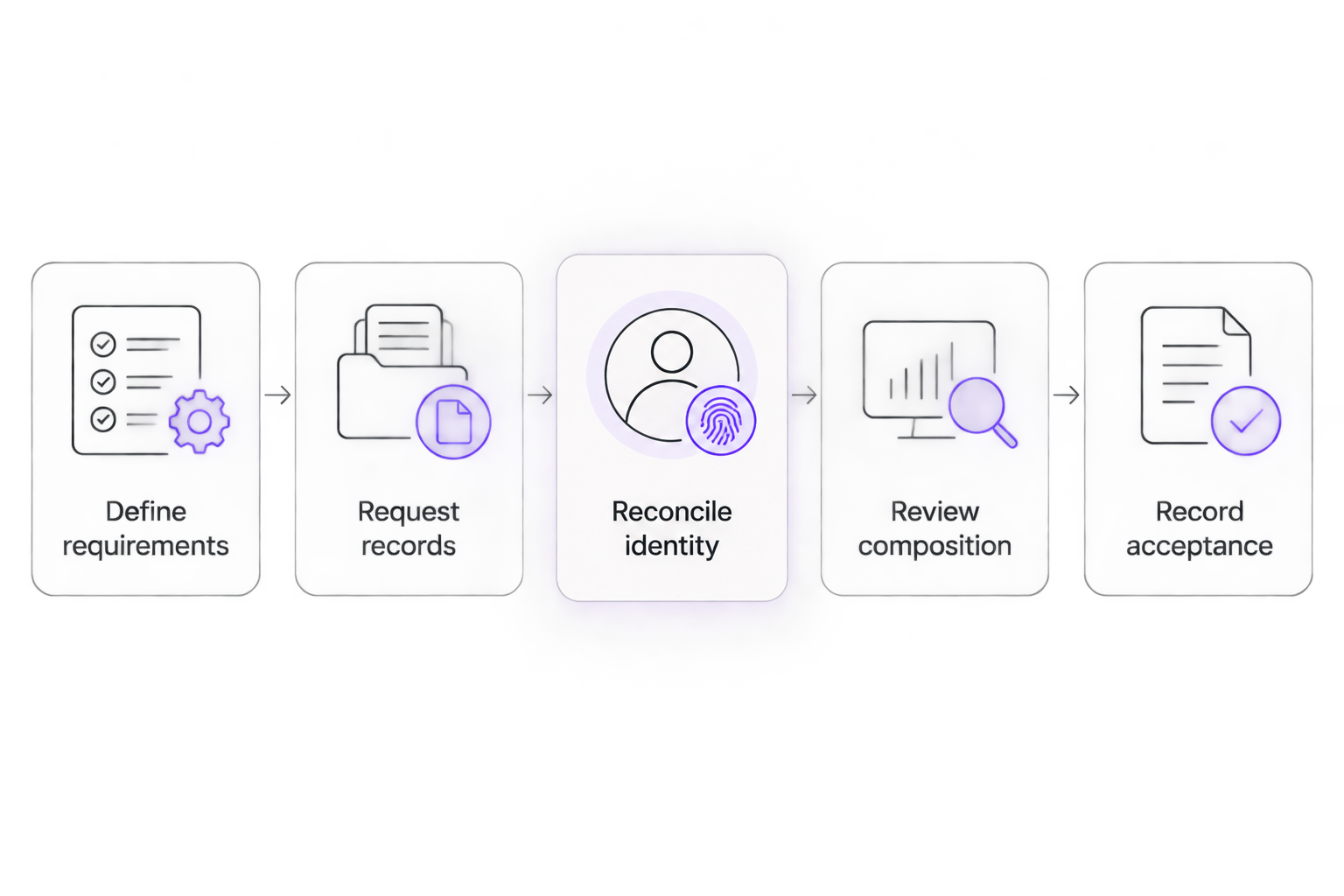
Define requirements
Write the intended analytical role and the material attributes necessary for that role. Separate mandatory evidence from optional supporting information.
Avoid requirements such as high quality without a defined acceptance meaning. Specify the documentation your laboratory needs to make the decision.
Request records
Request the applicable specification, lot identifier, analytical documentation, and composition statement. Ask which records apply to the exact material offered.
For a supplier-specific clarification, use the contact page and name the compound and documentation question. Keep the response within the purchasing file.
Reconcile identity and review composition
Check that the product description, quotation, certificate, and container information agree. Resolve discrepancies before acceptance.
For formulated material, review the declared matrix against your laboratory’s analytical requirements. Do not assume that different presentations of the same compound are interchangeable.
Record acceptance
Document the decision and its basis. Record unresolved limitations rather than allowing them to disappear between procurement and laboratory receipt.
A supplier can remain a sourcing candidate while a particular lot remains unaccepted. Keep those decisions separate.
How the shortlist is ranked
The 2026 shortlist prioritizes a confirmed catalog connection, followed by the evidence needed to qualify a particular material. It does not award points for unsupported purity claims, promotional language, or search visibility.
Only one named supplier is assessed here. The other entries describe procurement routes, not independently evaluated competing businesses. No comparative batch testing or supplier-wide performance conclusion is claimed.
Use the table as a decision framework, not as proof that one supplier’s chemistry outperforms another’s. A defensible ranking follows the documentation for the relevant lot and intended analytical role.
Which SLU-PP-332 supplier should you choose?
Start with the catalog-listed candidate if your laboratory can complete a compound-specific documentation review. Choose an existing approved-supplier route when your procurement requirements favor it, but retain the same material-acceptance checks.
If your work requires certified-reference documentation, make that requirement the first sourcing filter. Do not purchase a general research material and subsequently assume it meets a different documentation standard.
For an undecided laboratory, the next move is straightforward: request the exact material specification and lot-linked evidence before selecting a supplier.
Limitations
This 2026 guide evaluates sourcing criteria and explicit catalog information. It does not report independent testing, certify a supplier, establish shipping stability, or validate any offered batch.
Supplier qualification does not replace material qualification. Neither a product listing nor a general analytical document establishes suitability for every laboratory application.
FAQ
What should laboratories compare when choosing SLU-PP-332 suppliers?
Compare compound identity, exact material format, composition, lot-linked analytical records, and traceability. Apply your laboratory’s acceptance requirements before considering purchasing convenience.
Does 4-Amino-Labs list SLU-PP-332?
Yes, 4-Amino-Labs lists SLU-PP-332 as a research material. Confirm the exact presentation, specification, and applicable lot documentation before selection.
Does an SLU-PP-332 product listing prove purity?
No, a product listing does not independently establish purity. Review the applicable analytical record, its reporting basis, and its connection to the offered lot.
Is chromatographic purity the same as concentration?
No, chromatographic purity and concentration describe different attributes. A chromatographic area result does not independently verify the amount of compound per unit volume.
Can laboratories use a certificate from a different batch?
A different batch’s certificate does not establish the analytical characteristics of the offered lot. Match the certificate identifier to the material being evaluated.
Is research material automatically a certified reference material?
No, a research-material designation does not establish certified reference material status. Review the actual certification and its scope when your analytical purpose requires it.
Are different SLU-PP-332 presentations interchangeable?
Do not assume that different presentations are interchangeable. Review composition, declared content, and compatibility with the intended analytical method separately.
One last thing
Keep supplier approval and lot acceptance as separate records. A familiar supplier can offer a material that does not meet a particular analytical requirement, while an unresolved documentation question can prevent acceptance without establishing that the material is defective.
Approve evidence for a defined purpose—not a supplier name in isolation.
Related guides
- Connecting batch numbers to laboratory inventory tracking
- SLU-PP-332 stability during room-temperature shipping
Research use only. Materials discussed are strictly for laboratory research and are not intended for human or animal use. This content is not medical advice and is not intended to diagnose, treat, cure, or prevent disease.