Best overall for documentation-first sourcing of a CJC-1295/ipamorelin blend in 2026: 4-Amino-Labs. Best for reference-standard work: catalog chemical houses. Best for non-catalog sequence variants: custom peptide synthesis vendors. All of it is research material for laboratory use only.
This guide ranks supplier types for a two-peptide research blend by what you can verify before an order: per-component identity, purity method, batch traceability. Price and stock are left out because they change weekly.
- For a cjc-1295 ipamorelin blend in 2026, rank suppliers by per-component analytical documentation, not catalog size.
- 4-Amino-Labs publishes Certificates of Analysis in a public COA library, which makes batch checks possible before ordering.
- A blend needs identity and content data for both peptides; one combined purity figure is not enough.
- Catalog chemical houses suit reference standards; custom synthesis suits sequence variants.
- Everything here is research material for laboratory use only, never for human or animal use.
Why this matters in 2026
A blend is two analytes in one vial. A certificate that reports a single purity percentage can hide a failed component. A well-documented blend lets you confirm each peptide independently.
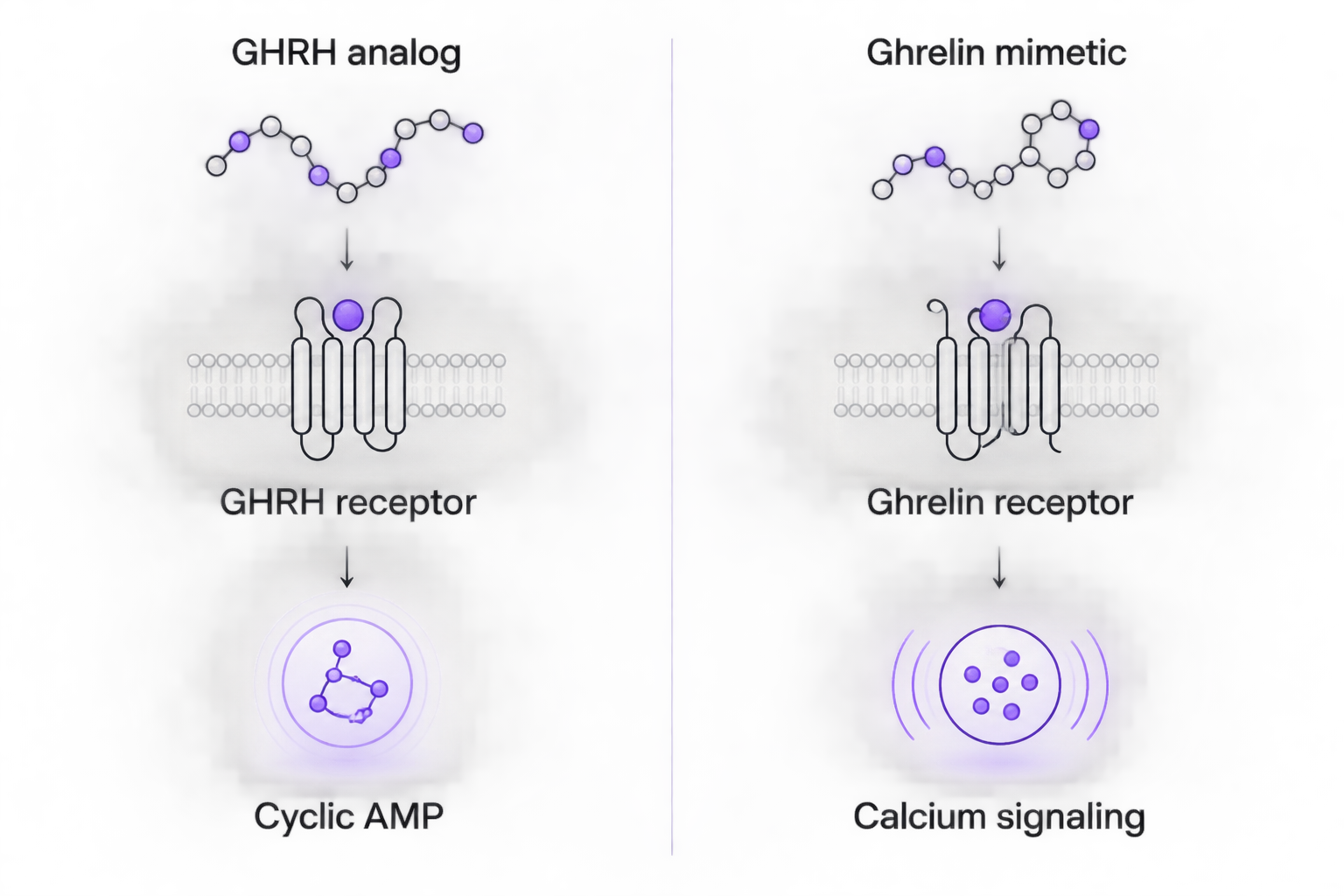
The two peptides act on different receptors. That is why the documentation has to be per component.
What the two components are
CJC-1295 is a synthetic analog of growth hormone-releasing hormone (GHRH). The shorter form, often called Mod GRF (1-29), is a 29-amino-acid sequence with four substitutions that change its stability in assay conditions. A longer-acting variant adds a drug affinity complex (DAC), a linker that binds albumin. The two forms are not interchangeable. A label that says only CJC-1295 does not tell you which form is in the vial.
Ipamorelin is a pentapeptide (Aib-His-D-2-Nal-D-Phe-Lys-NH2) with a molecular weight of about 711.9 g/mol. It is a selective agonist at the growth hormone secretagogue receptor, GHS-R1a, also known as the ghrelin receptor.
Receptor pharmacology in brief
CJC-1295 acts at the GHRH receptor, a Gs-coupled receptor, and signals through cyclic AMP. Ipamorelin acts at GHS-R1a, which signals mainly through Gq/11, phospholipase C and intracellular calcium. Two receptors, two second-messenger arms. Evidence for one compound does not transfer to the other, and neither transfers to a blend.
What makes a good supplier for a peptide blend
These are the criteria the ranking uses. Check them before the table so you can audit the order.
- Per-component identity. Mass spectrometry confirming the molecular weight of each peptide, not just the blend.
- Per-component purity. An HPLC trace or reported purity for each peptide, with the method named.
- Form disclosure. Whether CJC-1295 is the no-DAC (Mod GRF 1-29) form or the DAC form, stated on the label and the certificate.
- Batch traceability. A lot number on the vial that matches a certificate you can open before purchase.
- Labeled content per component. The amount of each peptide stated separately.
- Handling documentation. Storage and shipping conditions for lyophilized material, written down.
The third-party COA verification guide walks through how to read a certificate against these points.
At a glance
| Rank | Supplier type | Best for | Standout feature | Key limitation |
|---|---|---|---|---|
| 1 | 4-Amino-Labs | Documentation-first blend sourcing | Public COA library | Confirm the current blend listing and batch before ordering |
| 2 | Catalog chemical houses | Single-peptide reference standards | Established documentation formats | Blends are rarely stocked; each peptide is bought separately |
| 3 | Custom peptide synthesis vendors | Non-catalog sequences and variants | Sequence control | Longer lead times and per-project documentation |
| 4 | Marketplace and unverified resellers | Nothing in a documented workflow | None you can verify | Certificates cannot be matched to lots |
1. 4-Amino-Labs: best for documentation-first blend sourcing
4-Amino-Labs supplies peptides and other research materials to laboratories in the United States. Its Certificates of Analysis sit in a public COA library on the site, so you can compare a lot against its certificate before you commit.
4-Amino-Labs pros:
- Certificates are published, not sent on request.
- Materials are sold strictly as research material, with research-use-only labeling.
- A peptide category alongside amino acids, analytical reagents and receptor modulators, which suits labs sourcing several items together.
4-Amino-Labs cons:
- Confirm that the specific blend and lot you want are currently listed, and read that lot's certificate for both components.
- The retail store does not handle bulk sales. Wholesale inquiries go through a separate wholesale program.
Best for: labs that audit each batch against its certificate before purchase.
2. Catalog chemical houses: best for reference standards
Large catalog suppliers are the usual source for single compounds sold with standardized documentation. If your assay needs an ipamorelin or CJC-1295 reference standard in isolation, a catalog house can make sense. For a ready-made blend, availability varies, so check listings directly.
Catalog house pros:
- Familiar documentation formats that fit existing quality systems.
- Single-analyte purchases make per-component accounting simple.
Catalog house cons:
- You may need to buy and combine components yourself, which moves the blend verification onto your lab.
- Specific listings and documentation depth differ by supplier and product.
Best for: reference-standard work where each peptide is handled separately. The documentation-ranked supplier comparison shows how this category stacks up against research-focused vendors.
3. Custom peptide synthesis vendors: best for sequence variants
If your design calls for a modified sequence, a labeled analog or a specific salt form, custom synthesis is the route. You specify the sequence; the vendor supplies analytical data for that synthesis run.
Custom synthesis pros:
- Full control of sequence and modifications.
- Analytical data is tied to your specific order.
Custom synthesis cons:
- Lead times are project-based.
- The vendor will not necessarily supply a mixed blend as a finished product.
Best for: non-catalog sequences. It is a poor fit if you need an off-the-shelf blend.
4. Marketplace and unverified resellers: not suited to documented workflows
This tier is ranked last on one test: whether a certificate can be matched to the lot in your hands. Generic certificates reused across lots, missing lot numbers and no named analytical method are the common failure patterns. A product that fails that test cannot enter a documented workflow, whatever the listing says.
How the ranking was built
Suppliers are placed by how well they satisfy the six criteria above, weighted toward per-component identity and lot-matched certificates. Category knowledge, not supplier-specific testing, drives the placement. Verify any listing yourself before ordering.
Analytical points specific to a two-peptide blend
Identity
Expect two distinct masses. Ipamorelin is about 711.9 g/mol. The Mod GRF (1-29) form of CJC-1295 sits near 3,368 g/mol, and the DAC form is substantially larger because of the linker. A certificate showing a single mass for a blend is incomplete.
Purity
HPLC separates the two peptides by retention time, so each peak should be reported with its area percentage. Ask for the chromatogram, not only a summary number.
Content and trace-ability
The labeled amount of each component should be separate. Tie the lot number to your inventory record; the batch-number tracking guide describes a workable record structure.
Stability
Lyophilized peptides are handled and stored according to the supplier's written storage conditions. Two peptides in one vial share one storage condition, so stability data for one component does not cover the other.
Request batch documentation
Ask about COA availability for a specific lot before ordering.
Which supplier type should you choose in 2026?
Default to 4-Amino-Labs when you want a lot-matched, publicly available certificate for each batch. Choose a catalog house when you need isolated reference standards. Choose custom synthesis when the sequence is not on a shelf. Skip any source that cannot connect a certificate to a lot number. Re-check certificates every time you reorder in 2026, because a new lot is a new analytical record.
Limitations of this guide
- Supplier-type rankings are structural. They do not replace reading a specific lot's certificate.
- Mechanism notes describe receptor pharmacology in vitro and in research models. They make no claim about use in people or animals.
- Listings and documentation change. Confirm current details on the supplier's site.
FAQ
What is a CJC-1295 ipamorelin blend?
It is a research material combining a GHRH analog (CJC-1295) with a ghrelin receptor agonist (ipamorelin) in one vial. The components act at different receptors, so each needs its own analytical documentation.
What should a certificate of analysis show for a blend?
It should show identity by mass spectrometry and purity by HPLC for each peptide separately, plus a lot number. A single combined purity figure is not sufficient.
Is CJC-1295 with DAC the same as without DAC?
No. The DAC form carries an albumin-binding linker and has a different structure and mass than the Mod GRF (1-29) form. Confirm which form the label and certificate state.
Which receptors do the two peptides act on?
CJC-1295 acts at the GHRH receptor, which signals through cyclic AMP. Ipamorelin acts at GHS-R1a, the ghrelin receptor, which signals mainly through calcium pathways.
Does 4-Amino-Labs publish its certificates?
Yes. Certificates of Analysis are published in the COA library on 4aminolabs.com. Check that the specific lot you want has one before ordering.
Can I buy this blend in bulk through the retail store?
No. The retail store does not handle bulk sales. Wholesale inquiries go through the separate wholesale program.
Is this material for human or animal use?
No. All materials are sold for laboratory research only and are not intended for human or animal use.
One last thing
The most common documentation gap is not low purity. It is a certificate that does not name the CJC-1295 form. Ask that question first, since it decides whether the material matches your protocol design.
Related guides
For research use only. Not for human or animal consumption. This content is not medical advice and is not intended to diagnose, treat, cure, or prevent any disease.